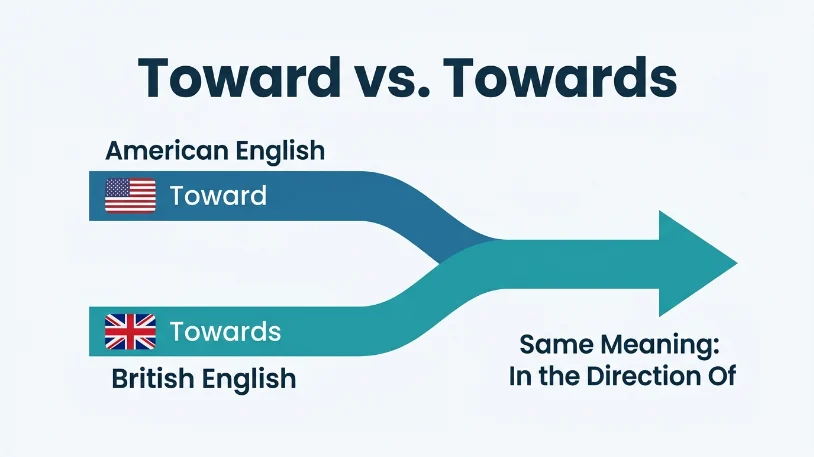
Toward and towards are two spellings of the same preposition meaning “in the direction of.” Both are correct and interchangeable. Use toward in American English and towards in British English, though either is acceptable.
Clearing Up the Confusion
Few small words in the English language create as much confusion as toward and towards. Writers often pause mid-sentence, wondering which spelling is correct. Editors, proofreaders, and language enthusiasts continue to debate this seemingly simple choice.
The good news? The answer is straightforward. Toward and towards are two spellings of the same word. They share the same meaning, the same pronunciation, and the same grammatical function. That means either spelling works in most situations.
Why do two versions exist? Language evolves over time, and regional preferences developed. American English writers tend to favor toward, while British English writers prefer towards. Understanding this difference helps writers choose the appropriate version for their audience.
This article explains everything you need to know about toward and towards. You will learn their definitions, usage rules, regional differences, and common mistakes. We also provide practical examples, comparison tables, and exercises to help you master these prepositions.
Key Takeaway & Summary
The most important thing to remember about toward and towards is that both are correct. There is no grammatical difference between them.
In American English, the preferred spelling is toward. In British English, towards is more common. However, neither is wrong. Many style guides, including the Chicago Manual of Style and AP Stylebook, recommend toward for American audiences . British publications typically use towards.
Here is what you need to know at a glance:
- Both spellings mean the same thing: “in the direction of
- Both function as prepositions
- Both are accepted in formal and informal writing
- Be consistent within a single document
- Neither version is grammatically superior
When in doubt, consider your audience. If you are writing for a North American readership, use toward. For British, Australian, or other Commonwealth audiences, towards works better.
Definition and Explanation of Toward and Towards
The definition of toward and towards is simple. Both are prepositions that mean “in the direction of” or “in relation to” . They indicate movement, position, attitude, or purpose.
Primary Meanings:
Direction: Moving in the direction of someone or something.
- “The dog ran toward the park.”
- “She walked towards the door.”
Facing: Positioned facing a particular direction.
- “His back was toward me.”
- “The windows face towards the east.”
Attitude: Expressing feelings or opinions about someone or something.
- “He has a positive attitude toward his work.”
- “Her feelings towards him were complicated.”
Purpose: Indicating contribution or goal.
- “The money goes toward the scholarship fund.”
- “We are saving towards a new car.”
Approximation: Referring to time or location close to a point.
- “We will arrive toward the end of the day.”
- “The meeting is scheduled towards noon.”
The word has existed since the 9th century. Both spellings emerged around the same time from the Old English “tōweard,” meaning “in the direction of” . The addition of the -s ending was an adverbial genitive form common in Old English.
Toward vs. Towards: The Regional Differences
The choice between toward and towards largely depends on geography. Regional preferences developed over centuries of language evolution .
American English Preferences
In the United States and Canada, toward is the preferred spelling. American style guides, including the Chicago Manual of Style and AP Stylebook, recommend toward. In written American English, toward appears roughly five times more often than towards .
British English Preferences
In the United Kingdom, Australia, and other Commonwealth nations, towards is more common. British publications, academic journals, and government documents typically use towards .
Other English-Speaking Regions
Countries like India, South Africa, and New Zealand generally follow British conventions and use towards. However, due to American cultural influence, toward appears increasingly in these regions too .
Frequency of Use
| Region | Preferred Spelling | Examples |
| United States | Toward | “We drove toward the coast.” |
| Canada | Toward | “He moved toward the exit.” |
| United Kingdom | Towards | “We drove towards the coast.” |
| Australia | Towards | “He moved towards the exit.” |
| India | Towards | “The train headed towards Delhi.” |
| South Africa | Towards | “She walked towards the store.” |
Despite these preferences, both forms are understood everywhere. The key is consistency. Choose one spelling and stick with it throughout your document .
Advantages and Disadvantages
There are no advantages or disadvantages in terms of meaning or correctness. Both toward and towards are grammatically valid. The choice has no impact on clarity or communication.
The only consideration is stylistic and regional appropriateness.
Advantages of Using the Preferred Regional Spelling:
- Aligns with audience expectations
- Matches style guide requirements
- Avoids unnecessary criticism from editors
- Appears more natural to native readers
Advantages of Using the Alternative Spelling:
- May sound better in spoken language
- Reflects personal preference
- Works in informal writing contexts
| Aspect | Toward | Towards |
| Correctness | Yes | Yes |
| Meaning | Identical | Identical |
| American Usage | Preferred | Less Common |
| British Usage | Less Common | Preferred |
| Style Guides (US) | Recommended | Discouraged |
| Style Guides (UK) | Accepted | Recommended |
The only real disadvantage is inconsistency. Switching between spellings in the same document looks sloppy and unprofessional. Choose one version and use it throughout your writing.
Real-World Examples
Understanding how toward and towards work in context helps you use them correctly. Here are practical examples showing both spellings in different contexts.
Physical Movement and Direction
These examples show movement in a literal sense:
- “The children ran toward the playground as soon as school ended.”
- “She walked towards the bus stop and waited for the 8:15 bus.”
- “The hurricane is moving toward the coast and could make landfall tomorrow.”
- “He turned towards the window when he heard the noise outside.”
Attitude and Feelings
These examples express opinions or emotions:
- “The manager showed a fair attitude toward all employees equally.”
- “Public sentiment towards climate change has shifted significantly.”
- “Her gratitude toward her mentor was evident in her speech.”
- “They expressed hostility towards the proposed legislation.”
Purpose and Contribution
These examples show effort directed at a goal:
- “The donation will go toward the construction of the new library.”
- “All proceeds go towards supporting local charities and community programs.”
- “She is working toward a master’s degree in environmental science.”
- “The team is making progress towards their quarterly targets.”
Approximate Time or Location
These examples indicate nearness:
- “We should arrive toward the end of the week.”
- “The store opens towards 9 AM on weekends.”
- “They live somewhere toward the edge of town.”
- “The temperature will drop towards freezing tonight.”
Professional and Academic Contexts
These examples show formal usage:
- “The policy represents a significant step toward sustainability and environmental protection.”
- “The government is taking steps towards reforming the healthcare system.”
- “The study provides valuable insights toward understanding cognitive development.”
- “The committee’s recommendations are directed towards improving educational outcomes.”
Common Mistakes and How to Avoid Them
Even experienced writers make mistakes with toward and towards. Here are the most common errors and how to fix them.
Mistake 1: Treating Them as Different Words
Some writers believe toward and towards have different meanings. This is incorrect. They are identical in meaning and function. Using one over the other does not change the meaning of your sentence .
Incorrect: “The choice of toward or towards changes the sentence meaning.”
Correct: “Toward and towards mean exactly the same thing.”
Mistake 2: Inconsistent Usage
Using both spellings in the same document is the most noticeable error. The Chicago Manual of Style emphasizes that consistency is key .
Incorrect: “She walked toward the store. She walked towards the park.”
Correct: “She walked toward the store. She walked toward the park.”
Mistake 3: Using “To” Instead of “Toward”
Toward and to are not always interchangeable. To often implies reaching a destination, while toward means moving in a direction without necessarily arriving .
Incorrect: “I am heading to the shops, but I will pick you up on the way.” (If you are not going to the shops, this is confusing.)
Correct: “I am heading towards the shops, but I will pick you up on the way.”
Mistake 4: Confusing “Toward” with “Untoward”
Untoward is a completely different word. It means unfortunate, inappropriate, or adverse. Do not confuse it with toward or towards .
Incorrect: “There was nothing toward about the situation.”
Correct: “There was nothing untoward about the situation.”
Mistake 5: Overthinking the Choice
Many writers spend unnecessary time agonizing over which spelling to use. Remember that both are correct. Choose the style appropriate for your audience and move on.
| Common Mistake | Correction | Why |
| Using “toward” and “towards” interchangeably in one document | Choose one spelling and stick with it | Consistency improves readability |
| Believing one spelling is more formal | Both are equally formal | No formal difference exists |
| Thinking the spelling depends on the context | Context does not matter | Use either for any situation |
| Using “to” instead of “toward” when destination is unclear | Use “toward” for direction without arrival | “To” implies reaching a destination |
Exercises with Answers
Practice using toward and towards with these exercises. Each question tests your understanding of when to use each spelling.
Exercise 1: Fill in the Blanks
Choose either toward or towards for each sentence. Consider the regional preference.
- The cat walked ______ the kitchen when it smelled food.
- She has a positive attitude ______ her studies.
- The company is moving ______ a paperless office.
- They live ______ the end of the street.
- The donation will go ______ building a new school.
- The windows face ______ the garden.
- He showed kindness ______ everyone he met.
Exercise 2: Identify the Error
Find and correct the errors in these sentences.
- The plane flew towards the airport. (For American English)
- “She walked toward the store and towards the bank.” (Consistency)
- “The report is geared towards American readers.” (For American English)
Exercise 3: Sentence Rewriting
Rewrite these sentences using the alternative spelling.
- “The students walked toward the cafeteria.” (Change to British English)
- “The government is working towards peace.” (Change to American English)
Answers
- toward or towards (Both are correct)
- toward or towards (Both are correct)
- toward or towards (Both are correct)
- toward or towards (Both are correct)
- toward or towards (Both are correct)
- toward or towards (Both are correct)
- toward or towards (Both are correct)
- Corrected: “The plane flew toward the airport.” (For American English)
- Corrected: “She walked toward the store and toward the bank.” (Keep consistent)
- Corrected: “The report is geared toward American readers.” (For American English)
- Rewritten: “The students walked towards the cafeteria.”
- Rewritten: “The government is working toward peace.”
Related Concepts and Comparisons
Understanding toward and towards becomes easier when you compare them with similar words and concepts.
Toward vs. To
The difference between to and toward is subtle but important. To implies reaching a destination or achieving a goal. Toward implies moving in a direction without necessarily reaching it .
| Word | Implication | Example |
| To | Reaching a destination | “I walked to the store.” (I arrived at the store) |
| Toward/Towards | Moving in the direction of | “I walked toward the store.” (I moved in that direction) |
Other Words Ending in -ward and -wards
The same regional preference applies to similar directional words:
- forward/forwards
- backward/backwards
- upward/upwards
- downward/downwards
- afterward/afterwards
American English tends to drop the -s in these words as well. British English often includes it .
| American English | British English |
| Forward | Forwards |
| Backward | Backwards |
| Upward | Upwards |
| Downward | Downwards |
| Toward | Towards |
Untoward
Untoward is a separate word meaning adverse or unfavorable. It does not follow the same regional pattern as toward. Untoward is spelled with the -ward ending in all forms of English.
Example: “Nothing untoward happened during the experiment.”
Other Prepositions of Direction
Other prepositions that indicate direction include:
- To: toward a destination
- At: specific location or target
- For: toward a purpose or goal
- Onto: toward the top or surface
Frequently Asked Questions
Is it grammatically correct to use toward or towards?
Yes, both spellings are grammatically correct. They are two variants of the same word with the same meaning and usage. Neither one is more grammatically appropriate than the other .
What is the difference between toward and towards?
There is no difference in meaning. The only difference is regional preference. American English speakers tend to use toward, while British and Australian English speakers tend to use towards .
Which spelling should I use in formal writing?
It depends on your audience. For American readers, use toward. For British, Australian, or Commonwealth readers, use towards. Always follow the style guide of your publication or organization .
What do toward and towards mean?
Both mean “in the direction of,” “in relation to,” or “for the purpose of.” They function as prepositions and indicate direction, position, attitude, or contribution toward a goal .
Which one does the Chicago Manual of Style recommend?
The Chicago Manual of Style recommends using toward for American English. The AP Stylebook also recommends toward without the -s .
Are there any cases where only one spelling works?
No. Both spellings work in all contexts. No situation requires one specific spelling over the other. The choice is purely a matter of style and regional preference .
Is towards used in American English?
Yes, but much less frequently than toward. Americans use toward about five times more often in written language. However, towards appears in spoken American English more frequently .
What about other words ending in -ward?
The same regional preference applies. Forward/forwards, backward/backwards, upward/upwards, and downward/downwards all follow the same pattern. American English uses the -ward version while British English uses -wards .
Should I use toward or towards in an international context?
Consider using toward, which is widely accepted in both American and British English. Alternatively, choose based on your primary audience. Consistency remains more important than which spelling you choose .
Is one spelling more modern or outdated?
Neither spelling is outdated. Both remain in active use. The -ward form has been more common in America since about 1900. The -wards form remains popular in the UK. Both are current and accepted .
Does the choice of toward or towards affect SEO or search rankings?
No. Search engines treat both spellings as the same word. Using either spelling does not affect search rankings. However, being consistent in your content may improve readability and user engagement.
What is the etymology of toward and towards?
The word comes from Old English “tōweard,” meaning “in the direction of.” Both spellings emerged around the 9th century. The -s ending was an adverbial genitive marker common in Old English .
Conclusion
Toward and towards are two correct spellings of the same preposition. They mean “in the direction of,” and they function identically in sentences. The only difference is regional preference. American and Canadian English favor toward, while British and Commonwealth English favor towards.
Here are the key takeaways:
- Both spellings are correct and interchangeable
- Choose based on your audience
- Be consistent within a single document
- The meaning never changes
- Follow style guide recommendations
- Do not overthink the choice
For professional writing, check your organization’s style guide. Many American publications require toward. British publications typically use towards. If no guide exists, choose the spelling that matches your primary audience.
The most common mistake is inconsistency. Switching between toward and towards in the same document looks unprofessional. Pick one version and stick with it throughout.
Remember, this is one of the simplest usage questions in English. Both answers are correct. The choice comes down to style, not grammar. So choose confidently and focus on writing clear, effective content.