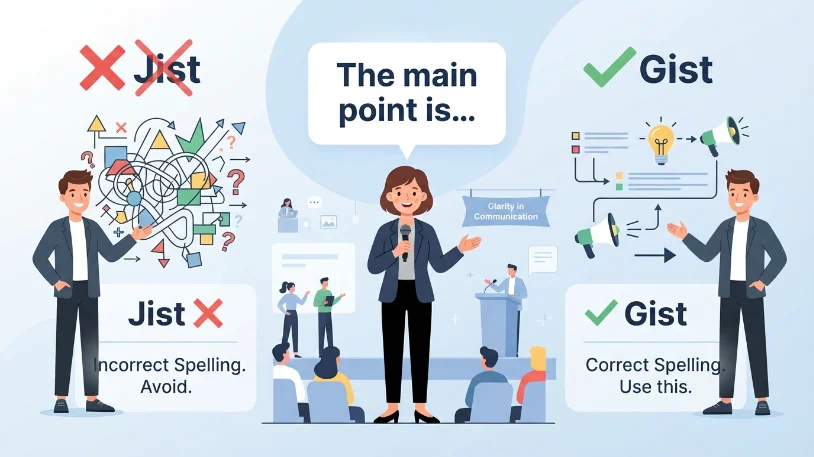
“Gist” is the correct spelling meaning the main point or essence of something. “Jist” is a common misspelling and should be avoided in all professional and academic writing.
Have you ever typed “jist” in an email and immediately questioned whether it was correct? If so, you are far from alone. This simple four-letter word causes surprising confusion among writers of all skill levels. The uncertainty stems from the way we pronounce “gist” with a soft “g,” making it sound exactly like “jist.” When we hear people say “get the gist of it,” we naturally assume it starts with a “j.” However, this assumption leads to a frequent and easily avoidable spelling error. Understanding the correct spelling of “gist” matters more than you might think. In professional communication, using “jist” can undermine your credibility and distract from your message. Whether you are writing a business report, an academic paper, or even a casual email, using the correct form demonstrates attention to detail and linguistic competence. This comprehensive guide will clarify the difference between jist and gist once and for all. Through simple explanations, practical examples, and helpful memory aids, you will learn to choose the right word with confidence every single time.
Key Takeaway
The most important point to remember is simple. Gist” is the only correct spelling when you mean the main point or essence of something. “Jist” is always a misspelling and has no legitimate place in standard English. If you want to sound professional and credible, always use “gist.” This guide will help you understand why this is the case and how to avoid this common error.
Definition and Explanation
To use these words correctly, you need to understand their definitions and origins thoroughly.
Gist
Gist” is a noun that means the main point or essential meaning of something. When someone says “get the gist,” they mean they understand the core idea without needing all the details. The word comes from Old French, where “gist” meant “to lie” or “to be located,” referring to where the main point of a legal case lay. Over time, it evolved to mean the central idea of any text or conversation.
For example:
- “I didn’t read the entire report, but I got the gist of it.”
- “The gist of her argument was that we need to reduce costs.”
- “Can you give me the gist of the meeting?”
Jist
“Jist” is simply a common misspelling of “gist.” It has no separate meaning or legitimate usage in standard English. The confusion arises because the “g” in “gist” is pronounced like a “j,” making the word sound exactly like “jist.” Since we often spell words based on how they sound, many people mistakenly write “jist.
The key point is that “jist” is always incorrect. There is no situation where “jist” is the right choice. If you are using it, you are making a spelling error.
Etymology and Pronunciation
The word “gist” has an interesting history. It comes from the Anglo-French phrase “cest action gist,” which meant “this action lies” or “this action is based on.” This legal term referred to the foundation or basis of a case. Over centuries, it broadened to mean the essence or main point of anything.
The pronunciation is straightforward: it rhymes with “list” but starts with a “j” sound. This soft “g” is why the misspelling “jist” is so common. Other words with this same pattern include “giant,” “gym,” and “giraffe.”
Side-by-Side Comparison
To visualize the difference between jist and gist, review this comparison table.
| Aspect | Gist | Jist |
| Definition | The main point or essence of something | No meaning; a misspelling |
| Correct Usage | “I got the gist of the lecture.” | Incorrect in all contexts |
| Part of Speech | Noun | Not applicable |
| Origin | Old French “gist” (to lie) | None |
| Professional Acceptability | Fully accepted | Unacceptable |
Advantages and Disadvantages
Understanding the correct usage of “gist” has clear benefits, while using “jist” carries distinct drawbacks.
Advantages of Correct Usage (Gist)
The primary advantage of using “gist” correctly is credibility. When you use the correct spelling, your reader perceives you as competent and professional. This is especially important in business and academic contexts. Additionally, using “gist” allows for clear and precise communication. It is a widely recognized word that effectively conveys the idea of understanding the main point.
Disadvantages of Incorrect Usage (Jist)
The disadvantages of using “jist” are significant. First, it immediately signals a lack of attention to detail. This can harm your professional reputation, particularly in formal writing. Second, it distracts the reader from your message. Instead of focusing on your ideas, they notice the spelling error. Finally, using “jist” can make you appear less educated or careless, even if that is not the case.
Real-World Examples
Seeing the difference between jist and gist in real contexts makes the distinction easier to grasp.
Gist in Action
- Business Meetings: “I missed the first part of the presentation, but I got the gist of the new strategy.”
- Academic Settings: “The professor summarized the gist of the theory in just a few sentences.”
- Everyday Conversations: “He explained the situation briefly, and I caught the gist of what happened.”
- Reading Comprehension: “Skimming the article gave me the gist without reading every word.”
- Legal Contexts: “The judge’s summary captured the gist of the complex case.”
Incorrect Jist in Action
These examples show how “jist” is misused and why it should be avoided.
- Common Error in Email: “I think I get the jist of your proposal.” (Should be “gist”)
- Social Media Mistake: “Can someone give me the jist of the drama?” (Should be “gist”)
- Workplace Misuse: “Let me give you the jist of the project.” (Should be “gist”)
Common Mistakes and Corrections
The most frequent mistake is using “jist” when “gist” is the intended word. Here are the common errors and their fixes.
| Common Mistake | Correction | Explanation |
| “I need the jist of the report.” | “I need the gist of the report.” | Gist” is the correct spelling for main point. |
| “She got the jist of the lecture.” | “She got the gist of the lecture.” | Always use “gist” in this context. |
| “Here’s the jist of what happened.” | “Here’s the gist of what happened.” | “Jist” is always incorrect. |
| “Can you summarize the jist?” | “Can you summarize the gist?” | The correct word is “gist.” |
| “The jist of the matter is simple.” | “The gist of the matter is simple.” | Always use “gist” in professional writing. |
Exercises with Answers
Practice makes perfect. Test your knowledge with these exercises.
Fill-in-the-Blanks
- I didn’t read the whole book, but I got the _______ of the story.
- Can you explain the _______ of your argument?
- The _______ of the meeting is that we need to increase sales.
- She quickly grasped the _______ of the complex situation.
- Please give me the _______ of your proposal.
Answer Key
- gist (The correct spelling for main point)
- gist (Always use “gist” in this context)
- gist (The standard spelling for essence)
- gist (This is the only correct form)
- gist (Use “gist” in professional writing)
Identify the Correct Word
- (Jist/Gist) of the matter is that we need to act quickly.
- I think I understand the (jist/gist) of your idea.
- Let me give you the (jist/gist) of the situation.
- She missed the (jist/gist) of the conversation.
- The (jist/gist) of the proposal is clear.
Answer Key
- Gist
- gist
- gist
- gist
- gist
Related Concepts or Comparisons
Gist vs. Summary
While “gist” and “summary” are related, they are not identical. Understanding the difference helps in choosing the right word.
| Aspect | Gist | Summary |
| Definition | The main point or essence | A concise restatement of key points |
| Length | Usually just a sentence or two | Can be several paragraphs |
| Detail | High-level, just the core idea | Includes more detail and structure |
| Purpose | To grasp the central idea | To convey the full argument briefly |
| Example | “The gist is that we need more funding.” | “In summary, we need more funding because…” |
Gist vs. Essence
- “Gist” and “essence” are very similar but have subtle differences.
| Aspect | Gist | Essence |
| Definition | The main point or idea | The intrinsic nature of something |
| Focus | Content or argument | Core nature or quality |
| Usage | “I got the gist of the speech.” | “The essence of happiness is contentment.” |
| Formality | Informal to neutral | More formal and philosophical |
Gist vs. Drift
“Drift” can sometimes mean a general sense of meaning, similar to “gist.”
| Aspect | Gist | Drift |
| Definition | The main point | The general meaning or tendency |
| Usage | “I got the gist of it.” | “I caught the drift of his argument.” |
| Frequency | Very common | Less common |
| Context | Formal and informal | Usually informal |
Global and Regional Usage
American English
In American English, “gist” is widely used and recognized. It appears in academic writing, business communication, and everyday conversation. The misspelling “jist” is common but is generally considered a mistake by educated speakers.
British English
Similarly, “gist” is standard in British English. It is used in all the same contexts and carries the same meaning. The pronunciation is identical, and the misspelling “jist” is equally avoided in professional writing.
Australian English
Australian English also follows the same rules. “Gist” is the correct and accepted spelling, while “jist” is a common error.
International English
In international contexts, “gist” is widely understood and accepted. It is a standard English word used across all English-speaking countries.
Common Mistakes and How to Avoid Them
Mistake 1: Using “Jist” in Formal Writing
Many people mistakenly use “jist” in emails, reports, and other professional documents. This can harm their credibility.
Correction: Always use “gist” in formal writing. If you are unsure, remember that “jist” is never correct.
Mistake 2: Confusing Pronunciation with Spelling
Because “gist” is pronounced like “jist,” people often spell it the way it sounds. This is a common trap.
Correction: Remember that the word is spelled with a “g,” not a “j.” Use a memory aid, such as “G is for good writing.
Mistake 3: Assuming “Jist” is an Alternate Spelling
Some people think “jist” is an accepted variant or a regional spelling.
Correction: “Jist” is not an acceptable variant. It is simply a mistake. Always use “gist.”
Mistake 4: Using “Jist” on Social Media
While social media is more casual, using “jist” can still make you appear less professional.
Correction: Use “gist” even in informal settings to maintain good habits.
Advanced Usage Tips
Using “Gist” in a Sentence
“Gist” is most commonly used with the verbs “get,” “give,” and “have.” Here are some examples:
- “I get the gist of what you’re saying.”
- “Can you give me the gist of the article?”
- “She has the gist of the matter.”
Variations of “Gist”
“Gist” can also be used in phrases like “the gist of it” or “the general gist.” These phrases emphasize that you are referring to the main point.
Synonyms for “Gist”
If you want to vary your writing, you can use synonyms for “gist.” Some common synonyms include:
- Essence
- Core
- Point
- Substance
- Crux
- Heart
- Main idea
For example, “The essence of the argument” instead of “The gist of the argument.”
Writing Tips for Professional Communication
Tip 1: Use “Gist” to Show Comprehension
Using “gist” effectively shows that you understand something without needing every detail. This is a useful skill in meetings and presentations.
Tip 2: Avoid “Jist” at All Costs
The simplest way to avoid this error is to remember that “jist” is never correct. When in doubt, use “gist.”
Tip 3: Proofread for This Error
When proofreading, specifically check for “jist.” Since it is such a common error, it’s worth taking an extra moment to ensure you’ve used the correct spelling.
Tip 4: Practice Using “Gist”
The more you use “gist” correctly, the more natural it will become. Try incorporating it into your writing today.
FAQs
What is the correct spelling: jist or gist?
The correct spelling is “gist.” It means the main point or essence of something. “Jist” is always a misspelling and has no legitimate use.
Why do so many people spell it “jist”?
Many people spell “jist” because the word “gist” is pronounced with a soft “g,” sounding exactly like a “j.” This phonetic confusion leads to the spelling error. However, “gist” is the only correct spelling.
Is “jist” ever acceptable in any context?
No, “jist” is never acceptable in standard English. It is simply a misspelling of “gist.” You should always use “gist” in all forms of writing.
What is the meaning of “gist”?
“Gist” means the main point, essence, or central idea of a text, speech, or situation. It refers to the key takeaway without all the supporting details.
How can I remember the correct spelling of “gist”?
Use a simple memory trick: “G is for good writing.” This reminds you that “gist” starts with a “g” and is the correct choice. You can also associate “gist” with “good” since they both start with “g.”
What are some synonyms for “gist”?
Common synonyms for “gist” include essence, core, point, substance, crux, heart, and main idea. These words all refer to the central or essential part of something.
Where does the word “gist” come from?
Gist” comes from the Old French word “gist,” meaning “to lie” or “to be located.” It was originally used in legal contexts to refer to the foundation of a case. Over time, it broadened to mean the main point.
Is “gist” used in British English?
Yes, “gist” is the standard spelling in British English, just as it is in American English. It has the same meaning and is used in the same contexts.
How is “gist” pronounced?
“Gist” is pronounced with a soft “g,” so it sounds like “jist.” This is why many people misspell it. It rhymes with “list” but starts with a “j” sound.
What is the difference between “gist” and “summary”?
“Gist” refers to the main point or essence of something, while “summary” is a concise restatement of the key points. A summary is usually longer and more detailed than a gist.
Conclusion
The choice between jist and gist is not a choice at all. “Gist” is the only correct spelling for the main point or essence of something. “Jist” is a common misspelling that has no place in professional or academic writing. By understanding this simple distinction, you can avoid a frequent and embarrassing error. Remember that the word is spelled with a “g,” even though it sounds like it starts with a “j.” Use memory tricks like “G is for good writing” to reinforce this rule. Incorporating “gist” correctly into your vocabulary will enhance your credibility and improve your communication.
Whether you are writing an email, a report, or a social media post, always choose “gist.” Your readers will appreciate your attention to detail and your command of the English language. Next time you are about to type “jist,” pause and remember the correct spelling is “gist.”