“Segway” refers to a two-wheeled motorized personal vehicle used for standing transport, while “segue” (pronounced seg-way) functions as a noun or verb meaning a smooth, uninterrupted transition from one topic, song, or scene to the next. Mixing up these two words is a common homophone error in writing. Writers can easily avoid mistakes by checking whether they are discussing electronic transportation or a conversational transition.
English spelling can play tricks on our eyes. Words that sound identical often carry completely different meanings. A great example of this is the choice between segway or segue. People frequently wonder which option is correct when writing about a smooth conversational shift. Writers struggle to pick the right term for their scripts, essays, or blogs. Grammar rules guide us toward correct usage every single time.
Mastering these words boosts your writing confidence. Clear sentences help readers follow your thoughts without distraction. Everyone benefits from strong communication skills. Let us explore the simple rules behind these terms right now.
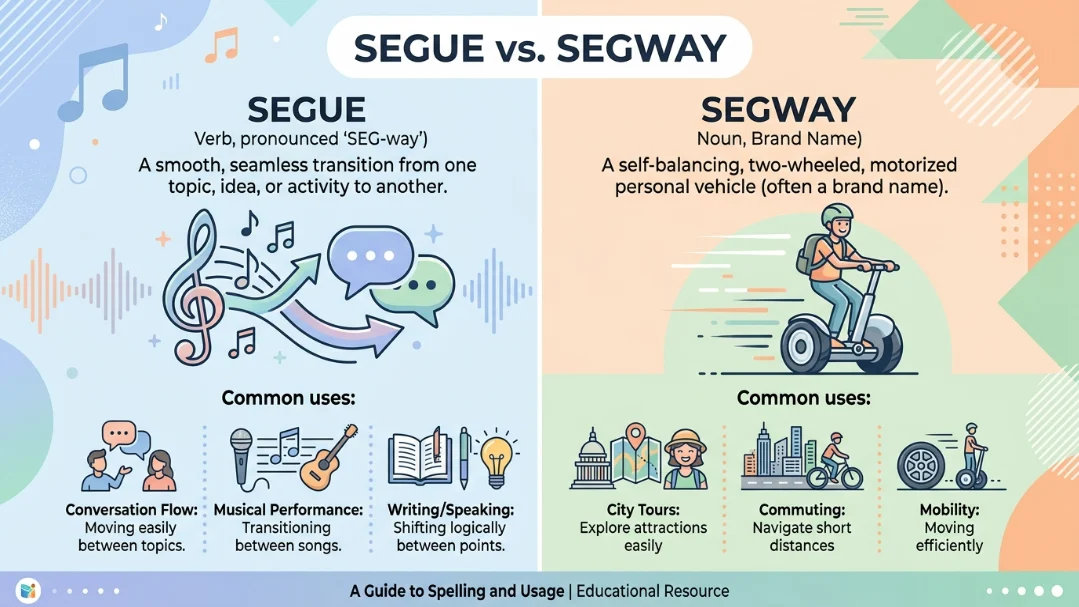
Understanding basic vocabulary definitions prevents embarrassing writing mistakes. “Segway” serves as a proper noun representing the brand of motorized personal transporters. “Segue” functions as a standard noun or verb representing a smooth transition between topics or musical segments. Pronunciation sounds identical for both words, which makes context the ultimate key to proper spelling.
Writers must check their topic before typing content. Transportation discussions require the brand name spelling. Conversational shifts demand the musical term spelling. Consistent accuracy creates professional and polished documents.
Definition and Explanation
What Does Segway Mean
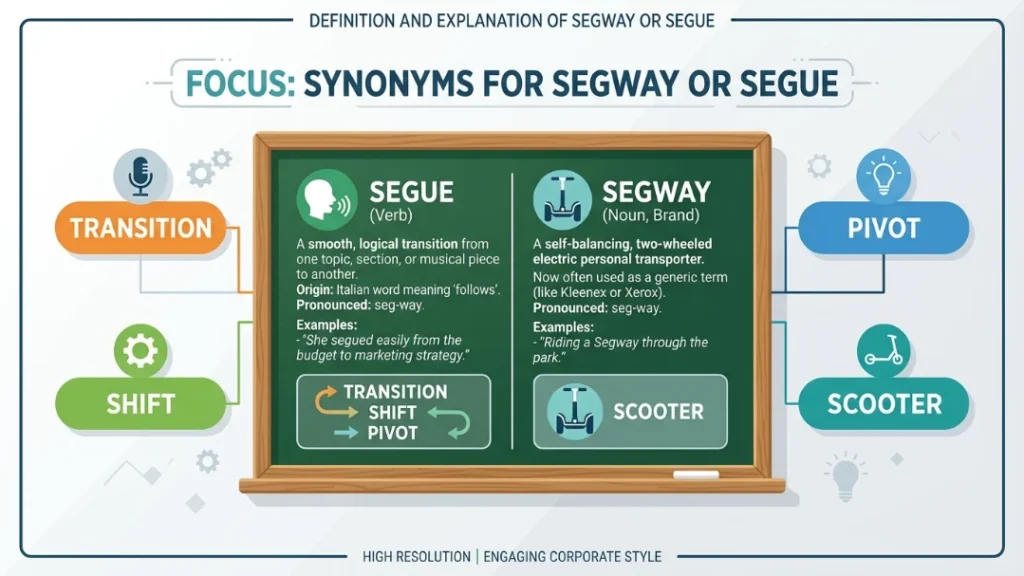
The proper noun refers to a motorized, self-balancing personal transportation device featuring two wheels and a vertical steering handle. This word establishes a physical vehicle. For example, tour guides riding electric scooters around city streets use this specific spelling.
What Does Segue Mean
The noun or verb describes an uninterrupted transition from one song, idea, subject, or scene to another. This word originates from musical terminology. For instance, moving smoothly from discussing economics to talking about sports in a podcast script requires this specific spelling.
Spelling and Etymology Comparison
Grammar and etymology separate these two vocabulary entries completely. “Segue” is an Italian musical term derived from seguire (to follow). “Segway” is a modern trademarked portmanteau blending “segue” with the prefix “way.”
| Spelling Variant | Part of Speech | Core Definition | Recommended Usage |
| Segue | Noun or Verb | A smooth transition between topics or music | Best for writing about conversational shifts or show flows |
| Segway | Proper Noun | A motorized two-wheeled personal vehicle | Best for writing about personal transportation machines |
Advantages and Disadvantages
Benefits of Correct Usage
Precise spelling elevates your professional reputation. Podcast scripts, screenplays, and corporate presentations require absolute accuracy. Readers trust authors who master fundamental language rules.
Drawbacks of Careless Mistakes
Typos distract audiences immediately. Using a brand-name vehicle spelling in place of a transition verb looks amateurish. Readers might judge your writing competence based on simple homophone confusions.
Real World Examples
Podcasting and Broadcasting
Media production environments demand clear communication. A podcast host moving from an interview segment to a commercial break executes a smooth verbal shift. Writers scripting the show notes need the correct transition term.
Tourism and Urban Mobility
Recreational industries involve physical equipment. Tour companies renting out electric personal transport devices to sightseers utilize the brand-name vehicle regularly.
Regional and Global Usage
Global English Standards
English grammar remains uniform across global regions regarding these words. Whether writing in London, New York, or Sydney, the definitions apply identically. Standard dictionaries maintain identical entries worldwide.
Modern Pop Culture
The popularity of personal transport machines introduced “Segway” into everyday lexicon, which unfortunately increased spelling confusion for the older musical transition term “segue.”
Common Mistakes
Using Segway as a Verb
Authors frequently write that a speaker “segwayed” into a new topic. This is an incorrect spelling of the verb form. The correct past-tense verb is “segued.”
Confusing Pronunciation with Spelling
Because both words sound like seg-way, writers often guess the wrong spelling. Memorizing the Italian origin of the transition word prevents recurring errors.
Exercises with Answers
Practice Questions
- Fill in the blank with the correct option: The tour group rented a fleet of electric ________ to explore the park.
- Fill in the blank with the correct option: The speaker made a smooth ________ from science to art.
- True or False: “Segway” is the correct spelling for a conversational transition.
- Correct the spelling error in this sentence: The news anchor tried to segway into the weather report.
Answer Key
- Segways
- segue
- False
- The news anchor tried to segue into the weather report.
Related Concepts and Comparisons
Transitions versus Machinery
Linguistic concepts rely on precise terminology. Understanding how to shift topics effectively helps writers structure narratives smoothly. Selecting appropriate vocabulary ensures logical coherence across paragraphs.
Synonyms and Alternative Terms
Writers expand their vocabulary using alternatives. Rich descriptions improve storytelling quality.
| Synonym | Definition | Tone |
| Transition | A passage from one state, stage, or place to another | Standard / Versatile |
| Shift | A slight change in position, direction, or tendency | Direct |
| Pivot | Turn or balance on a central point; change direction | Dynamic |
| Scooter | A light two-wheeled vehicle | Informal / Physical |
FAQs
What is the difference between segway and segue?
Segway” is a brand name for a two-wheeled motorized vehicle, while “segue” is a term meaning a smooth transition between topics or songs.
How do you pronounce segue?
It is pronounced exactly like seg-way, which is why people often confuse its spelling.
What is the past tense of the verb segue?
The correct past tense is “segued,” and the present participle is “seguing.”
Is segway ever used as a verb?
No, “Segway” is a proper noun. Using it as a verb meaning to transition is considered a spelling error.
Where did the word segue come from?
It comes from an Italian musical direction meaning “it follows.
Why is the vehicle spelled Segway?
The inventors chose “Segway” as a clever play on the word “segue” combined with “way” to imply smooth travel.
Do spell checkers catch segway used as a transition?
Usually no, because “Segway” is a recognized dictionary word, so spell checkers won’t flag it even when used incorrectly in place of segue.
Can segue be used as a noun?
Yes, you can say “that was a smooth segue.”
Are there alternative spellings for segue?
No, segue is the only standard spelling for the transition term.
How can I remember which is which?
Remember that the transition word “segue” ends in “ue” like unique music, while the vehicle “Segway” has “way” in it for traveling down a path.
Conclusion
Mastering fundamental vocabulary strengthens your overall writing performance. Distinguishing between segway or segue prevents embarrassing communication errors. Consistent practice builds reliable editing habits over time.