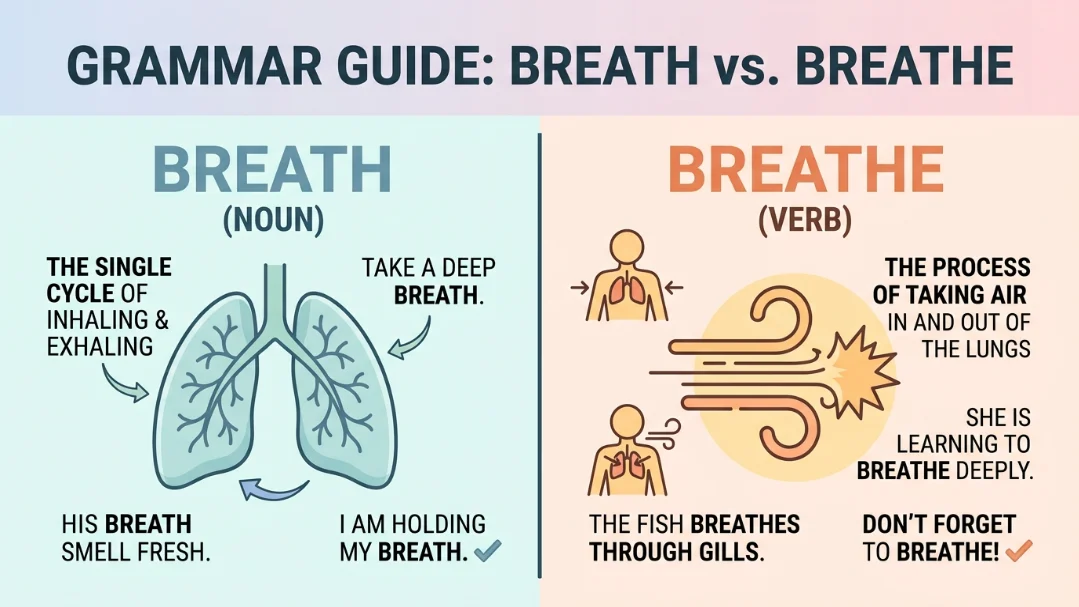
“Breath” is a noun referring to the air inhaled and exhaled into and out of the lungs, whereas “breathe” is a verb describing the physical action of taking air in and out. Confusing these two terms remains a frequent spelling and grammar error in academic, creative, and professional writing. Writers can easily avoid mistakes by remembering that the verb “breathe” ends with an “e,” just like other active verbs such as live, move, and bathe. Mastering this fundamental spelling distinction ensures absolute clarity in medical documentation, creative literature, and daily communication.
English spelling rules test our patience constantly. Silent vowels change word classes completely, transforming objects into actions and nouns into verbs with the simple addition or subtraction of a single letter. A classic example that trips up writers of all experience levels involves choosing between breath or breathe. People often wonder which option is correct when drafting poetry, medical reports, workout guides, or casual blogs. Grammar rules guide us toward correct usage every single time, providing reliable anchors in an otherwise chaotic linguistic landscape.
Mastering these words boosts your writing confidence. Clear sentences help readers understand your physiological descriptions instantly without stumbling over jarring typographical errors. Everyone benefits from strong communication skills, whether you are composing a formal scientific paper or writing an emotional passage in a fictional novel. Let us explore the simple rules behind these terms right now to ensure your writing remains polished, precise, and completely error-free.
Understanding basic grammar rules prevents awkward writing mistakes that can undermine your professional credibility. “Breath” serves as a noun representing the physical air moving through your respiratory system during inhalation and exhalation. “Breathe” functions as a verb representing the dynamic act of taking air in and out of your body. Pronunciation differs noticeably between both terms, which aids spoken communication but frequently misleads writers during transcription.
Writers must check their part of speech before typing. Noun positions require the shorter term without the final vowel. Verb positions demand the term featuring the silent e. Consistent accuracy creates professional and polished documents across all publishing platforms.
Comprehensive Definition and Explanation
What Does Breath Mean in Detail
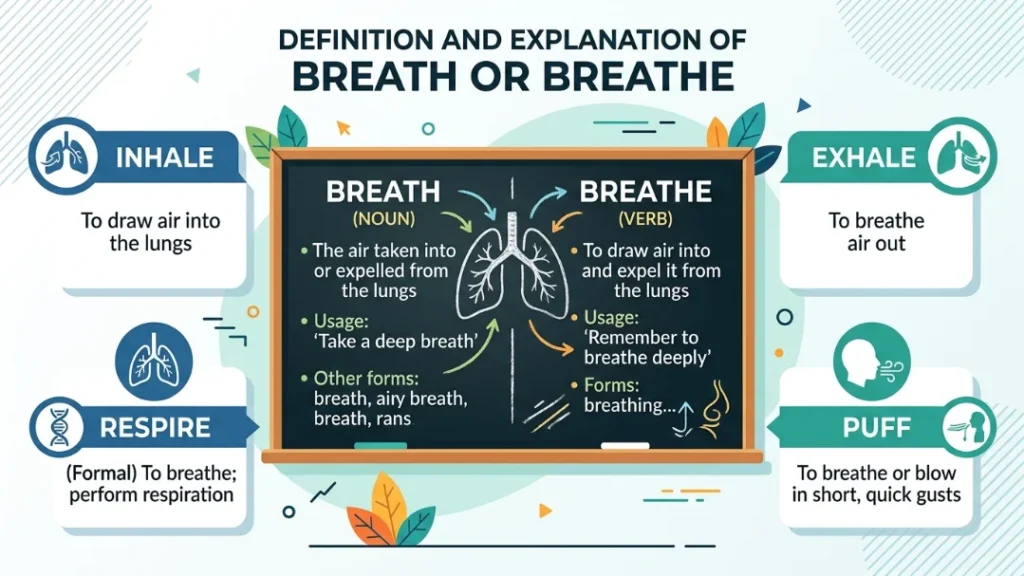
The noun refers specifically to the air taken into or expelled from the lungs during normal respiration. This word establishes a physical substance, a single act of breathing, or an intangible feeling associated with life, vitality, and presence. For example, taking a deep gulp of fresh morning air on a mountain hike uses this specific spelling.
Etymologically, “breath” traces its roots back to Old English bræþ, meaning odor, scent, or exhalation. Over centuries, its meaning shifted toward the physiological process of respiration. In literature and everyday idiom, the word takes on metaphorical dimensions, representing life itself (“holding one’s breath”), relief (“catching one’s breath”), or secrecy (“whispering under one’s breath”).
What Does Breathe Mean in Detail
The verb describes the active physiological process of inhaling and exhaling air to sustain life. This word establishes dynamic movement and bodily function. For instance, instructing someone during a meditation session to relax and inhale slowly requires this specific spelling.
From an etymological standpoint, the verb form evolved from the Old English noun bræðian or related verbal roots, eventually acquiring the silent “e” suffix that standardizes English action verbs. This silent “e” serves a dual purpose: it lengthens the preceding vowel sound (creating the long “ee” sound) and marks the word as a verb rather than a noun, following a predictable pattern seen in word pairs like bath and bathe, or cloth and clothe.
Pronunciation and Spelling Comparison
Grammar rules and pronunciation separate these two vocabulary entries completely. The noun “breath” features a short “e” sound, rhyming precisely with death and breath. The verb “breathe” features a long “ee” sound, rhyming with seethe and wreathe.
| Term | Part of Speech | Core Definition | Pronunciation Guide |
| Breath | Noun | The air inhaled or exhaled | Breth (rhymes with death) |
| Breathe | Verb | To inhale and exhale air | Breeth (rhymes with seethe) |
Advantages and Disadvantages of Grammatical Precision
Benefits of Correct Usage
Precise grammar elevates your professional reputation immediately. Medical journals, fiction manuscripts, and fitness guides require absolute accuracy to maintain authority and trust. Readers naturally trust authors who master fundamental language rules, as consistent formatting and spelling signal attention to detail and high editorial standards.
When your grammar is flawless, your audience remains entirely immersed in your narrative or instructional content without being jolted out of the experience by elementary typos. This smooth reading flow increases comprehension, engagement, and overall satisfaction.
Drawbacks of Careless Mistakes
Typos distract audiences immediately. When a reader encounters “take a deep breathe” instead of “take a deep breath,” their brain stumbles over the grammatical mismatch. Spell check software sometimes misses context errors because both words are valid dictionary entries, leaving the burden entirely on human proofreaders.
Readers might subconsciously judge your writing competence based on simple mistakes, assuming a lack of education or editorial care. Eliminating these errors protects your personal and professional brand.
Real World Examples Across Industries
Medical and Fitness Instructions
Healthcare and wellness environments demand crystal-clear communication. A yoga instructor telling students to inhale and exhale deeply uses the verb correctly in sentences like, “Remember to breathe deeply through your nose.”
Conversely, a doctor recording a patient’s respiratory stats or physical condition uses the noun in sentences like, “The patient experienced shortness of breath after minimal exertion.” Mixing these up in clinical notes could theoretically introduce ambiguity into medical records.
Creative Literature and Poetry
Poetry relies heavily on rhythm, meter, and precise imagery. Authors describing characters gasping for air select the appropriate noun or verb form to maintain poetic resonance. For example, a romantic novelist might write, “With every breath she took, she felt closer to peace,” utilizing the noun to establish emotional weight.
In contrast, a suspense author might write, “He hid behind the curtain, desperately trying not to breathe,” using the verb to emphasize a silent, life-or-death physical action.
Regional and Global Usage and Etymological Evolution
Global English Standards
English grammar remains remarkably uniform across global regions regarding these specific terms. Whether you are writing in London, New York, Sydney, or Toronto, these rules apply identically. Standard dictionaries maintain identical definitions and grammatical classifications worldwide, making this an absolute rule across all major English dialects.
Idiomatic Expressions and Historical Usage
The English language features countless idioms built around these terms. Understanding their fixed structures prevents accidental alterations:
- “Save your breath”: Requires the noun, meaning to avoid wasting words on someone who will not listen.
- “Breathe a sigh of relief”: Requires the verb, describing the physical expression of sudden relaxation.
- “Take someone’s breath away”: Uses the noun to describe overwhelming awe or beauty.
- “Out of breath”: Employs the noun to indicate physical exhaustion or oxygen depletion.
Common Mistakes and How to Avoid Them
Swapping Nouns and Verbs
Authors frequently insert the noun form when writing an action verb, or vice versa, due to the phonetic similarity and shared root. Proofreading catches these typos easily if you actively test the word’s grammatical slot.
- Incorrect: I need to take a deep breathe.
- Correct: I need to take a deep breath. (Requires noun after article “a” and adjective “deep”).
- Incorrect: Please breath slowly.
- Correct: Please breathe slowly. (Requires verb following the imperative subject).
Pronunciation Confusion
Spoken language sometimes causes spelling errors. Because the verb sounds like it has a long “e,” writers might forget to add the silent “e” at the end. Memorizing the visual structure of action verbs prevents future mistakes. Always look for the trailing “e” when you need an action word.
Step-by-Step Grammar Check Guide for Writers
- Identify the sentence structure: Locate where the word sits in relation to articles, pronouns, and verbs.
- Apply the part-of-speech test: If it follows words like a, an, the, my, deep, or short, it is almost certainly the noun breath.
- Apply the action test: If it follows auxiliary verbs like can, must, to, or serves as the primary action of the subject, it is the verb breathe.
- Check the vowel length: Say the word aloud in your head. If it rhymes with death, spell it without the “e”. If it rhymes with seethe, add the “e”.
Exercises with Answers
Practice Questions
- Fill in the blank with the correct option: Take a deep ________ before stepping onto the stage.
- Fill in the blank with the correct option: It is impossible to ________ underwater without specialized scuba gear.
- True or False: “Breath” is the correct verb form used for instruction.
- Correct the sentence: The doctor told the runner to breath deeply after the race.
- Identify whether the underlined word is a noun or verb: She held her breath during the suspenseful movie scene.
Answer Key
- breath
- breathe
- False (breathe is the verb)
- The doctor told the runner to breathe deeply after the race.
- Noun
Related Concepts and Comparisons
Respiratory Functions and Physiology
Scientific concepts rely on precise terminology. Understanding bodily systems helps writers choose accurate descriptors. Selecting appropriate vocabulary ensures logical coherence across scientific paragraphs, medical journals, and biological textbooks.
Synonyms and Alternative Terms
Writers expand their vocabulary using alternatives to keep prose dynamic and engaging. Rich descriptions improve storytelling quality and prevent repetitive phrasing.
| Synonym | Definition | Tone | Grammatical Class |
| Respire | To breathe; to inhale and exhale | Scientific / Formal | Verb |
| Puff | A short, quick emission of breath or wind | Informal / Descriptive | Noun / Verb |
| Inhale | To breathe in | Technical | Verb |
| Exhale | To breathe out | Technical | Verb |
| Gasp | A sudden intake of breath from shock | Emotional | Noun / Verb |
Frequently Asked Questions
What is the fundamental difference between breath and breathe?
Breath” is a noun meaning the physical air itself, while “breathe” is a verb meaning the active process of inhaling and exhaling.
How do I pronounce breath correctly?
It is pronounced with a short “e” sound, rhyming exactly with death.
How do I pronounce breathe correctly?
It is pronounced with a long “e” sound, rhyming with seethe.
Why does breathe have an e at the end?
In English, adding a silent “e” to the end of a noun often turns it into a verb and lengthens the preceding vowel sound, following patterns like bath versus bathe.
Can breath be used as an adjective?
Yes, it frequently acts as an attributive noun functioning like an adjective, such as in compound phrases like “breath mints” or “breath spray.”
Why do people confuse these words so often?
They sound similar, share the exact same etymological root, and appear frequently together in close proximity in writing, leading to careless typographical mix-ups.
Are these words used universally across all English dialects?
Yes, these fundamental terms are universal across American, British, Australian, Canadian, and global English dialects with zero spelling variations.
What is the past tense of breathe?
The past tense is “breathed,” formed by adding a “d” to the verb base.
How can I easily remember the difference?
Remember that “breathe” has an “e” at the end, just like the verb “exercise” or the fact that giving life takes an extra step.
Do automated spell checkers catch this mistake reliably?
Spell checkers frequently miss context errors if the misspelled word itself is a correctly spelled dictionary entry. Human proofreading remains essential.
Conclusion
Mastering fundamental vocabulary strengthens your overall writing performance and builds professional credibility. Distinguishing between breath or breathe prevents embarrassing communication errors in your personal, academic, and professional correspondence. Consistent practice builds reliable editing habits over time, ensuring your written communication remains pristine.
Review your drafts carefully before publishing any content, paying special attention to homophones and similarly spelled word pairs. Small details matter significantly in professional environments and creative works alike. Apply these grammar lessons daily to achieve complete communicative clarity and elevate your writing to the next level.