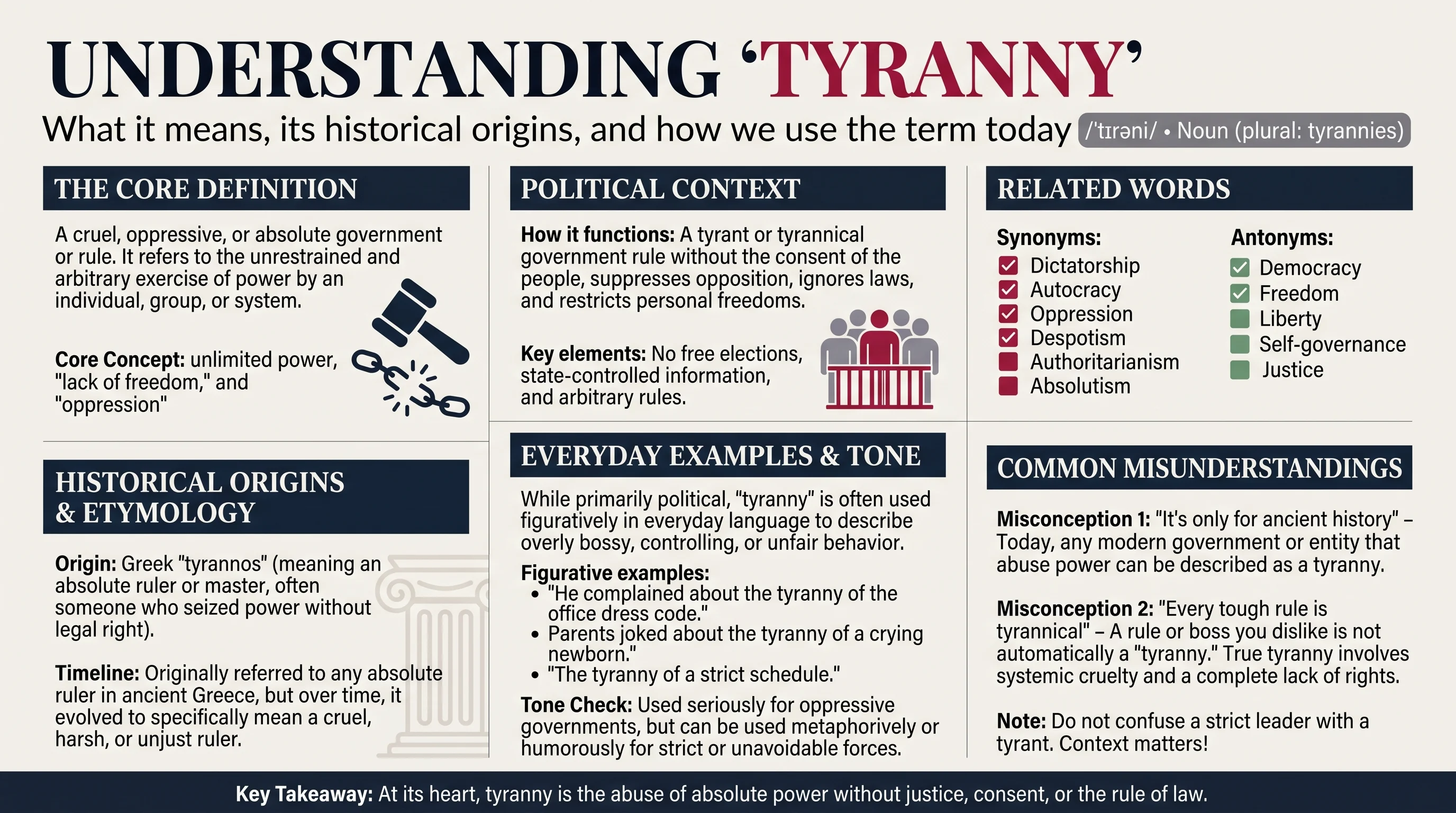
The tyranny meaning is the exercise of cruel, oppressive, or unjust power over people. It usually describes government or leadership that ignores rights, restricts freedom, and rules through fear, force, or abuse of authority.
The tyranny meaning describes oppressive or unjust control, especially when a person or government uses power without respecting freedom, rights, or fair limits. The word often appears in political discussions, history books, literature, news reports, and debates about leadership. However, people also use it more casually to describe harsh control in everyday situations.
For example, someone might call an abusive government tyrannical because it suppresses opposition and limits basic freedoms. Likewise, a writer might describe an unreasonable boss as a tyrant for controlling employees unfairly. The seriousness depends on context.
Furthermore, the word carries a strong negative judgment. It does not simply mean that someone has authority. Instead, it suggests that authority has become oppressive, abusive, or unjust.
Understanding this distinction matters. A strict rule is not automatically tyranny. A powerful leader is not automatically a tyrant. The term becomes appropriate when power is exercised in a way that seriously violates freedom, fairness, or legitimate rights.
QUICK ANSWER BOX
| Meaning | Context | Primary Platforms | Example | Tone |
| Cruel or oppressive use of power | Politics, history, literature, everyday speech | News, social media, blogs, conversations | The people protested against tyranny. | Strong, negative, serious |
What Does Tyranny Mean?
The tyranny’s meaning centers on oppressive power. In its traditional sense, tyranny refers to government or leadership that exercises power in a cruel, arbitrary, or unjust way.
The important idea is abuse of authority. A government can have extensive power without necessarily being tyrannical. The term becomes relevant when leaders use that power to suppress freedom, ignore rights, punish opposition, or control people unfairly.
Historical origin of the word
The English word “tyranny” comes through French and Latin from the Greek word tyrannia, meaning rule by a tyrant. The related Greek word tyrannos referred to a ruler who held power outside the traditional or established system of kingship.
Over time, the meaning became strongly associated with oppressive rule. Ancient political thought helped shape this negative sense. Later writers, historians, and political thinkers used tyranny to describe a government that placed the ruler’s interests above justice and the welfare of the people.
Consequently, modern English usually treats the word as strongly negative.
Tyranny versus ordinary authority
Authority and tyranny are not identical.
Authority can be legitimate. For example, a judge has legal authority to issue certain decisions. A school principal has authority to enforce school policies. A government has authority to create and enforce laws.
Tyranny describes authority that becomes oppressive or abusive.
| Concept | Basic idea | Typical implication |
| Authority | Legitimate power to make decisions | Usually neutral |
| Leadership | Guiding people toward a goal | Usually positive or neutral |
| Control | Ability to influence behavior | Depends on context |
| Dictatorship | Government concentrated under one ruler or group | Often negative |
| Tyranny | Oppressive or unjust exercise of power | Strongly negative |
| Despotism | Rule with extensive or arbitrary power | Strongly negative |
Therefore, calling something tyranny makes a much stronger claim than simply saying it involves strict leadership.
Tyrant and tyranny
A tyrant is a person who exercises oppressive or unjust power. Tyranny refers to the oppressive system, behavior, or condition created through that power.
For example:
The tyrant silenced political opponents.
Here, the word identifies the person.
The citizens lived under tyranny.
Here, the word identifies the oppressive condition.
Similarly, tyrannical is the adjective used to describe behavior or rule.
The ruler became increasingly tyrannical.
These three forms are closely connected but serve different grammatical purposes.
Contextual Dynamics & Nuances of the Term
Words related to oppression can vary considerably in strength. Therefore, context matters before you describe a situation as tyranny.
Political context
Politics is probably the most traditional setting for the word. Writers may describe a government as tyrannical when it suppresses political opposition, removes meaningful freedoms, uses arbitrary punishment, or concentrates power without effective accountability.
For example:
The revolution began as resistance to years of tyranny.
This sentence presents oppression as a major reason for political resistance.
However, political disagreements alone do not establish tyranny. Calling a government tyrannical is a serious characterization. It should be supported by the behavior being described.
Historical context
Historians frequently use the word when discussing oppressive rulers, authoritarian systems, or periods in which people experienced severe restrictions.
For instance, a textbook might describe resistance to an oppressive monarch as resistance against tyranny.
The term can also appear in historical speeches and political writings. In these cases, it often expresses both description and moral judgment.
Literary context
Authors use tyranny to create conflict. A fictional ruler might represent political oppression. A parent, employer, or social institution might represent another kind of controlling force.
Shakespearean drama, dystopian fiction, political novels, and historical literature often explore themes involving power and oppression.
For example:
The novel portrays tyranny as a force that slowly destroys individual freedom.
Here, the word describes a central theme rather than a specific government.
Everyday context
People sometimes use tyranny humorously in ordinary conversation.
Someone might say:
My alarm clock is tyranny before 6 a.m.
Clearly, this is not a literal political claim. The speaker is exaggerating to make a joke about an unpleasant routine.
Likewise:
The tyranny of group projects strikes again.
The phrase creates humor by applying a serious political word to a minor inconvenience.
This figurative use can work well in casual settings. However, it may sound inappropriate when discussing genuine political oppression or human suffering.
Emotional intensity
The word has considerable emotional force. It communicates more than inconvenience or strictness.
| Word | Emotional strength | Typical use |
| Strictness | Low | Rules and discipline |
| Control | Low to medium | Influence or restriction |
| Oppression | High | Severe restriction |
| Despotism | High | Arbitrary political power |
| Tyranny | Very high | Cruel or unjust domination |
Therefore, choose the word carefully. If you simply dislike a workplace rule, calling it tyranny may sound exaggerated.
Real Life Conversation Examples Using tyranny meaning
Example 1: Political discussion
Alex: The government keeps restricting public protests.
Jordan: That sounds like a serious abuse of power.
Alex: Exactly. Many people see it as tyranny.
Jordan: I understand. The issue is not just having laws. It is how those laws are enforced.
Meaning: This conversation uses the term in its traditional political sense to describe oppressive government behavior.
Example 2: Historical discussion
Maya: Why did the revolutionaries oppose the king?
Noah: They believed the monarchy had become oppressive.
Maya: So they were fighting against tyranny?
Noah: Yes. That was part of their argument.
Meaning: Here, the word refers to oppressive political rule in a historical setting.
Example 3: Casual texting
Sam: My professor assigned another five page paper.
Chris: The tyranny continues.
Sam: Honestly, I cannot disagree.
Meaning: This is a humorous exaggeration. The speaker uses a serious political term to joke about an overwhelming assignment.
Example 4: Workplace conversation
Taylor: Our manager now requires approval for every tiny decision.
Morgan: That sounds extremely controlling.
Taylor: It feels like workplace tyranny sometimes.
Meaning: The phrase is being used figuratively to describe excessive control in a workplace.
Example 5: Social media discussion
Jamie: People keep saying every strict policy is tyranny.
Riley: That is probably too broad.
Jamie: Right. Strict rules and oppressive rules are not automatically the same thing.
Meaning: This example highlights an important distinction. The word should describe serious abuse of power rather than ordinary disagreement.
Platform Specific Breakdown
Different platforms encourage different styles of language. Consequently, the word can sound formal in one setting and humorous in another.
How It Is Used on Snapchat
Snapchat conversations tend to be brief, informal, and highly contextual. Users may employ the word jokingly when complaining about school, parents, work, chores, or other restrictions.
For example:
Mom said no phone after midnight. Tyranny.
The speaker probably does not mean political oppression. Instead, the message creates dramatic humor.
Another example could be:
Three assignments due tomorrow. Academic tyranny.
The short format makes exaggerated language feel playful.
However, Snapchat users should consider their audience. A serious political discussion requires more precise language and less exaggerated phrasing.
The Role of tyranny meaning on TikTok
TikTok encourages short explanations, humor, commentary, storytelling, and cultural references. Therefore, the word can appear in both serious and comedic content.
A creator might discuss historical tyranny in an educational video. Another creator might jokingly describe strict workplace policies as tyranny.
Captions can also use dramatic phrasing for comedic effect.
When your boss schedules a meeting at 7 a.m. Tyranny has entered the chat.
The humor comes from exaggeration.
Nevertheless, context determines interpretation. A political video discussing actual oppression should use precise claims and supporting evidence rather than relying on dramatic wording alone.
Instagram and Texting Dynamics
Instagram captions often blend commentary with humor. A person might use the word to add drama to a personal story.
For example:
The tyranny of Monday mornings is undefeated.
That sentence is clearly figurative.
Text messages can be even shorter:
This schedule is tyranny.
The meaning depends heavily on the conversation around it.
In serious conversations, clarity becomes more important. If someone discusses government violence or systematic oppression, casual exaggeration may undermine the seriousness of the topic.
Alternative Meanings & NLP Variations of the Phrase
Natural language processing looks beyond exact words. It also considers related concepts, semantic relationships, and context.
The central concept connects with several lexical variations.
Common synonyms
Oppression emphasizes the unjust treatment of people.
Despotism emphasizes arbitrary or absolute power.
Dictatorship describes a political system in which power is concentrated in a ruler or small group.
Autocracy refers to a government in which one person holds extensive power.
Despotism and tyranny overlap significantly, but they are not perfect replacements in every sentence.
Related adjectives
The adjective tyrannical describes someone or something that behaves like a tyrant.
The ruler adopted tyrannical policies.
The adjective oppressive describes conditions that impose severe hardship or restriction.
Workers described the environment as oppressive.
The adjective authoritarian describes a system or approach that strongly emphasizes obedience and limited political freedom.
These words overlap, but each carries a slightly different emphasis.
Related nouns
| Word | Main focus |
| Tyrant | The person exercising oppressive power |
| Tyranny | The oppressive rule or condition |
| Oppression | Unjust or severe restriction |
| Despotism | Arbitrary or absolute rule |
| Autocracy | Concentrated individual rule |
| Dictatorship | A political system dominated by a dictator |
This semantic network helps writers choose a more precise word.
NLP interpretation
From a language perspective, the term commonly connects with concepts such as power, freedom, government, oppression, control, resistance, injustice, authority, rebellion, rights, and dictatorship.
These associations help search engines and language models understand the subject beyond an exact keyword.
For content creators, semantic variety also improves readability. Instead of repeating the same phrase, writers can naturally discuss oppressive rule, unjust authority, authoritarian behavior, political repression, and abuse of power.
Misinterpretations: When NOT to Use tyranny meaning
Strong vocabulary becomes weaker when people use it for everything.
Do not use it for ordinary rules
A school rule requiring students to arrive on time is not automatically tyranny.
You may dislike the rule. However, disagreement does not establish oppression.
Do not use it for every strict manager
A manager who expects employees to meet deadlines may be demanding. That alone does not make the manager tyrannical.
A stronger case would involve abusive control, arbitrary punishment, intimidation, or systematic mistreatment.
Do not treat political disagreement as proof
Political opponents often use emotionally charged language. However, disagreement with a policy does not automatically make that policy tyrannical.
A credible argument should explain the specific actions that allegedly restrict rights or abuse power.
Do not confuse humor with literal meaning
When someone writes:
The tyranny of Monday meetings.
They probably mean that Monday meetings are annoying.
The phrase is humorous because the comparison is intentionally exaggerated.
Avoid insensitive comparisons
Using the word casually can become inappropriate when discussing historical atrocities, political repression, imprisonment, or serious human rights abuses.
Humor depends on context. Therefore, consider the subject, audience, and setting before using exaggerated language.
How to Respond in Chat Comfortably
When someone uses the word in conversation, your response should match their intended meaning.
If they use it seriously
You can ask for clarification:
What specific actions are you referring to?
This keeps the conversation focused on evidence.
If they use it humorously
You can play along:
The struggle continues.
Or:
We demand better working conditions.
The playful response matches the exaggerated tone.
If you disagree
Stay specific:
I would call it strict rather than tyrannical.
This approach challenges the word without unnecessarily escalating the conversation.
If you are unsure
Ask:
Do you mean that literally or as a joke?
That simple question can prevent a major misunderstanding.
Choosing the right response
| Situation | Comfortable response style |
| Serious political discussion | Calm and evidence focused |
| Historical discussion | Educational and precise |
| Casual complaint | Light and humorous |
| Workplace issue | Professional and specific |
| Social media debate | Clear and measured |
| Sensitive topic | Respectful and careful |
The goal is not merely to understand the word. It is to understand what the speaker intends by using it.
FAQs
What is the meaning of tyranny in simple English?
It means cruel, unfair, or oppressive use of power. The term commonly describes rulers or governments that severely restrict people’s freedom or rights.
Is tyranny the same as dictatorship?
Not exactly. A dictatorship describes a political system dominated by a dictator or small group. Tyranny focuses more strongly on oppressive or unjust exercise of power.
What is an example of tyranny?
A government that uses arbitrary punishment, suppresses political opposition, removes basic freedoms, and rules through fear could be described as tyrannical.
What is the difference between tyranny and oppression?
Oppression is a broad concept involving unjust or severe restriction. Tyranny often emphasizes oppressive rule or domination by a powerful person or government.
Can tyranny be used jokingly?
Yes. People sometimes use the word humorously to exaggerate ordinary frustrations, such as difficult schedules, strict teachers, or annoying workplace rules.
What is a tyrant?
A tyrant is a person who exercises power in an oppressive, cruel, or unjust way. The term usually carries a strongly negative meaning.
Is tyranny always political?
No. Political use is the most traditional, but people can use the word figuratively for severe personal, social, or workplace control.
What is the adjective form?
The adjective is tyrannical. It describes someone, behavior, or a system that resembles the oppressive rule associated with a tyrant.
What are common synonyms for tyranny?
Common related words include oppression, despotism, dictatorship, autocracy, domination, and authoritarian rule. However, these terms are not interchangeable in every context.
Why does the word sound so strong?
The term carries centuries of political, historical, and literary associations with abusive power. Therefore, it communicates much more emotional weight than ordinary words such as strictness or control.
Conclusion
The tyranny meaning centers on oppressive, cruel, or unjust use of power. Traditionally, the word belongs to political and historical discussions. However, modern speakers also use it playfully to describe strict rules, frustrating routines, controlling workplaces, and everyday annoyances.
The key is context. A government that suppresses fundamental freedoms represents a far more serious use than a student joking about homework. Likewise, calling someone a tyrant makes a strong judgment about how that person uses authority.
Ultimately, precise word choice creates clearer communication. Use tyranny when the situation genuinely involves oppressive control, or when obvious exaggeration creates intentional humor. Understanding that distinction helps you write naturally, speak confidently, and avoid turning a powerful word into an empty expression.