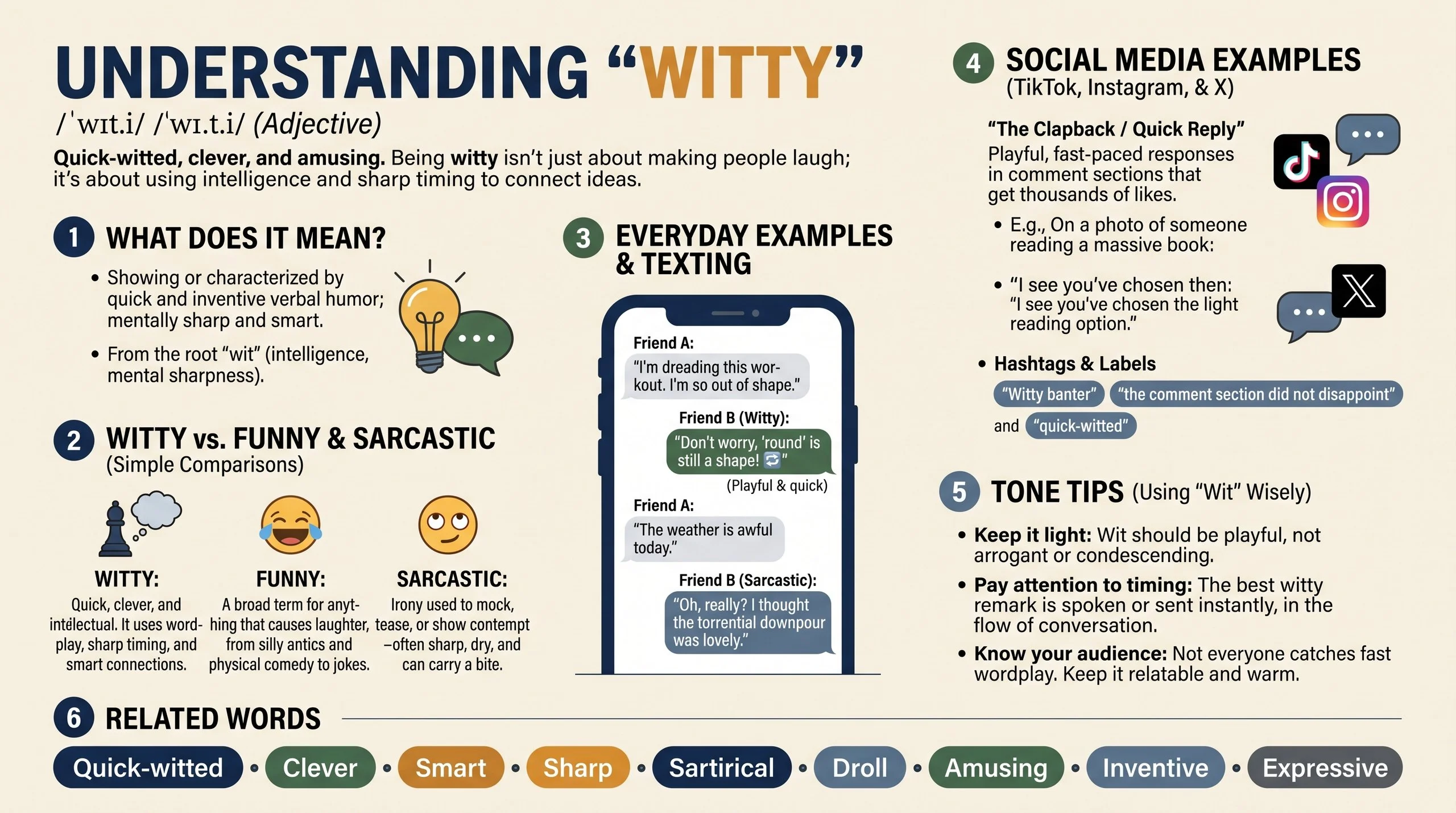
Witty meaning refers to using language in a clever, quick, and amusing way. A witty person or remark combines intelligence with humor, often through wordplay, irony, sharp observations, or an unexpected response that makes people smile.
witty meaning describes language that is both clever and amusing. In everyday American English, people use the word to praise a quick response, smart joke, clever comment, or entertaining observation. For example, someone might say, “That was a witty comeback,” after a friend gives a sharp but playful reply.
However, witty does not simply mean funny. A joke can make people laugh without showing much cleverness. A witty remark usually adds mental sharpness, timing, word choice, or an unexpected connection. Therefore, the word often carries a positive sense of intelligence and social awareness.
You may encounter this adjective in conversations, books, movies, workplace communication, social media captions, dating messages, comments, and casual texting. Its tone can range from warm and playful to sarcastic and sharply observant.
Understanding the distinction matters because calling someone witty usually compliments how they think and communicate, not merely how much they make others laugh.
Quick Answer Box
| Meaning | Context | Primary Platforms | Example | Tone |
| Clever and amusing use of language | Conversation, writing, humor | TikTok, Instagram, Snapchat, texting | “That was a witty reply.” | Smart, playful, humorous |
What Does witty meaning Mean?
The phrase points to the meaning and practical use of the adjective witty. Cambridge defines witty as using words in a clever and funny way. Oxford similarly describes it as clever and humorous. Cambridge Dictionary
In simple terms, something witty makes you think and smile at the same time. The humor may come from clever wording, an unusual comparison, irony, wordplay, timing, or an intelligent observation.
For example, imagine someone asks, “Why are you late?” A basic answer might be, “Traffic was bad.” A witty answer could be, “I had a very productive meeting with every red light in the city.”
The second response is not necessarily hilarious. Instead, it turns an ordinary situation into a playful observation.
Witty Versus Funny
The difference between witty and funny is important.
Funny focuses primarily on producing amusement or laughter. Witty emphasizes cleverness within that humor. Oxford specifically distinguishes witty from broader terms such as funny, amusing, humorous, comic, and hilarious. Oxford Learner’s Dictionaries
| Word | Main Idea | Typical Effect |
| Funny | Causes amusement | Makes you laugh |
| Witty | Clever and amusing | Makes you smile and notice the clever idea |
| Humorous | Shows or contains humor | Creates a light mood |
| Hilarious | Extremely funny | Produces strong laughter |
| Amusing | Pleasantly funny or entertaining | Gives enjoyment |
| Sarcastic | Uses irony to mock or criticize | Can amuse or sting |
Consequently, calling a comment witty often gives it more intellectual credit than simply calling it funny.
Witty as a Compliment
The word is usually complimentary.
If someone tells you, “You are so witty,” they normally mean that you respond cleverly, notice funny details, or use language skillfully.
For example:
“Your captions are always so witty.”
This suggests that the captions are not merely funny. They are smart, original, and well phrased.
Still, context matters. Someone can say “Well, aren’t we witty today?” sarcastically. In that situation, the speaker may be criticizing someone for making a clever remark at an inappropriate moment.
The Origin of the Word
The history of the word connects it to wit, a much older English word associated with intelligence, understanding, knowledge, and mental ability. Oxford traces witty to Old English wittig, meaning wise or having wisdom. Oxford Learner’s Dictionaries
Over time, the word developed toward its modern sense of clever and amusing expression. Etymological records also show that the sense associated with sparkling wit became established centuries ago. Etymology Online
Therefore, its modern meaning still reflects an older connection between intelligence and verbal skill.
Contextual Dynamics and Nuances of the Term
The meaning changes slightly depending on what you describe.
- A witty person tends to produce clever humor naturally.
- A witty comment contains clever humor.
- A witty conversation involves quick and entertaining exchanges.
Consider these examples:
| Expression | What It Suggests |
| Witty person | Someone skilled at clever humor |
| Witty remark | A clever and amusing comment |
| Witty response | A quick, intelligent reply |
| Witty conversation | Playful, clever interaction |
| Witty writing | Writing that uses intelligent humor |
| Witty caption | A short caption with clever humor |
| Witty comeback | A sharp response with humor |
Intellectual Cleverness
Wit often depends on making an unexpected connection.
For example:
“My calendar and I are in a toxic relationship. It keeps giving me dates I cannot handle.”
The joke works because it connects scheduling with relationships. That unexpected connection gives the sentence its clever quality.
Timing Matters
A clever sentence does not automatically become witty in every situation. Timing can make a major difference.
A short response delivered at exactly the right moment can feel much sharper than a long explanation. Therefore, conversational wit often depends on speed, relevance, and confidence.
Word Choice Matters
Witty language often uses ordinary words in unusual ways.
For example:
“I am not ignoring my inbox. I am allowing the emails time to reflect.”
The humor comes from pretending that unanswered emails need personal reflection.
Tone Can Change the Effect
Wit can be warm, playful, sarcastic, dry, romantic, professional, or teasing.
For example, a romantic message might say:
“I was going to play it cool, but apparently my personality had other plans.”
A workplace comment might say:
“Our meeting could have been an email, but at least the coffee was productive.”
Both examples use clever framing. However, their social purposes differ.
Real Life Conversation Examples Using witty meaning
Wit appears naturally in ordinary conversations because people often use humor to make simple exchanges more memorable.
Conversation One: Friends
Alex: “Are you coming to the party?”
Jordan: “Absolutely. My social battery has been charging since Tuesday.”
Alex: “So you are actually ready?”
Jordan: “Ready is a strong word. A present is guaranteed.”
This exchange feels witty because Jordan turns an ordinary social question into a playful description of low energy.
Conversation Two: Dating
Maya: “You took forever to reply.”
Chris: “I wanted to give my response the attention it deserved.”
Maya: “That sounds suspicious.”
Chris: “It was mostly poor time management with excellent intentions.”
The final response uses self aware humor. It acknowledges the mistake without becoming overly serious.
Conversation Three: Workplace Chat
Manager: “How is the presentation going?”
Employee: “The slides and I are currently negotiating.”
Manager: “Who is winning?”
Employee: “PowerPoint has the upper hand.”
This works because the employee describes a familiar work problem as though two parties were negotiating.
Conversation Four: Family Texting
Mom: “Did you clean your room?”
Son: “I have successfully located the floor.”
Mom: “That was not my question.”
Son: “Technically, it was progress.”
The response is playful rather than hostile. The humor comes from deliberately changing the definition of success.
Conversation Five: Social Media
Friend: “How many pictures did you take?”
You: “Enough to create a documentary about my inability to choose one.”
The response works well as a casual caption because it exaggerates a familiar social media habit.
Platform Specific Breakdown
Modern social platforms encourage short, memorable language. As a result, clever phrasing can work particularly well when users need to communicate an idea quickly.
How It Is Used on Snapchat
Snapchat conversations often move quickly. Messages may be casual, playful, teasing, or reaction based.
A clever response can make an ordinary snap feel more personal.
For example:
“That outfit has entered its main character era.”
Or:
“You really woke up and chose excellent lighting.”
These responses are playful compliments. They do not require a long explanation.
However, Snapchat also depends heavily on relationship context. A line that sounds funny between close friends could feel strange from someone you barely know.
Therefore, consider familiarity before using sarcasm or teasing.
The Role of witty meaning on TikTok
TikTok rewards concise language, recognizable situations, cultural references, and unexpected humor. Consequently, clever captions and comments often work because they communicate an entire idea in very few words.
Examples include:
“My five year plan is surviving Monday.”
“I came for one video and lost an entire evening.”
“This is exactly why I cannot be trusted with free time.”
These lines are not traditional jokes. Instead, they create a humorous perspective around an everyday experience.
TikTok comments also frequently use understated humor. A short sentence can become memorable because it reacts to the video from an unexpected angle.
For example, under a cooking video, someone might comment:
“The confidence is doing half the cooking.”
The line works because it treats confidence as though it were an ingredient.
Instagram and Texting Dynamics
Instagram captions often benefit from clever phrasing because users want personality without writing an essay.
A vacation picture might use:
“Currently accepting applications for my next vacation.”
A coffee photo might say:
“Emotionally available after caffeine.”
A group photo could say:
“Proof that our group chat occasionally leaves the house.”
Texting works similarly, although relationship context becomes even more important.
A friend might send:
“I am five minutes away.”
A playful response could be:
“Excellent. I will begin preparing for your grand entrance.”
The humor is gentle and works because both people understand the exaggeration.
Workplace Platforms
Clever humor can also appear in Slack, Microsoft Teams, email, and professional group chats. However, professional settings require more restraint.
A safe workplace example is:
“I think we have officially earned the right to call this meeting a meeting.”
A more sarcastic comment might be inappropriate with a manager, client, or unfamiliar colleague.
Therefore, professional wit should usually be brief, inclusive, and easy to interpret.
Alternative Meanings and NLP Variations of the Phrase
Although the phrase refers to the concept of being witty, users may search for related expressions when trying to understand the same idea.
Common semantic variations include:
| Variation | Meaning |
| Clever humor | Humor based on intelligence or clever thinking |
| Sharp humor | Fast, pointed, often highly observant humor |
| Quick wit | Ability to produce clever responses quickly |
| Clever remark | An intelligent or amusing comment |
| Witty response | A clever answer to something someone said |
| Smart humor | Humor involving intelligent observations |
| Wordplay | Humor created through language and multiple meanings |
| Banter | Playful exchange between people |
| Dry humor | Understated humor delivered seriously |
| Sarcasm | Often ironic language used for humor or criticism |
These terms overlap, but they are not interchangeable.
For instance, sarcasm can be witty, but not every witty statement is sarcastic. Likewise, banter can be witty, but banter depends more on interaction between people.
Witty and Clever
These words are closely related.
Clever emphasizes intelligence, skill, or ingenuity. Witty adds an element of humor or amusing expression.
A clever solution to a problem does not have to be funny. A witty solution might contain an amusing observation.
Witty and Sarcastic
Sarcasm often says something that differs from the speaker’s intended meaning. It can criticize, tease, or mock.
Wit does not require that contrast.
For example:
“That was an impressively organized spreadsheet.”
If the spreadsheet is actually chaotic, the statement may be sarcastic.
If the spreadsheet genuinely looks impressive and the speaker makes a playful observation about its complexity, it can simply be witty.
Witty and Funny
Funny is broader.
Someone can tell a funny story without using especially clever language. In contrast, a witty remark often depends on precision and mental agility.
Therefore, witty can be thought of as a more specific kind of humor.
Witty and Humorous
Humor is also broad.
A humorous story, article, or person contains or expresses humor. Witty adds the idea of cleverness.
Oxford makes a similar distinction by describing witty language as amusing in a clever way. Oxford Learner’s Dictionaries
Misinterpretations: When NOT to Use witty meaning
The word is positive in many contexts, but using it carelessly can create confusion.
Do Not Use It for Every Joke
A silly joke can be funny without being witty.
For example:
“Why did the chicken cross the road?”
Calling the joke witty would depend on the specific version and context. Simply being humorous does not automatically make something witty.
Avoid It for Serious Situations
If someone shares bad news, responding with a clever joke can seem insensitive.
For example, if a friend is discussing a serious personal problem, humor may not be appropriate unless you already know that they use humor to cope.
Context should come before cleverness.
Do Not Confuse Wit With Intelligence in Every Situation
Being witty can demonstrate verbal intelligence, but it does not prove that someone is intelligent in every area.
A person can be brilliant at mathematics without being verbally witty. Another person can have excellent comedic timing without being academically inclined.
Therefore, the adjective describes a communication style rather than a complete measure of intelligence.
Do Not Assume Every Sarcastic Comment Is Witty
Sarcasm can become repetitive, insulting, or predictable.
A clever sarcastic remark may be witty. A rude comment is not automatically witty just because it contains sarcasm.
Avoid Forced Humor
It usually feels natural.
If someone constantly tries to turn every statement into a joke, the result may feel exhausting rather than clever.
Good conversational humor often works because it fits the moment.
How to Respond to witty meaning in Chat Comfortably
If someone calls you witty, the best response depends on the relationship and the tone.
When Someone Compliments You
You can respond simply:
“Haha, I will take that as a compliment.”
Or:
“Glad my timing finally paid off.”
These responses accept the compliment without sounding overly serious.
When Someone Sends a Clever Comment
You might say:
“Okay, that was actually good.”
Or:
“I respect the wordplay.”
Or:
“You had that one ready, didn’t you?”
The last option adds playful teasing.
When Someone Is Being Sarcastic
Do not automatically assume the person is attacking you.
Look at the context, previous messages, and relationship. If the tone feels unclear, a simple reaction can help.
For example:
“Wait, are you being serious or am I missing the joke?”
That keeps the conversation relaxed while removing ambiguity.
When You Want to Sound Flirty
A playful response can create chemistry without becoming overly intense.
For example:
“Careful. Keep talking like that and I might become impressed.”
Another option is:
“Okay, that was dangerously charming.”
The goal is not to force humor. Instead, respond to the energy already present.
When You Want to Stay Professional
Keep your response brief.
“Nice one. That made the meeting more entertaining.”
This acknowledges the humor without changing the entire tone of the conversation.
FAQs
What does witty meaning mean in simple English?
It means using words in a clever and amusing way. A witty person can notice interesting details and turn them into quick, entertaining comments.
Is witty the same as funny?
Not exactly. Funny is a broad word for something that causes amusement. Witty usually suggests that the humor also involves clever thinking, unusual wording, sharp observation, or wordplay.
Is being called witty a compliment?
Yes, usually. Calling someone witty generally praises their ability to communicate clever and amusing ideas. However, context can change the meaning if someone uses the word sarcastically.
What is an example of a witty comment?
A simple example is, “My inbox and I are taking some time apart.” The sentence humorously describes avoiding emails as though it were a relationship problem.
Can witty describe a person?
Yes. You can describe someone as witty when they regularly make clever and amusing comments. For example, “She is one of the wittiest people in our office.”
Can witty be used in professional writing?
Yes. It can describe clever speeches, articles, presentations, headlines, campaigns, and remarks. However, humor should match the audience and professional setting.
Is it witty slang?
No. Witty is a standard English adjective rather than modern slang. It has a long history in English and appears in dictionaries as a conventional vocabulary word. Oxford Learner’s Dictionaries
What is the difference between witty and sarcastic?
Wit focuses on clever amusement. Sarcasm often involves saying something that contrasts with the intended meaning, usually for humor, criticism, or mockery. A sarcastic statement can be witty, but the two concepts are not identical.
What does witty mean in texting?
In texting, it usually describes a clever and amusing message. The expression can refer to playful replies, smart jokes, teasing comments, wordplay, or unexpected observations.
How can I become more witty in conversation?
Listen closely, notice unusual details, practice concise phrasing, and avoid forcing jokes. Good wit often comes from making an unexpected but relevant connection. Timing also matters, so allow the conversation to develop naturally.
Conclusion
Understanding witty meaning starts with one simple idea: clever humor expressed through language. The term describes more than laughter. It captures quick thinking, smart phrasing, timing, observation, and playful communication.
Today, that style appears everywhere. People use witty comments in texts, captions, workplace conversations, TikTok comments, Instagram posts, dating messages, and everyday chats. However, successful wit depends on context.
A strong witty response should feel natural rather than forced. It should also match the relationship, situation, and emotional tone.
Ultimately, it works because it gives ordinary language an unexpected twist. A short sentence can become memorable when it combines intelligence with humor. That combination explains why the word remains useful in both traditional English and modern digital communication.