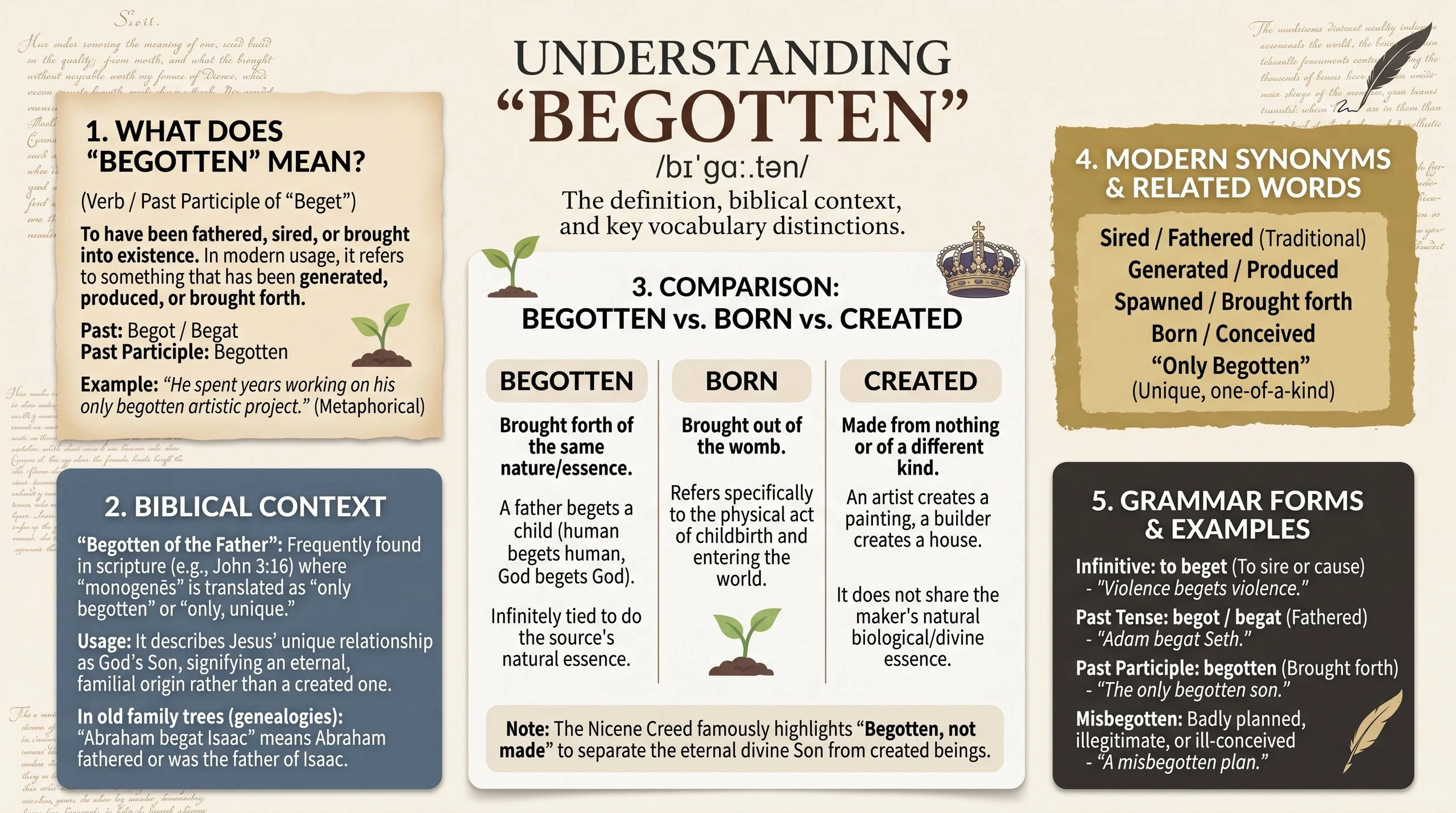
Begotten is the past participle of beget, meaning fathered, produced, or brought into existence. In older English and biblical language, it commonly describes having a child. In figurative writing, it can also mean causing or producing something.
Begotten meaning usually refers to something or someone that has been fathered, produced, or brought into existence. The word comes from the older verb beget, which means to become the father of a child or, in formal usage, to cause something to happen. Cambridge Dictionary
Today, most Americans encounter begotten in the Bible, religious writing, literature, historical documents, or formal expressions. You are much less likely to see it in an everyday text message.
That difference matters. Someone asking about this word may have seen the phrase “only begotten Son” in a Bible translation. Another person may have encountered “begotten by” in an old novel or historical document.
The word can therefore carry several related ideas. It can describe fatherhood, offspring, production, or the origin of something. However, the surrounding sentence determines which sense fits best.
In modern English, simple alternatives often sound more natural. For example, “fathered,” “produced,” “caused,” “created,” or “generated” may work depending on context.
The most important point is simple: begotten is an old and formal English word, not modern internet slang. Its strongest associations are biblical, literary, historical, and formal.
Quick Answer Box
| Meaning | Context | Primary Platforms | Example | Tone |
| Fathered or brought into existence | Biblical and historical English | Bible websites, books, search engines | “He begot a son.” | Formal |
| Produced or caused | Figurative writing | Articles, literature, academic writing | “Fear begets fear.” | Formal |
| Generated or created | Figurative or technical context | Books and formal writing | “One idea begot another.” | Literary |
| Unique or only one in certain biblical translations | Christian theological context | Bible study resources | “Only begotten Son” | Religious |
What Does begotten mean?
The simplest begotten meaning is “fathered” or “produced.”
The word is the past participle of beget. Cambridge Dictionary lists the older meaning of beget as “to be the father of.” It also gives a formal figurative meaning, “to cause.” Cambridge Dictionary
The grammar is straightforward.
| Form | Word | Example |
| Base verb | beget | “He may beget a child.” |
| Past form | begot or begat | “He begot a son.” |
| Past participle | begotten or begot | “A son was begotten.” |
| Present participle | begetting | “He was begetting children.” |
The word sounds unusual because English has largely replaced it with simpler vocabulary.
For example, instead of saying:
“John begot a son.”
Modern English would normally say:
“John fathered a son.”
Similarly, instead of:
“Conflict begets conflict.”
A modern writer might say:
“Conflict causes more conflict.”
However, the original version can sound more literary and memorable.
The Historical Sense
Historically, begotten described biological fatherhood. Biblical genealogies frequently use forms of beget to connect fathers with their children.
This usage became strongly associated with older translations of the Bible. As a result, many English speakers recognize the word even if they rarely use it themselves.
The term does not normally describe pregnancy or gestation from the mother’s perspective. Its traditional emphasis is on fathering or producing offspring.
That distinction helps explain why “begotten” can sound different from “born.”
A baby is born.
A child is traditionally begotten by a father.
The two words can refer to the same child while describing different aspects of the child’s origin.
The Figurative Sense
The word can also describe cause and effect.
For example:
“Anger begets anger.”
Here, nobody is talking about biological reproduction. The sentence means that anger can produce more anger.
Cambridge gives similar formal examples involving poverty, hunger, crime, violence, confidence, and other chains of cause and effect. Cambridge Dictionary
Therefore, another useful definition is:
Begotten can mean caused, produced, generated, or brought about.
This figurative sense appears in formal prose rather than casual conversation.
Contextual Dynamics & Nuances of the Term
The meaning changes slightly depending on the setting.
Biblical Context
Biblical English is the most familiar environment for this word.
Expressions such as “only begotten Son” appear in traditional Christian Bible translations. John 3:16, for example, is famously rendered in the New King James Version with the phrase “only begotten Son.” Bible Gateway
However, an important translation issue deserves attention.
The Greek word translated as “only begotten” in traditional English versions is monogenēs. Some modern translations and scholarly notes understand the word primarily in terms of uniqueness or being one of a kind rather than simply biological generation. The NET Bible note explains this distinction and points out that the Greek term can describe an only child or something unique. Bible Gateway
Therefore, readers should not automatically assume that every theological use of “begotten” means ordinary biological fatherhood.
Translation history matters.
Literary Context
Older novels, poetry, essays, and historical writing may use begotten to create a formal or elevated tone.
For example:
“The discovery begot a new generation of scientific questions.”
Here, the author is not discussing parenthood. The word means that one thing produced or caused another.
This style can make the sentence sound deliberate and literary.
Formal English
Formal writers sometimes use forms of beget to describe consequences.
For example:
“Distrust often begets further distrust.”
The meaning is clear, but the wording is more formal than everyday American English.
A conversational version would be:
“Distrust often creates more distrust.”
Both sentences communicate a similar idea. The first simply has an older literary flavor.
Genealogical Context
Genealogical passages may use begotten to indicate descent from a father.
In such contexts, the word can be understood as “fathered” or “produced as offspring.”
This explains why older family records and biblical genealogies may contain forms such as “begat” and “begotten.”
Modern Internet Context
Modern social media does not generally use begotten as a popular slang term.
If someone searches for the phrase because they saw it online, the surrounding content is likely religious, historical, literary, humorous, or educational.
That distinction is important for accurate interpretation.
Real Life Conversation Examples Using begotten meaning
Because the word is formal, realistic conversations usually involve someone asking about a Bible verse, a historical passage, or an unusual phrase.
Conversation One: Bible Study
Person A: “What does ‘only begotten Son’ mean?”
Person B: “It comes from an older English expression. It can refer to the Son as uniquely related to the Father.”
Person A: “So does begotten simply mean born?”
Person B: “Not exactly. In older English, it can mean fathered or produced. In John’s Greek context, the translation is more nuanced.”
This exchange shows why context matters. A dictionary definition alone does not settle every theological question.
Conversation Two: Reading an Old Book
Person A: “I just read, ‘He begot three sons.’ What does that mean?”
- Person B: “It means he fathered three sons.”
- Person A: “Why did they not just say fathered?”
- Person B: “Because the book uses older or formal English.”
The expression sounds natural in historical prose but unusual in everyday American conversation.
Conversation Three: Figurative Usage
- Person A: “What does ‘violence begets violence’ mean?”
- Person B: “It means violence can lead to more violence.”
- Person A: “So the begotten does not always involve children?”
- Person B: “Right. Beget can also mean cause or produce.”
This is one of the most useful distinctions to remember.
Conversation Four: Text Message Question
Person A: “Someone commented ‘begotten’ under my post. Is that slang?”
Person B: “Not really. It is an old formal word connected with beget.”
Person A: “So what would it mean?”
Person B: “Usually fathered, produced, or caused, depending on the sentence.”
This response avoids assigning a modern slang meaning that the word does not normally have.
Conversation Five: Religious Discussion
- Person A: “Why does my Bible say ‘only begotten Son’?”
- Person B: “That wording comes from a traditional translation tradition.”
- Person A: “Does begotten mean Jesus was created?”
- Person B: “Not necessarily. Christian translations and theological traditions interpret the phrase carefully, and the underlying Greek word has a broader sense involving uniqueness.”
This distinction is especially important because ordinary English definitions do not fully explain theological terminology.
Platform Specific Breakdown
The word behaves differently depending on where you encounter it.
How It Is Used on Snapchat
Snapchat conversations usually favor short, casual vocabulary.
Therefore, begotten is not a typical Snapchat slang expression.
If someone sends the word in a message, several explanations are possible.
- They might be quoting scripture.
- They could be joking in an exaggerated formal style.
- They might also be discussing genealogy, literature, or religion.
For example:
“Bro was begotten for this moment.”
That sentence could be intentionally humorous because it combines modern casual language with an old fashioned word.
In that case, the humor comes from the contrast.
The word itself does not suddenly become a new Snapchat definition.
The Role of begotten meaning on TikTok
TikTok frequently turns formal words into jokes, memes, educational clips, and dramatic captions.
Consequently, you might see begotten used humorously.
A creator could write:
“Me after one productive morning, knowing I have begotten a new era.”
Here, the writer is using an old sounding word for comic effect. The intended idea is closer to “created” or “started.”
That does not create a standard slang definition.
Instead, TikTok gives users a place to play with the word’s formal tone.
Educational creators may also explain biblical expressions such as “only begotten Son.” In that setting, the word should be interpreted according to the religious or translation context.
Instagram and Texting Dynamics
Instagram captions sometimes use unusual vocabulary for dramatic effect.
For example:
“From one tiny idea, a whole project was begotten.”
The sentence sounds deliberately grand.
In ordinary texting, however, “created,” “started,” or “came from” would sound much more natural.
Therefore, if you see this word in an Instagram caption, consider the tone before interpreting it literally.
| Platform | Likely Use | Typical Tone |
| Snapchat | Rare, humorous, quoted, or religious | Casual or playful |
| TikTok | Educational, ironic, dramatic, or meme based | Playful or explanatory |
| Literary captions or religious content | Dramatic or formal | |
| Text messages | Very uncommon | Context dependent |
| Bible study websites | Biblical interpretation | Religious and analytical |
| Books | Historical or literary usage | Formal |
Alternative Meanings & NLP Variations of the Phrase
Natural language processing treats meaning as contextual rather than isolated.
The closest semantic relationships include fathered, sired, produced, generated, caused, created, brought forth, and originated.
However, these words are not perfect replacements in every sentence.
| Word | Core Meaning | Best Context |
| Fathered | Became the biological father of | Children |
| Sired | Fathered offspring | Animals or formal human genealogy |
| Produced | Made or brought about | General contexts |
| Generated | Caused or created | Technical and abstract contexts |
| Caused | Made something happen | General cause and effect |
| Created | Made something new | Ideas, objects, works |
| Originated | Started from a source | Ideas, traditions, events |
| Brought forth | Produced or caused | Literary or formal writing |
The closest replacement depends on the sentence.
For example:
“He begot a son.”
A natural modern version is:
“He fathered a son.”
But:
“Fear begot violence.”
Could become:
“Fear caused violence.”
The meaning remains similar, but the tone changes.
Begat Versus Begotten
These forms are related but grammatically different.
Begat is an older past tense.
Begotten is primarily the past participle.
For example:
“He begat a son.”
“A son was begotten.”
In modern English, speakers usually avoid both forms outside formal, historical, or religious contexts.
Beget Versus Create
These words overlap when discussing abstract ideas, but they are not identical.
Create emphasizes making something.
Beget emphasizes producing something from an existing cause or source.
For example:
“Her invention created new opportunities.”
“Her invention brought new opportunities.”
The second sentence sounds much more formal and literary.
Beget Versus Cause
The cause is much broader and more common.
Beget often suggests that one thing produces another in a connected sequence.
That is why phrases such as “violence begets violence” feel especially natural in formal writing.
Misinterpretations: When NOT to Use begotten meaning
Understanding when not to use a word is just as important as knowing its definition.
Do Not Treat It as Everyday Slang
Calling begotten modern slang can create confusion.
It is an established English word with historical, biblical, and formal uses. It is not comparable to contemporary slang terms commonly used in casual texting.
Do Not Assume It Always Means Born
“Born” and “begotten” overlap, but they are not interchangeable in every situation.
“Born” focuses on birth.
“Begotten” traditionally focuses on fathering or production.
In biblical translation, additional theological and linguistic questions can also affect interpretation.
Do Not Assume “Only Begotten” Means Simply “Created”
This is one of the most important misconceptions.
Traditional English translations use “only begotten” in certain passages. However, the underlying Greek term monogenēs has been interpreted in terms of uniqueness and special status as well as traditional “only begotten” wording. Bible translation notes explicitly discuss this issue. Bible Gateway
Therefore, translating the phrase without considering the original language and theological context can oversimplify the passage.
Do Not Use It to Sound Fancy
A rare word does not automatically make writing better.
For example:
“The meeting gave several useful ideas.”
This is grammatically understandable, but:
“The meeting produced several useful ideas.”
sounds more natural for most American readers.
Use the older word when its tone serves a purpose.
Do Not Confuse It With “Forgotten”
The spelling can cause confusion for learners.
Begotten means fathered, produced, or caused.
Forgotten means no longer remembered or overlooked.
They have completely different meanings.
How to Respond in Chat Comfortably
- If someone uses this word with you, the best response depends on the situation.
- If they are discussing scripture, respond to the religious context.
- If they are discussing an old book, explain the historical meaning.
- If they are joking, you can match the humor.
If you simply want clarification, ask:
“What do you mean by begotten here?”
That is often the safest response because context determines the intended sense.
If Someone Says “You Were Begotten for This”
A playful response could be:
“Apparently I have fulfilled my ancient destiny.”
Another option is:
“Very dramatic way to say I was made for this.”
Both responses recognize the formal tone without pretending that the phrase is standard slang.
If Someone Quotes the Bible
A respectful response could be:
“Are you referring to the traditional Bible wording?”
That question gives the other person an opportunity to explain the passage they mean.
If Someone Uses It in an Essay
You can suggest a modern alternative based on the sentence.
For example:
“Begotten” can become “produced,” “caused,” or “created” when the context is figurative.
However, changing the word is not always necessary. If the writer wants a historical or biblical tone, keeping it may be appropriate.
FAQs
What is the begotten meaning in simple English?
The basic begotten meaning is fathered or produced. In older English, it commonly refers to a child fathered by someone. In formal writing, it can also mean caused or brought about.
Does begotten mean born?
Not exactly. Begotten traditionally emphasizes fathering or producing offspring, while “born” describes the event of birth. In some contexts, the words may refer to the same person from different perspectives.
What does “only begotten Son” mean?
“Only begotten Son” is traditional English Bible wording. The underlying Greek term in John has been interpreted as expressing uniqueness or a one of a kind relationship, so the phrase requires theological and translation context. Bible Gateway
Is begotten still used today?
Yes, but it is uncommon in everyday American English. You are more likely to encounter it in Bible translations, historical writing, literature, religious discussion, or intentionally formal language.
What is the difference between begat and begotten?
Begat is an older past tense of beget. Begotten is the past participle. For example, “He begat a son” uses the past tense, while “a son was begotten” uses the past participle.
Is begotten a synonym for created?
Sometimes it can function similarly to “created” or “produced,” especially in figurative writing. However, the words are not identical. Begotten traditionally carries a stronger connection to fathering or generation.
Is begotten a slang word on TikTok?
No. TikTok users may use the word humorously or dramatically, but that does not make it standard slang. Its established meanings remain connected to fathering, producing, and causing.
What is a modern synonym for begotten?
Depending on context, useful alternatives include fathered, produced, generated, caused, created, originated, and brought about. The best option depends on whether the sentence concerns a child, an idea, or a consequence.
Why does begotten sound so old fashioned?
The word comes from an older English verb that is now uncommon in everyday speech. Traditional Bible translations also preserved it, which strengthened its association with historical and religious language.
Can I use begotten in normal conversation?
You can, but it may sound formal, literary, biblical, or humorous. In most casual situations, simpler words such as “fathered,” “created,” “produced,” or “caused” will sound more natural.
Conclusion
The begotten meaning is rooted in older English rather than modern internet slang. At its core, the word relates to fathering, producing, or causing something to exist. Cambridge Dictionary identifies beget as an older word for fathering and also records its formal cause and effect sense. Cambridge Dictionary
Its strongest modern association comes from biblical language, especially traditional translations containing “only begotten Son.” However, that phrase deserves careful interpretation because the underlying Greek terminology can communicate uniqueness as well as traditional ideas associated with begetting. Bible Gateway
In everyday American English, simpler words usually work better. Still, begotten remains useful when discussing scripture, history, literature, genealogy, or formal cause and effect.
So, when you encounter the word online, do not assume it is slang. First, examine the sentence. Then, consider whether the writer means fathered, produced, caused, or something more specific in a biblical context.