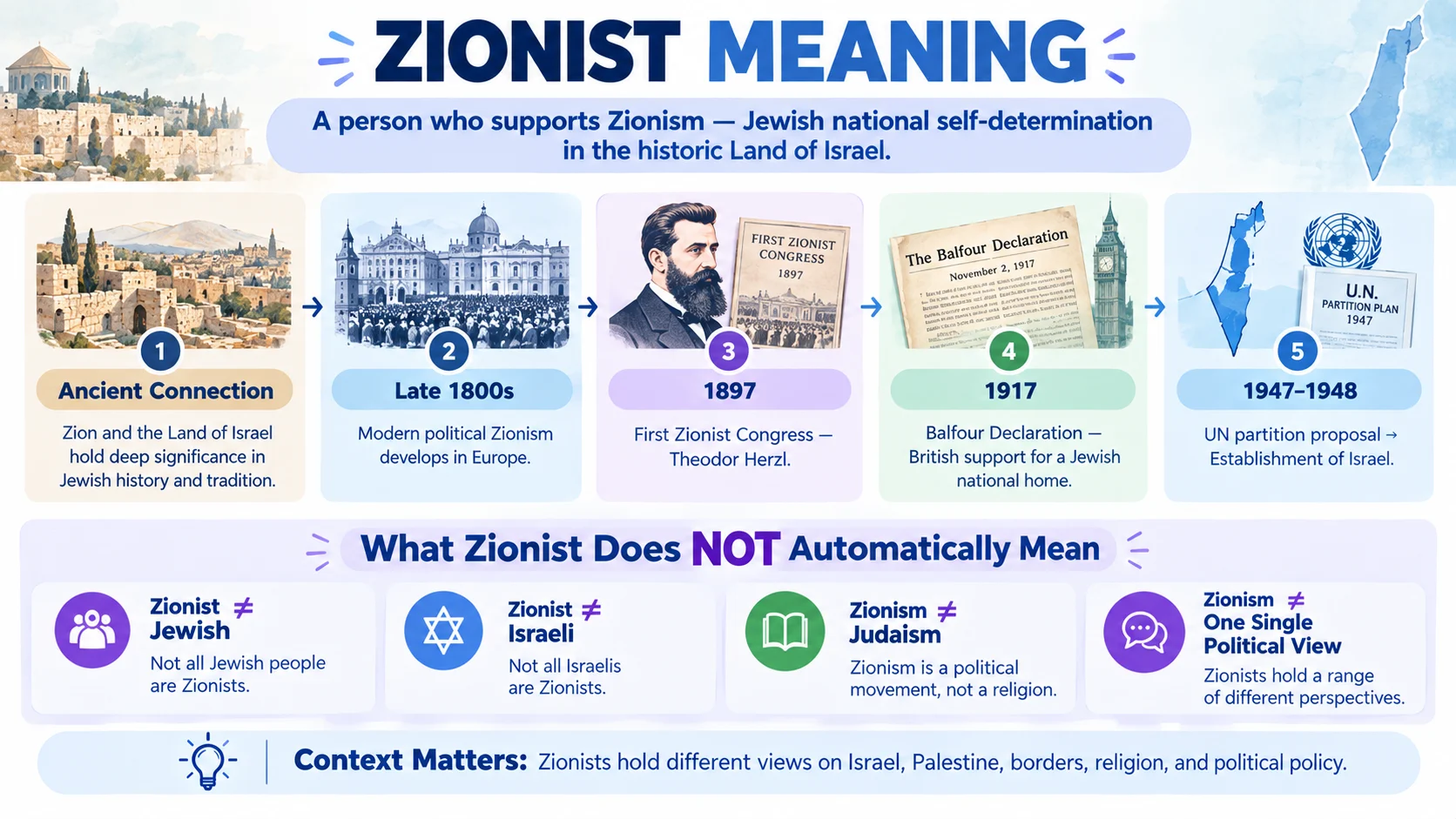
The Zionist meaning can be difficult to understand because the word appears in discussions about history, religion, politics, Israel, Palestine, and Jewish identity. In its basic historical sense, a Zionist is someone who supports Zionism, a modern Jewish nationalist movement that sought to establish a Jewish national home or state in the historic Land of Israel.
Modern Zionism developed in Europe during the late 19th century. It grew partly in response to antisemitism and the belief among many Jewish nationalists that Jews needed political self-determination and a secure homeland. Theodor Herzl became one of the movement’s best-known early political leaders and convened the First Zionist Congress in 1897.
The word has since developed a much wider political meaning. The establishment of Israel in 1948 became a central event in Zionist history. At the same time, the history of Zionism is closely connected to the Palestinian experience and the continuing Israeli-Palestinian conflict.
Therefore, understanding what does Zionist mean requires more than a one-line definition. The term has historical, political, religious, and personal dimensions.
What Does Zionist Mean?
A Zionist is generally a person who supports Zionism.
Zionism is a modern Jewish nationalist movement centered historically on the idea of Jewish self-determination and a Jewish national home in the historic Land of Israel.
Modern political Zionism emerged in Europe in the late 19th century. The movement developed partly in response to antisemitism and long-standing Jewish historical and religious connections to the Land of Israel.
Today, however, Zionist does not have one single political definition.
Different people who describe themselves as Zionists can have very different views about:
- Israel’s borders
- Palestinian statehood
- Jewish settlements
- Israeli government policies
- The Israeli-Palestinian conflict
- Religion and the Jewish state
- A two-state solution
- Palestinian rights
- The future political structure of the region
So, the word should be understood in context.
What Is Zionism?
Zionism is a modern Jewish nationalist movement.
Its name comes from Zion, a biblical name associated with Jerusalem and the Land of Israel. The movement developed into an organized political project in Europe during the late 19th century.
At its core, political Zionism argued that Jews should have a homeland in their historic homeland and should have the ability to govern themselves there.
For many early Zionists, this idea was connected to Jewish safety and self-determination.
The movement also developed during a period when nationalism was becoming a powerful political force across Europe.
At the same time, Jewish communities faced different forms of antisemitism. These conditions encouraged some Jewish thinkers to argue that assimilation alone could not guarantee Jewish security.
What Does Zionist Mean in Simple Terms?
In simple terms:
A Zionist is someone who supports the idea of Jewish national self-determination in the historic Land of Israel.
However, that simple definition needs context.
A Zionist might support the existence of Israel while disagreeing strongly with a particular Israeli government.
Another Zionist might support a two-state solution.
Someone else might support a different political arrangement.
Therefore, calling someone a Zionist does not automatically tell you every position that person holds.
Where Did the Word Zionist Come From?
The word Zionist comes from Zionism, which takes its name from Zion.
Zion is a biblical term associated with Jerusalem and the Land of Israel. The concept has deep religious and historical significance within Judaism.
However, modern political Zionism is not simply the same thing as ancient Jewish religious attachment to the land.
Jewish communities maintained connections to Jerusalem and the Land of Israel for centuries. Modern Zionism transformed that connection into a modern political and nationalist movement.
The U.S. Holocaust Memorial Museum describes modern Zionism as both old and new: it drew on ancient Jewish historical and religious connections while also developing as a modern political movement influenced by 19th-century European nationalism.
Theodor Herzl and Modern Zionism
One of the most important figures in modern Zionist history was Theodor Herzl.
Herzl was a Jewish journalist and political thinker from the Austro-Hungarian Empire. His experiences with antisemitism influenced his belief that Jews needed political self-determination.
In 1896, Herzl published Der Judenstaat, commonly translated as The Jewish State.
A year later, he organized the First Zionist Congress in Basel, Switzerland.
The congress became an important milestone in the development of organized political Zionism.
Participants sought international recognition for a Jewish homeland in the Land of Israel.
Herzl did not invent Jewish attachment to the Land of Israel. Rather, he became one of the leading figures who turned modern Zionism into an organized political movement.
Why Did Zionism Develop?
Several factors contributed to the growth of Zionism.
Antisemitism
Antisemitism had existed in Europe for centuries.
During the 19th century, new forms of political, racial, and nationalist antisemitism also developed. Some Jewish thinkers concluded that Jews needed political self-determination to achieve long-term security.
European Nationalism
The 19th century saw the growth of nationalist movements across Europe.
Many groups increasingly argued that people sharing national, cultural, linguistic, or historical identities should have political self-determination.
Jewish thinkers responded to this environment in different ways.
Some supported assimilation.
Others supported socialism or other political movements.
Zionists argued for Jewish national self-determination.
Jewish Historical Connection
The Land of Israel has a central place in Jewish history and religious tradition.
Jewish communities also maintained connections with the region over many centuries.
Modern Zionists therefore connected an ancient historical relationship with a modern political goal.
Persecution
Repeated persecution strengthened support for Zionism among some Jews.
The Holocaust later had an enormous effect on Jewish attitudes toward political security and statehood. Nazi Germany and its collaborators murdered six million European Jews between 1933 and 1945.
Zionism Before the Holocaust
It is important to understand that Zionism began before the Holocaust.
Modern political Zionism developed in the late 19th century.
The First Zionist Congress took place in 1897.
The Holocaust occurred decades later, from 1933 to 1945.
Therefore, the Holocaust did not create Zionism.
However, the Holocaust profoundly strengthened support for Jewish statehood among many survivors and other Jews. After World War II, many Jewish survivors viewed a Jewish homeland as a place where Jews could live with greater security and independence.
Zionism and the Balfour Declaration
Another major event was the Balfour Declaration of 1917.
The British government expressed support for establishing a national home for the Jewish people in Palestine, while also stating that the civil and religious rights of existing non-Jewish communities should not be prejudiced.
The declaration became an important part of the political history surrounding Zionism.
It was later incorporated into the framework of the British Mandate for Palestine.
However, the declaration did not settle the competing national aspirations of Jews and Palestinian Arabs.
Those tensions continued to grow during the Mandate period.
Zionism and the British Mandate
After World War I, the Ottoman Empire collapsed.
Britain received the League of Nations Mandate to administer Palestine.
During this period, Jewish immigration increased, while Arab opposition to Zionism also grew.
British authorities faced competing demands from Jewish and Arab communities.
The political situation became increasingly difficult.
By the 1930s and 1940s, violence and political conflict had intensified.
British restrictions on Jewish immigration also became a major source of disagreement within the Zionist movement, especially as Jews attempted to escape Nazi persecution.
Zionism and the Holocaust
The Holocaust is essential to understanding the later history of Zionism.
Between 1933 and 1945, Nazi Germany and its collaborators systematically persecuted and murdered six million Jews.
Many Jews who survived the Holocaust wanted to leave Europe.
For numerous survivors, British-controlled Palestine became a preferred destination.
The United States Holocaust Memorial Museum notes that from 1945 to 1948, increasing numbers of Jewish displaced persons chose Palestine as their desired destination.
The Holocaust therefore became a major factor in international discussions about Jewish statehood after World War II.
Zionism and the Creation of Israel
In 1947, the United Nations General Assembly adopted Resolution 181, which recommended partitioning Mandatory Palestine into an Arab state and a Jewish state, with Jerusalem under a special international regime.
Jewish leadership accepted the partition recommendation, although it had objections to parts of the proposal.
Palestinian Arab leadership and Arab states rejected the plan.
Violence followed.
On May 14, 1948, David Ben-Gurion announced the establishment of the State of Israel.
The declaration was followed by war.
The events of 1947–1949 also produced a major Palestinian refugee crisis and remain central to competing historical narratives about the region.
Is Zionism the Same as Supporting Israel?
Not necessarily.
The terms overlap, but they are not identical.
Someone can identify as a Zionist while strongly criticizing the Israeli government.
Likewise, someone can support Israel’s existence but disagree with specific Zionist policies or interpretations.
For example, a person might support Israel’s existence as a Jewish state while opposing settlement expansion.
Another person might support a different political arrangement while still identifying with some form of Jewish national self-determination.
Therefore, Zionism and support for every action of an Israeli government are not the same thing.
Is Zionism a Religion?
No.
Zionism is not a religion.
Judaism is a religion as well as a broader cultural and historical identity.
Zionism is a political and nationalist movement with religious and secular forms.
Some Zionists are religious.
Others are secular.
Some religious Jews have supported Zionism, while other religious Jewish groups have historically opposed political Zionism.
This diversity is important because Jewish identity and Zionist political belief are not identical concepts.
Are All Jews Zionists?
No.
Jews have diverse political and religious beliefs.
Many Jews identify as Zionists, while others do not.
Some Jewish groups have historically opposed Zionism for religious, political, or ideological reasons.
The same is true in reverse: Zionism is not limited to Jewish people.
Some non-Jews also identify as Zionists or support aspects of Zionism.
Therefore, it is inaccurate to assume that every Jewish person is a Zionist or that every Zionist is Jewish.
Is Zionism the Same as Judaism?
No.
Judaism is a religion and a broad Jewish tradition.
Zionism is a modern political and nationalist movement.
The two can overlap, but they are not synonyms.
For example:
- A Jewish person can be Zionist.
- A Jewish person can be non-Zionist.
- A non-Jewish person can support Zionism.
- A person can practice Judaism without supporting a particular political position about Israel.
The diversity of Jewish communities is well documented. Jewish people differ in religious practice, politics, geography, language, and approaches to Israel.
Different Forms of Zionism
Zionism is not one completely uniform ideology.
Different movements and thinkers have developed different approaches.
Political Zionism
Political Zionism focuses on Jewish political self-determination and statehood.
Theodor Herzl is closely associated with this form of Zionism.
Labor Zionism
Labor Zionism combined Jewish nationalism with socialist or labor-oriented ideas.
It played an important role in the development of the early Jewish community in Palestine and later Israel.
Revisionist Zionism
Revisionist Zionism developed around figures such as Ze’ev Jabotinsky.
It generally emphasized Jewish national rights and a stronger approach to political and territorial questions.
Religious Zionism
Religious Zionism combines Jewish religious beliefs with support for Jewish national self-determination in the Land of Israel.
Different religious Zionists hold very different views on politics and territory.
Cultural Zionism
Cultural Zionism emphasized Jewish cultural and spiritual renewal.
Rather than focusing only on political sovereignty, it stressed Jewish language, culture, education, and national identity.
These categories overlap, and modern Zionists may not fit neatly into one group.
Zionism and Palestinian Identity
The history of Zionism cannot be fully understood without discussing Palestinian Arabs.
Jewish national aspirations developed alongside an existing Arab population in Palestine.
As Jewish immigration and land purchases increased, many Palestinian Arabs became increasingly concerned about their political future.
The conflict therefore involved competing national movements and claims to the same land.
The United Nations’ 1947 partition proposal attempted to create both an Arab state and a Jewish state. However, the proposal was rejected by Palestinian Arab leadership and Arab states, while Jewish leadership accepted it.
The resulting conflict and the events of 1948 remain central to the modern Israeli-Palestinian dispute.
Why Is Zionism Controversial?
Zionism is controversial because it is connected to competing ideas about national self-determination, territory, security, displacement, statehood, and political rights.
Supporters often view Zionism as a movement for Jewish self-determination and security.
Critics may argue that some forms or implementations of Zionism have involved Palestinian displacement, unequal political arrangements, settlement expansion, or other policies they oppose.
These positions are not identical to one another.
Furthermore, people who criticize Zionism can have very different arguments.
Some criticize particular Israeli policies.
Others reject Jewish nationalism as a political principle.
Still others support both Jewish and Palestinian national self-determination but disagree about how it should be implemented.
Consequently, the word Zionist should not automatically be treated as a complete description of someone’s political views.
Zionism and Antisemitism Are Not the Same Word
Zionism and antisemitism are different concepts.
Antisemitism means prejudice, hatred, or discrimination against Jews.
Zionism refers to a political and nationalist movement concerning Jewish self-determination.
A person can oppose Zionism without being antisemitic.
At the same time, criticism of Zionism can become antisemitic if it uses anti-Jewish stereotypes, targets Jews as Jews, or promotes hatred against Jewish people.
Context and the specific language used matter.
The distinction is important because political criticism and prejudice are not automatically the same thing.
Is Criticism of Israel Anti-Zionist?
Not necessarily.
A person can criticize:
- Israeli government policies
- Military actions
- Settlement policies
- Treatment of Palestinians
- Specific laws
- Political leaders
while still supporting Israel’s existence.
Likewise, someone may oppose Zionism as an ideology while not expressing hostility toward Jewish people.
Therefore, criticism of Israel, criticism of Zionism, and antisemitism should not automatically be treated as identical.
The exact statement and context matter.
Zionist Meaning in News and Politics
In news reports, Zionist can function as a descriptive political term.
For example:
“The Zionist movement grew rapidly during the late 19th century.”
Here, the term describes a historical political movement.
A modern political article might say:
“The group describes itself as Zionist.”
In that case, the writer is describing the group’s political identity.
However, the word can also be used as a political accusation or insult in some online discussions.
Therefore, readers should examine the speaker’s meaning instead of assuming that every use has the same tone.
Zionist Meaning on Social Media
On TikTok, X, Instagram, Reddit, and other platforms, Zionist can appear in heated political debates.
People may use it to describe:
- Support for Israel
- Support for Jewish self-determination
- A political organization
- An Israeli policy
- A historical movement
- A specific political ideology
However, social-media usage can be much less precise than academic or historical usage.
Some users may use “Zionist” as a broad political label.
Others may use it as an accusation.
Still others may use the term in its historical sense.
Because of this variation, always examine the surrounding conversation.
Zionist vs. Zionism
These words are related but have different grammatical roles.
Zionism is the ideology or movement.
Zionist describes a person, group, idea, or position associated with Zionism.
For example:
“Zionism is a political movement.”
“She identifies as a Zionist.”
“The organization has a Zionist political position.”
A simple way to remember the difference is:
Zionism = the movement
Zionist = a person or thing associated with the movement
Zionist vs. Jewish
These words are not synonyms.
Jewish relates to Jews, Judaism, or Jewish culture and identity.
Zionist relates to support for Zionism.
A person can be Jewish without being Zionist.
Likewise, a Zionist can be non-Jewish.
Therefore, replacing one word with the other can create confusion.
Zionist vs. Israeli
These terms also describe different things.
Israeli generally means a citizen or resident associated with the State of Israel.
Zionist refers to support for Zionism.
Not every Israeli necessarily identifies as a Zionist.
Similarly, not every Zionist lives in Israel.
The terms therefore should not be treated as interchangeable.
Common Misconceptions About Zionism
“All Jews Are Zionists”
This is incorrect.
Jewish communities contain a wide range of political and religious positions.
“All Zionists Are Jewish”
This is also incorrect.
Some non-Jews support Zionism.
“Zionism Is a Religion”
No.
Zionism is a political and nationalist movement.
“Zionism Began After the Holocaust”
Modern political Zionism predates the Holocaust by decades.
The First Zionist Congress was held in 1897.
However, the Holocaust greatly strengthened support for Jewish statehood among many survivors and other Jews.
“Zionism Has Only One Political Position”
It does not.
Zionists have held different positions about religion, territory, Palestinian statehood, settlements, borders, and Israeli politics.
“Zionist Means Israeli”
Not necessarily.
Zionists can live anywhere in the world.
“Zionist Means Jewish”
Not necessarily.
The terms refer to different concepts.
Examples of Zionist in a Sentence
Here are some neutral examples.
Historical example:
“Theodor Herzl became one of the most influential early Zionist leaders.”
Political example:
“The organization describes itself as Zionist.”
Historical movement example:
“Zionist groups promoted Jewish immigration to Palestine during the early 20th century.”
Religious context:
“Religious Zionism combines Jewish religious ideas with support for Jewish national self-determination.”
Academic context:
“The historian examined the development of Zionist nationalism in Europe.”
How to Explain Zionist in Simple English
If someone asks, “What is a Zionist?”, a simple answer is:
A Zionist is generally someone who supports Zionism, the movement for Jewish national self-determination in the historic Land of Israel.
If you want to add modern context, say:
Today, Zionists can have very different views about Israel, Palestine, borders, and political policy.
That second sentence is important because the term covers a broad range of political positions.
Quick Reference Table
| Term | Meaning |
|---|---|
| Zionism | A modern Jewish nationalist movement centered on Jewish national self-determination |
| Zionist | A person or position that supports or relates to Zionism |
| Jewish | Relating to Jews, Judaism, or Jewish culture and identity |
| Israeli | Relating to Israel or its citizens |
| Antisemitism | Prejudice, hatred, or discrimination against Jews |
| Palestinian | Relating to the Palestinian people and their identity |
| Jewish state | A state understood as having a Jewish national character; commonly referring to Israel |
Frequently Asked Questions
What does Zionist mean?
A Zionist is generally someone who supports Zionism, a movement for Jewish national self-determination and a Jewish national home or state in the historic Land of Israel.
What does Zionism mean?
Zionism refers to a modern Jewish nationalist movement that developed in the late 19th century. It sought Jewish national self-determination in the historic Land of Israel.
Is Zionism the same as Judaism?
No. Judaism is a religion and broader Jewish tradition, while Zionism is a modern political and nationalist movement.
Are all Jews Zionists?
No. Jewish people have diverse political and religious beliefs, and not every Jew identifies as a Zionist.
Are all Zionists Jewish?
No. Some non-Jewish people also support Zionism.
Is Zionism the same as supporting Israel?
Not necessarily. Zionists can disagree strongly about Israeli politics and government policies.
When did modern Zionism begin?
Modern political Zionism developed in Europe during the late 19th century. The First Zionist Congress, organized by Theodor Herzl, took place in 1897.
Did Zionism begin because of the Holocaust?
No. Zionism developed decades before the Holocaust. However, the Holocaust greatly affected support for Jewish statehood after World War II.
What was the Balfour Declaration?
The Balfour Declaration of 1917 expressed British support for establishing a national home for the Jewish people in Palestine while stating that the civil and religious rights of existing non-Jewish communities should not be prejudiced.
What happened in 1947?
The United Nations General Assembly adopted Resolution 181, recommending partition of Mandatory Palestine into an Arab state and a Jewish state, with Jerusalem under a special international regime.
What happened in 1948?
On May 14, 1948, David Ben-Gurion declared the establishment of the State of Israel. War followed, and the events of 1947–1949 produced a major Palestinian refugee crisis.
Is being anti-Zionist the same as being antisemitic?
No. Opposition to Zionism and antisemitism are distinct concepts. However, political language about Zionism can become antisemitic when it targets Jews as Jews, relies on anti-Jewish stereotypes, or promotes hatred toward Jewish people.
What is the difference between Zionist and Israeli?
A Zionist supports or relates to Zionism. An Israeli is generally a citizen or resident of Israel. The two terms describe different things.
What is the difference between Zionist and Jewish?
Jewish relates to Jewish identity, Judaism, or Jewish culture. Zionist relates to support for Zionism. They overlap for some people but are not synonyms.
Conclusion
The Zionist meaning is best understood through history and context. A Zionist is generally someone who supports Zionism, a modern Jewish nationalist movement centered on Jewish national self-determination in the historic Land of Israel.
Modern political Zionism developed in Europe during the late 19th century. The movement grew partly in response to antisemitism and drew on much older Jewish historical and religious connections to the Land of Israel. Theodor Herzl and the First Zionist Congress played major roles in organizing the movement.
The Holocaust later transformed the political environment surrounding Jewish statehood. In 1947, the United Nations recommended partitioning Mandatory Palestine into Arab and Jewish states. Israel was established in 1948, followed by war and a major Palestinian refugee crisis.
Today, Zionist remains a broad and contested political term. Different Zionists hold different views about Israel, Palestine, borders, security, settlements, religion, and Palestinian statehood.
Most importantly, Zionist, Jewish, Israeli, and antisemitic are not interchangeable terms. Understanding those distinctions makes discussions about the subject more accurate, respectful, and historically informed.

Charlotte Wilson is a language writer passionate about word meanings, synonyms, and clear communication. She creates accurate and engaging content to help readers expand their vocabulary and language skills.







2 thoughts on “Zionist Meaning| What Does Zionist Mean? History, Beliefs & the Origins of Zionism Explained 2026”