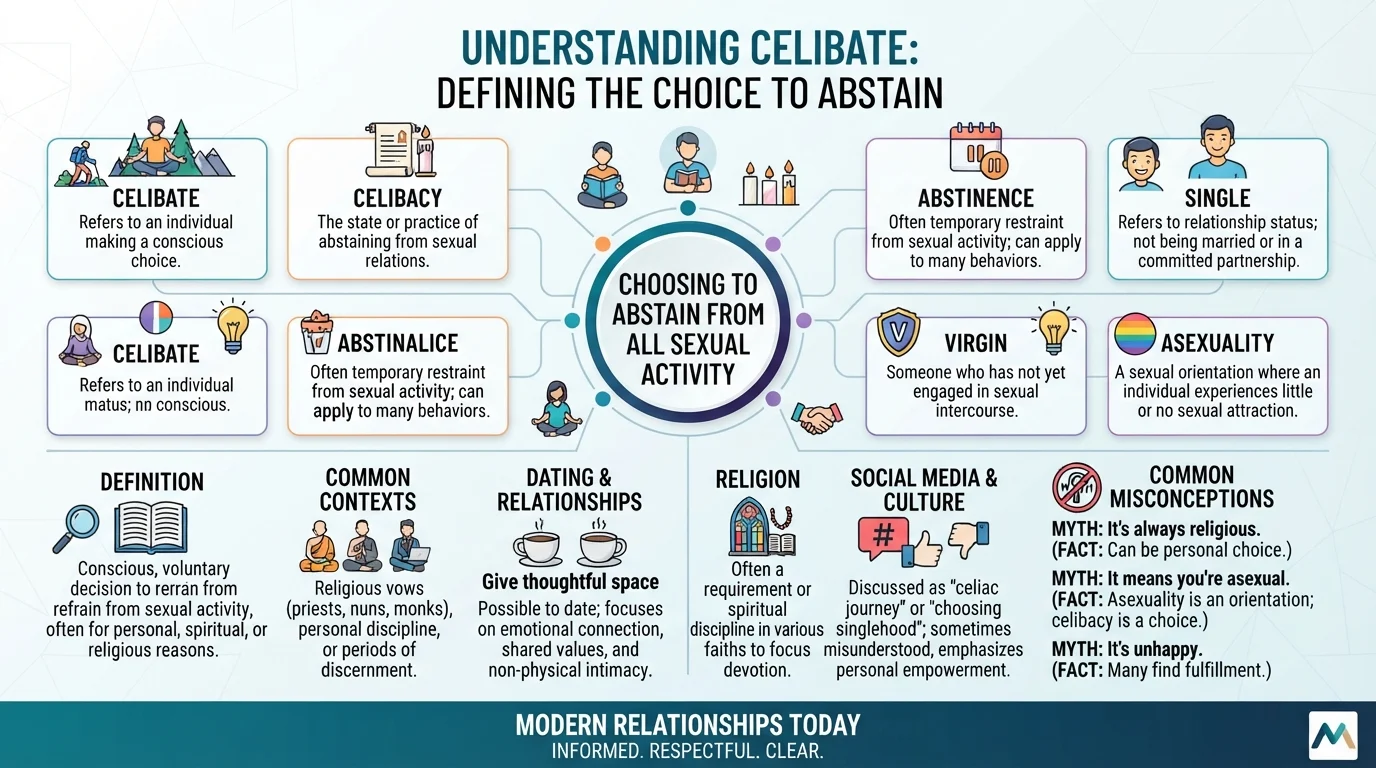
Celibate means choosing to abstain from sexual activity. The term can describe a temporary or long term choice. It may relate to personal values, relationships, religion, lifestyle, or individual goals, and does not automatically mean someone is single.
what does celibate mean is a common question because people often encounter the word in dating profiles, conversations, religious discussions, social media posts, or relationship advice. However, the word has a more specific meaning than many casual online uses suggest.
At its core, celibate describes a person who abstains from sexual activity. The exact boundaries can vary by person, culture, religion, or community. Therefore, you should not assume that every celibate person follows the same rules.
The term also differs from words such as single, abstinent, virgin, and asexual. These words can overlap in some situations, but they describe different ideas.
Furthermore, celibacy does not automatically reveal someone’s relationship status. A person can be unmarried and sexually active. Likewise, someone can be married and choose celibacy for a period of time.
This guide explains the meaning, origins, modern usage, social media context, conversational nuances, and common misunderstandings surrounding the term.
Quick Answer Box
| Category | Answer |
| Meaning | Choosing to abstain from sexual activity |
| Context | Personal, romantic, cultural, religious, or lifestyle discussions |
| Primary Platforms | TikTok, Instagram, Snapchat, Reddit, dating apps, texting |
| Example | “I am celibate right now because I want to focus on myself.” |
| Tone | Usually neutral, personal, or serious |
What Does what does celibate mean? Full Definition and Origin
The simplest definition is abstaining from sexual activity. Yet, context matters because people use the word differently.
The adjective celibate comes from the noun celibacy. Both words have long histories in English. The concept also has deep connections with religious traditions.
Historically, celibacy often referred to people who intentionally avoided marriage or sexual relationships. Religious institutions sometimes connected celibacy with spiritual devotion. For example, certain religious roles traditionally involved vows or expectations of sexual abstinence.
Modern usage is broader.
Today, someone may describe themselves as celibate because they want to avoid sex while dating. Another person may choose celibacy after a breakup. Someone else may adopt it as part of a religious commitment.
Consequently, the reason behind celibacy can differ greatly from one individual to another.
Celibate vs. Celibacy
These words share the same basic concept, but their grammatical roles differ.
| Word | Part of Speech | Meaning | Example |
| Celibate | Adjective | Describes someone abstaining from sexual activity | “She is celibate.” |
| Celibacy | Noun | The practice or state of abstaining | “He chose celibacy.” |
Therefore, you can say someone is celibate, while you can describe their choice as celibacy.
What Does Celibate Mean in Everyday English?
In everyday conversation, the word usually communicates intentional sexual abstinence.
For example:
“I’m celibate right now.”
This statement generally means the speaker has decided not to engage in sexual activity.
However, it does not explain why.
The person might have personal goals. They might have religious reasons. They might want to reset their dating life. They might simply prefer not to have sex.
Therefore, asking respectfully about the reason can be appropriate in a close conversation, but assuming the reason is not.
Does Celibate Mean Single?
No.
This distinction causes frequent confusion.
Single describes relationship status. Celibate describes sexual behavior or a deliberate commitment to abstain.
A person can be:
| Relationship Status | Sexual Choice | Possible Description |
| Single | Abstaining | Single and celibate |
| Single | Sexually active | Single but not celibate |
| Dating | Abstaining | Dating while celibate |
| Married | Abstaining | Married and temporarily celibate |
| Married | Sexually active | Married and not celibate |
As a result, the two concepts should not be treated as synonyms.
Contextual Dynamics and Nuances of the Term
The meaning becomes clearer when you examine the situation around the word.
Personal Celibacy
Some people choose celibacy for personal reasons.
They may want to focus on education, career, family, emotional recovery, or personal development. Others may simply feel more comfortable avoiding sexual relationships.
In this context, celibacy does not necessarily involve religion.
For example:
“After my last relationship, I decided to stay celibate for a while.”
The statement communicates a personal boundary. It does not necessarily indicate a permanent decision.
Religious Celibacy
Religious contexts give the term another layer.
Certain religious traditions connect sexual abstinence with spiritual commitments. In these settings, celibacy may involve formal vows, community expectations, or a long term lifestyle.
However, religious celibacy varies significantly across traditions and individuals. Therefore, avoid treating one religious definition as universal.
Temporary Celibacy
Celibacy can also describe a temporary choice.
Someone might say:
“I’m taking a year off from dating and sex.”
They may later return to dating or sexual relationships.
Therefore, celibacy does not always mean a lifelong commitment.
Celibacy and Dating
Dating while celibate can seem confusing to people who associate dating with sexual activity.
However, dating and sexual activity are separate concepts.
A celibate person may still want companionship, romance, emotional intimacy, or marriage. They simply maintain a boundary around sexual activity.
Consequently, someone can actively date while remaining celibate.
Celibacy and Sexual Orientation
Celibacy does not define sexual orientation.
A gay, straight, bisexual, or otherwise oriented person can choose celibacy. Similarly, someone who identifies as asexual may or may not describe themselves as celibate.
These concepts answer different questions.
| Concept | Main Question |
| Sexual orientation | Who can someone experience attraction toward? |
| Celibacy | Is someone choosing sexual abstinence? |
| Relationship status | Is someone currently partnered? |
| Virginity | Has someone had certain sexual experiences? |
| Abstinence | Is someone refraining from a particular activity? |
This distinction matters because labels can describe very different aspects of a person’s life.
Real Life Conversation Examples Using what does celibate mean
The best way to understand the term is to see how people use it naturally.
Scenario 1: Dating Conversation
Maya: “Are you dating anyone right now?”
Jordan: “Not seriously. I’m celibate for the moment.”
Maya: “Got it. Is that a personal choice?”
Jordan: “Yeah. I want to focus on myself for a while.”
Here, the word describes Jordan’s current sexual boundary. It does not necessarily mean Jordan has stopped meeting people.
Scenario 2: Text Message
Alex: “Why did you put ‘celibate’ in your dating profile?”
Sam: “Because I still want a relationship, but I don’t want sex right now.”
Alex: “That makes sense. Thanks for explaining.”
This conversation shows why context matters. A dating profile may use the term to communicate a boundary clearly.
Scenario 3: Social Media Comment
User 1: “You said you’re taking a break from dating. Does that mean you’re celibate?”
User 2: “Pretty much. I’m choosing not to have sex right now.”
The phrase may appear casually online. However, the speaker still controls what the label means for them.
Scenario 4: Religious Discussion
Person A: “Why did you choose celibacy?”
Person B: “It’s part of my spiritual commitment.”
Person A: “I understand.”
Here, the word has a religious dimension. The speaker’s motivation comes from faith or spiritual practice.
Scenario 5: Friend Asking for Clarification
Friend 1: “You said you’re celibate. Does that mean you don’t date?”
Friend 2: “No. I still date. I just don’t have sex.”
Friend 1: “Okay, now I understand.”
This example highlights one of the biggest misconceptions. Celibacy does not automatically mean avoiding romance or relationships.
Platform Specific Breakdown
Online communities can change how people encounter the word. However, the core definition remains stable.
How It Is Used on Snapchat
Snapchat conversations tend to be informal and highly personal. Users may mention celibacy while discussing dating, relationships, boundaries, or personal challenges.
For example:
“I’m staying celibate this year.”
A friend might respond:
“Respect. Is that for personal reasons?”
The platform itself does not create a special Snapchat definition.
Instead, users bring ordinary language into a casual messaging environment.
Because Snapchat messages can feel private, people may use the term more directly than they would in a public post.
Still, context remains important.
If someone says, “I’m celibate,” do not automatically assume they are avoiding dating. Ask for clarification when it genuinely matters.
The Role of what does celibate mean on TikTok
TikTok has helped popularize conversations about dating boundaries, self improvement, relationships, and lifestyle choices.
Creators may discuss “celibacy journeys,” dating breaks, personal boundaries, or changes in sexual behavior. However, social media creators sometimes use terminology loosely.
Therefore, viewers should distinguish between a creator’s personal definition and the standard meaning of the word.
A TikTok caption such as:
“30 days into my celibacy journey”
usually describes a personal period of sexual abstinence.
Another creator might use “celibate” while discussing spirituality.
A third might use the term as part of a broader dating reset.
Consequently, the surrounding video matters more than the platform.
Instagram and Texting Dynamics
Instagram often combines educational content with personal storytelling. People may use celibacy in captions, comments, reels, or private messages.
For example:
“Choosing celibacy helped me rethink what I want from relationships.”
That statement describes a personal experience.
Texting can be even more direct:
“I’m celibate right now, so I’m taking things slowly.”
The message establishes a boundary without requiring a long explanation.
Reddit and Online Discussion
Reddit discussions can introduce more detailed debates about definitions, relationships, religion, and personal experiences.
However, community terminology varies. Some users may distinguish between sexual abstinence and broader relationship abstinence. Others may use the words interchangeably.
Therefore, do not assume every online community uses the term identically.
Dating Apps and Profiles
Dating profiles sometimes mention celibacy to communicate expectations.
For example:
“Looking for a serious relationship. Currently celibate.”
This tells potential matches something important about the person’s boundaries.
However, it does not automatically explain whether the person wants a long term celibate lifestyle.
A respectful follow up can clarify the person’s expectations.
Alternative Meanings and NLP Variations of the Phrase
Search engines and AI systems may encounter many variations around the same concept.
Common semantic variations include:
| Phrase | General Meaning |
| What does celibacy mean? | Asking for the noun’s definition |
| What does being celibate mean? | Asking about the personal state |
| What is celibacy? | Asking for a general definition |
| Celibate definition | Dictionary style query |
| Celibate meaning | Short definition query |
| Choosing celibacy | Voluntary abstinence |
| Celibacy journey | A personal period of abstinence |
| Practicing celibacy | Following a celibate lifestyle |
| Sexually abstinent | Refraining from sexual activity |
| Celibate lifestyle | A sustained approach to sexual abstinence |
Celibate vs. Abstinent
These terms can overlap, but they are not always identical.
Abstinence means refraining from something. In sexual contexts, it can mean avoiding sexual activity.
Celibacy often carries a stronger sense of an intentional lifestyle or personal commitment.
However, ordinary speakers may use the terms interchangeably.
Celibate vs. Virgin
Virginity and celibacy are not the same concept.
Virginity generally refers to a person’s lack of prior sexual experience, although definitions vary widely.
Celibacy describes a current or chosen practice of sexual abstinence.
Therefore, someone can have previous sexual experience and later become celibate.
Celibate vs. Asexual
Asexuality concerns sexual attraction or lack thereof. Celibacy concerns behavior or a deliberate choice.
An asexual person may choose sexual activity or abstinence. A sexual person may choose celibacy.
Consequently, these labels should not be treated as interchangeable.
Celibate vs. Chaste
The words can overlap, particularly in religious or historical contexts.
However, chaste can carry broader moral, cultural, or behavioral meanings. Celibate focuses more specifically on abstention from sexual relationships or activity.
Context determines the most accurate interpretation.
Misinterpretations: When NOT to Use what does celibate mean
Using the word incorrectly can create unnecessary confusion.
Do Not Use It as a Synonym for Single
Someone who is single may still have an active sex life.
Therefore, “single” and “celibate” communicate different information.
Do Not Assume It Means Never Having Sex
A person can become celibate after previous sexual relationships.
For example:
“I’ve been celibate for two years.”
This statement does not tell you what happened before those two years.
Do Not Assume It Means No Romance
A person may continue dating, flirting, falling in love, or pursuing marriage while remaining celibate.
Therefore, avoid assuming emotional intimacy has disappeared.
Do Not Use It to Label Someone Without Their Consent
Personal relationship and sexual boundaries are private.
If someone has not described themselves as celibate, avoid assigning the label to them.
For example, saying “You’re basically celibate” can sound intrusive or judgmental.
Do Not Treat Social Media Definitions as Universal
A creator may use the word differently from a dictionary definition.
For example, one person may define celibacy as avoiding intercourse. Another may define it more broadly as avoiding all sexual activity.
Consequently, ask what the person means if the distinction affects the conversation.
How to Respond to What Does Celibate Mean in Chat
When someone asks you about the term, keep your response simple.
A useful answer is:
“Celibate means choosing to abstain from sexual activity. Some people do it temporarily, while others choose it as a long term lifestyle.”
You can then add context if necessary.
Casual Response
“It basically means someone is choosing not to have sex.”
This works well for a quick text.
More Detailed Response
“Celibacy means intentionally abstaining from sexual activity. The reason can be personal, religious, emotional, or lifestyle related.”
This works when someone wants more information.
If Someone Asks About Your Personal Choice
You do not need to provide private details.
You can say:
“Yes, I’m choosing celibacy right now, but I’d rather keep the reasons personal.”
That response establishes a clear boundary.
If You Are Unsure What Someone Means
Ask:
“When you say celibate, do you mean no sex or something broader?”
This is often the most respectful response.
If Someone Uses the Word Incorrectly
Avoid embarrassing them.
Instead, say:
“I think you might mean abstinent. Celibate usually refers to intentionally refraining from sexual activity.”
A gentle correction keeps the conversation productive.
FAQs
1. What does celibate mean?
It generally means choosing to abstain from sexual activity. The choice can be temporary or long term.
2. Does celibate mean single?
No. Someone can be in a relationship and still choose sexual abstinence.
3. Can a celibate person date?
Yes. Dating and sexual activity are separate. A person can date while maintaining celibacy.
4. Can celibacy be temporary?
Yes. Some people choose abstinence for a specific period, such as several months or a year.
5. Is celibacy always religious?
No. Religion is one reason people choose celibacy, but personal, emotional, lifestyle, and relationship reasons also exist.
6. Is celibacy the same as abstinence?
The concepts overlap. However, celibacy can imply a more intentional or sustained lifestyle choice, while abstinence can describe avoiding a particular activity.
7. Is a celibate person a virgin?
Not necessarily. A person may have previous sexual experience and later choose celibacy.
8. Is celibacy the same as asexuality?
No. Asexuality concerns sexual attraction. Celibacy concerns sexual behavior or intentional abstinence.
9. Can married people practice celibacy?
Yes. A married person may choose a period of sexual abstinence for personal, religious, medical, or relationship reasons.
10. How should I ask someone about their celibacy?
Ask respectfully and avoid demanding personal details. A simple question such as “What does celibacy mean for you?” allows the person to define their own boundaries.
Conclusion
Although people sometimes encounter celibate through internet slang and social media conversations, the word itself is not technically slang. It is an established English term with a long linguistic and cultural history.
Modern platforms have simply expanded the situations in which people encounter it.
Today, someone might mention celibacy in a dating profile, TikTok video, Instagram caption, Snapchat conversation, Reddit discussion, or private text. The core idea remains intentional sexual abstinence.
However, the personal meaning can vary.
One person may choose celibacy for religious reasons. Another may want emotional space after a breakup. Someone else may want a temporary dating reset. Another person may follow a long term personal commitment.
Therefore, context matters.
The most important distinction is between celibacy, relationship status, sexual orientation, and sexual history. These concepts answer different questions. Mixing them together can create inaccurate assumptions.
If someone tells you they are celibate, the respectful approach is simple: take their statement at face value and let them explain what the choice means for them.
In everyday language, that clarity matters more than complicated terminology. The word communicates a boundary, while the individual decides the deeper meaning behind that boundary.
Ultimately, understanding the term requires more than memorizing a dictionary definition. You also need to recognize how people use it across relationships, religion, personal development, dating culture, and modern digital communication.

Jack Murphy is a language writer with a passion for word meanings, synonyms, and effective communication. He creates informative and easy to understand content to help readers enhance their vocabulary and language skills.
2 thoughts on “what does celibate mean| The Complete Guide”