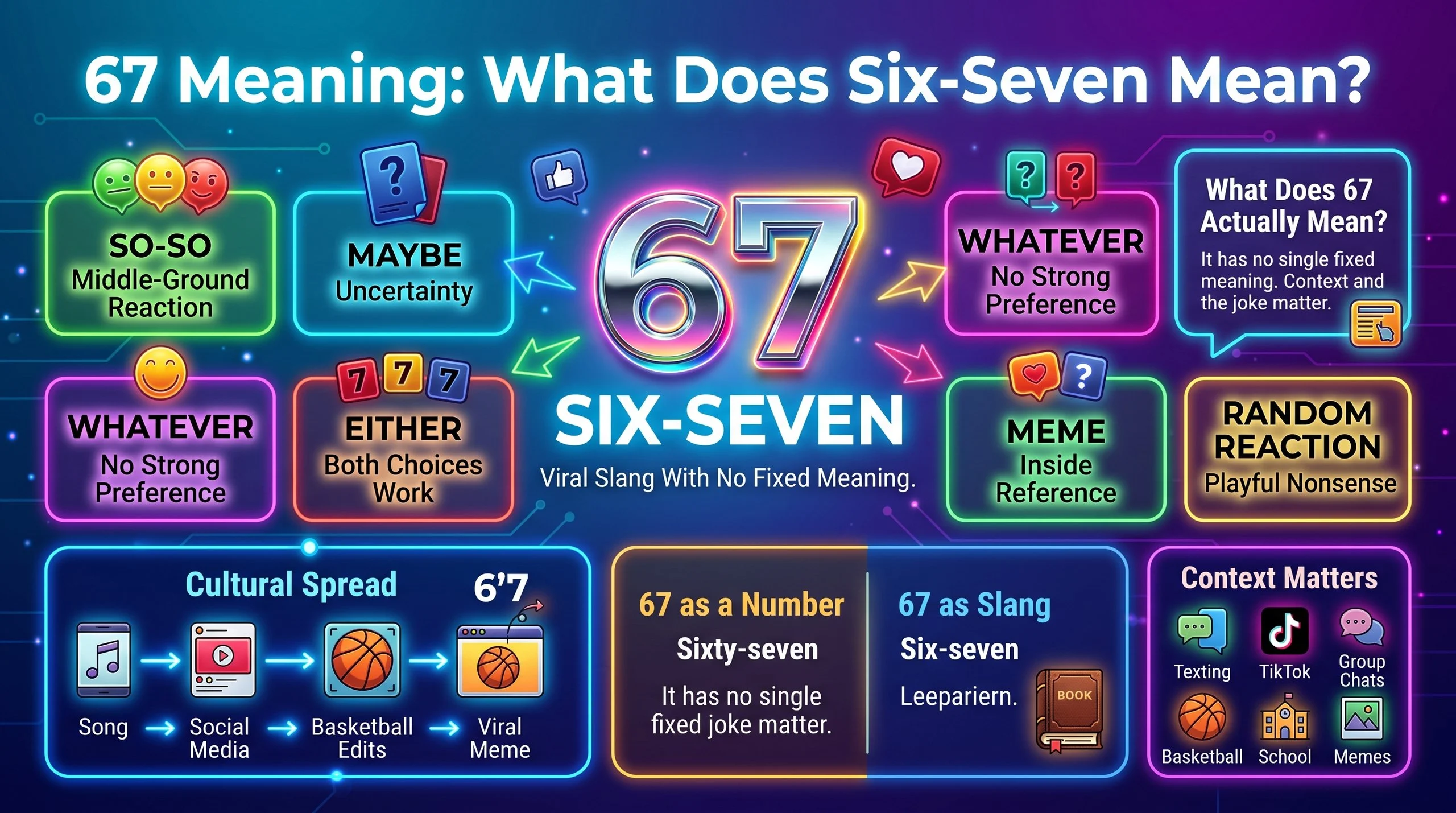
If you have heard people randomly say “67” or “six-seven,” you may be wondering about the 67 meaning in slang. The simplest answer is that 67 has no single fixed definition. Instead, it is a viral internet expression that can act as a joke, reaction, inside reference, or deliberately nonsensical response. In some situations, people loosely interpret it as “so-so” or “maybe this, maybe that,” but the ambiguity is part of the meme itself.
The expression is generally pronounced “six-seven,” not “sixty-seven,” when it refers to the slang trend. It became strongly associated with youth and internet culture after spreading through short-form videos, basketball edits, classrooms, and social media. Consequently, understanding the phrase requires more than looking for a traditional dictionary definition.
What Does 67 Mean?
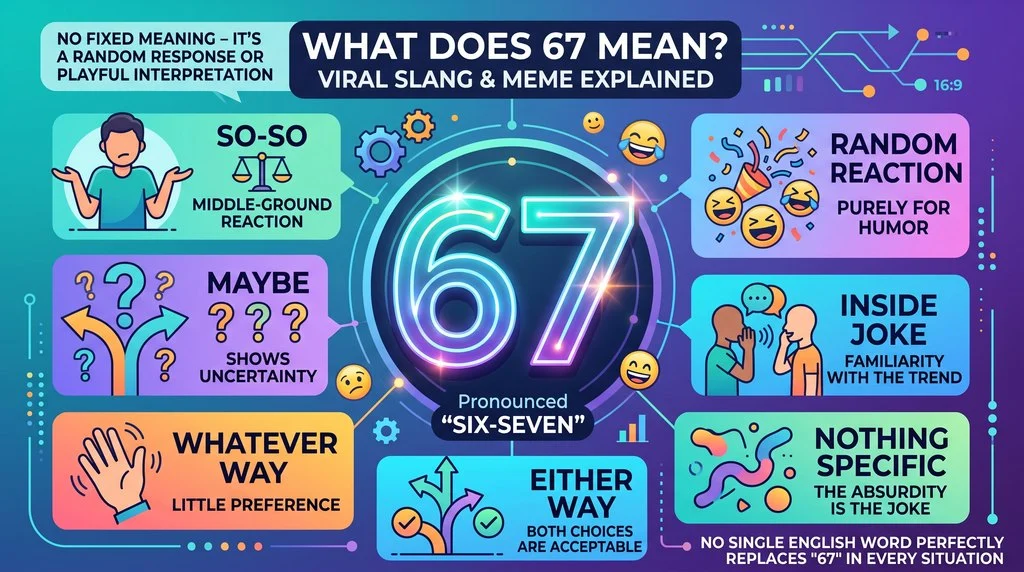
67, pronounced “six-seven,” is a viral slang expression with no fixed meaning. People may use it as a random reaction, an inside joke, or a playful response. In some contexts, it loosely suggests “so-so,” “maybe this, maybe that,” or “either way.” However, the phrase often exists simply because it is recognizable and funny to people who know the meme.
In practical terms, 67 can mean different things depending on the situation:
- So-so — when expressing a middle-ground reaction
- Maybe — when showing uncertainty
- Whatever — when showing little preference
- Either way — when both choices seem acceptable
- Random reaction — when the phrase is used purely for humor
- Inside joke — when the speaker wants to signal familiarity with the trend
- Nothing specific — when the absurdity itself is the joke
Therefore, there is no single English word that perfectly replaces “67” in every situation.
What Does 67 Mean in Slang?
In current internet slang, 67 is a nonsensical or deliberately ambiguous expression associated with Gen Alpha and broader online culture. Dictionary sources describe it as an interjection rather than an ordinary word with a conventional definition.
People often say “six-seven” after hearing the numbers 6 and 7 together. They may also use it when answering a question, commenting on a video, joking with friends, or simply participating in the meme.
For example:
“How was school today?”
“Six-seven.”
The answer does not necessarily mean that school was good, bad, or average. Instead, the response can signal that the speaker is participating in the joke.
Similarly:
“Which one do you want?”
“67.”
Here, the speaker might be implying that either choice is fine. However, they could also simply be using the meme without intending a literal meaning.
That flexibility is one of the defining characteristics of the expression. Dictionary.com has described the term as ambiguous and largely nonsensical, while Merriam-Webster likewise identifies “six seven” as a nonsensical expression connected to a song and basketball culture.
Where Did 67 Come From?
The modern “67” trend is generally traced to the drill song “Doot Doot (6 7)” by Skrilla. The phrase appeared in the song and later became especially popular through short-form videos and basketball-related edits.
During the meme’s spread, basketball became particularly important. Videos featuring basketball players were paired with the song and the “six-seven” phrase. LaMelo Ball, who is listed at 6 feet 7 inches, became an especially recognizable association because his height matched the numbers.
From there, the expression moved beyond basketball content. Young users began saying “six-seven” in conversations, classrooms, videos, comments, and other everyday settings.
Eventually, the phrase became recognizable even when the original song or basketball connection was not present.
Why Does 67 Mean Nothing?
The lack of a fixed definition is actually a major part of the appeal.
Many internet memes work because people recognize the reference rather than because the phrase communicates precise information. In the case of 67, saying the expression can demonstrate that someone understands the trend and belongs to the group participating in it.
As a result, the phrase can function more like a social signal than a conventional vocabulary item.
For example, someone might say “67” because:
- Friends around them are saying it.
- They recognize the meme.
- They want to make someone laugh.
- They are responding playfully to a question.
- They want to participate in an online trend.
- They enjoy the absurdity of the expression.
- They want to show that they understand the reference.
Dictionary.com selected “67” as its 2025 Word of the Year, emphasizing the unusual way the expression spread through youth and internet culture despite having little conventional meaning.
In other words, the lack of meaning is part of the meaning.
Is 67 Pronounced “Six-Seven” or “Sixty-Seven”?
When referring to the viral slang expression, 67 is pronounced “six-seven.”
It is not normally pronounced “sixty-seven” in the meme context. Dictionary.com specifically distinguishes the slang pronunciation from the ordinary number.
There is an important distinction here:
- 67 = “six-seven” when referring to the slang or meme
- 67 = “sixty-seven” when referring to the actual number
For instance:
“My grandmother is sixty-seven years old.”
That sentence uses the ordinary number, not the meme.
By contrast:
“Everyone in the comments keeps saying six-seven.”
That sentence refers to the slang expression.
What Is the 67 Hand Gesture?
The 67 meme is often accompanied by a recognizable hand movement.
Typically, the speaker holds both palms upward and moves the hands alternately up and down. The motion can resemble a small balancing scale or a seesaw.
The gesture is sometimes interpreted as representing “so-so,” “this or that,” or a lack of strong preference. Nevertheless, it does not give the phrase a strict definition.
In fact, someone can say “six-seven” without making the gesture at all.
The movement simply adds another recognizable feature to the meme and can make the reference easier to identify.
What Does 67 Mean on TikTok?
On TikTok, 67 generally functions as a viral slang reference rather than a word with one literal definition.
Users may include it in:
- Comments
- Short videos
- Captions
- Reaction clips
- Basketball edits
- School-related videos
- Meme content
- Group jokes
Sometimes the numbers appear naturally in a video. Other times, someone deliberately says “six-seven” simply because the phrase has become recognizable.
For example, a creator might show the number 67 on screen and immediately react by saying:
“Six-seven!”
The humor comes from recognizing the meme rather than from interpreting the number mathematically.
Because TikTok trends often evolve rapidly, individual communities may also give the phrase slightly different uses. Even so, the central characteristic remains its ambiguity.
What Does 67 Mean in Texting?
In texting, 67 usually works as a playful slang response or meme reference.
Someone might send:
“67 😂”
without expecting the recipient to translate it into a conventional English sentence.
Depending on the conversation, it could suggest:
- “Whatever.”
- “Maybe.”
- “So-so.”
- “Either one.”
- “I know the meme.”
- “I’m just joking.”
However, context matters more than the number itself.
If a friend asks:
“Do you want pizza or burgers?”
and you reply:
“67”
they might interpret it as “either one.”
On the other hand, if someone sends “67” randomly in a group chat, there may be no literal meaning at all.
Does 67 Have a Literal Meaning?
Yes and no.
As an ordinary number, 67 means sixty-seven. It is the whole number that comes after 66 and before 68.
As slang, however, 67 does not have one established literal meaning. Instead, its use depends on the social context surrounding the meme.
This distinction is essential because the same symbol can represent two completely different things.
Ordinary number
“There are 67 students in the program.”
Here, 67 is simply a number.
Internet slang
“Bro really said 67.”
In this sentence, the number refers to the viral expression.
Therefore, always consider the surrounding context before interpreting it.
Is 67 the Same as 6-7?
Yes, when referring to the slang trend.
67, 6-7, 6 7, and “six-seven” can all refer to the same viral expression. The formatting changes, but the cultural reference remains essentially the same.
For example:
- 67
- 6-7
- 6 7
- six-seven
- six seven
All can refer to the meme.
The pronunciation is usually six-seven, rather than sixty-seven, when the slang meaning is intended.
Is 67 the Same as “Sixes and Sevens”?
No. These expressions should not be confused.
“Sixes and sevens” is a traditional English expression meaning a state of confusion or disorder.
By contrast, “six-seven” as modern internet slang refers to the viral meme associated with the song, social media, and youth culture.
The two phrases may look related because they contain the same numbers. Nevertheless, they have different origins, meanings, and uses.
Sixes and sevens
“After the sudden change, the office was at sixes and sevens.”
This means confused or disorganized.
Six-seven
“Everyone at school keeps saying six-seven.”
This refers to the modern slang trend.
What Are the Synonyms for 67 Meaning?
Because 67 does not have one fixed definition, its possible synonyms are contextual rather than exact.
Useful alternatives include:
- So-so — for a middle-ground opinion
- Maybe — for uncertainty
- Whatever — for indifference
- Either way — when either choice is acceptable
- Kind of — for partial agreement
- Not sure — for uncertainty
- Meh — for weak enthusiasm
- Who knows — for an unknown outcome
- I guess — for hesitant agreement
- Perhaps — for mild uncertainty
These words should not be treated as interchangeable.
For instance, “maybe” communicates uncertainty, while “whatever” suggests indifference. Likewise, “so-so” describes an average experience, whereas “inside joke” describes the social function of the meme.
Consequently, the right replacement depends on what the speaker is trying to communicate.
67 vs. “So-So”
So-so is one of the closest contextual alternatives to 67 when someone uses the expression to indicate that something is neither particularly good nor particularly bad.
Example:
“How was the movie?”
“So-so.”
The phrase is much clearer than “67.”
Still, the two are not exact equivalents. Someone can say “67” without expressing an opinion about quality at all.
67 vs. “Maybe”
Maybe works when the intended idea is uncertainty.
For example:
“Are you coming tomorrow?”
“Maybe.”
A person who replies “67” could potentially communicate the same uncertainty. Nevertheless, “maybe” provides a direct answer, whereas “67” preserves the meme’s ambiguity.
67 vs. “Whatever”
Whatever is a possible alternative when the speaker has no strong preference.
For example:
“Which restaurant should we visit?”
“Whatever works.”
Although “67” can sometimes fill the same role, “whatever” can sound dismissive depending on tone.
Therefore, it is best used with friends or in relaxed conversations.
67 vs. “Meh”
Meh communicates weak enthusiasm or indifference.
For example:
“Did you like the new game?”
“Meh.”
This is somewhat similar to using “67” as a vague or unimpressed response.
However, “meh” has a clearer emotional meaning. It usually suggests that something was not particularly exciting.
67 vs. “Either Way”
Either way means that the outcome or choice does not matter much.
For example:
“Should we meet Friday or Saturday?”
“Either way works for me.”
This phrase can replace “67” when the speaker wants to communicate flexibility clearly.
Unlike the meme, however, it does not carry the same humorous or cultural reference.
67 vs. “Inside Joke”
An inside joke is not an exact synonym for 67.
Instead, it describes one way the expression can function.
If a group repeatedly says “67” because everyone understands the reference, the phrase becomes a shared joke or social signal.
That is why someone unfamiliar with the trend may hear “67” and think the speakers are simply talking about a number.
Words Related to 67
Several terms are closely connected to the cultural phenomenon without being direct synonyms.
Meme
A meme is a piece of content, phrase, image, behavior, or idea that spreads through a community, especially online.
The 67 expression became a meme, but “meme” does not mean “67.”
Slang
Slang refers to informal language used within particular social groups or communities.
The modern six-seven expression is commonly treated as slang.
Catchphrase
A catchphrase is a memorable expression that people repeat.
67 can function like a catchphrase because people repeat it even when it contributes little literal information.
Inside Joke
An inside joke is humor understood primarily by people who share a particular experience or reference.
The 67 trend can operate this way among people familiar with the meme.
Brainrot
Brainrot is informal internet language used for highly repetitive, absurd, or extremely online content.
Some coverage places 67 within this broader internet culture because of its deliberately nonsensical nature.
Why Do People Say 67 Randomly?
There are several reasons.
First, repetition helps memes spread. Once enough people recognize an expression, saying it becomes a way to participate.
Second, the phrase is easy to remember. Two short numbers are simple to repeat in conversation.
Third, its ambiguity makes it useful in jokes. Someone can answer almost anything with “67” and create a deliberately absurd moment.
Finally, the expression can act as an in-group signal. People who understand the reference immediately recognize that someone else is participating in the same internet culture.
Consequently, the social function can matter more than the literal meaning.
Why Did 67 Become So Popular?
The expression benefited from several overlapping internet trends.
The original song provided the phrase. Basketball edits then gave it visual and cultural momentum. Social media made the expression easy to repeat, while younger users brought it into classrooms and everyday conversations.
The association with basketball was particularly useful because LaMelo Ball’s listed height of 6 feet 7 inches created a natural visual connection between the numbers and sports content.
Later, people began using the phrase outside its original context.
That transition is common with internet slang. A phrase can begin in one community and eventually become a general-purpose meme.
Is 67 Gen Alpha Slang?
Yes. 67 is strongly associated with Gen Alpha and younger internet users, although adults, sports communities, creators, and broader online audiences have also used or referenced it.
The expression became particularly visible in schools and youth-oriented social media spaces.
At the same time, its popularity extended beyond one age group. Media coverage, sports references, and online discussions helped make “six-seven” recognizable to a much wider audience.
Therefore, calling it only a “Gen Alpha word” can be somewhat limiting. It is more accurately described as a youth-driven internet slang expression that spread into mainstream online culture.
Is 67 Still Used in 2026?
Yes. The expression continues to appear in internet slang discussions and youth-oriented online culture in 2026. Recent coverage still describes “six-seven” as a viral phrase whose defining feature is its lack of a fixed meaning.
However, internet slang changes quickly.
A phrase can become extremely popular, spread into mainstream culture, and eventually decline as another meme replaces it. Therefore, its frequency may vary by platform, age group, location, and online community.
How to Use 67 in a Sentence
Since “67” functions as slang rather than standard formal English, its natural use is mostly casual.
Example 1
“How was your day?”
“67.”
The response is deliberately vague.
Example 2
“Are you going to the game?”
“Six-seven!”
Here, the phrase is being used playfully rather than as a clear yes or no.
Example 3
“Why did everyone start yelling 67?”
This sentence refers directly to the meme.
Example 4
“He saw the number 67 and immediately said six-seven.”
The phrase is being used as a reaction to seeing the numbers.
Example 5
“The group chat has been filled with six-seven jokes all morning.”
This describes repeated meme usage.
These examples show that the expression does not need a conventional grammatical meaning to function naturally within casual communication.
Common Mistakes With 67
Mistake 1: Assuming it always means “so-so”
Although “so-so” is sometimes used as an interpretation, it is not the complete definition.
The phrase can simply be nonsense or a meme reference.
Mistake 2: Pronouncing the slang as “sixty-seven”
When referring to the meme, “six-seven” is the usual pronunciation.
Mistake 3: Treating 67 like formal English
The expression is informal internet slang.
Therefore, it would normally be inappropriate in an academic essay, business report, or formal email unless you are specifically discussing the slang itself.
Mistake 4: Assuming every use has a hidden meaning
Sometimes “67” really does not mean anything specific.
The randomness is often the joke.
Mistake 5: Confusing the meme with “sixes and sevens”
The modern “six-seven” expression and the traditional phrase “at sixes and sevens” are unrelated in everyday meaning.
Is 67 Appropriate to Use?
In casual settings, using “67” can be perfectly understandable when the people involved know the meme.
However, context matters.
A friend may understand:
“67 😂”
immediately.
A teacher, employer, customer, or professional reader may not.
For that reason, standard English is usually a better choice when you need to communicate information clearly.
Instead of:
“The result is 67.”
use:
“The result is uncertain.”
Instead of:
“67 works.”
use:
“Either option works.”
Instead of:
“How was it?” — “67.”
use:
“It was so-so.”
The clearer alternative depends on the intended meaning.
67 Meaning in Different Contexts
| Context | Possible Function of 67 | Clearer Alternative |
|---|---|---|
| TikTok | Meme reference | Meme phrase |
| Group chat | Inside joke | Inside joke |
| Question response | Random reaction | Depends on question |
| Opinion | Middle-ground reaction | So-so |
| Decision | No strong preference | Either way |
| Uncertain plan | Uncertainty | Maybe |
| Indifference | No preference | Whatever |
| School joke | Social signal | Meme reference |
| Basketball content | Meme or six-seven reference | Six-seven |
| Formal writing | Usually inappropriate | Precise wording |
This table highlights why there is no universal translation for the slang.
67 Meaning vs. 67 as a Number
The context determines whether 67 represents slang or an ordinary number.
| Use | Meaning |
|---|---|
| 67 students | The number sixty-seven |
| 67 miles | Sixty-seven miles |
| “Six-seven!” | Viral slang expression |
| “67 😂” | Likely meme usage |
| 67 in a math problem | Ordinary number |
| 67 in a TikTok comment | Potential meme reference |
As a result, you should never assume that every appearance of “67” refers to the internet trend.
Antonyms of 67 Meaning
Because the slang has no fixed definition, it does not have one standard antonym.
Instead, the opposite depends on the interpretation.
If 67 means uncertainty, possible opposites include:
- certainty
- confidence
- definitely
- absolutely
- clearly
If 67 means indifference, possible opposites include:
- strong preference
- enthusiasm
- concern
- commitment
If 67 is simply a random meme response, the opposite would be a specific and meaningful answer.
For example:
“67.”
could be contrasted with:
“Yes, I definitely want option A.”
The first response is deliberately vague, while the second is precise.
How to Choose a Better Alternative to 67
When translating the slang into ordinary English, begin by asking what the speaker actually intends.
For uncertainty
Use:
- maybe
- perhaps
- possibly
- not sure
For indifference
Use:
- whatever
- either way
- I don’t mind
- either option
For an average reaction
Use:
- so-so
- okay
- average
- not bad
For low enthusiasm
Use:
- meh
- not really
- nothing special
For formal writing
Use:
- uncertain
- ambiguous
- inconclusive
- undecided
- indeterminate
Most importantly, do not choose a synonym simply because it appears on a list. The replacement should preserve the intended meaning and tone.
Quick 67 Meaning Summary
- 67 is pronounced “six-seven” when used as slang.
- It is not normally pronounced “sixty-seven” in the meme context.
- The expression has no fixed definition.
- Some people interpret it as “so-so” or “maybe this, maybe that.”
- In many cases, it is simply a random or humorous reaction.
- The phrase is associated with internet and youth culture.
- Its modern popularity grew from Skrilla’s “Doot Doot (6 7)” and subsequent social media and basketball content.
- LaMelo Ball’s 6-foot-7-inch height became part of the meme’s basketball association.
- The phrase can act as an inside joke or social signal.
- Standard English alternatives include maybe, so-so, whatever, either way, and not sure, depending on context.
FAQs About 67 Meaning
What does 67 mean in slang?
67 means a viral, deliberately ambiguous expression with no single fixed definition. It can be used as a joke, reaction, inside reference, or playful response. Some people loosely interpret it as “so-so” or “maybe this, maybe that.”
What does six-seven mean?
Six-seven is the spoken form of the 67 slang meme. It is generally pronounced “six-seven” rather than “sixty-seven” when referring to the internet trend.
Is 67 a bad word?
No, 67 is not inherently a swear word or profanity. It is primarily an informal slang expression and meme. However, its appropriateness depends on the setting and audience.
Why do people say 67?
People say 67 to participate in a viral meme, make a joke, or signal that they recognize the trend. In many cases, the expression does not communicate a literal message.
Does 67 mean “so-so”?
Sometimes, but not always. “So-so” is one interpretation associated with the hand gesture and middle-ground responses. Nevertheless, the broader slang expression has no fixed meaning.
Where did 67 come from?
The modern slang trend is generally traced to Skrilla’s song “Doot Doot (6 7).” It later spread through social media, basketball edits, and youth culture.
Why is 67 connected to basketball?
The phrase became associated with basketball because social media edits used the song with basketball content, while LaMelo Ball’s listed height of 6 feet 7 inches created an especially memorable connection.
What is another word for 67?
There is no exact synonym for the slang expression. Depending on the context, alternatives may include so-so, maybe, whatever, either way, meh, or not sure.
Is 67 Gen Alpha slang?
Yes, 67 is strongly associated with Gen Alpha and younger internet users. However, the expression has also spread into broader social media, sports, and popular culture.
What is the opposite of 67?
There is no universal opposite because 67 has no fixed meaning. If it represents uncertainty, the opposite could be certainty. If it represents indifference, the opposite could be a strong preference.
Conclusion
The 67 meaning is unusual because there is no simple definition to memorize. Pronounced “six-seven,” the expression became a viral piece of internet slang connected to music, basketball, social media, and youth culture.
Although some people use it to suggest “so-so,” “maybe,” “whatever,” or “either way,” those interpretations do not apply every time. In many situations, the phrase works simply as a meme, reaction, or social signal.
Ultimately, that ambiguity is what makes 67 different from ordinary slang. If you want to understand what someone means, look at the context, tone, surrounding conversation, and audience. When clarity matters, replace the meme with a precise expression such as “maybe,” “so-so,” “whatever,” or “not sure.”
In short, 67 does not have to mean something specific to be meaningful as a piece of internet culture. The shared joke and recognition of the reference are often the real point.

Jack Murphy is a language writer with a passion for word meanings, synonyms, and effective communication. He creates informative and easy to understand content to help readers enhance their vocabulary and language skills.
45 thoughts on “67 Meaning| What Does Six-Seven Mean in Slang? From Random Numbers to a Viral Internet Catchphrase 2026”