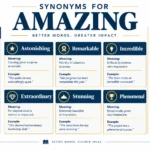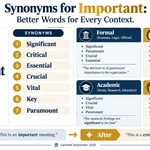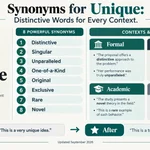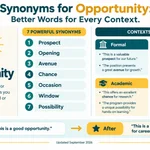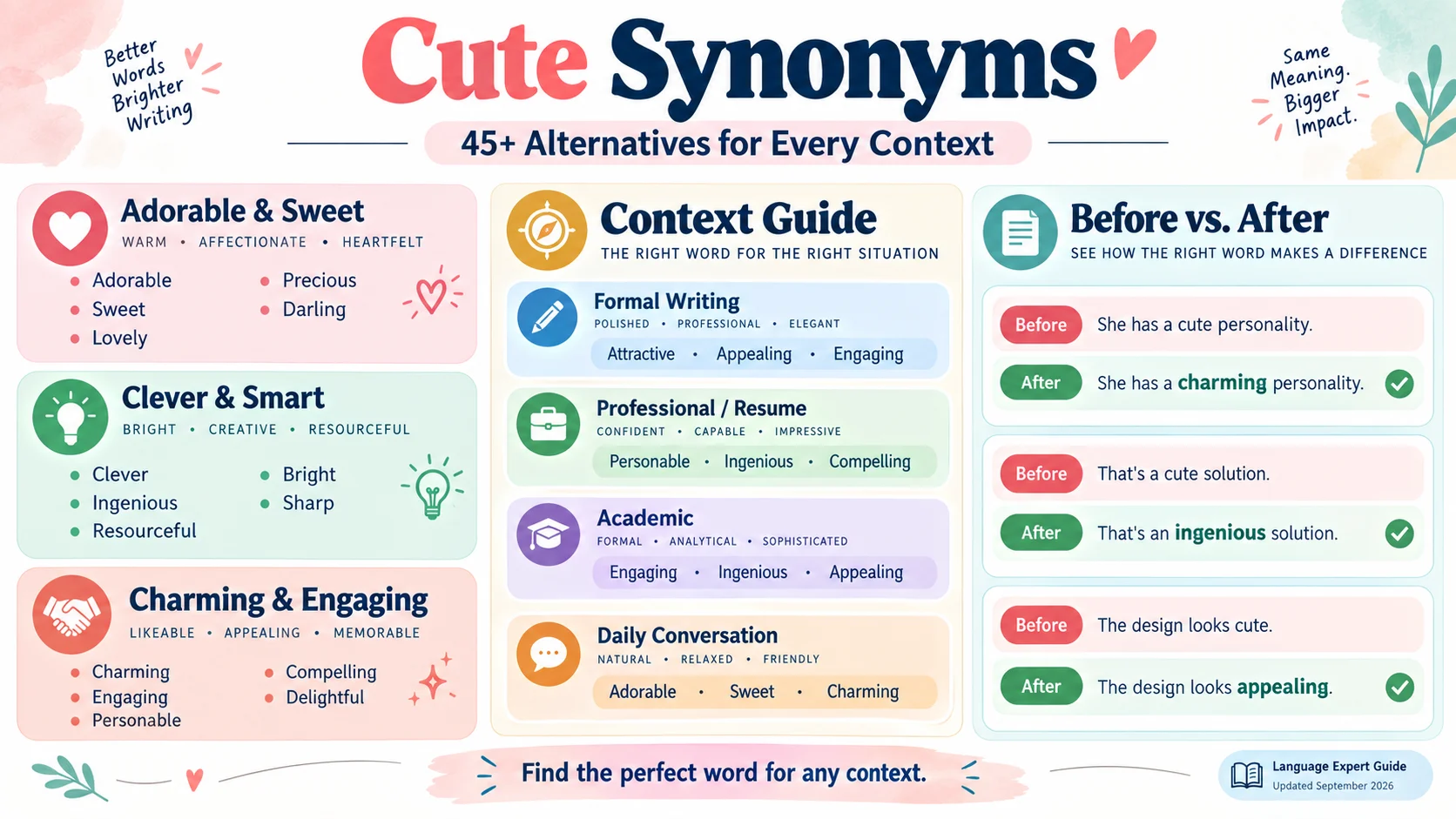
The best synonym for cute depends on your context. For appearance, use adorable or charming. For cleverness, use ingenious or resourceful. For professional writing, choose appealing or engaging to maintain a formal tone.
What Does Cute Mean?
Definition
Cute is a versatile adjective with several distinct meanings in American English:
- Appearance-based: Attractive in a charming, endearing, or pretty way, often with a youthful or delicate quality. Think puppies, babies, and a playful smile.
- Behavior-based: Showing cleverness, shrewdness, or sometimes a mild form of cunning. When someone is “cute” in this sense, they are being cleverly strategic.
- Informal tone: Used to describe something that is pleasing, sweet, or emotionally appealing without being overwhelmingly beautiful or stunning.
Common Uses
| Usage Type | Meaning | Example |
|---|---|---|
| Physical appearance | Endearingly attractive, often small or youthful | “Look at that cute little kitten.” |
| Personality trait | Sweet, charming, or likable | “He has such a cute sense of humor.” |
| Clever or shrewd | Ingenious, sometimes slightly manipulative | “That’s a cute way to solve the problem.” |
| Romantic or affectionate | Attractive in an appealing, sweet way | “She sent me a cute text message.” |
| Ironic or dismissive | Mildly annoying or overly clever | “Don’t get cute with me.” |
Best Synonyms for Cute
| Synonym | Meaning | Best Used When | Example |
|---|---|---|---|
| Adorable | Extremely cute, inspiring love or affection | Describing babies, pets, or anything that makes you say “aw” | “The puppy was so adorable I wanted to take it home.” |
| Charming | Pleasing and delightful, with charisma | Describing personalities, places, or social interactions | “He had a charming smile that won everyone over.” |
| Endearing | Inspiring affection or warm feelings | Describing someone’s habits, traits, or expressions | “Her habit of humming while working was endearing.” |
| Sweet | Pleasant, kind, and gentle | Describing people’s nature, gestures, or small things | “She left a sweet note on my desk this morning.” |
| Lovely | Beautiful and enjoyable in a gentle way | Describing things, experiences, or people in a warm tone | “We had a lovely evening together.” |
| Attractive | Pleasing to the eye or mind | Professional contexts, formal writing | “The product design is highly attractive to younger consumers.” |
| Appealing | Attractive and interesting | Professional, persuasive, or marketing contexts | “The new features make this software very appealing.” |
| Ingenious | Clever and original | Describing solutions, ideas, or smart designs | “What an ingenious way to organize the workspace.” |
| Clever | Quick and smart in a creative way | Describing intelligence, wit, or problem-solving | “That was a clever idea for the campaign.” |
| Engaging | Charming and captivating attention | Professional, academic, or media contexts | “The presenter had an engaging style of teaching.” |
Synonyms by Context
Formal Writing
In formal writing, “cute” is generally too casual. Here are professional alternatives:
| Word | Tone | Example |
|---|---|---|
| Attractive | Formal, neutral | “The proposal offered an attractive value proposition.” |
| Appealing | Formal, persuasive | “The data present an appealing case for investment.” |
| Engaging | Formal, professional | “Her engaging presentation captivated the board.” |
| Delightful | Formal, warm | “The venue provided a delightful atmosphere for the gala.” |
| Endearing | Formal, slightly emotional | “The memoir’s endearing honesty resonated with critics.” |
Professional & Business Writing
In resumes, emails, and business documents, these words work better than “cute”:
| Word | Context | Example |
|---|---|---|
| Personable | Describing interpersonal skills | “A personable team leader who excels at client relations.” |
| Clever | Describing solutions or strategies | “A clever marketing strategy that increased brand awareness.” |
| Ingenious | Describing innovative designs or ideas | “An ingenious product redesign reduced manufacturing costs.” |
| Engaging | Describing communication style | “Delivered engaging presentations to stakeholders.” |
| Charming | Describing client or social interactions | “A charming and persuasive communicator.” |
| Compelling | Describing arguments, proposals, or designs | “The campaign used compelling visuals to drive sales.” |
Academic Writing
Academic contexts require precision. Avoid “cute” entirely and use:
| Word | Context | Example |
|---|---|---|
| Endearing | Psychology or literature | “The subject’s endearing qualities made her a sympathetic character.” |
| Engaging | Education or communication | “The teacher’s engaging style improved student participation.” |
| Ingenious | Problem-solving or innovation | “The researcher’s ingenious methodology produced reliable results.” |
| Appealing | Marketing or consumer studies | “The product’s appealing design influenced purchasing decisions.” |
| Attractive | Statistical or experimental contexts | “The hypothesis presents an attractive framework for analysis.” |
Daily Conversation
In everyday speech, you have the most flexibility. Here are natural alternatives:
| Word | Example |
|---|---|
| Adorable | “That baby is absolutely adorable!” |
| Sweet | “It was so sweet of you to remember.” |
| Charming | “Your new neighbor seems really charming.” |
| Lovely | “We had a lovely time at the picnic.” |
| Precious | “Look at that precious little dog.” |
| Darling | “That’s a darling little dress you’re wearing.” |
Professional Alternatives for Resume & Business Writing
If you are writing a resume, cover letter, or professional email, never use “cute.” Here is what to use instead:
| Resume/Business Word | Meaning | Example Sentence |
|---|---|---|
| Personable | Friendly and easy to get along with | “A personable professional who builds strong client relationships.” |
| Clever | Intelligent and creative | “Developed clever solutions to complex logistics problems.” |
| Ingenious | Remarkably clever and original | “Designed an ingenious inventory management system.” |
| Engaging | Captivating and interesting | “Led engaging team meetings that boosted morale.” |
| Compelling | Strongly persuasive or attractive | “Created compelling marketing materials that increased conversions.” |
| Charming | Pleasant and likable | “A charming communicator with excellent negotiation skills.” |
Resume Example:
“A personable marketing professional with a clever approach to brand storytelling and an engaging presentation style.”
Business Email Example:
“I found your proposal quite compelling. The clever integration of AI features makes it especially appealing to our tech-forward clients.”
Simple Alternatives (for easy reading)
For content aimed at broader audiences, younger readers, or informal settings:
| For Cute (appearance) | For Cute (clever) | For Cute (behavior) |
|---|---|---|
| Sweet | Smart | Nice |
| Nice | Bright | Kind |
| Pretty | Sharp | Friendly |
| Lovely | Quick | Pleasant |
| Dear | Wise | Warm |
Example: “That’s a cute idea” → “That’s a clever idea” or “That’s a smart idea.”
Stronger Alternatives (for emphasis)
When you need more emotional impact or intensity:
| Word | Intensity Level | Example |
|---|---|---|
| Adorable | Very High | “The baby’s adorable laugh made everyone smile.” |
| Precious | Very High | “Those precious moments with family are unforgettable.” |
| Irresistible | High | “The irresistible charm of the little village drew tourists.” |
| Enchanting | High | “The enchanting garden felt like something from a fairy tale.” |
| Delightful | High | “A delightful performance that brought the audience to tears.” |
| Captivating | High | “Her captivating storytelling held the room spellbound.” |
Difference Between Similar Synonyms
Cute vs. Adorable
Cute describes general attractiveness with a playful or youthful quality. Adorable implies a much stronger emotional reaction it makes you want to hug or protect the subject.
Example: “The kitten was cute, but the sleepy puppy was absolutely adorable.”
Cute vs. Pretty
Pretty focuses on visual appeal, often in a delicate or pleasing way. Cute includes visual appeal but also suggests personality, charm, or cleverness.
Example: “The model was pretty, but the journalist was cute because she had a witty sense of humor.”
Cute vs. Beautiful
Beautiful is a strong, intense term for something visually or emotionally stunning. Cute is gentler, more playful, and often associated with youth or smallness.
Example: “The actress was beautiful on screen, but off-screen she had a cute, approachable personality.”
Cute vs. Clever
Clever focuses entirely on intelligence, creativity, or wit. Cute can mean clever, but often with a slightly playful or shrewd undertone.
Example: “He had a clever solution to the puzzle, but his cute remark made everyone laugh.”
Opposite Words (Antonyms)
| Antonym | Meaning | Example |
|---|---|---|
| Ugly | Visually unpleasant | “The building was ugly and unwelcoming.” |
| Unattractive | Not pleasing to the eye | “He felt unattractive in his old college sweater.” |
| Repulsive | Causing strong disgust | “The repulsive behavior was not tolerated.” |
| Awful | Extremely bad or unpleasant | “We had an awful experience at that restaurant.” |
| Unpleasant | Not enjoyable or agreeable | “The unpleasant weather ruined the picnic.” |
| Repellent | Causing dislike or disgust | “His repellent attitude drove customers away.” |
| Clumsy (for cleverness) | Lacking skill or grace | “A clumsy solution that caused more problems.” |
| Dull (for cleverness) | Lacking intelligence or interest | “The presentation was dull and unoriginal.” |
FAQs
What is a formal synonym for cute?
For appearance: attractive, appealing, or engaging. For cleverness: ingenious, clever, or resourceful.
What is another word for a cute girl?
Adorable girl, charming woman, sweet lady, lovely young woman, or darling girl (informal).
What is a professional alternative for cute?
Use personable, engaging, appealing, compelling, or attractive depending on context.
What word can replace cute in a sentence?
| Sentence | Replacement |
|---|---|
| “She is so cute.” | “She is so charming.” |
| “That’s a cute idea.” | “That’s a clever idea.” |
| “What a cute puppy!” | “What an adorable puppy!” |
| “He sent a cute text.” | “He sent a sweet text.” |
| “Don’t get cute with me.” | “Don’t get clever with me.” |
Is cute a formal word?
No, “cute” is considered informal or casual. In formal writing, business contexts, and academic papers, avoid “cute” and use attractive, appealing, engaging, or ingenious instead.
What is the difference between cute and beautiful?
Cute suggests a playful, youthful, or endearing quality it is gentle and often makes you smile. Beautiful is much more intense and implies a striking, stunning, or deeply pleasing quality. A cute puppy makes you say “aw”; a beautiful sunset makes you stop and stare.
Is cute always positive?
Mostly, but not always. Cute” can be used ironically to mean annoying, overly clever, or dismissive. Phrases like “Don’t get cute with me” or “That’s cute, but it won’t work” carry negative or sarcastic undertones.
Conclusion
Cute is one of the most common words in English, but it is also one of the most context-dependent. Whether you are describing a person’s appearance, a clever solution, or a warm gesture, there is almost always a better word available.
For appearance, reach for adorable, charming, or sweet. For cleverness, use ingenious or resourceful. For professional and academic settings, choose attractive, appealing, or engaging to maintain credibility and polish.
Key takeaway: Always match your synonym to the subject, the tone, and the audience. The right word makes your writing clearer, more engaging, and more professional.

Charlotte Wilson is a language writer passionate about word meanings, synonyms, and clear communication. She creates accurate and engaging content to help readers expand their vocabulary and language skills.