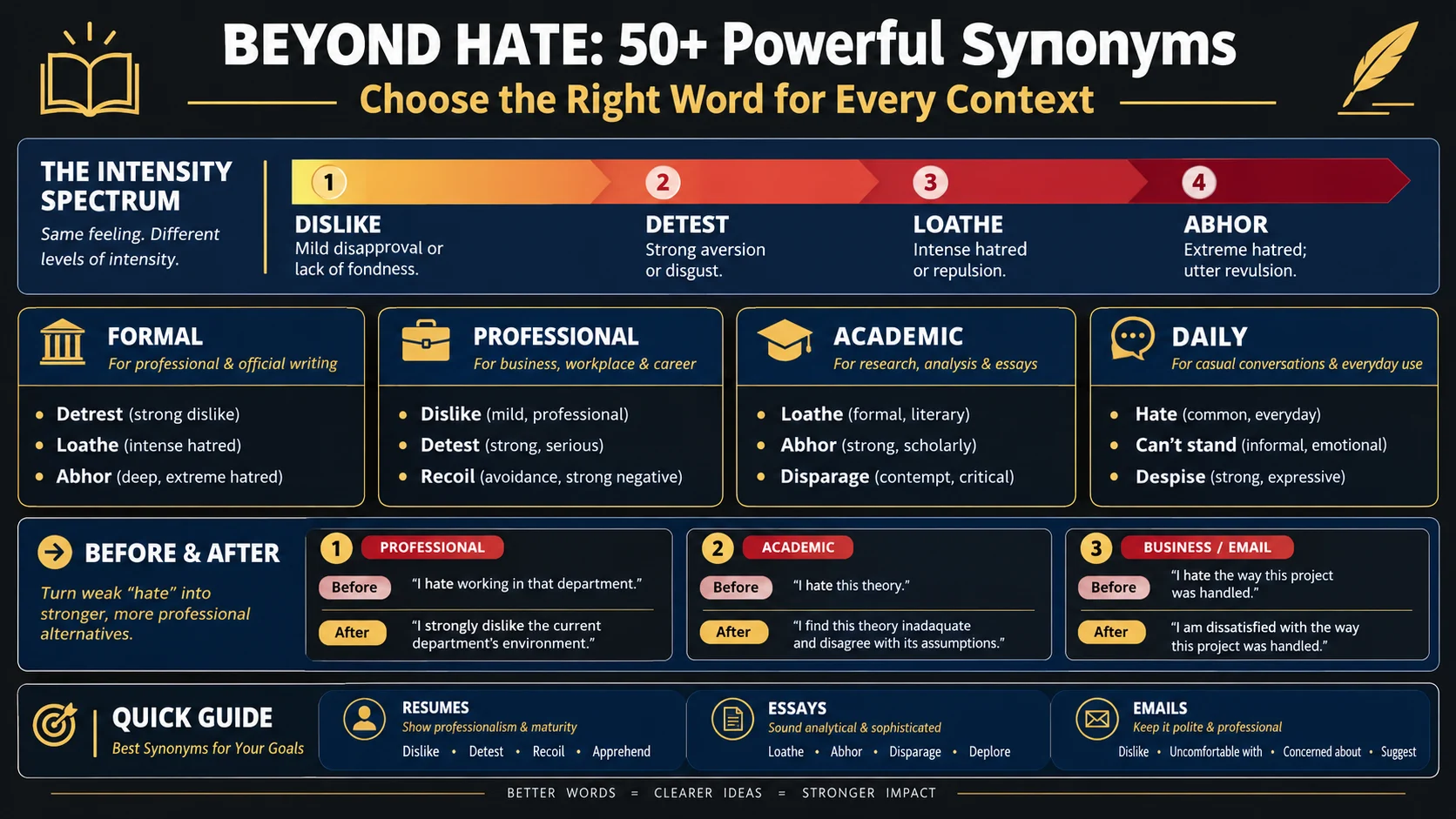
The best synonym for hate depends on your intensity and context. For everyday dislike, use loathe, despise, or detest. For extreme hatred, choose abhor, execrate, or abominate. In professional writing, softer alternatives like strongly dislike or have an aversion to are more appropriate.
What Does Hate Mean?
Definition
Hate is a powerful verb and noun that describes an intense, deep-seated hostility or aversion toward someone or something. It represents one of the strongest negative emotions in the English language, sitting at the extreme end of the dislike spectrum.
Common Uses
| Usage Type | Meaning | Example |
|---|---|---|
| Emotional aversion | Intense dislike or hostility | “I hate how he interrupts me constantly.” |
| Strong rejection | Refusal to accept or tolerate | “She hates injustice in all its forms.” |
| Personal animosity | Deep-seated ill will toward a person | “They hated each other for years.” |
| Distaste for things | Strong negative reaction to objects/situations | “He hates the taste of cilantro.” |
| Self-directed | Intense self-criticism or regret | “I hate myself for making that mistake.” |
| Hyperbolic expression | Exaggerated dislike (informal) | “I hate Monday mornings!” |
Best Synonyms for Hate
| Synonym | Meaning | Best Used When | Example |
|---|---|---|---|
| Loathe | Strong disgust and aversion | You find something repulsive or deeply unpleasant | “She loathes the smell of cigarette smoke.” |
| Despise | Contempt combined with dislike | You have no respect for the person or thing | “He despises dishonesty in any form.” |
| Detest | Intense, active dislike | You want to avoid something at all costs | “They detest the hot, humid summers here.” |
| Abhor | Moral revulsion or horror | Something violates your values or ethics | “I abhor violence against innocent people.” |
| Abominate | Extreme disgust and hatred | You find something completely unacceptable | “She abominates cruelty to animals.” |
| Execrate | Fierce, vehement hatred | You publicly denounce or curse something | “The community execrated the corrupt officials.” |
| Dislike | Mild negative feeling | You want a softer, more neutral word | “I dislike the taste of mushrooms.” |
| Scorn | Contempt with disdain | You reject something as worthless | “He scorned the idea of quitting.” |
Synonyms by Context
Formal Writing
In formal contexts, precision matters. Choose words that convey the right intensity without being overly emotional:
| Word | Intensity | Example |
|---|---|---|
| Abhor | Extreme | “The committee abhors any form of discrimination.” |
| Detest | High | “Scholars detest the misrepresentation of historical facts.” |
| Despise | High | “She despises intellectual dishonesty.” |
| Have an aversion to | Moderate | “He has a strong aversion to public speaking.” |
| Disdain | High | “The CEO showed disdain for unethical business practices.” |
Professional Writing
Professional environments require measured language. Replace “hate” with these diplomatic alternatives:
| Word | Context | Example |
|---|---|---|
| Strongly oppose | Business decisions | “We strongly oppose the proposed merger terms.” |
| Have reservations about | Mild disagreement | “I have reservations about implementing this strategy.” |
| Find unacceptable | Policy violations | “The board finds this behavior unacceptable.” |
| Take issue with | Professional criticism | “I take issue with the methodology used.” |
| Reject outright | Complete refusal | “Management rejected the proposal outright.” |
Academic Writing
Academic discourse demands objectivity and precision:
| Word | Academic Context | Example |
|---|---|---|
| Deplore | Strong moral judgment | “The study deplores the systemic inequality observed.” |
| Condemn | Formal criticism | “Researchers condemn the manipulation of scientific data.” |
| Repudiate | Formal rejection | “The theory was repudiated by subsequent studies.” |
| Have an antipathy toward | Clinical description | “Subjects showed a marked antipathy toward the stimulus.” |
| Find reprehensible | Moral or ethical criticism | “The findings reveal behavior many find reprehensible.” |
Daily Conversation
Everyday speech allows for more flexible and expressive language:
| Word | Example |
|---|---|
| Can’t stand | “I can’t stand the traffic in this city.” |
| Can’t stomach | “I can’t stomach reality TV shows.” |
| Detest | “I detest people who chew loudly.” |
| Loathe | “He loathes doing the dishes.” |
| Can’t bear | “She can’t bear the cold weather.” |
Professional Alternatives for Hate
When writing resumes, professional emails, or business documents, avoid the emotional intensity of “hate.” These alternatives maintain professionalism:
| Professional Alternative | Best Used For | Example |
|---|---|---|
| Prefer to avoid | Personal preferences | “I prefer to avoid confrontation when possible.” |
| Have a strong preference against | Definite opinions | “I have a strong preference against micromanagement.” |
| Lack enthusiasm for | Mild disinterest | “I lack enthusiasm for the current approach.” |
| Find counterproductive | Professional disagreement | “I find the proposed timeline counterproductive.” |
| View unfavorably | Objective assessment | “Stakeholders view the new policy unfavorably.” |
Simple Alternatives for Hate
For everyday communication where you need a straightforward word:
| Simple Alternative | Example |
|---|---|
| Dislike | “I dislike waking up early.” |
| Don’t like | “I don’t like the new policy.” |
| Can’t stand | “She can’t stand loud music.” |
| Hate (itself) | “I hate waiting in line.” |
Stronger Alternatives for Hate
When “hate” isn’t strong enough, or you need to express extreme emotion:
| Strongest Alternative | Intensity Level | Example |
|---|---|---|
| Abhor | Extreme | “I abhor all forms of oppression.” |
| Abominate | Extreme | “They abominate the very thought of compromise.” |
| Execrate | Extreme | “The public execrated the dictator’s regime.” |
| Detest | Very High | “I detest hypocrisy more than anything.” |
| Loathe | Very High | “She loathes him with every fiber of her being.” |
| Despise | Very High | “He despises the corporate culture there.” |
Difference Between Similar Synonyms
Hate vs. Loathe vs. Detest vs. Despise
| Word | Key Difference |
|---|---|
| Hate | Broadest term; covers general intense dislike |
| Loathe | Suggests disgust and repulsion; physically repellent |
| Detest | Active hostility; you want to avoid the object |
| Despise | Adds contempt and disrespect; looking down on something |
| Abhor | Moral revulsion; violation of values or ethics |
Example Comparison:
- “I hate spiders” → General fear/dislike
- “I loathe spiders” → You find them physically repellent
- “I detest spiders” → You actively avoid them
- “I despise spiders” → You look down on them as lesser beings
- “I abhor spiders” → You find them morally or instinctively repulsive
Opposite Words (Antonyms)
| Antonym | Meaning | Example |
|---|---|---|
| Love | Deep affection | “I love my family unconditionally.” |
| Adore | Great affection and admiration | “She adores her new puppy.” |
| Like | Positive feeling | “I like the new restaurant downtown.” |
| Cherish | Hold dear, protect | “He cherishes every moment with his children.” |
| Embrace | Accept willingly | “The company embraces innovative ideas.” |
| Appreciate | Value, recognize worth | “I appreciate your honest feedback.” |
| Admire | Respect and approve | “We admire their commitment to excellence.” |
FAQs
What is a formal synonym for hate?
Abhor, detest, despise, or have an aversion to. For professional settings, use oppose, disapprove of, or find unacceptable.
What is a stronger word for hate?
Abhor, abominate, and execrate are the strongest synonyms, expressing extreme moral revulsion or vehement opposition.
What is another word for strongly dislike?
Loathe, detest, despise, and abhor all express strong dislike, with varying degrees of intensity and nuance.
What is a professional alternative for hate?
In professional writing, use strongly oppose, have reservations about, find counterproductive, or take issue with.
What is the difference between hate and loathe?
Hate is a general term for intense dislike. Loathe specifically implies disgust and revulsion, often with a physical or visceral component.
What can I say instead of “I hate you” in a professional context?
Replace this inflammatory phrase with measured language like “I strongly disagree with your approach,” “I find your behavior unprofessional,” or “I take issue with your comments.”
What word can replace hate in an essay?
For academic essays, use deplore, condemn, repudiate, object to, or take exception to, depending on your context and intensity.
Conclusion
“Hate” is a powerful word that should be used sparingly. This guide gives you the right synonym for any context whether you need to tone down your language for professionalism, amp up the intensity for emotional writing, or find the perfect word for academic precision.
Key takeaway: The best alternative depends on your audience and purpose. Choose abhor or despise when you need strong, formal language. Use loathe or detest for personal intensity. And in professional settings, opt for measured words like strongly oppose or take issue with to maintain credibility.

Harry Edwards is a language writer specializing in word meanings, synonyms, and language usage. He creates clear, accurate, and engaging content to help readers improve their vocabulary and communication skills.
11 thoughts on “50+ Hate Synonyms | Stronger & Professional Alternatives For 2026”