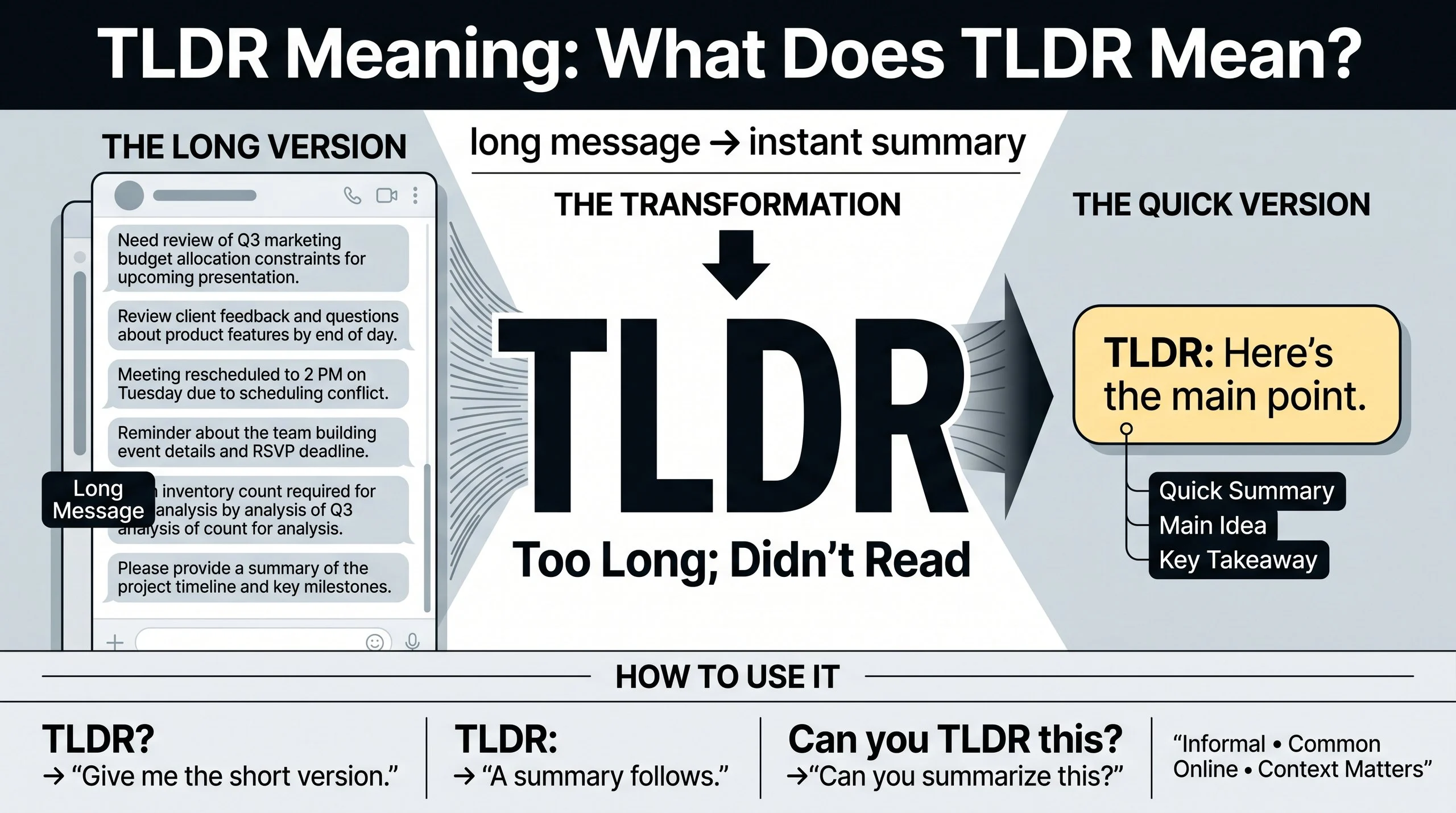
The TLDR meaning is “too long; didn’t read.” It is an internet abbreviation people use when a message, article, post, or explanation is very long. It can also introduce a short summary of the main point.
For example, someone may write “TLDR: The meeting was moved to Friday.” Here, TLDR means “here is the short version.”
The abbreviation is common in texting, forums, social media, emails, comments, and online discussions. Depending on the context, it can sound helpful, humorous, neutral, or slightly dismissive.
In simple terms, TLDR means “too long; didn’t read,” or “here’s the short version.”
What Does TLDR Mean?
TLDR stands for “too long; didn’t read.”
People use it in two main ways:
- To say that something was too long to read.
- To provide a short summary of something lengthy.
For example:
TLDR: We need more time to finish the project.
In this example, TLDR introduces the main takeaway.
The abbreviation is informal and is especially common in digital communication.
What Does TLDR Stand For?
TLDR stands for “too long; didn’t read.”
You may also see it written as:
- TLDR
- TL;DR
- tl;dr
- TL;DR:
The punctuation can vary. However, the meaning usually stays the same.
The semicolon in TL;DR represents the separation between “too long” and “didn’t read.”
Today, people often use TLDR without punctuation because internet abbreviations tend to become simplified over time.
TLDR Meaning in Simple Words
In simple words, TLDR means “this is a short summary of a long explanation.”
Imagine that someone writes a five-paragraph message about a problem.
At the end, they add:
TLDR: The order will arrive tomorrow.
You can read the short version without going through the entire message.
As a result, TLDR is useful when readers want the main point quickly.
TLDR Meaning in Texting
In texting, TLDR usually means that a message or story is too long to read in full.
For example:
Friend: “I wrote a huge explanation about what happened at work.”
You: “TLDR?”
Here, the person is asking for the short version.
Someone might also write:
TLDR: I’m running late, so start without me.
In this case, TLDR introduces a quick summary.
Because texting often favors speed, TLDR can save time and reduce unnecessary reading.
TLDR Meaning in Social Media
On social media, TLDR is commonly used when a post contains a lot of information.
For instance:
TLDR: The event has been canceled because of the weather.
The writer gives readers the key point without requiring them to read every detail.
Likewise, someone commenting “TLDR?” may be asking another person to summarize a long post.
This usage is especially useful on platforms where users share lengthy stories, explanations, reviews, or opinions.
TLDR Meaning on Reddit
Reddit is one of the places where TLDR is especially familiar.
Users often write detailed posts and then add a short summary near the bottom.
For example:
TL;DR: I bought the laptop, tested it for two weeks, and decided to return it.
The full post might contain several paragraphs about the experience.
Meanwhile, the TLDR gives readers the conclusion immediately.
You may also see:
TLDR at the bottom.
That tells readers that a short version is available.
TLDR Meaning on TikTok
On TikTok, TLDR may appear in captions, comments, or discussions about long explanations.
For example:
TLDR: She changed the recipe because the original version was too sweet.
The abbreviation can also appear when users summarize information from a longer video.
Because short-form platforms focus on quick consumption, a concise summary can make complicated information easier to understand.
TLDR Meaning on Instagram
On Instagram, TLDR may appear in captions or comments.
For example:
TLDR: The trip was amazing, but our flight home was delayed.
A long caption might explain the entire trip.
The TLDR gives followers the central point without requiring them to read everything.
It can also appear in comments when users ask for a summary of a long post.
TLDR Meaning in Emails
TLDR can appear in informal work emails, but you should consider your audience.
For example:
TLDR: We approved the new deadline for June 15.
This can be useful when an email contains several details.
However, TLDR may sound too casual in a formal business setting.
For professional communication, alternatives such as these may work better:
- Summary
- Key takeaway
- In brief
- Bottom line
- Executive summary
- In short
The relationship between the writer and reader matters.
How Is TLDR Used?
TLDR has two major functions.
1. TLDR as a Summary
This is probably the most useful modern usage.
Example:
TLDR: The product works well, but the battery life is weak.
The writer summarizes a longer review.
2. TLDR as a Reaction
Someone can also use TLDR to say they did not read something because it was too long.
Example:
“That article is 40 pages. TLDR.”
This version can sound dismissive or humorous.
Therefore, the surrounding context matters.
TLDR Examples in Texting
Here are some natural examples.
1: Asking for a Summary
A: “I just sent you a huge message about what happened.”
B: “TLDR?”
2: Giving the Main Point
TLDR: I can’t make it tonight, but I’ll join tomorrow.
3: Long Story
TLDR: We missed the train and had to take a bus.
4: Funny Use
TLDR: Everything went wrong.
5: Online Discussion
TLDR: The update improves performance but removes two features.
These examples show how flexible the abbreviation can be.
TLDR Examples for Social Media
A creator might write:
TLDR: Save your work before installing the update.
A reviewer could say:
TLDR: Great camera, average battery, high price.
A commenter might ask:
TLDR?
Someone sharing a personal story could write:
TLDR: I quit my job and started a new career.
In each case, the reader can quickly understand the main point.
TLDR Examples for Reddit and Forums
Online discussions often contain long explanations.
For example:
TL;DR: The computer problem was caused by an outdated driver.
Another user might comment:
I didn’t read the whole thing. TLDR?
A forum moderator could write:
TLDR: Follow the first three steps to fix the issue.
Therefore, TLDR works especially well in communities where detailed posts are common.
Is TLDR Rude?
TLDR is not automatically rude, but it can sound dismissive depending on how you use it.
Consider these two examples:
TLDR: Here are the main points.
This sounds helpful.
Now compare:
TLDR. Not reading all that.
This sounds more dismissive.
Tone depends on the wording, relationship, and situation.
If you want to sound polite, use a softer phrase such as:
Short version:
or:
Here’s the quick summary:
Is TLDR Formal or Informal?
TLDR is informal internet language.
It works well in:
- texting
- casual emails
- social media
- online forums
- group chats
- casual workplace messages
However, it may not fit formal documents, academic writing, or highly professional correspondence.
Instead, use:
- Summary
- Brief summary
- Key points
- In brief
- Executive summary
The right choice depends on your audience.
TLDR vs. TL;DR
These forms generally have the same meaning:
| Form | Meaning | Usage |
|---|---|---|
| TLDR | Too long; didn’t read | Common online form |
| TL;DR | Too long; didn’t read | Traditional punctuation |
| tl;dr | Too long; didn’t read | Casual lowercase form |
| TL;DR: | Summary follows | Common heading style |
There is no major difference in meaning.
The punctuation is mostly a matter of style.
Why Do People Use TLDR?
People use TLDR because online communication can become lengthy.
A short summary helps readers:
- save time
- find the main point
- understand long posts
- skip unnecessary details
- decide whether to read the full content
- quickly understand a conclusion
For writers, TLDR can also improve readability.
Instead of forcing every reader through a long explanation, the writer can provide the main takeaway first.
TLDR and Attention Spans
Digital communication often involves quick scrolling and rapid information exchange.
Consequently, readers may not want to spend several minutes on every post.
A TLDR gives them a quick entry point.
For example:
Full explanation: 800 words
TLDR: The software update fixes security issues but may slow older devices.
The reader now understands the main point immediately.
TLDR in Online Articles
Writers sometimes use TLDR near the beginning or end of an article.
For example:
TLDR: This word means something different depending on context.
This format gives readers a direct answer.
However, a professional website may use headings such as:
- Quick Answer
- Key Takeaway
- In Short
- Summary
- Bottom Line
These options can be clearer for a broad audience.
TLDR vs. Summary
TLDR and summary are closely related, but they are not identical.
| TLDR | Summary |
|---|---|
| Informal | Neutral or formal |
| Internet slang | Standard English |
| Common in online communication | Common in writing and speech |
| Often very brief | Can be detailed |
| Casual tone | Flexible tone |
For example:
TLDR: The plan needs more time.
Formal version:
Summary: The project requires additional time before completion.
The basic idea remains similar.
TLDR vs. In Short
Both expressions introduce a condensed version.
However, “in short” is standard English, while TLDR is internet slang.
Casual:
TLDR: We need another week.
More professional:
In short, we need another week.
Therefore, choose TLDR for casual digital communication and “in short” when you need a more polished tone.
TLDR vs. BTW
These abbreviations serve different purposes.
TLDR = Too long; didn’t read
BTW = By the way
Example:
TLDR: The meeting starts at 10.
versus:
BTW, the meeting starts at 10.
TLDR summarizes information.
BTW introduces an additional or side point.
TLDR vs. IMO
These terms also have different functions.
TLDR = Too long; didn’t read
IMO = In my opinion
For example:
TLDR: The movie has a weak ending.
This summarizes a point.
Meanwhile:
IMO, the movie has a weak ending.
This expresses an opinion.
How to Use TLDR Correctly
If you want to use TLDR as a summary label, place it before the short version.
Common formats include:
TLDR: Main point here.
or:
TL;DR: Main point here.
For example:
TLDR: The package arrives Friday.
You can also place the summary at the end of a long post.
That approach lets readers choose between the full explanation and the quick version.
Common Mistakes With TLDR
1. Assuming TLDR Always Means “I Didn’t Read It”
Modern usage often means “here is the short version.”
The writer may have read and understood the entire subject.
2. Using It in Every Formal Document
TLDR is informal. A formal report should usually use Summary or Key Takeaways instead.
3. Thinking TLDR Is Always Rude
Tone depends on context.
A helpful summary is not rude simply because it uses TLDR.
4. Confusing TLDR With a Topic
TLDR is an abbreviation, not the name of a subject or concept.
5. Forgetting the Context
Someone writing “TLDR?” is usually asking you to summarize something.
Meanwhile, “TLDR:” usually introduces a summary.
Can You Say “TLDR Me”?
Yes, although it is highly informal.
Someone might say:
TLDR this for me.
That means:
“Give me a short summary of this.”
You may also see:
Can you TLDR this?
This means:
“Can you summarize this?”
The verb-like use is common in casual internet language.
Can TLDR Be Used as a Verb?
Yes.
Internet slang often turns abbreviations into verbs.
For example:
Can you TLDR this article?
Here, TLDR means summarize this.
Likewise:
Please TLDR the conversation.
This means:
Please give me a brief summary of the conversation.
This usage is informal and should be avoided in formal writing.
TLDR Tone and Context
The tone can change significantly depending on the wording.
| Expression | Likely Tone |
|---|---|
| TLDR: Here’s the main point. | Helpful |
| TL;DR: The project is delayed. | Neutral |
| TLDR? | Casual |
| TLDR please | Direct |
| TLDR. | Potentially dismissive |
| Too long, didn’t read. | Blunt |
| Quick summary: | Polite and clear |
Adding friendly language can make the abbreviation sound less harsh.
For example:
TLDR: Here’s the quick version.
sounds more helpful than:
TLDR.
Professional Alternatives to TLDR
When TLDR feels too casual, use one of these alternatives:
1. Quick Summary
Good for emails and online communication.
2. Key Takeaway
Useful when highlighting the most important point.
3. In Brief
A concise and professional option.
4. Bottom Line
Useful when giving a direct conclusion.
5. Summary
Simple, neutral, and widely accepted.
6. Executive Summary
Best suited to formal reports and business documents.
Is TLDR a Bad Word?
No. TLDR is not a swear word or inherently offensive term.
It is simply an informal internet abbreviation.
However, the way you use it can sound rude.
For example:
TLDR: Here are the three main points.
is generally harmless.
On the other hand:
TLDR. I don’t care.
can sound dismissive.
So, the issue is usually tone, not the abbreviation itself.
TLDR Meaning in Different Contexts
| Context | Likely Meaning |
|---|---|
| Texting | Too long; didn’t read / give me the short version |
| Short summary of a long post | |
| TikTok | Brief summary of longer information |
| Quick caption or comment summary | |
| Short version of a long message | |
| Forums | Summary of a detailed discussion |
| Articles | Key takeaway or brief summary |
| Casual conversation | Short version |
Context determines the exact use.
TLDR Meaning in a Sentence
Here are some natural sentences:
- TLDR: The event starts at 7 PM.
- Can you TLDR this article?
- TLDR? I don’t have time to read the whole thing.
- Here’s the TLDR: We need more money for the project.
- TL;DR, the plan didn’t work.
- I skipped the details and read the TLDR.
These examples show both the noun-like and verb-like uses.
The Origin of TLDR
TLDR developed as part of early internet communication, where users often shared lengthy posts and discussions.
The phrase “too long; didn’t read” became a way to acknowledge that a message was lengthy while offering or requesting a condensed version.
Over time, TL;DR became a common label for summaries.
Today, the abbreviation is widely recognized across many online communities.
Its meaning has also expanded. Instead of only saying “I did not read this,” TLDR often means:
“Here is the important part.”
Why TLDR Is Useful
TLDR is useful because it supports quick information scanning.
Readers can immediately identify the central idea.
Writers also benefit because a concise summary can make lengthy content more accessible.
For example:
Long explanation:
A company discusses several reasons for changing its delivery policy.
TLDR:
Delivery times are increasing because demand has grown.
The second version gives the reader the essential information immediately.
When Should You Avoid TLDR?
Avoid TLDR when the situation requires a formal or polished tone.
That includes:
- academic papers
- legal documents
- formal business reports
- official letters
- professional proposals
- highly formal emails
Instead, choose Summary, Key Points, or Executive Summary.
Additionally, avoid using TLDR as a way to mock someone for writing a detailed explanation.
Quick TLDR Meaning Guide
| Question | Answer |
|---|---|
| What does TLDR mean? | Too long; didn’t read. |
| What does TLDR stand for? | Too long; didn’t read. |
| What does TLDR mean in text? | A short version of a long message or a comment that something was too long to read. |
| What does TLDR mean on Reddit? | Usually a short summary of a long post. |
| Is TLDR slang? | Yes, it is informal internet language. |
| Is TLDR rude? | It can sound rude depending on context and wording. |
| Is TLDR formal? | No. It is generally informal. |
| What does TL;DR mean? | The same as TLDR: “too long; didn’t read.” |
| Can TLDR be a verb? | Yes. “TLDR this” means “summarize this.” |
| What is a formal alternative? | Summary, key takeaway, in brief, or executive summary. |
| Is TLDR a bad word? | No. It is an informal abbreviation, not profanity. |
| Can TLDR introduce a summary? | Yes. This is one of its most common modern uses. |
FAQs
1. What does TLDR mean?
TLDR means “too long; didn’t read.” It is commonly used to summarize a long message, article, post, or explanation.
2. What does TLDR stand for?
TLDR stands for “too long; didn’t read.”
3. What does TLDR mean in texting?
In texting, TLDR can mean that something is too long to read. It can also introduce a short summary.
4. What does TLDR mean on Reddit?
On Reddit, TLDR usually introduces a brief summary of a longer post or discussion.
5. What does TL;DR mean?
TL;DR has the same meaning as TLDR. The punctuation simply separates the two parts of the original phrase.
6. Is TLDR rude?
Not necessarily. It can be helpful when introducing a summary, but it may sound dismissive when used as a blunt response.
7. Is TLDR slang?
Yes. TLDR is informal internet slang and an abbreviation used in digital communication.
8. Can I use TLDR in a professional email?
You can, especially in a casual workplace. However, Summary or Key Takeaway is usually better for formal professional communication.
9. Can TLDR be used as a verb?
Yes. People may say “TLDR this” to mean “summarize this.”
10. What is a polite alternative to TLDR?
Good alternatives include “Quick summary,” “In brief,” “Key takeaway,” and “Here’s the short version.”
11. Does TLDR mean the person did not read anything?
Not always. Modern usage often means “here is the short version” rather than a literal admission that someone skipped the entire text.
12. Is TLDR a bad word?
No. TLDR is not profanity. It is simply an informal abbreviation.
13. What does “TLDR?” mean?
When someone writes “TLDR?”, they are usually asking for a short summary.
14. What does “TLDR:” mean?
When a writer uses “TLDR:”, it usually means that a short summary or main takeaway follows.
15. Is TLDR the same as summary?
They have similar functions, but TLDR is informal internet language, while summary is standard English and works in both formal and informal settings.
Conclusion
The TLDR meaning is “too long; didn’t read.” However, modern internet users often use it more positively to introduce a short summary or the most important point from a longer message.
You may see TLDR in texting, Reddit posts, social media captions, emails, forums, articles, and online discussions. It can be written as TLDR, TL;DR, or tl;dr, with little difference in meaning.
In casual communication, the abbreviation is convenient and widely understood. For formal writing, however, alternatives such as Summary, Key Takeaway, and In Brief are usually more appropriate.
Most importantly, remember the two common uses:
TLDR = “Too long; didn’t read.”
TLDR: = “Here’s the short version.”
Context and tone determine which meaning is intended.

Charlotte Wilson is a language writer passionate about word meanings, synonyms, and clear communication. She creates accurate and engaging content to help readers expand their vocabulary and language skills.

12 thoughts on “TLDR Meaning| What Does TLDR Mean in Texting and Online?”