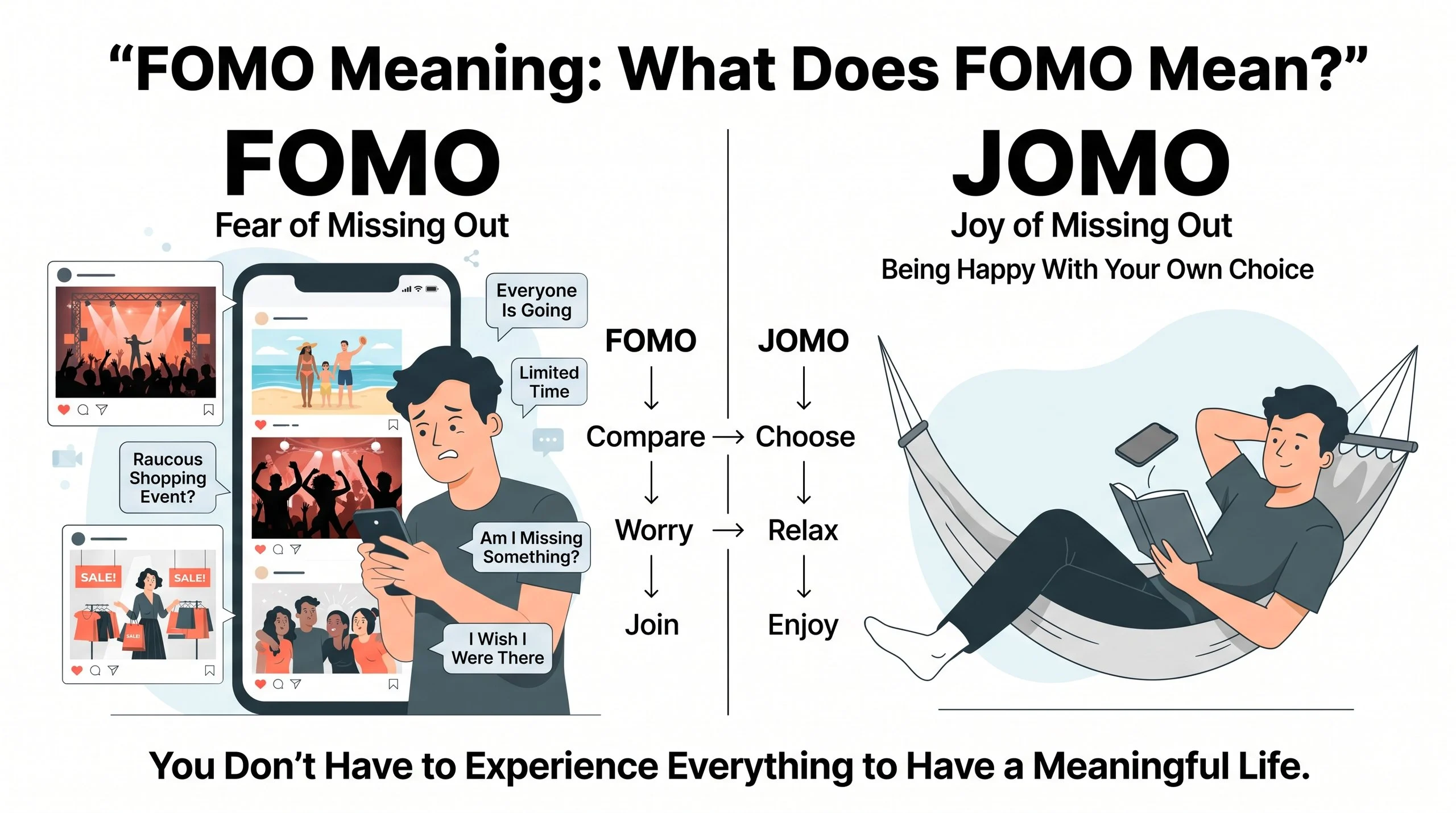
The FOMO meaning is “Fear of Missing Out.” It describes the uneasy feeling that other people are experiencing something exciting, valuable, or important without you. As a result, you may feel pressured to join an event, check social media, buy something, respond to a message, or make a decision because you do not want to be left out.
FOMO is especially common in conversations about social media, parties, travel, entertainment, shopping, friendships, and online trends. For example, someone might say, “Everyone is going to the party, and now I have FOMO.”
In simple terms, FOMO means worrying that you are missing something good while other people are enjoying it without you.
What Does FOMO Mean?
FOMO stands for “Fear of Missing Out.”
It refers to the feeling that you might be missing an enjoyable experience, social event, opportunity, trend, or important information.
For example:
“I wasn’t planning to go, but everyone else is going, so I have FOMO.”
Here, the speaker feels pressure to participate because they do not want to feel excluded.
The term is widely used in casual conversations, texting, memes, and social media.
What Does FOMO Stand For?
FOMO stands for:
Fear of Missing Out
Each part of the phrase contributes to its meaning:
- Fear — an uncomfortable feeling or concern
- Missing — not experiencing or participating in something
- Out — being excluded from an activity or situation
Together, the phrase describes anxiety about being left out of something that other people are experiencing.
Although the phrase can describe serious social anxiety, everyday users often employ it casually.
FOMO Meaning in Simple Words
In simple language, FOMO means feeling like you are missing something fun, important, or exciting while everyone else is involved.
Imagine that your friends post pictures from a party you skipped. You suddenly wish you had gone because the event looks much more exciting than you expected.
That feeling is a classic example of FOMO.
Similarly, you might see people discussing a popular movie and immediately decide to watch it because you do not want to be the only person who has not seen it.
Therefore, FOMO is closely connected to comparison, curiosity, social belonging, and the fear of exclusion.
FOMO Meaning in Texting
In texting, FOMO is usually informal and conversational.
Someone might send:
“I wasn’t going to come, but now I have FOMO 😂.”
The person means that seeing other people participate has made them reconsider their decision.
Another example is:
“Don’t give me FOMO with those pictures!”
This means:
“Your pictures are making me wish I had been there.”
Because FOMO is a familiar internet abbreviation, people can use it without explaining the full phrase.
FOMO Meaning on Social Media
Social media is strongly associated with FOMO because users constantly see carefully selected snapshots of other people’s lives.
For example, you might see:
- friends attending a concert
- someone traveling abroad
- people at a party
- a new restaurant everyone is visiting
- a product selling out
- a viral trend
- an exclusive event
- someone celebrating an achievement
Seeing these posts can create the impression that everyone else is having exciting experiences.
However, social media usually shows selected moments rather than someone’s complete life. Therefore, what appears to be a constant stream of fun may not represent reality.
FOMO Meaning on TikTok
On TikTok, people commonly use FOMO when talking about trends, events, products, challenges, travel, entertainment, or experiences.
For example:
“TikTok gave me FOMO, so I booked the trip.”
The speaker means that watching other people’s videos made them want to experience the same thing.
Another common use involves viral products:
“Everyone has this skincare product. Major FOMO.”
Here, FOMO means the person feels left out because they have not tried something popular.
The expression can therefore describe both genuine emotional discomfort and playful exaggeration.
FOMO Meaning on Instagram
Instagram can also trigger or describe FOMO.
Stories, Reels, posts, and event photos often show people enjoying experiences that others are not sharing.
Someone might comment:
“This is giving me serious FOMO.”
That means:
“Seeing this makes me wish I were there.”
Similarly:
“Weekend FOMO is real.”
This can refer to feeling left out after seeing other people’s weekend activities.
Common Examples of FOMO
FOMO can appear in many everyday situations.
1. Social Events
“I skipped the party, but the pictures gave me FOMO.”
The person now wishes they had attended.
2. Travel
“Everyone is traveling this summer, and I have major FOMO.”
The speaker feels left out because others are traveling.
3. Concerts
“I didn’t buy tickets, and now I have FOMO.”
The person regrets missing the event.
4. Shopping
“The sale ends tonight, and I don’t want to miss out.”
Here, FOMO creates urgency around a purchase.
5. Social Media Trends
“Everyone is doing this challenge, so I have FOMO.”
The person feels pressure to participate.
6. Friendships
“They all went out without me. Instant FOMO.”
The speaker feels excluded from a social experience.
Why Do People Experience FOMO?
Several factors can contribute to FOMO.
1. Social Comparison
People naturally compare their experiences with those of others.
When someone appears to be having more fun, achieving more, or participating in more activities, you may feel that your own life is lacking.
2. Fear of Exclusion
Humans generally have a desire to belong.
Being left out of a group activity can therefore feel uncomfortable, particularly when the group includes close friends.
3. Social Media Exposure
Constant access to other people’s updates can make comparison easier.
Instead of occasionally hearing about what friends are doing, you can now see updates throughout the day.
4. Uncertainty
Sometimes FOMO comes from not knowing what might happen.
You may think:
“What if this turns out to be the best event of the year?”
That uncertainty can make staying home feel like a risky decision.
5. Desire for New Experiences
Curiosity can also contribute to FOMO.
People naturally want to explore interesting places, activities, trends, and opportunities.
FOMO and Social Media
The relationship between FOMO and social media is particularly important.
Platforms make it easy to observe what other people are doing in real time. Consequently, users can constantly encounter reminders of events they did not attend or opportunities they did not pursue.
For example, a person may spend an ordinary evening at home. Meanwhile, their feed shows friends at restaurants, concerts, parties, or vacations.
The comparison can create the impression:
“Everyone else is living an exciting life except me.”
That conclusion may not be accurate. Social media is selective, and people generally choose what they want others to see.
Thus, FOMO can sometimes be intensified by an incomplete picture of other people’s lives.
1. FOMO vs. Regret
FOMO and regret are related but different.
FOMO usually happens before or during a decision.
You worry that you might miss something.
Regret often happens afterward.
You wish you had made a different choice.
For example:
“I don’t want to stay home because I might miss something.”
This is FOMO.
Later:
“I wish I had gone to the party.”
This is regret.
The two emotions can overlap, but they describe different points in the decision-making process.
2. FOMO vs. JOMO
The opposite idea of FOMO is often called JOMO, or “Joy of Missing Out.”
FOMO says:
“What if I’m missing something?”
JOMO says:
“I’m happy doing what I chose instead.”
For example:
FOMO:
“Everyone is going out tonight. Maybe I should go too.”
JOMO:
“Everyone is going out, but I’m enjoying a quiet night at home.”
JOMO emphasizes satisfaction with your own choices rather than comparing them with other people’s activities.
3. FOMO vs. YOLO
FOMO and YOLO can sometimes influence the same decision, but they have different meanings.
FOMO = Fear of Missing Out
YOLO = You Only Live Once
FOMO focuses on avoiding exclusion or missing opportunities.
YOLO focuses on taking risks or enjoying life because life is limited.
For example:
“I bought the expensive concert ticket because of FOMO.”
The person did not want to miss the event.
Meanwhile:
“I bought the ticket because YOLO.”
The person is emphasizing the idea of enjoying life.
FOMO in Marketing and Advertising
Businesses sometimes use FOMO to encourage customers to act quickly.
Common examples include:
- “Only a few left!”
- “Sale ends tonight!”
- “Limited-time offer!”
- “Almost sold out!”
- “Last chance!”
- “Join thousands of others!”
These messages can create a sense of urgency.
The underlying idea is simple: if people believe an opportunity might disappear, they may be more likely to act immediately.
FOMO marketing is especially common in online shopping, ticket sales, memberships, travel bookings, and limited-edition products.
4. FOMO and Decision-Making
FOMO can influence everyday decisions.
Someone might:
- attend an event they do not actually want to attend
- purchase something they do not need
- stay online longer than intended
- constantly check notifications
- join trends simply because others are doing them
- accept too many invitations
- make an impulsive decision
- compare their lifestyle with others
The problem is not necessarily participating.
Instead, the concern arises when fear of missing out consistently determines your choices.
Signs You May Be Experiencing FOMO
Common signs include:
- constantly checking social media
- feeling anxious when you are not included
- saying yes when you want to say no
- comparing your life with others
- worrying about what you might miss
- frequently changing plans
- making impulsive purchases
- feeling uncomfortable when offline
- checking messages repeatedly
- regretting decisions before anything has happened
Occasional FOMO is normal. However, persistent distress may indicate that your relationship with social media, comparison, or decision-making deserves closer attention.
How to Deal With FOMO
FOMO does not have to control your decisions.
Several simple strategies can help.
1. Ask What You Actually Want
Before saying yes to something, ask:
“Would I choose this if I hadn’t seen what everyone else was doing?”
That question can separate genuine interest from social pressure.
2. Limit Social Media Checking
Constant exposure can intensify comparison.
Setting specific times to check social media can create more mental space.
3. Focus on Your Current Experience
Instead of thinking about what others are doing, pay attention to what you are doing.
A quiet evening can be enjoyable without being compared to someone else’s night.
4. Accept That You Cannot Do Everything
Every choice involves alternatives.
If you attend one event, you may miss another. If you spend money on one experience, you may not spend it elsewhere.
Accepting this reality can reduce unnecessary pressure.
5. Practice JOMO
Try intentionally enjoying the things you choose not to do.
Staying home, taking a break, reading, spending time with family, or simply resting can all be worthwhile.
6. Remember That Social Media Is Selective
People usually share highlights rather than every ordinary moment.
A person’s feed does not provide a complete picture of their life.
FOMO in Different Situations
| Situation | Typical FOMO Thought |
|---|---|
| Party | “Everyone is there without me.” |
| Travel | “I’m missing out on great experiences.” |
| Shopping | “What if the deal disappears?” |
| Social media | “Everyone seems to be having fun.” |
| Gaming | “Everyone is playing without me.” |
| Dating | “What if I miss my chance?” |
| Career | “What if everyone advances while I stay behind?” |
| Entertainment | “Everyone has seen this except me.” |
| Friendships | “What if they become closer without me?” |
The underlying pattern is usually the same: concern about missing an experience, opportunity, or connection.
FOMO in a Sentence
Here are natural examples of the term in everyday communication:
- “I have FOMO after seeing everyone’s vacation photos.”
- “Don’t post the concert videos; you’re giving me FOMO!”
- “I joined the group chat because I had FOMO.”
- “My friends convinced me to come because I didn’t want FOMO.”
- “I bought the tickets because of FOMO.”
- “Social media sometimes gives me serious FOMO.”
- “I’m staying home tonight and embracing JOMO instead.”
These examples show how FOMO can function naturally as a noun in casual conversation.
Is FOMO a Slang Word?
FOMO is commonly treated as informal slang or an internet-era abbreviation.
It is now widely understood in everyday English, particularly in conversations involving social media and modern digital culture.
Despite its informal origins and usage, the term can also appear in discussions about psychology, marketing, technology, and consumer behavior.
Therefore, FOMO occupies an interesting space between casual slang and a widely recognized modern expression.
Is FOMO Only About Social Media?
No.
Social media can make FOMO more noticeable, but the feeling existed before modern social platforms.
People can experience FOMO when they hear friends discussing an event, discover that coworkers attended a gathering, learn about an opportunity after it passed, or see a group enjoying an activity without them.
Social media simply makes these experiences easier to observe and compare.
Can FOMO Be a Good Thing?
FOMO is usually discussed negatively, but it can sometimes encourage people to participate in worthwhile experiences.
For example, fear of missing an opportunity might encourage someone to:
- attend a networking event
- reconnect with friends
- try a new activity
- travel somewhere new
- learn about an opportunity
- participate in a community
The important distinction is why you are making the decision.
If FOMO encourages you to explore something you genuinely value, the result may be positive. On the other hand, if it repeatedly pushes you into unwanted commitments or impulsive choices, it can become unhealthy.
Common Mistakes When Using FOMO
1. Thinking FOMO Means “Missing Something”
FOMO is more specific than simply missing an event.
It describes the fear or anxiety associated with missing out.
2. Using FOMO in Formal Situations Without Explanation
Although widely recognized, FOMO remains informal in many contexts.
A formal article may define the term before using it.
3. Assuming FOMO Always Means Serious Anxiety
People often use FOMO casually.
For example:
“I have FOMO because everyone ordered pizza.”
This does not necessarily indicate severe emotional distress.
4. Confusing FOMO With Regret
FOMO generally concerns the fear of missing something, while regret usually involves wishing you had made a different choice after the fact.
5. Assuming FOMO Is Always Bad
The feeling can occasionally motivate someone to participate in an experience they genuinely value.
Related Terms to FOMO
Several modern expressions are connected to FOMO.
| Term | Meaning |
|---|---|
| FOMO | Fear of Missing Out |
| JOMO | Joy of Missing Out |
| YOLO | You Only Live Once |
| FOBO | Fear of a Better Option |
| Social comparison | Comparing your experiences with others |
| Peer pressure | Influence from other people |
| Regret | Distress about a past decision |
| Fear of exclusion | Concern about being left out |
Among these, JOMO is the closest conceptual opposite of FOMO.
FOMO Meaning Compared With Similar Expressions
| Expression | Meaning | Main Focus |
|---|---|---|
| FOMO | Fear of Missing Out | Avoiding exclusion |
| JOMO | Joy of Missing Out | Enjoying your own choice |
| YOLO | You Only Live Once | Taking opportunities |
| FOBO | Fear of a Better Option | Difficulty choosing |
| Regret | Wishing you chose differently | Past decision |
| Peer pressure | Pressure from others | Social influence |
These expressions may appear together online, but each describes a different idea.
FOMO Grammar and Usage
FOMO is generally used as a noun.
Common patterns include:
- “I have FOMO.”
- “That gave me FOMO.”
- “I’m getting FOMO.”
- “My FOMO made me go.”
- “She has serious FOMO.”
- “Don’t give me FOMO.”
The word can also appear in compounds such as:
- FOMO-driven
- FOMO marketing
- FOMO culture
- FOMO behavior
Because it is an acronym, it is usually written in capital letters as FOMO.
Quick FOMO Meaning Guide
| Question | Answer |
|---|---|
| What does FOMO mean? | Fear of Missing Out |
| What does FOMO stand for? | Fear of Missing Out |
| Is FOMO slang? | It is an informal modern abbreviation |
| What does FOMO mean in texting? | Feeling worried about missing something |
| Is FOMO related to social media? | Yes, although it is not limited to social media |
| What is the opposite of FOMO? | JOMO, or Joy of Missing Out |
| Can FOMO affect decisions? | Yes |
| Can FOMO influence shopping? | Yes |
| Is FOMO always serious? | No; it is often used casually |
| Can FOMO be positive? | It can sometimes motivate participation |
| Is FOMO the same as regret? | No |
| Is FOMO the same as YOLO? | No |
FAQs About FOMO Meaning
1. What does FOMO mean?
FOMO means “Fear of Missing Out.” It describes the feeling that you are missing an enjoyable, important, or valuable experience that other people are having.
2. What does FOMO stand for in texting?
In texting, FOMO stands for Fear of Missing Out. People commonly use it to describe feeling left out or wishing they were participating in something.
3. What is an example of FOMO?
Seeing your friends at a party and wishing you had gone is a simple example of FOMO.
4. What does FOMO mean on social media?
On social media, FOMO describes the feeling of missing out after seeing other people’s activities, achievements, trips, events, purchases, or experiences.
5. What is the opposite of FOMO?
The commonly used opposite is JOMO, meaning “Joy of Missing Out.” It describes feeling comfortable or happy with choosing not to participate.
6. Is FOMO a bad thing?
Not necessarily. Occasional FOMO is common. However, persistent FOMO can encourage unhealthy comparison, impulsive decisions, or excessive social-media use.
7. Why does social media cause FOMO?
Social media constantly exposes users to selected moments from other people’s lives. This can increase comparison and create the impression that others are always enjoying better experiences.
8. Is FOMO the same as anxiety?
FOMO can involve anxiety or worry, but the terms are not identical. FOMO specifically concerns the fear of missing an experience, opportunity, connection, or event.
9. Can FOMO affect shopping?
Yes. Limited-time offers, low-stock messages, and exclusive products can create urgency and encourage people to buy because they fear missing an opportunity.
10. What does “you’re giving me FOMO” mean?
It means that something someone shared is making you wish you were participating in the same experience.
11. What does “I have FOMO” mean?
It means the speaker feels worried or disappointed about potentially missing something that other people are experiencing.
12. How can I reduce FOMO?
You can reduce FOMO by limiting unnecessary social-media checking, focusing on your own priorities, accepting that you cannot do everything, and becoming more comfortable with your personal choices.
Conclusion
The FOMO meaning is “Fear of Missing Out.” It describes the feeling that other people are enjoying experiences, opportunities, events, or connections that you are missing.
Today, FOMO is especially common in texting and social media conversations. Instagram, TikTok, online communities, and digital marketing can all amplify the feeling because they make other people’s activities highly visible.
Still, FOMO is not limited to the internet. People can experience it whenever they compare their choices with opportunities or experiences they believe they are missing.
Understanding FOMO can make the feeling easier to recognize. Instead of automatically following what everyone else is doing, you can ask whether the experience genuinely matters to you.
Sometimes, joining in is exactly what you want. Other times, choosing not to participate can be just as valuable.
That is where the idea of JOMO, or Joy of Missing Out, becomes useful: a meaningful life does not require experiencing everything. It can also involve being comfortable with the experiences you deliberately choose.

Harry Edwards is a language writer specializing in word meanings, synonyms, and language usage. He creates clear, accurate, and engaging content to help readers improve their vocabulary and communication skills.


11 thoughts on “FOMO Meaning| What Does FOMO Mean in Text? The Psychology, Examples & Digital Culture Explained 2026”