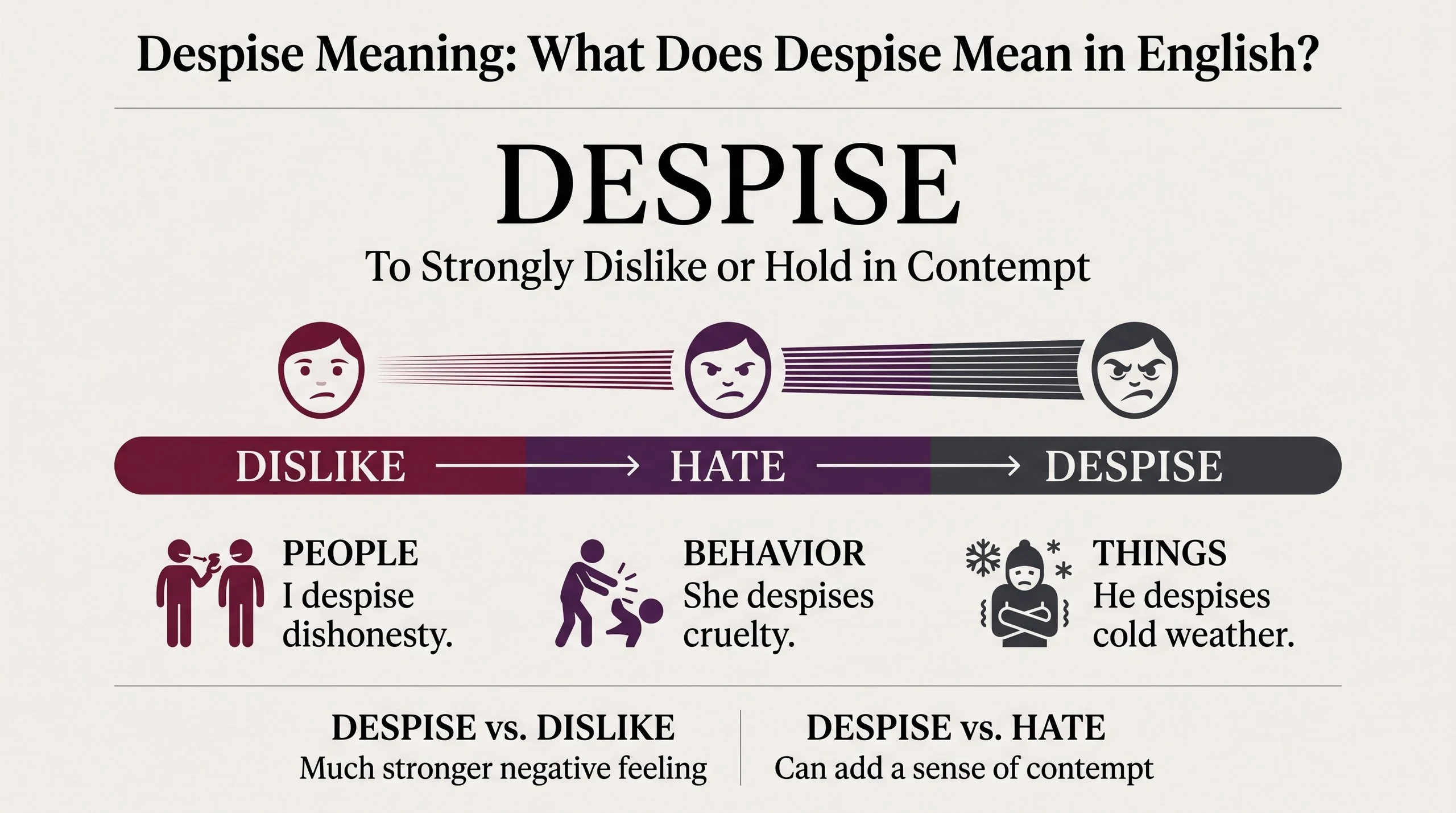
Despise meaning is to strongly dislike, hate, or have intense contempt for someone or something. The word expresses a much stronger negative feeling than ordinary dislike. For example, “I despise dishonesty” means “I strongly hate or have deep contempt for dishonesty.”
Despise meaning refers to having an intense feeling of dislike, hatred, or contempt toward someone or something. When you despise something, you strongly reject it emotionally or morally rather than simply finding it unpleasant.
For example, someone might say, “I despise cruelty.” This statement shows a powerful negative reaction toward cruel behavior. Likewise, “She despises dishonesty” means that she has a deep dislike or contempt for dishonest actions.
The word despise is stronger than dislike, but it does not always mean exactly the same thing as hate. In many contexts, despise suggests contempt, disrespect, or a belief that someone or something is beneath respect.
You can use despise for people, behaviors, habits, ideas, situations, and things. However, the word usually carries a serious or emotionally intense tone. Therefore, choosing it carefully can make your writing more precise.
This guide explains the despise meaning, its origin, synonyms, examples, differences from related words, common mistakes, and natural ways to use it in everyday English.
Quick Answer
| Meaning | Context | Primary Platforms | Example | Tone |
|---|---|---|---|---|
| Strongly dislike | Everyday English | Conversation, writing | “I despise dishonesty.” | Strongly negative |
| Feel contempt for | People or behavior | Conversation, literature | “He despises cruelty.” | Harsh |
| Strongly reject | Ideas or practices | Formal writing | “She despises corruption.” | Serious |
| Hate intensely | Casual conversation | Texting, speech | “I despise waking up early.” | Emotional |
| Regard with contempt | Literature and formal English | Books, essays | “The ruler despised his enemies.” | Formal |
What Does Despise Mean?
The verb despise means to strongly dislike someone or something, often with feelings of contempt or disrespect.
A simple definition is:
To despise something means to dislike it intensely and regard it with contempt.
For example:
“He despises dishonesty.”
This sentence means that he has an extremely strong negative attitude toward dishonesty.
Another example is:
“She despises being treated unfairly.”
Here, despise emphasizes a powerful emotional rejection of unfair treatment.
Is Despise Stronger Than Dislike?
Yes.
The word dislike can describe a mild or moderate negative feeling.
For example:
“I dislike rainy weather.”
This does not necessarily mean that the speaker feels intense emotion.
By contrast:
“I despise cruelty.”
This expresses a much stronger reaction.
The difference can be summarized like this:
Dislike → Strong dislike → Despise
However, emotional intensity depends on context. Someone may use despise casually for emphasis, even when the feeling is not literally extreme.
Despise Meaning in Everyday English
In everyday English, people use despise when they want to emphasize how strongly they dislike something.
Common examples include:
- “I despise arrogance.”
- “She despises dishonesty.”
- “He despises being late.”
- “They despise unfair treatment.”
- “I absolutely despise that attitude.”
The word can sound stronger and more dramatic than ordinary conversational alternatives.
For example:
“I don’t like rude people.”
sounds relatively neutral.
Meanwhile:
“I despise rude behavior.”
sounds much more forceful.
As a result, despise often appears when the speaker wants to communicate a strong emotional or moral reaction.
Despise Meaning in Simple English
If you want to explain despise in very simple language, you can say:
Despise means to dislike someone or something very strongly.
Another simple explanation is:
If you despise something, you strongly hate or look down on it.
The second explanation highlights the idea of contempt.
For example:
“She despises lies.”
means:
“She strongly hates or looks down on lying.”
Despise vs. Hate
Despise and hate are close in meaning, but they are not always identical.
Hate generally means to feel intense dislike toward someone or something.
Despise often adds an element of contempt or disrespect.
Compare:
“I hate waiting in long lines.”
This expresses strong annoyance or dislike.
“I despise people who exploit others.”
This expresses strong dislike combined with moral condemnation or contempt.
Therefore, despise can sound more judgmental than hate.
When Should You Use Hate Instead?
Use hate when you simply want to express very strong dislike.
For example:
“I hate waking up early.”
This sounds natural and common.
Use despise when you want a stronger or more formal expression, especially when contempt is part of the meaning.
“He despises dishonesty.”
That sentence sounds more deliberate and serious.
Despise vs. Dislike
The difference is mainly one of intensity.
| Word | General Strength | Example |
|---|---|---|
| Dislike | Mild to moderate | “I dislike loud music.” |
| Hate | Very strong | “I hate dishonesty.” |
| Despise | Very strong, often with contempt | “I despise cruelty.” |
Dislike works well for ordinary preferences.
Despise usually describes a much stronger emotional reaction.
Despise vs. Loathe
Loathe is one of the closest synonyms for despise.
Both words can express intense dislike.
For example:
“I loathe dishonesty.”
and:
“I despise dishonesty.”
have very similar meanings.
However, loathe often emphasizes intense emotional hatred or disgust, while despise can emphasize contempt.
The distinction is subtle.
Example
“She loathes spiders.”
This emphasizes intense dislike.
“She despises dishonest politicians.”
This can suggest both intense dislike and contempt for their behavior.
Despise vs. Detest
Detest means to dislike something extremely strongly.
It is another close synonym of despise.
For example:
“He detests hypocrisy.”
and:
“He despises hypocrisy.”
Both sentences express strong negative feelings.
Still, despise can carry a stronger sense of looking down on the object of dislike.
Despise vs. Contempt
These words are related but have different grammatical functions.
Despise is a verb.
Contempt is a noun.
For example:
“She despises arrogance.”
Here, despises describes an action or emotional attitude.
You could also say:
“She has contempt for arrogance.”
The two expressions communicate a similar idea, although the sentence structures differ.
Despise Meaning in Relationships
The word can describe intense negative feelings between people.
For example:
“He despises his former business partner.”
This means he feels extremely strong dislike or contempt toward that person.
However, the word does not necessarily tell us why.
The reason could involve:
- Betrayal
- Conflict
- Dishonesty
- Abuse
- Broken trust
- Personal resentment
- Serious disagreement
The surrounding context explains the cause.
Does Despise Mean You Hate Someone?
It can.
If someone says:
“I despise him.”
they are expressing extremely strong negative feelings toward that person.
However, despise often adds the idea of contempt. The speaker may not simply dislike the person; they may also regard that person’s behavior or character with deep disrespect.
Despise Meaning in Texting
In texting, despise usually retains its standard meaning: to strongly dislike or have contempt for something.
For example:
“I despise Mondays.”
This means:
“I really hate Mondays.”
Because despise sounds slightly more formal than hate, its use in texting can sometimes feel dramatic or playful.
For example:
“I despise doing laundry 😂”
The speaker may be exaggerating for humor.
Despise in Casual Messages
People may use the word for:
- Annoying habits
- Bad weather
- Certain foods
- Difficult tasks
- Unpleasant routines
- Negative behavior
Examples include:
“I despise traffic.”
“I despise cold coffee.”
“I despise unnecessary drama.”
The seriousness depends on the context.
Despise Meaning on Social Media
Social media users may use despise to express strong opinions.
For example:
“I despise clickbait.”
or:
“I despise this trend.”
The word can make a statement sound more forceful.
However, online communication often uses exaggerated language. Someone may say they “despise” something while simply finding it annoying.
Therefore, do not always interpret the word as evidence of deep personal hatred.
Despise Meaning in Literature
Despise appears frequently in literature because it can communicate intense emotional conflict.
Writers may use it to describe:
- Enemies
- Betrayal
- Jealousy
- Social injustice
- Arrogance
- Cruelty
- Corruption
- Moral conflict
For example:
“The hero despised the tyrant’s cruelty.”
This sentence conveys more than simple dislike. It suggests that the hero strongly rejects the tyrant’s behavior and views it with contempt.
The word is especially useful when an author wants to show a character’s powerful emotional response without repeatedly using hate.
Despise Meaning in Formal Writing
Despise can work well in formal writing when the subject involves strong opposition or contempt.
Examples include:
“The author despises corruption and hypocrisy.”
“The character despises injustice.”
“The philosopher argued that societies should despise cruelty.”
However, formal writing should still use the word carefully.
If the writer is describing another person’s attitude, the sentence should make that attribution clear.
For example:
“The character despises the practice.”
This tells readers whose attitude is being described.
Despise Meaning in Psychology and Emotion
The word can describe a strong emotional reaction involving negative judgment.
When someone despises something, the reaction may include:
- Anger
- Disgust
- Resentment
- Contempt
- Moral rejection
- Strong dislike
Not every use involves all these emotions.
For example, someone might say:
“I despise waking up early.”
That may simply express frustration.
Meanwhile:
“She despises cruelty.”
may express a deeper moral objection.
Thus, context determines the emotional depth.
Contextual Dynamics & Nuances of Despise
The word despise can communicate different shades of meaning.
Despise as Strong Dislike
“I despise bitter coffee.”
Here, the speaker simply has a very strong negative preference.
Despise as Contempt
“He despises dishonest people.”
This suggests that he not only dislikes dishonesty but also looks down on it.
Despise as Moral Rejection
“She despises cruelty toward animals.”
This expresses strong moral opposition.
Despise as Dramatic Emphasis
“I despise Mondays.”
The speaker may simply be exaggerating a common frustration.
Therefore, the word does not always indicate literal hatred.
Real-Life Examples of Despise
Example 1: Personal Preference
“I despise extremely sweet drinks.”
The speaker strongly dislikes them.
Example 2: Behavior
“She despises dishonesty.”
The sentence indicates strong dislike and possibly contempt for lying.
Example 3: Workplace
“He despises unnecessary meetings.”
The speaker strongly dislikes meetings that seem unproductive.
Example 4: Relationships
“After the betrayal, she began to despise him.”
The sentence describes an intense negative emotional change.
Example 5: Moral Belief
“They despise cruelty in any form.”
This expresses strong moral opposition.
How to Use Despise in a Sentence
Despise is a transitive verb, so it usually takes a direct object.
Basic Structure
Subject + despise + object
Examples:
“I despise dishonesty.”
“She despises arrogance.”
“They despise violence.”
“He despises unfair rules.”
Using Despise With a Person
“She despises her former manager.”
This means she feels intense dislike or contempt toward that person.
Using Despise With an Action
“He despises lying.”
This means he strongly dislikes or condemns lying.
Using Despise With a Thing
“I despise cold weather.”
This expresses a very strong dislike of cold weather.
Despise Verb Forms
The verb changes according to tense.
| Form | Example |
|---|---|
| Base form | “I despise dishonesty.” |
| Third-person singular | “She despises dishonesty.” |
| Past tense | “He despised dishonesty.” |
| Present participle | “They are despising the behavior.” |
| Past participle | “She has despised the practice for years.” |
The simple past form is despised.
The third-person singular form is despises.
Common Mistakes When Using Despise
Mistake 1: Treating Despise as a Noun
Despise is primarily a verb.
Incorrect:
“My despise for him is strong.”
Better:
“My contempt for him is strong.”
Or:
“I despise him.”
If you need the noun form, contempt, hatred, or dislike may fit depending on the context.
Mistake 2: Saying “Despise for”
The usual construction is:
“I despise dishonesty.”
Not:
“I have despise for dishonesty.”
Use:
“I have contempt for dishonesty.”
Mistake 3: Using Despise for Mild Preferences
If you only have a slight dislike, despise may sound exaggerated.
For example:
“I despise this shade of blue.”
could sound unusually strong if you simply prefer another color.
In that situation, dislike may be more natural.
Mistake 4: Assuming Despise Always Means Hate
Although the meanings overlap, despise can specifically communicate contempt.
That extra shade matters in some contexts.
Mistake 5: Overusing the Word
If every disliked thing is something you “despise,” your language may lose emotional precision.
Use the word when you want to communicate strong dislike or contempt.
Is Despise a Strong Word?
Yes.
Despise generally expresses a high level of negative feeling.
A rough scale might look like:
Dislike → Strong dislike → Hate / Detest / Despise
However, there is no universal emotional ranking among these words.
Different speakers may use them differently.
The important point is that despise is much stronger than ordinary dislike.
Is Despise a Negative Word?
Yes.
Despise has a clearly negative connotation.
It communicates:
- Strong dislike
- Contempt
- Rejection
- Disrespect
- Moral opposition
- Intense negative feeling
For that reason, it can make a statement sound forceful.
Is Despise the Same as Hate?
Not exactly.
The words overlap significantly, but hate is broader.
You can hate something without necessarily feeling contempt for it.
For example:
“I hate being stuck in traffic.”
This expresses strong frustration.
By contrast:
“I despise dishonesty.”
may communicate both intense dislike and contempt.
Therefore, despise often has a more judgmental or morally charged tone.
Can You Despise a Person?
Yes.
You can say:
“He despises his former employer.”
or:
“She despises him.”
These sentences communicate very strong negative feelings.
However, because the word is intense, you should use it when the context supports that strength.
Can You Despise Yourself?
Yes, grammatically and conceptually, people can use the phrase “despise myself” to express extremely strong self-directed dislike or contempt.
For example:
“After making the mistake, he said he despised himself.”
In serious emotional contexts, this wording can communicate severe self-criticism. Therefore, readers should consider the surrounding context rather than treating the phrase as a casual expression.
Can You Despise an Object?
Yes.
Despise can describe strong dislike toward ordinary objects or things.
For example:
“I despise that old chair.”
or:
“She despises bitter medicine.”
The object does not need to have moral significance.
However, the word often sounds more natural when the speaker has a strong reason for the reaction.
Despise Synonyms
The best synonym depends on the intended shade of meaning.
Hate
Strongly dislike or feel intense negative emotion toward something.
Detest
Dislike something extremely strongly.
Loathe
Feel intense hatred or disgust toward something.
Abhor
Regard something with intense hatred or disgust, often because of moral opposition.
Dislike
Have an unfavorable feeling toward something. It is much weaker than despise.
Scorn
Treat someone or something as unworthy of respect or consideration.
Detest
Express very strong dislike, often with emotional intensity.
Contemn
Treat someone or something as unworthy of respect. This is formal and uncommon in everyday speech.
Despise vs. Abhor
Abhor is especially useful when the negative feeling involves moral disgust or strong opposition.
For example:
“She abhors cruelty.”
This sounds strongly moral.
Despise can also express moral rejection:
“She despises cruelty.”
However, despise works more broadly for people, things, habits, and situations.
Despise vs. Scorn
Scorn focuses strongly on contempt.
For example:
“He scorned the suggestion.”
This means he treated the suggestion as unworthy or foolish.
Despise expresses intense dislike or contempt.
“He despised the suggestion.”
The second sentence communicates stronger personal negativity.
Despise vs. Resent
These words describe different emotional processes.
Resent means to feel anger or bitterness because of perceived unfairness or an unwanted situation.
Despise means to strongly dislike or hold someone or something in contempt.
For example:
“She resents being ignored.”
This focuses on the feeling caused by unfair treatment.
“She despises dishonest behavior.”
This focuses on intense negative judgment.
What Is the Opposite of Despise?
Possible opposites include:
- Love
- Admire
- Respect
- Appreciate
- Cherish
- Adore
- Value
- Like
The best opposite depends on context.
For example:
“I despise arrogance.”
The opposite could be:
“I admire humility.”
Likewise:
“She despises him.”
could contrast with:
“She respects him.”
How to Respond When Someone Says “I Despise This”
The best response depends on the situation.
If They Are Expressing a Preference
Them: “I despise pineapple on pizza.”
You: “Fair enough. I actually like it.”
If They Are Expressing Strong Emotion
Them: “I despise how they treated me.”
A supportive response could be:
“That sounds really upsetting. What happened?”
If They Are Being Playful
Them: “I despise Mondays.”
You could respond:
“Same here.”
The surrounding conversation determines the appropriate tone.
FAQs
What does despise mean?
Despise means to strongly dislike someone or something, often with feelings of contempt, disrespect, or moral rejection.
Is despise stronger than dislike?
Yes. Despise generally expresses much stronger negative feelings than dislike. It can also suggest contempt.
Is despise the same as hate?
Despise and hate overlap, but despise can carry an additional sense of contempt or looking down on someone or something.
What is a synonym for despise?
Common synonyms include hate, detest, loathe, abhor, scorn, and dislike. The best choice depends on the intensity and context.
What is the opposite of despise?
Possible opposites include love, admire, respect, appreciate, adore, cherish, and value.
Can you despise a person?
Yes. Saying “I despise him” means that you have extremely strong negative feelings toward him, often including contempt.
Can you despise something?
Yes. You can despise behaviors, habits, ideas, situations, objects, or actions.
Is despise a formal word?
Despise is a standard English word that can appear in both everyday and formal writing. However, it usually communicates strong emotion.
What is the difference between despise and loathe?
Both mean to dislike something intensely. Loathe often emphasizes intense emotional dislike or disgust, while despise can emphasize contempt.
How do you use despise in a sentence?
Use despise as a verb before the object of strong dislike: “I despise dishonesty” or “She despises arrogant behavior.”
Conclusion
Despise is a strong verb that means to intensely dislike someone or something, often with feelings of contempt or disrespect.
The word is considerably stronger than dislike. It can overlap with hate, detest, loathe, and abhor, yet each word can carry a slightly different emotional shade.
In everyday English, people may use despise for habits, foods, situations, or annoying experiences. In more serious writing, the word can describe deep moral opposition or contempt toward harmful behavior.
Context remains important. Saying “I despise Mondays” may simply express humorous frustration, while saying “I despise cruelty” can communicate a serious moral position.
The most useful distinction is simple: dislike expresses a negative preference, while despise communicates a much stronger rejection, often with contempt.
Used carefully, the word gives your writing a clear sense of emotional intensity and helps distinguish ordinary dislike from deep negative feeling.