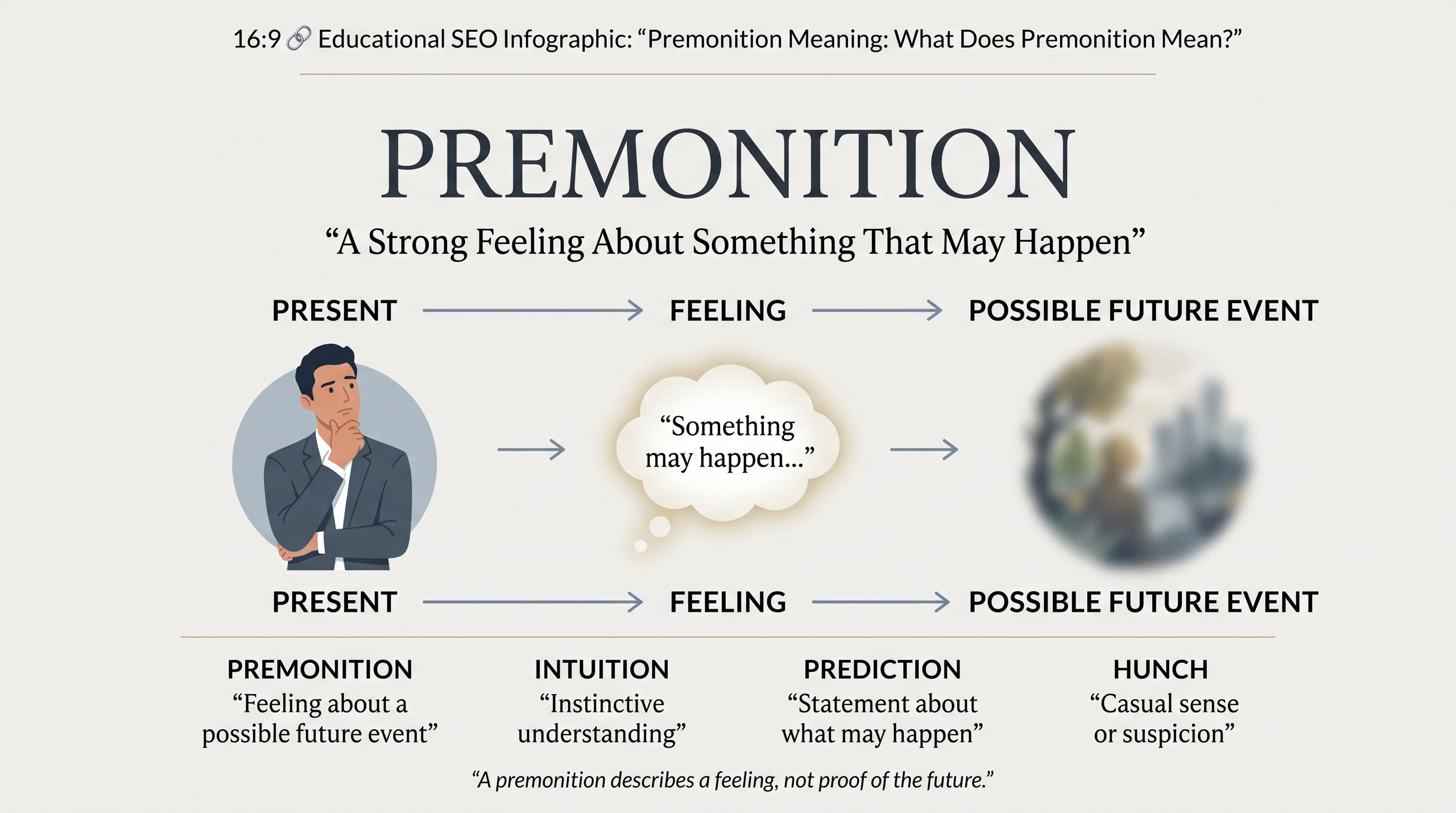
Premonition meaning refers to a strong feeling or sense that something is going to happen before there is clear evidence. A premonition can feel like a warning, intuition, dream, or unexplained sense of an upcoming event, but it does not prove that the event will occur.
Premonition meaning describes a strong feeling that something may happen in the future, especially something important, unusual, or unpleasant. The feeling often appears before a person has clear evidence that the event is coming.
For example, someone might say, “I had a premonition that something was wrong.” The speaker means they experienced an unexplained feeling that a problem might occur.
Premonitions often appear in conversations about intuition, dreams, emotions, uncertainty, and unusual experiences. They also appear frequently in books, movies, television shows, and stories involving mysterious or supernatural events.
However, a premonition does not necessarily mean that a person can predict the future. In everyday English, the word can simply describe a strong feeling that something is about to happen.
This guide explains premonition meaning, how to use the word naturally, its origin, synonyms, examples, related concepts, common misunderstandings, and the difference between a premonition, intuition, prediction, and warning.
Quick Answer
| Meaning | Context | Primary Platforms | Example | Tone |
|---|---|---|---|---|
| A strong feeling about a future event | Everyday English | Conversation, texting | “I had a premonition something would happen.” | Mysterious |
| A sense that something may happen | Personal experiences | Conversation | “She had a strange premonition.” | Serious |
| An apparent warning before an event | Stories and literature | Books, movies | “His premonition warned him to leave.” | Dramatic |
| An unexplained expectation | Emotional context | Social media, forums | “I had a premonition about the trip.” | Reflective |
| A perceived future sign | Spiritual or supernatural contexts | Online discussions | “He believed the dream was a premonition.” | Interpretive |
What Does Premonition Mean?
Premonition is a noun that means a strong feeling or impression that something is going to happen, especially before the person has clear evidence.
A simple definition is:
A premonition is a feeling that something may happen in the future.
For example:
“I had a premonition that we should not take that road.”
The speaker felt that something might go wrong, even though they did not have concrete evidence.
Another example is:
“She had a strange premonition before the phone call.”
This means she experienced an unusual feeling that something connected to the phone call might happen.
The word does not automatically mean that the person actually knows the future. Instead, it describes the experience of having the feeling.
Premonition Meaning in Simple English
In very simple English, a premonition is:
A strong feeling that something is going to happen before it happens.
For example:
“I had a premonition that I would receive bad news.”
This means:
“I had a strange feeling that I might receive bad news.”
The feeling may come from intuition, anxiety, memories, dreams, circumstances, or personal beliefs.
Therefore, the word describes the feeling without proving its cause.
Premonition Meaning in Everyday Conversation
People use premonition when they want to describe an unusual feeling about a future event.
Common examples include:
- “I had a premonition something was wrong.”
- “She felt a strange premonition before leaving.”
- “He described the dream as a premonition.”
- “I can’t explain it, but I had a premonition.”
- “That feeling turned out to be nothing more than a premonition.”
The word often sounds more dramatic than feeling or hunch.
For example:
“I had a feeling we would be late.”
sounds ordinary.
“I had a premonition that we would be late.”
sounds more mysterious or significant.
As a result, writers and speakers often choose premonition when they want to emphasize the unusual quality of the experience.
Is a Premonition a Prediction?
Not exactly.
A prediction is a statement or belief about what will happen in the future. It can come from evidence, analysis, knowledge, or reasoning.
A premonition is usually an unexplained or intuitive feeling about a future event.
Compare these examples:
“The weather forecast predicts heavy rain.”
This is a prediction based on meteorological information.
“I had a premonition that it would rain.”
This describes a personal feeling.
Therefore, predictions often have identifiable reasons behind them, while premonitions can feel spontaneous or difficult to explain.
Premonition vs. Intuition
Premonition and intuition are closely related, but they are not identical.
Intuition is a quick understanding or feeling that arises without conscious reasoning.
For example:
“My intuition told me that the offer was not right.”
A premonition, however, specifically involves a sense connected to something that may happen in the future.
For example:
“I had a premonition that something would go wrong.”
The distinction is simple:
- Intuition: An immediate sense or understanding.
- Premonition: A feeling about a possible future event.
An intuitive feeling can lead to what someone describes as a premonition, but the two terms are not interchangeable in every situation.
Premonition vs. Hunch
A hunch is an informal word for a feeling or suspicion that something is true or will happen.
For example:
“I have a hunch that he will call.”
A premonition can express a similar idea:
“I have a premonition that he will call.”
However, hunch sounds casual, while premonition sounds more serious, mysterious, or dramatic.
You might say:
“I have a hunch we’ll win.”
In a more dramatic story, you might write:
“She had a premonition that something terrible was coming.”
Premonition vs. Warning
A warning usually communicates a potential danger or problem.
For example:
“The sign was a warning about the dangerous road.”
A premonition is different because it describes a personal feeling about what might happen.
For example:
“He had a premonition that the road would be dangerous.”
A warning can come from another person, an object, a sign, or evidence. A premonition usually describes an internal experience.
Premonition vs. Déjà Vu
Déjà vu is the feeling that you have experienced a current situation before.
A premonition involves a feeling about something that may happen in the future.
For example:
“I felt like I had seen this moment before.”
This may describe déjà vu.
Meanwhile:
“I felt that something was about to happen.”
This may describe a premonition.
The two experiences can sometimes appear together in stories, but they have different meanings.
Contextual Dynamics & Nuances of Premonition
The meaning of premonition can change slightly depending on context.
Premonition as a Warning Feeling
Someone may experience a strong feeling that they should avoid a particular situation.
For example:
“I had a premonition that I should stay home.”
The statement describes an internal warning rather than confirmed knowledge.
Premonition as a Dream
Some people describe certain dreams as premonitions when they believe the dream resembles a later event.
For example:
“She believed her dream was a premonition.”
This statement reports her interpretation. It does not establish that the dream actually predicted the future.
Premonition in Fiction
Stories often use premonitions as a plot device.
A character might suddenly sense danger before an important event.
For example:
“The detective had a premonition that the case was not over.”
This creates suspense and prepares the reader for a later development.
Premonition as a Strong Intuitive Feeling
In everyday speech, someone may use the word without any supernatural meaning.
For example:
“I had a premonition that the meeting would be difficult.”
The speaker may simply be describing an unusually strong intuition.
Can a Premonition Be Positive?
Yes.
Although premonitions often involve danger or bad news, they do not have to be negative.
Someone could say:
“I had a premonition that this trip would change my life.”
The feeling could be hopeful or exciting.
However, the word frequently appears in negative contexts because people tend to describe unusual feelings about danger or trouble as premonitions.
Positive Example
“She had a strange premonition that everything would work out.”
Negative Example
“He had a premonition that something terrible would happen.”
The surrounding words establish the emotional tone.
Can a Premonition Be About a Person?
Yes.
A person may feel that something is about to happen involving another person.
For example:
“I had a premonition that my brother would call.”
Or:
“She had a strange premonition about her friend.”
In these cases, the word simply describes the person’s sense of an upcoming event.
Can a Premonition Be a Dream?
A dream can be described as a premonition when someone interprets it as a sign of a future event.
For example:
“He believed the dream was a premonition.”
However, the word premonition does not specifically mean dream.
A premonition can occur while someone is awake.
For example:
“While driving home, she suddenly had a premonition that something was wrong.”
Therefore, dreams are one possible form of experience that people may describe as a premonition, but they are not the definition of the word.
Real-Life Conversation Examples Using Premonition
Example 1: A Strange Feeling
Maya: “Why did you leave the party so early?”
Jordan: “I don’t know. I just had a strange premonition that I should go home.”
This example uses premonition to describe an unexplained feeling.
Example 2: Before a Phone Call
Alex: “You looked worried before your phone rang.”
Sam: “I had a premonition that someone was going to call with bad news.”
Here, the word describes a feeling about an upcoming event.
Example 3: Talking About a Dream
Nina: “You said you dreamed about the accident?”
Chris: “Yes. I wondered whether it was a premonition.”
The speaker describes an interpretation rather than a confirmed prediction.
Example 4: Casual Use
Lena: “Why did you bring an umbrella?”
Mark: “Just a premonition. The sky looked strange.”
Here, the speaker uses the word playfully or dramatically.
Example 5: Fictional Discussion
Ryan: “Why did the character refuse to enter the building?”
Emma: “She had a premonition that something bad would happen.”
This example shows how writers use the word to create suspense.
Premonition in Texting
In texting, premonition usually has the same meaning as it does in standard English.
However, people may use it more casually or humorously online.
For example:
“I have a premonition that this meeting will last three hours 😭”
The speaker probably does not claim to possess supernatural knowledge. Instead, they are using the word dramatically to describe a strong expectation.
Another example:
“Had a premonition that I forgot something.”
This can simply mean:
“I suddenly felt like I had forgotten something.”
Therefore, context matters when interpreting the word in messages.
Premonition Meaning on Snapchat
On Snapchat, someone might use premonition in a caption, message, or story when describing an unusual feeling.
Examples include:
“Had a weird premonition before leaving.”
“Why did I have a premonition about this?”
“My premonition was right 😳.”
The word is not Snapchat-specific slang. Instead, it remains a standard English noun used in a social-media setting.
A user may also use emojis to make the message sound mysterious, humorous, or dramatic.
The Role of Premonition on TikTok
TikTok creators may use premonition when discussing dreams, coincidences, intuition, unusual experiences, or fictional stories.
For example, a video caption might say:
“The dream felt like a premonition.”
Another creator might write:
“I had a premonition before this happened.”
However, online claims about predictions should be treated as personal accounts rather than automatically accepted as evidence that someone predicted an event.
The word itself only describes the reported experience.
Instagram and Texting Dynamics
On Instagram, people may use premonition in:
- Captions
- Story posts
- Comments
- Personal messages
- Storytelling content
- Entertainment discussions
For example:
“That dream felt like a premonition.”
Or:
“I had the weirdest premonition yesterday.”
Because Instagram favors visual storytelling, the word can create a mysterious or reflective tone.
In texting, however, users may choose simpler words such as feeling, hunch, or gut feeling.
Alternative Meanings & NLP Variations of the Phrase
Premonition has one primary dictionary meaning, but several related expressions help explain its semantic range.
Premonition of Something
This structure identifies the event or situation someone senses.
“She had a premonition of danger.”
Premonition That Something Will Happen
This structure introduces a specific expected event.
“He had a premonition that something would go wrong.”
Strange Premonition
This phrase emphasizes the unusual nature of the feeling.
“I had a strange premonition before the trip.”
Sudden Premonition
This phrase highlights how quickly the feeling appeared.
“A sudden premonition made her stop.”
Bad Premonition
This usually describes an unsettling feeling about a possible negative event.
“He had a bad premonition about the journey.”
Premonitory Feeling
Premonitory is the adjective related to premonition.
For example:
“She experienced a premonitory feeling.”
This form is less common in everyday conversation but can appear in formal or literary writing.
Premonition Word Forms
The main word forms include:
| Word | Part of Speech | Example |
|---|---|---|
| Premonition | Noun | “I had a premonition.” |
| Premonitions | Plural noun | “He experienced several premonitions.” |
| Premonitory | Adjective | “She had a premonitory feeling.” |
The noun premonition is by far the most common form in everyday English.
Origin and Etymology of Premonition
The word premonition comes from Latin roots associated with warning beforehand.
It developed through French into English and ultimately relates to the idea of forewarning.
The Latin verb praemonere means roughly “to warn beforehand.”
The parts of the word reflect this idea:
- pre- = before
- monere = to warn
Therefore, the historical sense of the word connects closely with the modern idea of receiving a feeling or warning before an event.
This background also explains why premonition often appears in contexts involving anticipation, warning, and future events.
Premonition in Literature
Premonitions have played an important role in storytelling for centuries.
Authors use them to create:
- Suspense
- Foreshadowing
- Mystery
- Anxiety
- Anticipation
- Character development
A character might experience a strange dream before an important event. Later, the story may reveal why that feeling mattered.
This technique is known as foreshadowing when the story provides clues about future events.
However, premonition and foreshadowing are not the same thing.
A premonition is an experience a character has.
Foreshadowing is a storytelling technique used by an author.
Premonition and Foreshadowing
Consider this example:
“Before leaving the house, Anna suddenly felt that she should stay.”
That feeling is a premonition within the story.
If the author includes that moment because something later happens, the scene may function as foreshadowing.
Thus:
Premonition = character’s feeling
Foreshadowing = author’s storytelling technique
This distinction helps readers understand how the two concepts work together.
Premonition and Supernatural Beliefs
Premonitions often appear in discussions about supernatural experiences.
Some people interpret unusual feelings or dreams as signs of future events. Others understand them through psychological processes such as intuition, memory, coincidence, or pattern recognition.
The word itself does not require a supernatural explanation.
For example:
“I had a premonition that my friend would call.”
This statement reports a personal experience.
It does not establish why the feeling occurred.
Therefore, premonition can be used in both ordinary and supernatural discussions without automatically confirming either explanation.
Misinterpretations: When NOT to Use Premonition
Do Not Use It for Every Prediction
A carefully researched forecast is usually a prediction, not a premonition.
For example:
“The analyst predicted higher sales.”
Calling this a premonition would change the meaning.
Do Not Use It for Ordinary Planning
If someone expects an event because they have scheduled it, that is not normally a premonition.
For example:
“I know the train will arrive at six because I checked the schedule.”
This is information, not a premonition.
Do Not Confuse It With Déjà Vu
Déjà vu describes a feeling of having experienced something before.
Premonition describes a feeling about something that may happen.
Do Not Treat the Word as Proof
Calling an experience a premonition does not prove that someone predicted the future.
The word describes the experience or interpretation.
Do Not Use It When “Hunch” Is More Natural
In casual conversation, hunch may sound more natural.
For example:
“I have a hunch he’ll call.”
This sounds relaxed.
“I have a premonition he’ll call.”
This sounds more dramatic.
How to Respond in Chat Comfortably
If someone says:
“I had a premonition that something bad will happen.”
You can respond calmly:
“What made you feel that way?”
This invites them to explain.
If they say:
“I had a premonition about this trip.”
You could reply:
“Was it a dream or just a feeling?”
That response keeps the conversation open without automatically treating the feeling as a prediction.
If Someone Says a Dream Was a Premonition
You might say:
“That sounds unusual. What happened in the dream?”
If Someone Uses It as a Joke
If a friend says:
“I have a premonition that we’re going to be late.”
You could respond:
“Then we’d better leave now!”
The best response depends on whether the person is being serious, playful, or reflective.
Common Mistakes With Premonition
Mistake 1: Using “Premonition” as a Verb
Premonition is a noun.
Correct:
“I had a premonition.”
Incorrect:
“I premonitioned that something would happen.”
Use predicted, sensed, or felt instead.
Mistake 2: Confusing Premonition With Premeditation
These words look somewhat similar but have very different meanings.
Premonition means a feeling about a future event.
Premeditation means planning something in advance, especially a deliberate action.
Mistake 3: Confusing Premonition With Prediction
A prediction can come from evidence or analysis.
A premonition usually refers to an unexplained or intuitive feeling.
Mistake 4: Assuming Every Premonition Is Supernatural
The word can describe an ordinary intuitive feeling.
It does not automatically make a supernatural claim.
Mistake 5: Using It for Past Events
A premonition generally concerns something that someone believes may happen before the event occurs.
For a past event, words such as memory, recollection, or déjà vu may be more appropriate depending on the context.
Synonyms for Premonition
The best synonym depends on the situation.
Hunch
A casual feeling that something may happen or be true.
“I had a hunch he’d call.”
Intuition
A feeling or understanding that occurs without conscious reasoning.
“My intuition told me something was wrong.”
Foreboding
A strong feeling that something bad may happen.
“She felt a sense of foreboding.”
Suspicion
A feeling that something may be true, often based on incomplete evidence.
“He had a suspicion that something was wrong.”
Expectation
A belief that something will happen.
“Her expectation was that the meeting would end early.”
Warning
A message or sign indicating possible danger.
“The sign served as a warning.”
Presentiment
A feeling that something is about to happen.
This is a close, but less common, synonym for premonition.
Premonition vs. Foreboding
These words are particularly close.
Foreboding usually carries a negative meaning. It suggests a feeling that something bad is coming.
Premonition can be positive, negative, or neutral.
Compare:
“She had a premonition that she would receive good news.”
This can be positive.
But:
“She felt a sense of foreboding.”
This almost always suggests danger or trouble.
Therefore, foreboding is narrower in emotional tone.
Premonition vs. Presentiment
Presentiment means a feeling or sense that something is about to happen.
It is very close to premonition.
For example:
“He had a presentiment of danger.”
and:
“He had a premonition of danger.”
Both sentences describe a sense of something approaching.
However, premonition is much more common in modern English.
Is Premonition Always About Something Bad?
No.
Many examples involve danger because premonitions often appear in dramatic situations. Nevertheless, the word itself does not require a negative event.
You can say:
“She had a premonition that she would meet someone important.”
You can also say:
“He had a premonition that everything would work out.”
The context determines whether the feeling sounds positive, negative, or neutral.
Is Premonition a Feeling?
Yes, in common usage, a premonition is a feeling or impression about a possible future event.
However, it is more specific than simply having a feeling.
For example:
“I feel tired.”
This is a physical or emotional state.
“I have a premonition that something will happen.”
This is a feeling directed toward a possible future event.
Can a Premonition Be Wrong?
Yes.
A person can experience a strong feeling that something will happen, yet the event may never occur.
The word describes the experience, not a guaranteed outcome.
For example:
“I had a premonition that the meeting would be canceled, but it happened as planned.”
The sentence is completely natural because the premonition was simply a feeling.
FAQs
What does premonition mean?
Premonition means a strong feeling or impression that something may happen in the future, often without clear evidence.
What is an example of a premonition?
An example is: “I had a premonition that something was wrong.” The speaker felt that a problem might occur before having clear evidence.
Is a premonition the same as intuition?
They are related but not identical. Intuition is a broader instinctive understanding, while a premonition specifically concerns a possible future event.
Is a premonition always negative?
No. A premonition can concern a positive, negative, or neutral event. However, the word often appears in situations involving danger or bad news.
What is the difference between a premonition and a prediction?
A prediction is an expectation about the future that may come from evidence, reasoning, or knowledge. A premonition usually describes an unexplained or intuitive feeling.
What is another word for premonition?
Depending on the context, alternatives include hunch, intuition, foreboding, presentiment, suspicion, or warning.
Can a dream be a premonition?
People may describe a dream as a premonition when they believe it anticipated a later event. However, premonition itself does not specifically mean dream.
Can a premonition be wrong?
Yes. A premonition describes a person’s feeling about what might happen. It does not guarantee that the expected event will occur.
What is the opposite of premonition?
There is no single perfect opposite. Depending on context, certainty, ignorance, or lack of expectation may provide an approximate contrast.
How do you use premonition in a sentence?
You can say, “I had a premonition that something would happen,” or “She experienced a strange premonition before the journey.”
Conclusion
Premonition describes a strong feeling or impression that something may happen in the future. The feeling can seem mysterious, intuitive, emotional, or difficult to explain.
The word often appears in conversations about dreams, unusual experiences, intuition, danger, and future events. It also plays an important role in literature and entertainment because writers use premonitions to create suspense and foreshadowing.
Still, a premonition does not automatically mean that someone can predict the future. In ordinary English, it can simply describe an unexplained feeling or expectation.
The distinction becomes clearer when you compare related terms. Intuition describes a broader instinctive understanding, hunch sounds more casual, prediction usually involves an expectation about the future, and foreboding specifically suggests that something bad may happen.
Ultimately, the simplest way to remember the premonition meaning is this: a premonition is a strong feeling that something may happen before there is clear evidence that it will.