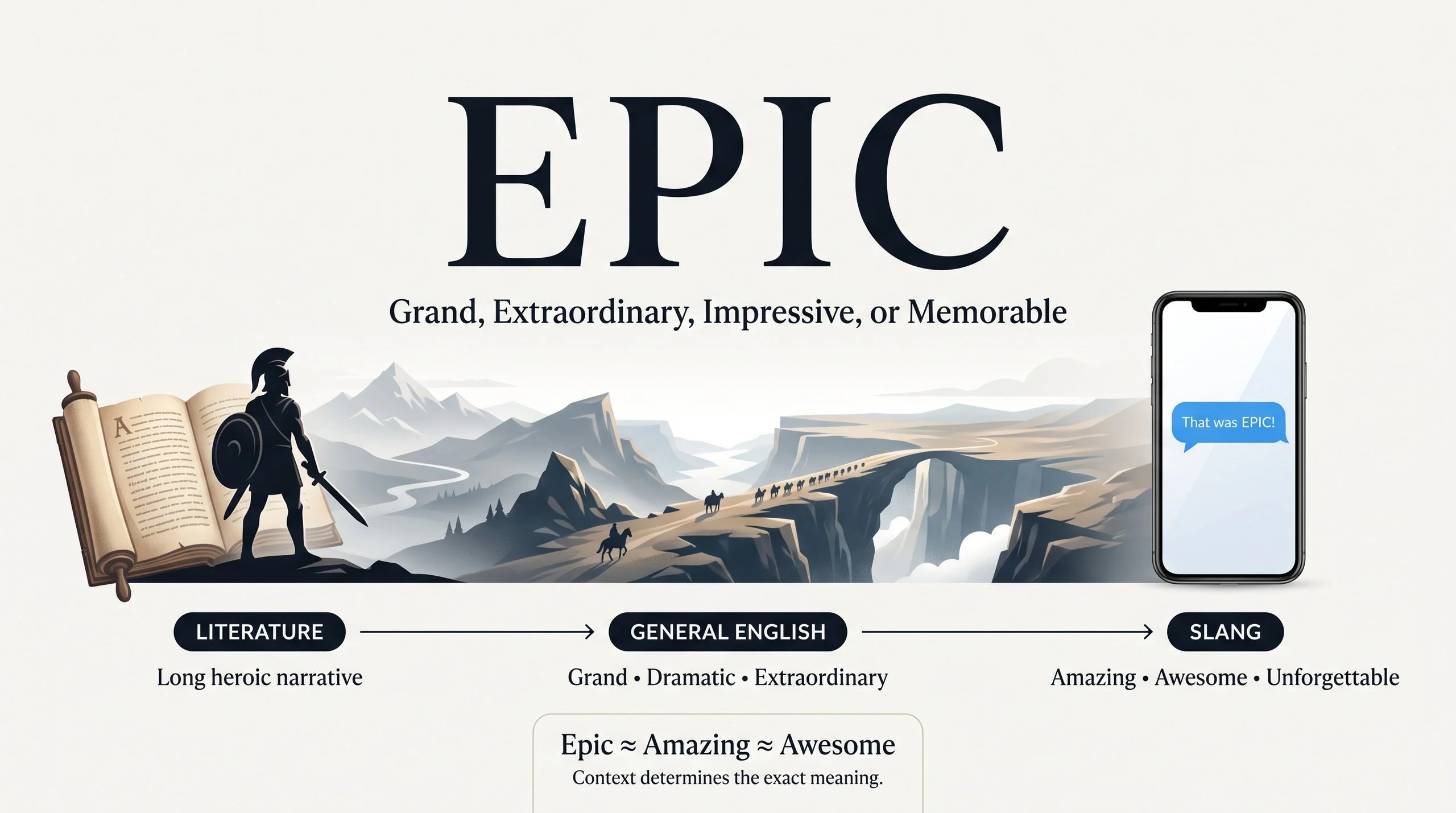
Epic meaning usually describes something extremely impressive, memorable, grand, or extraordinary. In modern slang, people use “epic” to praise an amazing experience, achievement, event, image, story, or moment. The word can also describe a long narrative poem or literary work.
Epic meaning can change depending on how the word appears in a sentence. In everyday English, epic often means something unusually impressive, exciting, dramatic, or memorable. Online, people commonly use it as enthusiastic slang for something amazing.
For example, someone might say, “That concert was epic!” They are not necessarily talking about a literary work. Instead, they mean the experience was exceptionally exciting or memorable.
The word also has an important traditional meaning. In literature, an epic is a long narrative work that tells the story of heroic figures, major events, or legendary adventures. Famous examples include ancient works such as The Iliad and The Odyssey.
Today, the casual meaning appears frequently in texting, social media, gaming, entertainment, and everyday conversation. Therefore, context matters when deciding exactly what epic means.
This guide explains the different meanings of epic, its origin, modern slang use, examples, synonyms, comparisons, common mistakes, and practical ways to use it naturally.
Quick Answer
| Meaning | Context | Primary Use | Example | Tone |
|---|---|---|---|---|
| Extremely impressive | Everyday English | Experiences and events | “That concert was epic!” | Enthusiastic |
| Amazing or extraordinary | Slang | Texting and social media | “Epic photo!” | Excited |
| Grand or heroic | Literature | Stories and events | “An epic battle” | Dramatic |
| Long narrative poem | Literary studies | Poetry and classics | “The Odyssey is an epic.” | Formal |
| Very large or significant | General English | Events or challenges | “An epic journey” | Dramatic |
What Does Epic Mean?
The word epic has several related meanings.
In modern everyday English, it usually means extremely impressive, remarkable, exciting, or memorable.
For example:
“That was an epic performance.”
This means the performance was exceptionally impressive.
In literature, an epic refers to a long narrative work centered on heroic actions, legendary events, or a significant cultural story.
The word can also function as an adjective:
“They went on an epic journey.”
Here, epic suggests that the journey was unusually large, dramatic, important, or memorable.
Simple Definition of Epic
In simple English:
Epic means extremely impressive, grand, extraordinary, or memorable.
When used as a noun in literature, it refers to a long narrative poem or similar work about heroic or legendary events.
Epic Meaning in Everyday English
In ordinary conversation, epic often adds emphasis.
Someone might say:
- “That movie was epic.”
- “We had an epic weekend.”
- “The party was epic.”
- “That comeback was epic.”
- “This view is epic.”
In each example, the speaker describes something as unusually impressive or memorable.
The word is stronger than simply saying good.
Compare:
“The concert was good.”
with:
“The concert was epic.”
The second sentence expresses much greater enthusiasm.
Epic Meaning in Slang
In modern slang, epic commonly means amazing, awesome, incredible, or exceptionally impressive.
People often use it as a quick reaction.
For example:
“Epic!”
Someone might say this after seeing an impressive video, hearing exciting news, or watching a remarkable achievement.
The slang use is especially common in:
- Text messages
- Gaming
- TikTok comments
- YouTube comments
- Group chats
- Online forums
- Casual conversations
Why Do People Say “Epic”?
The word gives a statement more emotional force.
Instead of:
“That was really good.”
someone can say:
“That was epic!”
The shorter expression can sound more energetic and enthusiastic.
Epic Meaning in Texting
In texting, epic usually means amazing, impressive, or unforgettable.
For example:
Friend: I finally got tickets to the concert!
You: Epic!
Here, the word expresses excitement.
Another example:
Friend: Look at this sunset.
You: Epic photo!
In this context, epic works as a casual compliment.
Epic in Short Text Responses
People may use the word by itself:
“Epic!”
or with a noun:
“Epic win!”
“Epic trip!”
“Epic fail!”
The surrounding words help determine the exact meaning.
Epic Meaning on Social Media
Social media users often use epic as a reaction to visually impressive or entertaining content.
A person might comment:
“Epic shot!”
under a photograph.
Someone could write:
“This is epic.”
under a video showing an unusual event.
The word can also appear in captions:
“An epic weekend with the crew.”
Here, epic creates a sense of excitement and significance.
However, because social media language is highly informal, people sometimes use epic simply to show strong enthusiasm rather than to make a precise claim about how extraordinary something is.
Epic Meaning in Gaming
Gaming is one of the contexts where epic has several meanings.
Gamers may use it to describe:
- A major victory
- An impressive move
- A difficult challenge
- A memorable battle
- A powerful item
- A rare achievement
- An exciting gaming moment
For example:
“That was an epic comeback!”
The player is describing the comeback as exceptionally impressive.
Epic as a Gaming Rarity
Some video games also use epic as a specific category or rarity level for equipment, characters, items, or rewards.
In such cases, the meaning is determined by the game’s system.
For example, a game might classify items as:
Common → Rare → Epic → Legendary
Here, Epic is not simply casual slang for “amazing.” It is a defined game category.
Therefore, context matters.
Epic Meaning in Literature
The literary meaning of epic is much older than its modern slang use.
An epic is traditionally a long narrative poem that tells the story of heroic figures, legendary journeys, wars, or culturally important events.
Classic examples include:
- The Iliad
- The Odyssey
- The Aeneid
- Beowulf
These works often involve heroes, battles, journeys, supernatural forces, and major conflicts.
Characteristics of an Epic
Traditional epics often include:
- A central heroic figure
- A large-scale conflict
- A long journey or quest
- Extraordinary challenges
- Supernatural or divine elements
- Significant cultural themes
- A grand narrative scope
Not every modern story needs all these characteristics to be called epic in the literary sense.
Epic as a Noun
As a noun, epic can refer to a long narrative poem or story.
For example:
“The Odyssey is an ancient Greek epic.”
Here, epic is a literary category.
Modern writers can also use the noun more broadly:
“The film became an epic of survival.”
This suggests a large, dramatic story with significant events.
Epic as an Adjective
As an adjective, epic can describe something that is:
- Grand
- Heroic
- Extraordinary
- Impressive
- Large-scale
- Dramatic
- Memorable
Examples include:
“an epic journey”
“an epic battle”
“an epic adventure”
“an epic performance”
“an epic mistake”
The meaning changes slightly with each noun.
Epic Meaning in History
Epic can describe historical events that have a huge scale or lasting significance.
For example:
“The expedition became an epic journey.”
The word emphasizes the extraordinary nature of the experience.
However, epic does not automatically mean historically important. It often expresses the speaker’s view of the event’s scale or drama.
Epic Meaning in Movies
The word epic is common in discussions of movies.
People may describe a film as epic when it features:
- A large-scale story
- Major battles
- Sweeping landscapes
- Heroic characters
- Dramatic stakes
- Long journeys
- Spectacular visual scenes
For example:
“The movie has an epic ending.”
This could mean the ending is dramatic, powerful, or visually impressive.
A film can also be called an epic as a genre or style.
Epic Meaning in Music
Music fans may use epic to describe a powerful or emotionally intense song.
For example:
“That guitar solo was epic.”
This means the solo was exceptionally impressive.
Likewise:
“The final chorus feels epic.”
Here, epic suggests scale, emotional power, or dramatic impact.
Epic Meaning in Sports
Sports fans often use epic to describe memorable performances or dramatic contests.
Examples include:
“That was an epic comeback.”
“The final was epic.”
“He made an epic save.”
The word adds excitement and emphasizes the importance of the moment.
It does not necessarily mean that the event was historically significant. Sometimes it simply reflects the speaker’s enthusiasm.
Contextual Dynamics & Nuances of Epic
The word can express different shades of meaning depending on context.
Epic as Praise
“Your presentation was epic.”
Here, epic functions as a strong compliment.
Epic as Scale
“They planned an epic road trip.”
The word emphasizes the size, duration, or memorable nature of the trip.
Epic as Drama
“The final match was an epic battle.”
Here, epic highlights the dramatic intensity of the competition.
Epic as Humor
“I made an epic mistake.”
The speaker may be exaggerating for comedic effect.
The mistake may not actually be enormous. The word simply makes the statement more playful.
Epic as Irony
People can also use epic ironically.
“Epic timing.”
If someone arrives several hours late, the statement may actually criticize their timing.
Therefore, tone and context matter.
Real-Life Conversation Examples Using Epic
Example 1: Concert
Maya: How was the concert?
Alex: Absolutely epic.
Here, epic means extremely exciting and memorable.
Example 2: Gaming
Chris: Did you see that final move?
Jordan: Yeah. Epic!
The speaker is expressing admiration.
Example 3: Travel
Sam: How was your road trip?
Taylor: Epic. We visited five national parks.
Here, epic describes the trip as extraordinary and memorable.
Example 4: Social Media
Post: A photo from a mountain hike.
Comment: Epic view!
The commenter is strongly praising the scenery.
Example 5: Humor
Nina: I forgot my umbrella again.
Chris: Epic planning.
The phrase is probably sarcastic.
Epic vs. Amazing
Epic and amazing can be synonyms in casual speech, but they do not always feel identical.
Amazing generally means extremely good, surprising, or impressive.
Epic often adds a sense of scale, drama, excitement, or memorability.
Compare:
“She gave an amazing performance.”
This praises the quality of the performance.
“She gave an epic performance.”
This may suggest something especially dramatic, memorable, or powerful.
The distinction is subtle, especially in casual speech.
Epic vs. Awesome
Awesome is another common synonym for the slang sense of epic.
“That game was awesome.”
“That game was epic.”
Both express strong approval.
However, epic can suggest something larger, more dramatic, or more memorable.
Awesome is often a general expression of enthusiasm.
Epic vs. Legendary
Legendary can describe something extremely famous, memorable, or exceptional.
Epic often focuses on scale, drama, excitement, or extraordinary impact.
For example:
“That was an epic battle.”
focuses on the dramatic scale of the battle.
“He is a legendary athlete.”
focuses on the athlete’s lasting reputation.
The words overlap, but they are not always interchangeable.
Epic vs. Extraordinary
Extraordinary means unusually impressive, unusual, or remarkable.
It is more formal than the slang use of epic.
Compare:
“That was an extraordinary achievement.”
This sounds professional or formal.
“That was epic!”
This sounds casual and enthusiastic.
Therefore, choose the word based on the audience and setting.
Epic Synonyms
Depending on the context, useful synonyms include:
- Amazing
- Awesome
- Incredible
- Extraordinary
- Spectacular
- Remarkable
- Impressive
- Magnificent
- Grand
- Monumental
- Legendary
- Dramatic
- Heroic
- Unforgettable
- Colossal
These words do not all work in every sentence.
For example, heroic works well for courageous actions, while spectacular often suits visual experiences.
How to Use Epic in a Sentence
Epic as an Adjective
“We had an epic adventure.”
“That was an epic performance.”
“They faced an epic challenge.”
“The movie features an epic battle.”
Epic as a Noun
“The poem is a classic epic.”
“The novel reads like an epic.”
The intended meaning becomes clear from the surrounding words.
Common Mistakes When Using Epic
Mistake 1: Assuming Epic Always Means “Amazing”
In casual slang, epic often means amazing.
However, in literature, an epic refers to a specific type of long narrative work.
For example:
“The Odyssey is an epic.”
Here, the word has its literary meaning.
Mistake 2: Using Epic in Every Situation
If you describe every ordinary event as epic, the word can lose its impact.
Compare:
“I had an epic cup of water.”
That sounds exaggerated unless you are intentionally joking.
Use the word when you want to communicate strong enthusiasm, drama, scale, or humor.
Mistake 3: Confusing Epic With Legendary
The words overlap, but they emphasize different qualities.
Epic often emphasizes scale or dramatic impact.
Legendary often emphasizes lasting reputation or exceptional status.
Mistake 4: Ignoring Context in Gaming
In some games, Epic is a formal rarity category.
Do not automatically interpret it as casual slang.
Mistake 5: Using Slang in Formal Writing
In a professional report, saying:
“The results were epic.”
may sound too informal.
Instead, choose a precise word such as:
“The results were exceptional.”
Is Epic a Positive Word?
Usually, yes.
In modern slang, epic is strongly positive when used as praise.
It can communicate:
- Excitement
- Admiration
- Approval
- Surprise
- Enthusiasm
- Celebration
However, context can change the tone.
For example:
“Epic failure.”
This phrase is negative because the noun failure changes the meaning.
Likewise:
“Epic mistake.”
usually describes a very serious or humorous error.
Can Epic Be Used Negatively?
Yes.
Epic can intensify a negative noun.
Examples include:
- Epic failure
- Epic mistake
- Epic disaster
- Epic misunderstanding
In these phrases, epic means unusually large, severe, dramatic, or memorable.
The word itself still contributes a sense of scale rather than directly meaning something negative.
Is Epic Slang?
Epic is a standard English word, not exclusively slang.
It has long-established meanings in literature and general English.
However, its use as a casual synonym for amazing or awesome is informal and can be considered slang or colloquial usage.
Therefore:
- Literary epic: standard/formal
- Epic journey: standard descriptive English
- That was epic!: informal slang
Is Epic Still Popular?
Yes. Epic remains widely recognizable in casual English and online communication.
Its popularity comes partly from its flexibility.
Someone can use it to describe:
- A funny moment
- A great performance
- A major achievement
- A difficult challenge
- A memorable trip
- A dramatic event
- A spectacular image
The word can therefore function as both everyday vocabulary and internet slang.
What Does Epic Mean From a Guy or Girl?
Epic does not have a special gender-specific meaning.
If a guy or girl says:
“That’s epic!”
the person usually means that something is extremely impressive, exciting, or memorable.
The expression does not automatically indicate romantic interest, attraction, or any hidden emotional message.
The surrounding conversation provides the relevant context.
Can You Say “Epic” by Itself?
Yes.
Someone can simply say:
“Epic!”
as a reaction to exciting or impressive news.
For example:
Friend: I got us tickets for Saturday.
You: Epic!
This is a natural casual response.
How to Respond to “Epic”
Your response depends on the context.
If someone says:
“That movie was epic!”
you could say:
“Totally!”
or:
“I loved it too.”
If they say:
“I finally won the tournament. Epic!”
you could respond:
“Congratulations!”
or:
“That’s awesome!”
When someone uses epic sarcastically, your response should follow the tone.
FAQs
What does epic mean?
Epic usually means extremely impressive, extraordinary, memorable, grand, or exciting. In literature, it can also mean a long narrative poem or story about heroic or legendary events.
What does epic mean in slang?
In slang, epic usually means amazing, awesome, incredible, or exceptionally impressive. People commonly use it in texting, gaming, social media, and casual conversation.
Is epic a positive word?
Usually, yes. Modern slang uses epic as strong praise. However, expressions such as “epic failure” use the word to emphasize the size or seriousness of something negative.
Is epic a synonym for amazing?
In casual English, epic can work as a synonym for amazing. However, epic often adds a sense of scale, drama, excitement, or memorability.
What does epic mean in texting?
In texting, epic usually expresses strong excitement or approval. Someone might reply “Epic!” after receiving good news or seeing something impressive.
What does epic mean in gaming?
In gaming, epic can mean something extremely impressive. Some games also use Epic as a specific item, character, or reward rarity.
What is an epic in literature?
An epic is a long narrative poem or story that traditionally focuses on heroic figures, major conflicts, legendary journeys, or culturally significant events.
What is another word for epic?
Depending on context, alternatives include amazing, awesome, extraordinary, spectacular, remarkable, grand, monumental, legendary, and unforgettable.
Can epic be used sarcastically?
Yes. Someone can use epic ironically to make fun of an ordinary or unpleasant situation, especially when the surrounding context contradicts the apparent praise.
Is epic formal or informal?
Epic is a standard English word, but using it to mean “amazing” is generally informal. The literary meaning of epic is appropriate in formal academic discussion.
Conclusion
Epic is a versatile English word with both traditional and modern meanings.
In literature, an epic is a long narrative work associated with heroic figures, major conflicts, legendary journeys, and culturally significant events. In everyday English, the adjective can describe something grand, dramatic, extraordinary, or memorable.
Meanwhile, modern slang uses epic as a strong expression of approval. When someone says, “That was epic,” they usually mean that something was amazing, impressive, exciting, or unforgettable.
Context remains the key.
A literary discussion may use epic as a formal genre term, while a friend may simply text “Epic!” to celebrate good news. Gaming communities may also use Epic as a specific rarity level.
So, while the word has ancient literary roots, its everyday use continues to evolve. Whether it describes a heroic poem, a massive adventure, or an unforgettable moment, epic communicates a sense of unusual scale, impact, or importance.