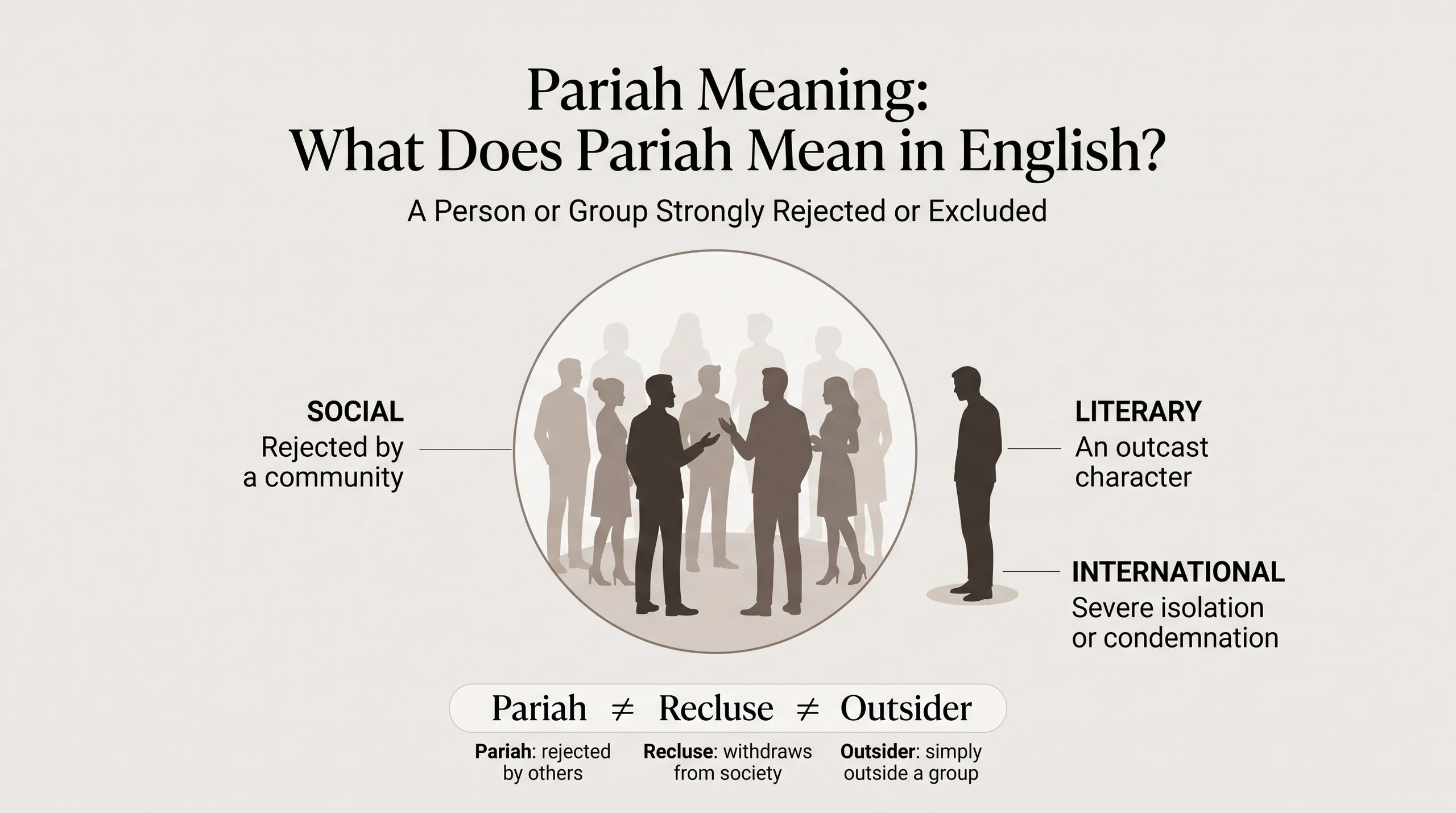
Pariah meaning refers to a person or group that other people strongly reject, avoid, or exclude from a community. The word often describes someone treated as an outsider because of social disapproval, stigma, conflict, or a serious loss of acceptance.
Pariah meaning describes a person or group that society, a community, or a particular social circle treats as an outcast. The word usually carries a strong sense of rejection rather than simply describing someone who prefers to be alone.
For example, if a person becomes widely disliked and others deliberately avoid them, someone might describe that person as a pariah. Likewise, a group can become a pariah when other groups refuse to associate with it.
The term often appears in journalism, history, politics, literature, social commentary, and everyday English. However, its meaning can shift slightly depending on context. Sometimes it describes social exclusion. In other cases, it refers to international isolation or widespread public condemnation.
Understanding this distinction helps you use the word accurately. In this guide, you will learn the definition of pariah, its historical origin, examples, synonyms, related terms, common mistakes, and the difference between a pariah and an ordinary outsider.
Quick Answer
| Meaning | Context | Primary Use | Example | Tone |
|---|---|---|---|---|
| A rejected outsider | Social situations | People and groups | “He became a pariah.” | Negative |
| Someone excluded by a community | Social conflict | Communities | “She was treated like a pariah.” | Strongly negative |
| An isolated state or organization | International relations | Countries and institutions | “The regime became a global pariah.” | Formal, negative |
| A socially condemned person | Public discussion | Society, media, literature | “He was considered a pariah.” | Critical |
What Does Pariah Mean?
The word pariah means an outcast or a person who has been rejected or avoided by others.
It can refer to:
- A person excluded from a social group
- Someone widely rejected by a community
- A person who has lost social acceptance
- A group that others refuse to associate with
- A country or organization facing severe international isolation
The key idea is rejection.
Someone who simply enjoys solitude is not necessarily a pariah. A pariah is generally separated from others because other people reject, condemn, distrust, or avoid them.
Simple Definition of Pariah
In simple English:
A pariah is someone whom other people strongly reject or treat as an outcast.
For example:
“After the scandal, he became a pariah in the community.”
This sentence suggests that people no longer accepted or wanted to associate with him.
Does Pariah Always Mean a Bad Person?
No.
Calling someone a pariah describes their social position or treatment, not necessarily their moral character.
A person may become socially isolated because of a controversial action, belief, accusation, conflict, political disagreement, or unfair prejudice.
Therefore, the word does not automatically prove that the person deserves rejection.
That distinction matters when using the term in serious writing.
Pariah Meaning in Everyday English
In everyday English, pariah often describes someone who has been pushed outside a social group.
Imagine a workplace where an employee becomes deeply unpopular after breaking an important rule. If coworkers refuse to speak with that person or include them in activities, someone might say:
“He became a pariah at work.”
The word creates a stronger image than simply saying:
“People did not like him.”
Why? Because pariah suggests a significant level of exclusion.
Similarly, a person could become a pariah within a friend group after a major betrayal.
The term therefore emphasizes the reaction of the surrounding community.
Pariah Meaning in Social Contexts
Social exclusion is one of the most common contexts for the word.
A community may treat someone as a pariah when that person:
- Violates an important social expectation
- Breaks trust
- Becomes associated with a serious controversy
- Challenges a strongly held group belief
- Is accused of harmful behavior
- Becomes the subject of widespread stigma
However, the reasons can vary widely.
The important point is that the person experiences substantial rejection from others.
Example
“After the dispute, he was treated as a pariah by his former friends.”
This sentence suggests more than disagreement. It indicates that the friends have distanced themselves from him.
Pariah Meaning in Politics and International Relations
The word also has a formal use in international affairs.
A pariah state generally refers to a country that faces severe international isolation or widespread condemnation.
For example:
“The government faced increasing isolation and was described by some commentators as a pariah state.”
Here, pariah does not describe an individual. Instead, it describes the country’s relationship with other states.
The term often appears in discussions involving:
- Diplomatic isolation
- International sanctions
- Human rights controversies
- Military aggression
- Severe political disputes
- International condemnation
Because pariah state can involve interpretation and political judgment, careful writers often attribute the label to a specific government, organization, analyst, or source rather than presenting it as an objective status.
Pariah Meaning in Literature
Writers frequently use pariah to describe characters who exist outside accepted society.
A literary pariah might be:
- Rejected by a family
- Excluded from a village
- Shunned by a community
- Misunderstood by society
- Punished for breaking social rules
- Unable to fit into a particular culture
The word can therefore help establish themes of:
- Alienation
- Rejection
- Loneliness
- Stigma
- Social pressure
- Identity
- Belonging
For instance:
“The novel portrays its main character as a pariah who struggles to find acceptance.”
The word immediately communicates that the character exists on the margins of society.
Origin of the Word Pariah
The history of pariah is connected to South Asia and the social history of the Tamil-speaking region.
The English word came through European languages from Tamil, where paraiyar referred historically to members of a particular social group associated with the parai, a type of drum.
Over time, the term acquired broader associations in English. It eventually developed the figurative meaning of an outcast or someone rejected by society.
Today, English speakers generally use pariah in its figurative sense.
Why the Historical Origin Matters
The word’s history is important because its development is connected to complex systems of social hierarchy and discrimination.
Modern English speakers usually use pariah to mean “outcast,” but the historical background is more specific than the modern general definition.
Therefore, it is useful to understand both meanings without treating the modern English sense as a complete description of the word’s history.
Pariah vs. Outcast
Pariah and outcast are close synonyms, but they can carry different shades of meaning.
| Word | Main Idea | Intensity | Common Use |
|---|---|---|---|
| Pariah | Strongly rejected person or group | High | Social commentary, formal writing |
| Outcast | Person excluded from a group | High | Everyday and literary English |
| Outsider | Person outside a group | Moderate | General situations |
| Recluse | Person who avoids society | Moderate | Solitude |
| Misfit | Person who does not fit in | Moderate | Casual descriptions |
An outcast is someone excluded from a group.
A pariah often suggests stronger social rejection.
An outsider, however, does not necessarily face hostility. They may simply not belong to the group.
Pariah vs. Outsider
These words are not interchangeable in every situation.
An outsider may simply be unfamiliar with a group.
For example:
“As a newcomer, she felt like an outsider.”
That does not mean anyone rejected her.
By contrast:
“After the betrayal, he became a pariah.”
This sentence suggests active social rejection.
Therefore, outsider can be neutral, while pariah is strongly negative.
Pariah vs. Recluse
A recluse generally chooses or prefers isolation.
A pariah usually experiences rejection or exclusion from others.
For example:
“He lived as a recluse.”
This suggests voluntary or preferred solitude.
Meanwhile:
“He was treated as a pariah.”
This suggests that other people rejected him.
That difference is essential.
Pariah vs. Hermit
A hermit typically lives away from society, often by choice.
A pariah is defined by social rejection rather than physical isolation.
Someone could live alone without being a pariah.
Likewise, someone could be a pariah while still living and working around other people.
Pariah Synonyms
Several words can replace pariah, depending on the exact context.
Outcast
An outcast is someone excluded from a community or social group.
“He became an outcast after the dispute.”
This is one of the closest everyday alternatives.
Social Reject
This phrase emphasizes rejection by society or a social group.
It is usually more blunt and informal than pariah.
Outsider
An outsider exists outside a group, but the word does not necessarily imply rejection.
Therefore, it is a weaker alternative in many contexts.
Misfit
A misfit is someone who does not fit comfortably into a particular social environment.
The word can sound less severe than pariah.
Exile
An exile is someone forced or required to live away from their home or community.
It focuses more on removal or displacement than social condemnation.
Scapegoat
A scapegoat is someone unfairly blamed for a problem.
This term overlaps with pariah in some situations, but the meanings are not identical.
A scapegoat receives blame. A pariah receives rejection or exclusion.
Contextual Dynamics & Nuances of Pariah
The word can communicate different shades of meaning depending on the situation.
Social Pariah
A social pariah is someone widely rejected within a community.
“He became a social pariah after the controversy.”
This usage emphasizes relationships and acceptance.
Cultural Pariah
A person may become a cultural pariah when a particular society strongly rejects their views, behavior, or identity.
However, writers should use this term carefully because social rejection can result from unfair prejudice as well as legitimate disagreement.
Political Pariah
A political figure may be described as a pariah when other political actors strongly isolate or condemn them.
Because this use can involve contested judgments, precise writing should explain who rejected the person and why.
International Pariah
A country or organization may receive the label when it faces broad diplomatic isolation.
Again, the word functions as a description of international treatment rather than a simple synonym for “bad.”
Real-Life Examples of Pariah
Example 1: Community
“After repeatedly violating the community’s rules, he became a pariah.”
The sentence suggests that the community strongly rejected him.
Example 2: Workplace
“Her coworkers treated her like a pariah after the public dispute.”
This describes serious social exclusion.
Example 3: Literature
“The protagonist is a pariah who cannot find acceptance in his village.”
The word highlights alienation.
Example 4: International Affairs
“The government faced increasing diplomatic isolation and was described by critics as a pariah.”
Here, the term applies to a government rather than an individual.
Example 5: Casual Conversation
“After that argument, I felt like a pariah.”
The speaker uses the word figuratively to describe feeling excluded.
How to Use Pariah in a Sentence
The most common grammatical form is the noun pariah.
As a Noun
“He became a pariah within the group.”
“She was treated as a pariah.”
“The organization became a pariah among its former partners.”
With “A”
Because pariah is a countable noun when referring to an individual, it commonly appears with an article.
Correct:
“He became a pariah.”
Also correct:
“She was treated like a pariah.”
Plural Form
The plural is pariahs.
Example:
“The novel contains several characters who become social pariahs.”
Common Mistakes When Using Pariah
Mistake 1: Using It for Someone Who Simply Likes Being Alone
Someone who enjoys solitude is not automatically a pariah.
Better:
“He prefers to keep to himself.”
Use pariah when social rejection is central to the meaning.
Mistake 2: Treating Pariah as a Direct Synonym for Bad Person
A pariah is not necessarily a bad person.
The term describes exclusion.
Better:
“The community treated him as a pariah.”
This states the social situation without making an unsupported moral judgment.
Mistake 3: Using Pariah When “Outsider” Is More Accurate
An outsider may simply be unfamiliar with a group.
If no rejection exists, outsider may be more precise.
Mistake 4: Confusing Pariah With Recluse
A recluse withdraws from society.
A pariah is rejected or excluded by others.
These are different ideas.
Mistake 5: Using the Word Too Casually
Calling someone a pariah can sound harsh.
For example, describing a mildly unpopular coworker as a pariah may exaggerate the situation.
Use the word when the level of rejection supports it.
Is Pariah a Negative Word?
Yes. Pariah usually has a strongly negative connotation.
It suggests:
- Rejection
- Exclusion
- Stigma
- Isolation
- Social condemnation
- Loss of acceptance
Still, the word describes a condition rather than automatically proving wrongdoing.
That distinction becomes especially important in journalism and serious social discussions.
Is Pariah an Insult?
It can function as an insult when directed at a person.
Calling someone a pariah may suggest that they are unwanted or rejected.
However, the word also appears in neutral descriptive writing.
For example:
“The novel explores the experience of becoming a social pariah.”
Here, the author is describing a social condition rather than directly insulting someone.
Can Pariah Describe a Group?
Yes.
Although the word often describes a person, it can also describe groups, organizations, governments, and countries.
Examples include:
“The organization became a pariah within the industry.”
“The regime was described as an international pariah.”
The exact meaning depends on who is doing the rejecting and what kind of isolation has occurred.
Can Pariah Be Used for a Country?
Yes.
The phrase “pariah state” is commonly used in political and international discussions.
It generally describes a state that faces substantial international isolation or condemnation.
However, the label can be politically contested. Therefore, responsible writing should provide the underlying facts rather than relying on the label alone.
For example, instead of simply writing:
“It is a pariah state.”
a more informative sentence might explain:
“The country faced diplomatic isolation and sanctions from several governments.”
That approach gives readers concrete information.
Pariah in Modern Culture
The idea of the pariah appears frequently in movies, novels, television, journalism, and online discussions.
Stories often use the concept to explore what happens when someone loses social belonging.
A character may become a pariah because of:
- A secret
- A betrayal
- A controversial decision
- A family conflict
- A social taboo
- A misunderstanding
- A political dispute
These stories often ask a deeper question:
What happens when a community decides that someone no longer belongs?
That question gives the word strong emotional power.
Pariah and Social Isolation
Social isolation and being a pariah overlap, but they are not identical.
Social isolation describes a condition in which someone has limited interaction with others.
Pariah describes someone who is rejected or excluded by others.
A person can be socially isolated without being a pariah.
For example, someone who moves to a new city may feel isolated because they have not built friendships yet.
That person is not necessarily a pariah.
Pariah and Stigma
The concept of stigma also overlaps with pariah.
Stigma refers to a negative social attitude or mark associated with a person, condition, behavior, or group.
A person may experience stigma without becoming a complete social outcast.
A pariah, by contrast, often experiences a stronger form of social rejection.
Thus, the two concepts can appear together:
“The stigma surrounding the accusation turned him into a social pariah.”
How to Respond When Someone Says “I Feel Like a Pariah”
If someone says:
“I feel like a pariah.”
they are probably expressing a strong feeling of exclusion.
A supportive response might be:
“I’m sorry you’re feeling excluded. Do you want to talk about what happened?”
You can also ask:
“What makes you feel that way?”
The phrase may be emotional rather than literal. Someone can feel like a pariah without actually being universally rejected.
FAQs
What does pariah mean?
Pariah means a person or group that others strongly reject, avoid, or exclude. It is commonly used for an outcast or someone who has lost social acceptance.
Is pariah a bad word?
Pariah is not a profanity, but it has a strongly negative meaning. It describes rejection, exclusion, or social condemnation.
Is pariah the same as an outcast?
Pariah and outcast have very similar meanings. Both can describe someone excluded from society or a community, although pariah can carry a particularly strong sense of rejection.
What is the opposite of pariah?
Depending on the context, possible opposites include insider, accepted member, respected member, or beloved member of a community.
Can pariah describe a group?
Yes. Pariah can describe an organization, community, government, or country that faces strong rejection or isolation.
What is a social pariah?
A social pariah is a person who experiences strong rejection or exclusion from a particular community or social group.
What is a pariah state?
A pariah state is a country described as facing severe international isolation or widespread condemnation. The term can be subjective, so the underlying diplomatic circumstances matter.
Is a pariah the same as a recluse?
No. A recluse generally withdraws from society, often voluntarily. A pariah is defined more by rejection or exclusion from others.
What is the plural of pariah?
The plural form is pariahs.
How do you use pariah in a sentence?
You can use it to describe someone who has been strongly rejected: “After the controversy, he became a pariah within the community.”
Conclusion
Pariah is a powerful word for describing someone who has been strongly rejected or excluded by a community. It usually carries a more intense meaning than simply calling someone an outsider.
The word can apply to individuals, groups, organizations, and even countries. In social settings, it often describes someone treated as an outcast. It can represent alienation and the struggle for belonging in literature. In international discussions, it may describe severe diplomatic isolation.
At the same time, pariah should be used carefully. The word describes a person’s or group’s social position, but it does not automatically establish that the person deserves rejection or that every criticism against them is justified.
Understanding that distinction makes your writing more accurate.
In short, a pariah is an outcast who faces strong rejection or exclusion. The word is useful when you want to communicate more than simple loneliness or difference—it highlights the powerful role that social acceptance and rejection play in human relationships.