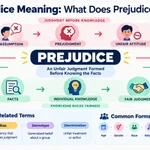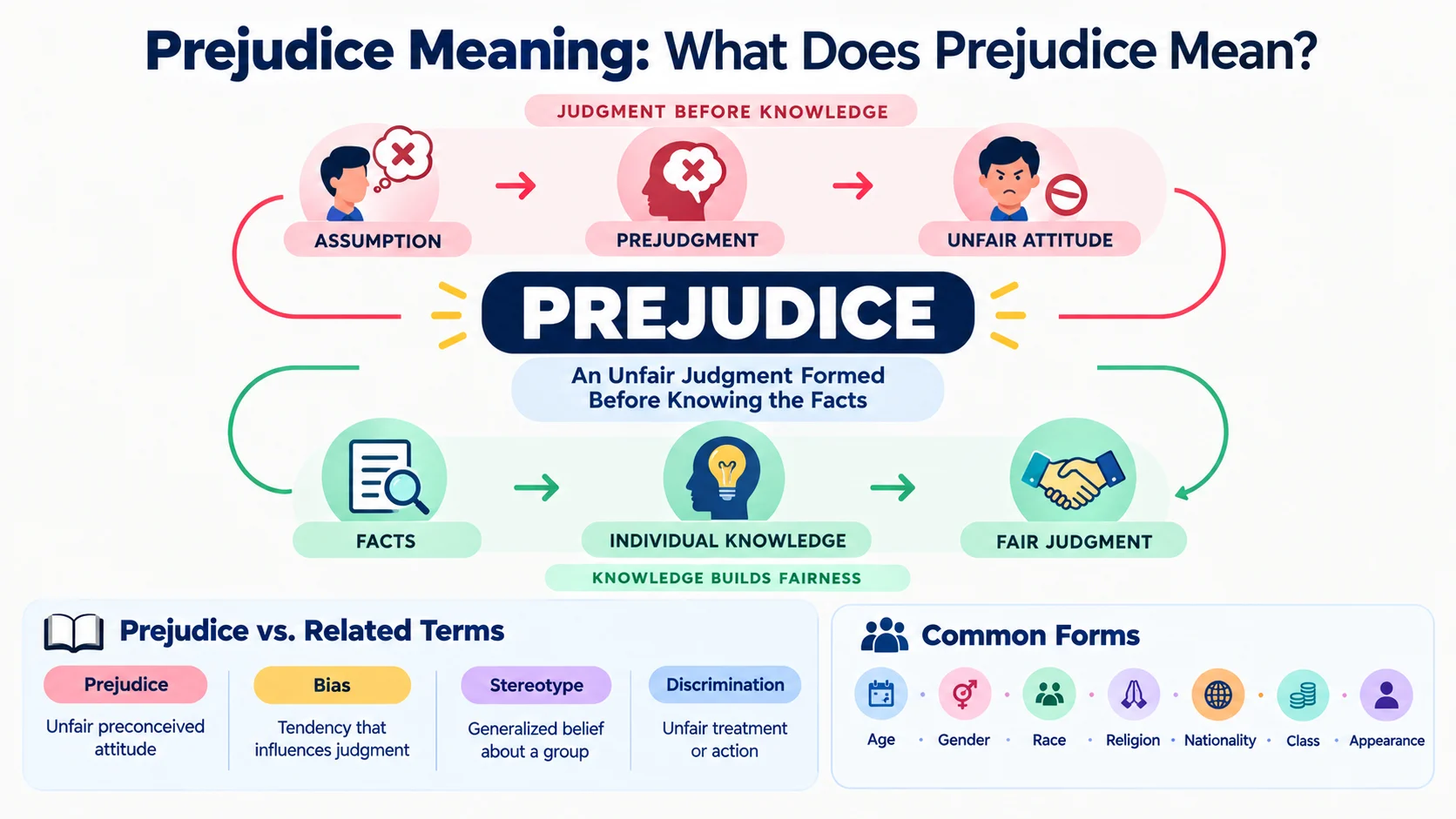
Prejudice means forming an unfair or unreasonable opinion about a person or group before knowing enough about them. It often involves negative assumptions based on characteristics such as race, religion, gender, age, nationality, appearance, or social background.
Understanding the prejudice meaning can help explain why people sometimes make unfair judgments about others. Prejudice occurs when someone forms an opinion about a person or group without enough knowledge or fair consideration. That judgment often comes from assumptions about characteristics such as race, religion, gender, age, nationality, appearance, social class, or background.
For example, assuming that someone is lazy because of their background is a form of prejudiced thinking. Likewise, deciding that a person is untrustworthy simply because they belong to a particular group relies on an unfair assumption rather than personal knowledge.
However, prejudice does not always look obvious. Sometimes it appears through subtle comments, expectations, social attitudes, or automatic assumptions. In addition, a person may hold a prejudiced belief without realizing how strongly it affects their judgment.
This guide explains what prejudice means, how the word works in everyday English, and how prejudice differs from bias, stereotypes, and discrimination. You will also find clear examples, common types, related words, and answers to frequently asked questions.
What Does Prejudice Mean?
Prejudice means an unfair, preconceived opinion or feeling about a person or group formed without enough knowledge or experience.
The word usually describes a negative or unfavorable judgment, although prejudice can technically refer to a preconceived attitude more broadly.
For example:
Assuming someone is unintelligent because of their nationality is prejudice.
In simple terms:
Prejudice = judging someone before fairly getting to know the facts.
Prejudice Definition
The noun prejudice refers to a preconceived opinion, attitude, or feeling about someone or something.
The key idea is prejudgment.
A person may make a judgment before they have enough information to support it. That judgment can come from stereotypes, social influences, personal experiences, fear, misinformation, or assumptions.
For example, imagine someone meets a new coworker and immediately assumes the person will be difficult to work with because of the group they belong to.
The coworker has not done anything to justify that conclusion. The judgment came first.
That is the central idea behind prejudice.
What Is Prejudice in Simple Words?
In simple words, prejudice means judging a person or group unfairly before knowing the individual or situation well enough.
Consider these examples:
- “People from that country are all dishonest.”
- “Older workers cannot learn new technology.”
- “Teenagers are always irresponsible.”
- “Someone with that appearance must be unfriendly.”
These statements make broad judgments without considering individual differences.
Therefore, prejudice often replaces personal knowledge with an assumption.
What Does the Word Prejudice Mean?
The word prejudice comes from the idea of making a judgment beforehand.
The concept combines the idea of prejudging with an opinion or attitude.
Today, English speakers commonly use the word when discussing unfair attitudes toward individuals or social groups.
For example:
“She experienced prejudice because of her accent.”
This means that someone treated or judged her unfairly based on an assumption connected to her accent.
Examples of Prejudice
Prejudice can appear in many settings.
1. Prejudice Based on Age
Age prejudice occurs when someone makes unfair assumptions about people because of their age.
For example:
“Older employees cannot understand technology.”
That statement treats an entire age group as if everyone in it has the same abilities.
Similarly, assuming that every young person is irresponsible also relies on an age-based assumption.
2. Prejudice Based on Gender
Gender prejudice involves unfair assumptions connected to gender.
For example:
“Women are not good leaders.”
or:
“Men should never show emotion.”
Both statements impose broad expectations on individuals because of gender.
3. Racial Prejudice
Racial prejudice involves negative assumptions or attitudes toward people based on perceived race or racial background.
For example:
“People from that racial group are naturally less intelligent.”
This makes a sweeping judgment about individuals based on group identity.
4. Religious Prejudice
Religious prejudice involves unfair assumptions about people because of their religion or perceived religious identity.
For example:
“Everyone who follows that religion must believe the same things.”
Religions contain diverse communities and individuals. Therefore, treating every person within a religion as identical can create unfair assumptions.
5. Nationality-Based Prejudice
People may also experience prejudice because of their nationality or national background.
For example:
“People from that country are all rude.”
This assumes that millions of different individuals share one personality trait.
6. Social-Class Prejudice
Social-class prejudice involves judging people based on income, occupation, education, family background, or perceived social status.
For example:
“Someone from a poor neighborhood cannot be successful.”
This assumption ignores individual circumstances, abilities, and achievements.
7. Appearance-Based Prejudice
Appearance can also become the basis for unfair judgment.
Someone might assume that a person is:
- Unfriendly because they look serious
- Unprofessional because of their clothing
- Unintelligent because of their appearance
- Untrustworthy because of a physical feature
These judgments may have little connection to the person’s actual personality or behavior.
Types of Prejudice
Prejudice can take many forms because people can make unfair assumptions about many aspects of identity or background.
Commonly discussed forms include:
- Racial prejudice
- Gender prejudice
- Religious prejudice
- Age prejudice
- Nationality-based prejudice
- Class prejudice
- Appearance-based prejudice
- Disability-related prejudice
- Sexual-orientation-related prejudice
- Cultural prejudice
These categories can overlap. A person may experience more than one type of prejudice at the same time.
Prejudice in Everyday Life
Prejudice does not always appear as an obvious insult or openly hostile statement.
It can also appear through everyday assumptions.
For example, someone may:
- Assume a stranger is unfriendly because of their appearance.
- Expect a certain person to perform poorly because of their background.
- Avoid someone because of a group they belong to.
- Make assumptions about someone’s intelligence based on their accent.
- Treat one person’s mistake as evidence about an entire group.
These examples demonstrate why prejudice can be difficult to recognize.
The important issue is not simply having an opinion. Instead, the problem arises when an unfair preconceived judgment replaces evidence about the individual.
Prejudice in the Workplace
Prejudice can affect workplace interactions and decisions.
For example, an employee might assume that an older coworker cannot learn new software. Another person might assume that someone with a particular accent cannot communicate effectively.
Prejudice can also influence expectations about leadership, teamwork, hiring, promotions, or professional ability.
However, not every workplace disagreement represents prejudice. A fair analysis should consider the specific behavior and evidence involved rather than automatically assigning a label.
Prejudice in Education
Schools and educational environments can also involve prejudiced assumptions.
For example, a teacher, student, or peer might assume that someone will perform poorly because of their background.
Similarly, students may make assumptions about classmates based on:
- Family income
- Nationality
- Appearance
- Language
- Religion
- Gender
- Disability
- Academic performance
Recognizing these assumptions can help people evaluate individuals based on their actual behavior and work rather than broad generalizations.
Prejudice in Relationships
Prejudice can affect friendships, dating, family relationships, and other social interactions.
For example, someone may refuse to get to know another person because of their nationality, religion, social background, or appearance.
A person might also enter a relationship with an assumption about how their partner “should” behave because of gender or cultural stereotypes.
In these situations, prejudice can prevent people from seeing individuals as individuals.
Prejudice vs. Bias
Prejudice and bias are closely related, but they are not exact synonyms.
Bias means a preference, tendency, or inclination that can affect judgment. Bias may be positive, negative, conscious, or unconscious.
Prejudice usually refers to a preconceived and often unfair attitude toward a person or group.
For example:
- Bias: Preferring one brand because you have had good experiences with it.
- Prejudice: Assuming people from a particular group are untrustworthy without knowing them.
Therefore, bias is broader, while prejudice usually carries a stronger sense of unfair or preconceived judgment.
Prejudice vs. Stereotype
A stereotype is a generalized belief about a group.
Prejudice is an attitude, feeling, or judgment toward a person or group.
For example:
“All teenagers are irresponsible.”
This is a stereotype because it makes a generalized claim about a group.
If someone then dislikes or distrusts a teenager because they believe the stereotype, that attitude can become prejudice.
In simple terms:
Stereotype = generalized belief
Prejudice = preconceived attitude or judgment
The two can reinforce each other, but they are not identical.
Prejudice vs. Discrimination
This distinction is especially important.
Prejudice involves an attitude, belief, or feeling.
Discrimination involves unfair treatment or behavior.
For example:
“I do not trust people from that group.”
This expresses a prejudiced attitude.
By contrast:
“I will not hire anyone from that group.”
This describes discriminatory behavior.
Therefore:
Prejudice = unfair judgment or attitude
Discrimination = unfair treatment or action
Prejudice can contribute to discriminatory behavior, but the terms describe different things.
Prejudice vs. Racism
Prejudice is a broad term for preconceived and unfair judgments.
Racism specifically concerns race or racial groups and can involve beliefs, attitudes, practices, or systems, depending on the context and definition being used.
Therefore, racial prejudice is one form of prejudice.
However, not every example of prejudice involves race. Prejudice can also involve age, religion, gender, nationality, class, appearance, disability, or other characteristics.
Is Prejudice Always Negative?
In everyday modern English, prejudice usually has a negative meaning.
People commonly use it to describe unfair attitudes or judgments.
However, the broader dictionary concept of prejudice can include a preconceived opinion or feeling that is not necessarily based on sufficient knowledge. In ordinary conversation, though, the word strongly suggests unfairness or bias.
For example:
“The manager showed prejudice against applicants from a certain background.”
Here, the word clearly carries a negative meaning.
What Causes Prejudice?
There is no single cause of prejudice.
Several factors can contribute to prejudiced attitudes, including:
- Stereotypes
- Social learning
- Limited personal experience
- Fear of unfamiliar groups
- Misinformation
- Group pressure
- Cultural influences
- Personal experiences
- Repeated negative messages
- Overgeneralization
People can learn attitudes from families, peers, communities, media, or other social environments.
At the same time, personal experiences can also shape beliefs. A single negative experience may lead someone to make an unfair generalization about an entire group.
That generalization can become prejudiced when the person applies it broadly to individuals without sufficient evidence.
Conscious and Unconscious Prejudice
Prejudice can be conscious, meaning a person recognizes the attitude they hold.
It can also involve automatic or less conscious assumptions.
For example, someone may consciously reject a stereotype while still noticing that they make certain automatic assumptions.
That does not mean every automatic reaction represents deliberate prejudice. Instead, it highlights the importance of examining assumptions and responding to people based on relevant evidence.
How Can People Reduce Prejudice?
Reducing prejudice starts with examining assumptions.
Useful approaches include:
Learn About Different People
Learning about people outside your usual experiences can challenge simplistic assumptions.
Meet Individuals Instead of Relying on Generalizations
Individual experiences can provide a more accurate understanding than broad stereotypes.
Question Automatic Assumptions
When you notice an immediate judgment, ask:
“What evidence do I actually have?”
That simple question can encourage more careful thinking.
Separate Individuals From Groups
A person’s behavior does not automatically represent an entire group.
Check the Source of a Belief
Consider where an assumption came from. Was it based on direct evidence, repeated stories, stereotypes, or a single experience?
Focus on Relevant Evidence
When making decisions, use information that actually relates to the person or situation.
Common Misconceptions About Prejudice
“Prejudice Only Means Racism”
Not necessarily.
Racial prejudice is one form of prejudice, but the broader term can involve many characteristics and social groups.
“Only Mean People Have Prejudice”
Prejudice can involve learned assumptions and automatic judgments. Therefore, understanding and examining one’s assumptions matters.
“Prejudice and Discrimination Mean the Same Thing”
They do not.
Prejudice generally describes an attitude or judgment, while discrimination describes unfair treatment or behavior.
“Every Opinion Is Prejudice”
Having an opinion does not automatically mean having prejudice.
Prejudice involves a preconceived or unfair judgment, particularly one formed without sufficient knowledge or evidence.
“A Single Experience Proves a Group Is Like That”
It does not.
One person’s behavior cannot reliably describe an entire group.
Common Phrases With Prejudice
Here are several common expressions involving the word:
“Prejudice against”
“The organization worked to address prejudice against minority groups.”
“Prejudice based on”
“Prejudice based on age can affect how people are treated.”
“Racial prejudice”
“The discussion focused on racial prejudice.”
“Religious prejudice”
“The policy aimed to reduce religious prejudice.”
“Free from prejudice”
“Everyone deserves to be evaluated fairly and without prejudice.”
“Prejudiced against”
“He was accused of being prejudiced against people from another country.”
How to Use Prejudice in a Sentence
Here are natural examples:
- “Prejudice can lead people to make unfair assumptions.”
- “She experienced prejudice because of her background.”
- “The teacher encouraged students to question stereotypes and prejudice.”
- “His decision appeared to rely on prejudice rather than evidence.”
- “Education can help people recognize and challenge prejudice.”
- “Prejudice can affect how people view individuals they do not know.”
Prejudice as a Verb, Noun, and Related Forms
Prejudice is most commonly used as a noun.
“Prejudice can influence judgment.”
It can also function as a verb.
“The rumor may prejudice people against the new employee.”
The related adjective is prejudiced.
“That comment sounds prejudiced.”
The related adjective prejudicial is more formal and often means harmful to a fair judgment or outcome.
Prejudice Pronunciation
Prejudice is pronounced approximately:
PREJ-uh-dis
The stress falls on the first syllable.
The adjective prejudiced is pronounced approximately:
PREJ-uh-dist
Prejudice: Quick Reference
| Term | Meaning |
|---|---|
| Prejudice | A preconceived and often unfair judgment or attitude |
| Bias | A tendency or preference that can influence judgment |
| Stereotype | A generalized belief about a group |
| Discrimination | Unfair treatment or behavior |
| Prejudiced | Holding or showing prejudice |
| Racial prejudice | Prejudice based on perceived race |
| Gender prejudice | Prejudice based on gender |
| Age prejudice | Prejudice based on age |
Frequently Asked Questions
What does prejudice mean?
Prejudice means an unfair or preconceived opinion or attitude about a person or group formed without enough knowledge or evidence.
What is an example of prejudice?
Assuming that someone is unintelligent because of their nationality is an example of prejudice.
Is prejudice the same as bias?
No. Bias is a broader term for a tendency or preference that can influence judgment. Prejudice usually refers to a preconceived and often unfair attitude toward a person or group.
Is prejudice the same as discrimination?
No. Prejudice generally involves an attitude or judgment, while discrimination involves unfair treatment or action.
What is the difference between prejudice and a stereotype?
A stereotype is a generalized belief about a group. Prejudice is an attitude or judgment toward a person or group that can develop from such beliefs.
Can prejudice be unconscious?
People can have automatic assumptions that influence their judgments without consciously intending to do so. However, identifying an automatic reaction and deciding how to respond to it are separate issues.
What are common types of prejudice?
Commonly discussed forms include racial, gender, religious, age, nationality-based, class, appearance-based, disability-related, and cultural prejudice.
Is prejudice always about race?
No. Race is only one area in which prejudice can occur. The term can also involve age, gender, religion, nationality, social class, appearance, disability, culture, and other characteristics.
What is the opposite of prejudice?
Depending on the context, possible contrasts include fair-mindedness, objectivity, openness, impartiality, acceptance, and tolerance.
Can prejudice affect everyday decisions?
Yes. Prejudiced assumptions can influence how people perceive, interact with, or evaluate others.
What does “prejudiced against” mean?
“Prejudiced against” means having an unfair or preconceived negative attitude toward a person or group.
What does “without prejudice” mean?
“Without prejudice” can mean without an unfair bias or preconceived judgment. In legal contexts, however, the phrase can have specific meanings depending on how it is used.
Conclusion
The prejudice meaning is an unfair or preconceived opinion, attitude, or judgment formed about a person or group without enough knowledge or evidence.
Prejudice can involve race, gender, religion, age, nationality, social class, appearance, disability, culture, and other characteristics. It may appear openly, but it can also take the form of subtle assumptions and generalizations.
It is also important to distinguish prejudice from related concepts. A stereotype is a generalized belief, bias is a tendency that can affect judgment, and discrimination involves unfair treatment or action. These concepts can overlap, but they describe different parts of the process.
Ultimately, understanding prejudice means recognizing the difference between an evidence-based judgment and an assumption made too early. By questioning broad generalizations and focusing on individuals and relevant evidence, people can make fairer and more thoughtful judgments.

Harry Edwards is a language writer specializing in word meanings, synonyms, and language usage. He creates clear, accurate, and engaging content to help readers improve their vocabulary and communication skills.