What Is Another Word for Happy?
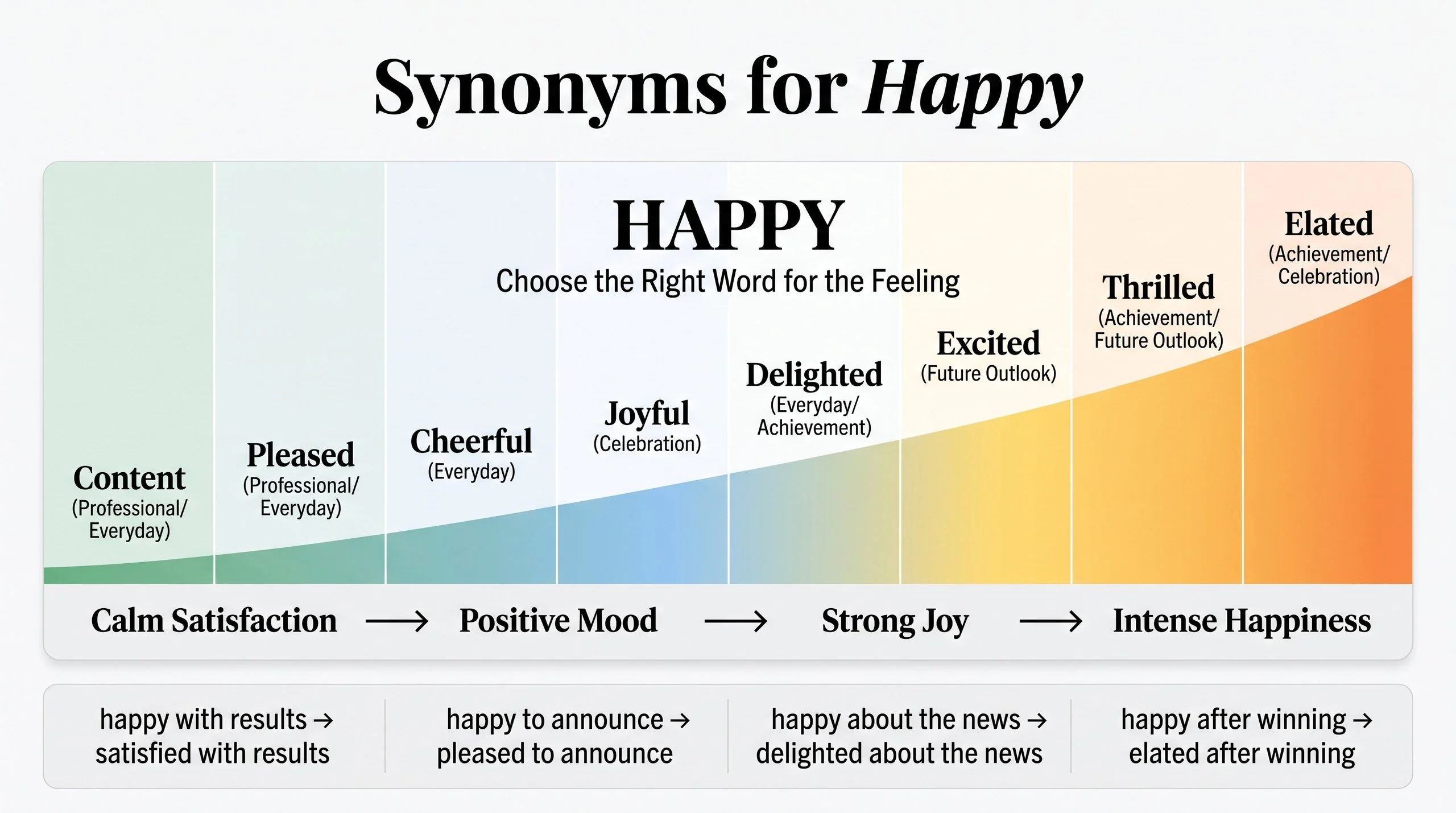
Another word for happy depends on the feeling or situation. Common synonyms include joyful, cheerful, delighted, pleased, content, satisfied, glad, excited, optimistic, and elated. For formal writing, pleased, content, and satisfied often work well. For stronger emotions, delighted, joyful, or elated can express a higher level of happiness.
What Does Happy Mean?
Definition
Happy means feeling or showing pleasure, joy, satisfaction, or positive emotion. It can describe a temporary mood, a reaction to good news, or a deeper sense of contentment.
The word is broad, so the best synonym depends on what kind of happiness you want to express.
For example:
She was happy about the promotion.
Here, pleased or delighted may be more precise.
He is happy with his new home.
In this sentence, satisfied or content may work better.
The children were happy at the party.
Here, cheerful, excited, or joyful could describe the mood more specifically.
Common Uses
The word happy commonly describes:
- Positive emotions
- Good news
- Personal satisfaction
- Success
- Celebrations
- Relationships
- Life circumstances
- Pleasant experiences
- Optimistic attitudes
- Feelings of contentment
Because happiness can range from quiet satisfaction to intense excitement, selecting a precise synonym can make your writing more expressive.
Best Synonyms for Happy
| Synonym | Meaning | Best Used When | Example |
|---|---|---|---|
| Joyful | Full of joy | Strong positive emotion | She felt joyful after the celebration. |
| Cheerful | Bright and positive in mood | Personality or everyday mood | He remained cheerful throughout the day. |
| Delighted | Very pleased | Good news or positive experiences | She was delighted with the results. |
| Pleased | Satisfied or happy about something | Professional and everyday situations | We were pleased with the outcome. |
| Content | Calmly satisfied | General life satisfaction | He felt content with his decision. |
| Satisfied | Pleased because expectations were met | Results, services, or achievements | Customers were satisfied with the service. |
| Glad | Happy about something | Everyday conversation | I’m glad you came. |
| Excited | Very enthusiastic about something upcoming | Events, opportunities, news | She was excited about the trip. |
| Optimistic | Hopeful about the future | Attitudes and expectations | He remained optimistic about the future. |
| Elated | Extremely happy | Major achievements or exciting news | She was elated after winning the award. |
Synonyms by Context
Formal Writing
Formal writing often benefits from precise alternatives to happy.
Useful choices include:
- Pleased
- Satisfied
- Content
- Delighted
- Optimistic
- Gratified
For example:
Basic:
The committee was happy with the proposal.
More formal:
The committee was pleased with the proposal.
Similarly:
Basic:
The participants were happy with the results.
Formal:
The participants were satisfied with the results.
The word pleased works well in professional communication because it sounds positive without being overly emotional.
Professional Writing
Business writing often requires a measured tone. Depending on the situation, use:
- Pleased
- Satisfied
- Delighted
- Optimistic
- Gratified
- Encouraged
For example:
We are pleased to announce the launch of our new service.
This sounds more professional than:
We are happy to announce the launch of our new service.
Likewise:
The client was satisfied with the final product.
Here, satisfied communicates that expectations were successfully met.
Academic Writing
Academic writing generally avoids overly emotional language unless emotion is part of the subject being studied.
Useful alternatives include:
- Satisfied
- Content
- Positive
- Optimistic
- Pleased
- Well-being
For example:
Participants reported feeling satisfied with the program.
This is more precise than:
Participants reported feeling happy with the program.
When discussing research, satisfaction or well-being may also communicate the specific concept more accurately.
Daily Conversation
Everyday American English uses simple and natural words such as:
- Glad
- Happy
- Cheerful
- Excited
- Thrilled
- Great
- Joyful
For example:
I’m glad you made it.
Or:
I’m thrilled about the opportunity!
These words sound natural in casual conversations and messages.
Professional Alternatives for Happy
Pleased
Meaning: Feeling satisfied or happy about something.
Tone: Professional and neutral.
Difficulty: Easy.
Usage frequency: Very common.
Best for: Emails, announcements, customer communication, business writing, and formal conversation.
Business example:
We are pleased with the progress of the project.
Academic example:
Participants were pleased with the program.
Daily example:
I’m pleased to hear the good news.
Satisfied
Meaning: Feeling that something has met expectations or requirements.
Tone: Professional and neutral.
Difficulty: Easy.
Usage frequency: Very common.
Best for: Customers, services, products, results, and achievements.
The customer was satisfied with the service.
Unlike happy, this word often suggests that a specific expectation has been met.
Delighted
Meaning: Very pleased or happy.
Tone: Warm and positive.
Difficulty: Easy.
Usage frequency: Common.
Best for: Good news, announcements, customer relationships, and personal experiences.
We are delighted to welcome our newest team member.
It is stronger and warmer than pleased.
Optimistic
Meaning: Hopeful and confident about a positive future.
Tone: Professional and positive.
Difficulty: Medium.
Usage frequency: Common.
Best for: Business, academic writing, future plans, and predictions.
The company remains optimistic about future growth.
Unlike happy, this word focuses on future expectations rather than present emotion.
Simple Alternatives for Happy
If you want an easy synonym, consider:
- Glad
- Pleased
- Cheerful
- Joyful
- Excited
- Content
- Satisfied
- Thrilled
For example:
I’m happy you’re here.
can become:
I’m glad you’re here.
Similarly:
She was happy with the gift.
can become:
She was pleased with the gift.
The simplest word is not always the best. Choose the synonym that matches the exact feeling.
Stronger Alternatives for Happy
When you want to express intense happiness, consider:
Delighted
Shows strong pleasure.
She was delighted by the surprise.
Thrilled
Shows intense excitement and happiness.
He was thrilled to receive the offer.
Elated
Describes an exceptionally high level of happiness.
She felt elated after achieving her goal.
Ecstatic
Describes overwhelming happiness or excitement.
The fans were ecstatic after the victory.
Overjoyed
Means extremely happy.
The parents were overjoyed by the news.
These words are stronger than ordinary happy, so they should be used when the emotional intensity justifies them.
Difference Between Similar Synonyms
Happy vs. Glad
Happy is broad and can describe a general emotional state. Glad often describes happiness about a specific event or fact.
She is happy with her life.
I’m glad you came.
Happy vs. Joyful
Joyful suggests a stronger, more expressive sense of joy.
The children were happy.
The children were joyful.
The second sentence creates a more vivid emotional image.
Happy vs. Pleased
Pleased usually means satisfied or happy about a particular result.
She was pleased with her performance.
This makes it especially useful in professional writing.
Happy vs. Content
Content means peacefully satisfied rather than highly excited.
He feels content with his life.
It suggests calm satisfaction.
Happy vs. Excited
Excited includes strong enthusiasm, usually about something happening or expected to happen.
I’m excited about the trip.
A person can be happy without being excited.
Happy vs. Satisfied
Satisfied usually means that expectations or needs have been met.
The customer was satisfied with the service.
Therefore, it works particularly well in business and customer-service contexts.
Happy vs. Elated
Elated is much stronger than happy.
She was elated after winning the competition.
The word suggests an exceptionally positive emotional state.
Synonym Analysis at a Glance
| Synonym | Tone | Difficulty | Frequency | Best For |
|---|---|---|---|---|
| Glad | Casual | Easy | Very Common | Conversation |
| Pleased | Professional | Easy | Very Common | Business, emails |
| Joyful | Positive | Easy | Common | Creative writing, celebrations |
| Cheerful | Warm | Easy | Common | Personality, daily life |
| Delighted | Strong | Easy | Common | News, experiences |
| Content | Calm | Easy | Common | Life satisfaction |
| Satisfied | Neutral | Easy | Very Common | Business, results |
| Excited | Energetic | Easy | Very Common | Events, opportunities |
| Optimistic | Hopeful | Medium | Common | Business, future plans |
| Elated | Very strong | Medium | Less Common | Major achievements |
Before-and-After Examples
Precise word choices can make a sentence more expressive.
Before:
She was happy about the promotion.
After:
She was delighted about the promotion.
Before:
The customer was happy with the service.
After:
The customer was satisfied with the service.
Before:
We are happy to announce the results.
After:
We are pleased to announce the results.
Before:
He was happy about his future.
After:
He was optimistic about his future.
Before:
The children were very happy.
After:
The children were joyful.
Before:
She was extremely happy after winning.
After:
She was elated after winning.
The goal is not simply to use a more complicated word. Instead, choose the word that communicates the exact type of happiness.
Opposite Words
Common antonyms for happy include:
- Sad
- Unhappy
- Miserable
- Disappointed
- Upset
- Gloomy
- Depressed
- Dissatisfied
- Discontent
- Sorrowful
These words describe different forms or degrees of negative emotion. For example, disappointed usually relates to an unmet expectation, while dissatisfied often relates to an unmet need or standard.
FAQs
What is another word for happy?
Common synonyms for happy include joyful, cheerful, delighted, pleased, content, satisfied, glad, excited, optimistic, and elated.
What is a formal synonym for happy?
Formal alternatives include pleased, satisfied, content, delighted, optimistic, and gratified. Pleased is especially common in professional communication.
What is a professional word for happy?
Useful professional alternatives include pleased, satisfied, optimistic, delighted, encouraged, and gratified. The right word depends on the situation.
What is a stronger word for happy?
Stronger alternatives include delighted, thrilled, elated, ecstatic, and overjoyed. These words express greater emotional intensity.
What is a simple synonym for happy?
Simple alternatives include glad, pleased, cheerful, joyful, content, and excited.
What is a synonym for happy in writing?
Depending on the context, use joyful, delighted, pleased, content, satisfied, cheerful, or elated. For formal writing, pleased and satisfied are often appropriate.
What is a synonym for very happy?
Strong alternatives include delighted, thrilled, elated, ecstatic, and overjoyed.
What is a synonym for happy with something?
Satisfied, pleased, content, and delighted can replace happy with something. For example, “happy with the results” can become “satisfied with the results.”
What is a synonym for happy person?
Depending on the intended meaning, use cheerful person, joyful person, upbeat person, optimistic person, or content person.
What is a synonym for happy life?
Possible alternatives include joyful life, fulfilling life, satisfying life, contented life, or positive life, depending on the exact meaning.
Conclusion
The best synonyms for happy depend on the type and intensity of happiness you want to express. Glad works naturally in everyday conversation, while pleased and satisfied are useful in professional settings. Joyful and cheerful describe positive moods, whereas content suggests calm satisfaction.
For stronger emotions, delighted, thrilled, elated, ecstatic, and overjoyed communicate greater intensity. Meanwhile, optimistic is better when happiness comes from confidence about the future.
The key is to choose a word that explains why someone is happy and how strongly they feel it. A precise synonym makes your writing more natural, expressive, and useful.