The word antebellum often appears in discussions about American history, literature, architecture, and the period before the Civil War. If you have seen phrases such as “antebellum South” or “antebellum house,” you may wonder exactly what the term means and why it is used so often in historical writing. Understanding the antebellum meaning makes these references much easier to understand.
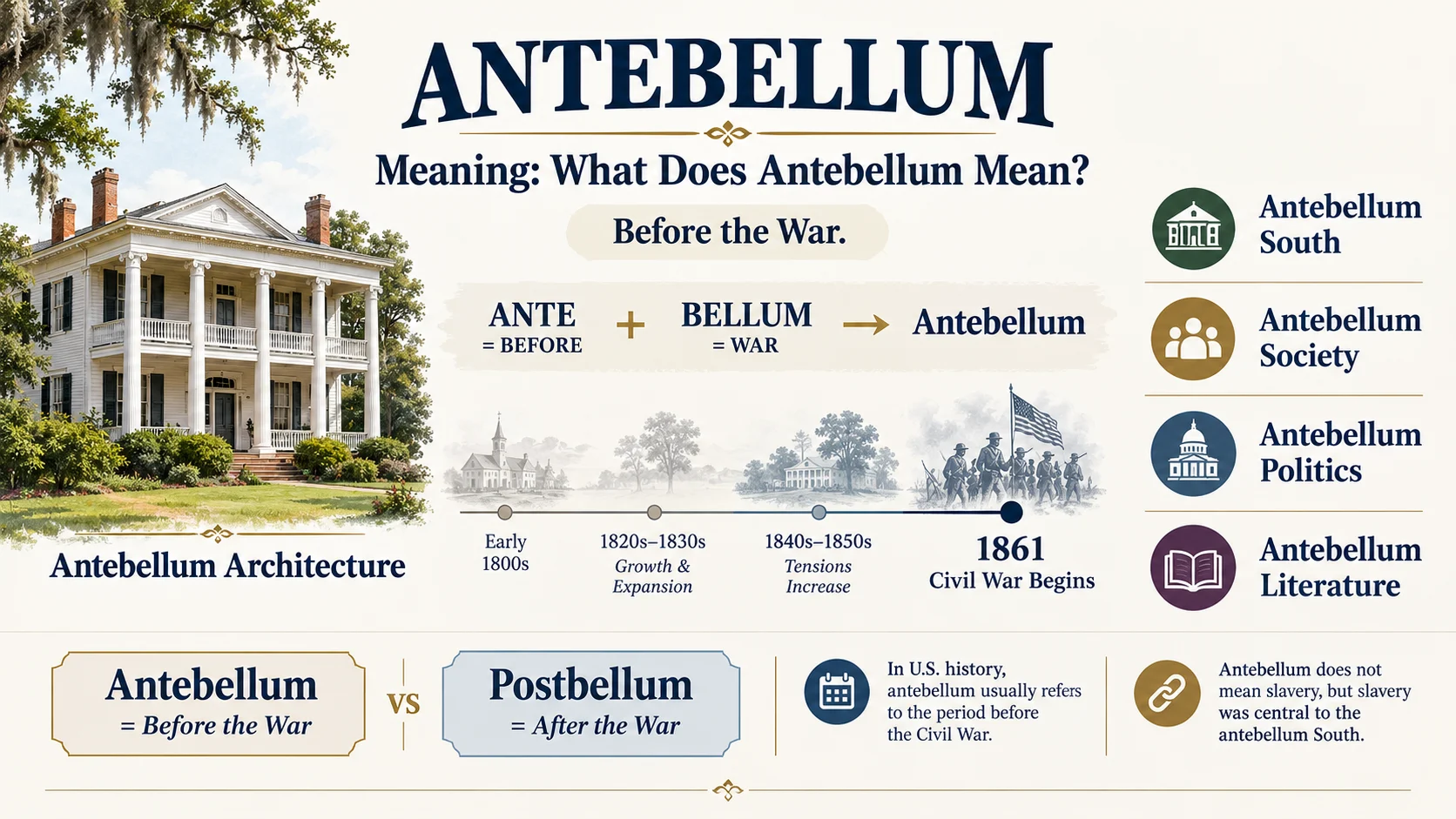
In simple terms, antebellum means “before the war.” It comes from Latin: ante means “before,” while bellum means “war.” In American history, the word most commonly describes the period before the American Civil War, especially the years leading up to the conflict in 1861. The term can also describe the culture, economy, politics, buildings, and social conditions of that era.
However, antebellum does not simply mean “old” or “historic.” It has a specific historical context. In this guide, we will explore the antebellum meaning, its origin, historical period, common examples, relationship to slavery, and how to use the word correctly in modern English.
What Does Antebellum Mean?
Antebellum means “before the war.” In American history, it usually refers to the period and society before the American Civil War, particularly the decades before 1861.
For example, antebellum South refers to the Southern United States before the Civil War. Likewise, an antebellum house is a building constructed before the war, especially a historic Southern home associated with that period.
The word itself does not mean “slavery,” but slavery was a major part of the social, economic, and political system of the antebellum American South.
Antebellum Meaning in Simple English
The simplest definition of antebellum is:
Antebellum = existing or happening before a war.
The word has a broader meaning than just “before the Civil War.” In theory, it can describe any period before a war. However, American English often uses antebellum specifically for the years before the U.S. Civil War.
Consider these examples:
- Antebellum America = America before the Civil War
- Antebellum South = the Southern United States before the Civil War
- Antebellum society = society during the pre-Civil War period
- Antebellum architecture = architecture associated with that period
- Antebellum plantation = a plantation that existed during the pre-Civil War era
Therefore, the exact meaning depends on the context.
What Does Antebellum Literally Mean?
Antebellum comes from Latin.
- Ante = before
- Bellum = war
Together, ante bellum means “before the war.”
The English word antebellum developed from this Latin expression. Although the literal meaning is general, American historical writing gave the word a particularly strong association with the period before the Civil War.
As a result, readers often understand “antebellum” as a reference to pre-Civil War America without needing the writer to specify the war.
Antebellum Meaning in American History
In American history, antebellum usually describes the period between the formation of the United States and the beginning of the Civil War, although historians may use different boundaries depending on the topic.
A common usage focuses on the decades immediately before 1861.
This period included major changes in:
- Politics
- Industry
- Transportation
- Agriculture
- Religion
- Literature
- Westward expansion
- Immigration
- Social reform
- Slavery and abolition
The antebellum period was therefore not simply a peaceful period before a war. Instead, it was a time of significant economic growth, political conflict, social change, and sectional tension.
What Was the Antebellum Period?
The antebellum period refers to the era before the American Civil War.
Historians often focus on the early-to-mid 19th century when using the term. During this period, the Northern and Southern states developed different economic and social systems.
The North experienced increasing industrialization, urban growth, immigration, and commercial development. Meanwhile, much of the Southern economy depended heavily on agriculture and enslaved labor.
At the same time, disagreements over slavery and its expansion into new territories became increasingly intense.
Why Was the Antebellum Period Important?
The period was important because many of the issues that eventually contributed to the Civil War became more serious during these decades.
For example, Americans debated:
- Whether slavery should expand into western territories
- The power of the federal government
- The rights and powers of individual states
- Economic differences between regions
- Abolition and antislavery movements
- The political balance between free and slave states
Consequently, the antebellum period provides important background for understanding the Civil War.
Antebellum South Meaning
The phrase antebellum South refers to the Southern United States before the Civil War.
The term often appears in discussions of:
- Plantation agriculture
- Slavery
- Southern politics
- Southern culture
- Architecture
- Cotton production
- Social hierarchy
- Wealth and land ownership
The Southern economy relied heavily on agricultural production, particularly cotton in many areas. Enslaved African Americans performed much of the forced labor that supported this economy.
Therefore, the term antebellum South should not be understood only as a description of elegant homes, plantations, or Southern traditions. The period was also defined by slavery, racial inequality, political conflict, and resistance to slavery.
Antebellum and Slavery
One important point is that antebellum does not literally mean slavery.
Instead, it means before the war. However, when the word is used in the context of the American South, slavery is an essential part of the historical background.
For example:
Antebellum plantation
A plantation operating before the Civil War, often relying heavily on enslaved labor.
Antebellum society
The broader society of the period, including its political, economic, racial, and social structures.
Antebellum literature
Literature produced during the pre-Civil War period, including works that sometimes addressed slavery, abolition, religion, reform, and American identity.
Thus, the word describes a period, while slavery describes one of the central institutions of that period.
Antebellum Architecture Meaning
Antebellum architecture refers to architectural styles and buildings associated with the American South before the Civil War.
Large Southern homes are often strongly associated with the term.
Common features may include:
- Large columns
- Wide front porches
- Symmetrical designs
- High ceilings
- Large windows
- Formal entrances
- Expansive grounds
Greek Revival and Classical Revival influences were especially important in many antebellum buildings.
However, not every old Southern building is automatically “antebellum.” The building generally needs to date from the relevant pre-Civil War period or be strongly associated with that era.
What Is an Antebellum House?
An antebellum house is generally a house built before the American Civil War, particularly one associated with the Southern United States.
Many famous examples are large plantation homes. Nevertheless, antebellum architecture was not limited to plantations or wealthy families.
An antebellum house may be recognized by architectural features such as:
- Classical columns
- Large porches
- Balanced proportions
- Decorative entrances
- Tall windows
- Formal interior spaces
The phrase describes the building’s historical period rather than automatically describing its size or wealth.
Antebellum Plantation Meaning
An antebellum plantation was a large agricultural estate in the American South that existed before the Civil War.
Many plantations produced crops such as:
- Cotton
- Tobacco
- Rice
- Sugar
- Indigo
Enslaved people provided much of the forced labor that made plantation agriculture possible.
Because of this history, modern descriptions of antebellum plantations should provide appropriate historical context. Presenting these places only as symbols of wealth or romantic Southern life can hide the experiences of the enslaved people who lived and worked there.
Antebellum vs. Postbellum
The terms antebellum and postbellum describe opposite sides of a war.
| Term | Meaning | U.S. Historical Use |
|---|---|---|
| Antebellum | Before the war | Before the Civil War |
| Postbellum | After the war | After the Civil War |
| Wartime | During the war | During the Civil War |
The prefix ante- means “before,” while post- means “after.”
Therefore, the distinction is easy to remember:
Antebellum = before
Postbellum = after
Antebellum vs. Prewar
Antebellum and prewar can both refer to a period before a war, but they are not always interchangeable.
Prewar is a general term. It can describe the period before almost any war.
Antebellum is more formal and historical. In American English, it often refers specifically to the period before the Civil War.
For example:
- “Prewar Europe” could refer to Europe before World War II.
- “Antebellum South” normally refers to the Southern United States before the Civil War.
Therefore, antebellum carries a stronger historical association.
Antebellum vs. Historic
These words also have different meanings.
Historic means important in history or related to the past.
Antebellum identifies a particular historical period before a war.
A 1900 building may be historic, but it is not necessarily antebellum. A house built in 1850 in the American South may be described as antebellum.
So, antebellum is more specific than historic.
Examples of Antebellum in a Sentence
Here are several natural examples:
- The museum is located inside an antebellum house.
- Historians study antebellum politics to understand the causes of the Civil War.
- The novel explores life in the antebellum South.
- The city has several preserved antebellum buildings.
- Researchers examined antebellum society and its changing political divisions.
- The plantation dates to the antebellum period.
- The author wrote about antebellum America and its social conflicts.
- The building is known for its antebellum architecture.
These examples show that the word can describe a period, place, society, building, culture, or historical condition.
How to Use Antebellum Correctly
Use antebellum when you want to describe something connected to a period before a war.
In American historical writing, the word commonly refers to the period before the Civil War.
Correct Usage
- antebellum South
- antebellum America
- antebellum period
- antebellum architecture
- antebellum house
- antebellum literature
- antebellum politics
Incorrect or Misleading Usage
Avoid using antebellum simply as a synonym for:
- Old
- Traditional
- Southern
- Historic
- Beautiful
- Plantation
- Southern-style
The word has a specific historical meaning. Therefore, context matters.
Is Antebellum a Positive or Negative Word?
The word antebellum itself is generally neutral. It describes a historical period.
However, the subject being described may involve deeply harmful or unjust conditions, especially when discussing slavery and racial inequality in the antebellum South.
For example, calling a building an “antebellum house” is primarily a historical description. It does not automatically express approval of the society in which the building existed.
Still, writers should avoid romanticizing the antebellum period when discussing plantation life or Southern society. Historical accuracy requires acknowledging the experiences of enslaved people and the broader system of slavery.
Common Misunderstandings About Antebellum
1. Antebellum Does Not Mean “Slavery”
The word means before the war, not “slavery.”
Slavery is closely connected to many discussions of the antebellum South, but the words are not synonyms.
2. Antebellum Does Not Mean “Old”
Something can be old without being antebellum.
The term points to a particular historical period.
3. Antebellum Does Not Mean “Southern”
Not everything from the American South is antebellum.
The word specifically relates to the period before the Civil War.
4. Antebellum Does Not Always Refer to the Civil War
Its literal meaning is “before the war.” In other historical contexts, writers can theoretically use it for a different war.
However, American English strongly associates antebellum with the period before the Civil War.
5. Not Every Plantation Was Antebellum
A plantation may have existed before, during, or after the Civil War.
The word antebellum applies when the subject belongs to the pre-Civil War period.
Antebellum in Literature
The term antebellum literature refers to American literature produced before the Civil War.
This period included major writers and movements.
Literary works from the era explored themes such as:
- Freedom
- Religion
- Slavery
- Abolition
- Morality
- Individual identity
- Social reform
- Nature
- American democracy
Writers from this period included figures such as Harriet Beecher Stowe, Frederick Douglass, Ralph Waldo Emerson, Henry David Thoreau, Nathaniel Hawthorne, and Edgar Allan Poe.
Their works reflected different experiences and viewpoints, so antebellum literature cannot be treated as a single unified style.
Antebellum in Modern Usage
Today, antebellum is most often used in historical, academic, architectural, and cultural discussions.
You may encounter it in:
- History books
- Museums
- University courses
- Historic property descriptions
- Architecture articles
- Literature studies
- Documentaries
- Genealogy research
- Discussions of American culture
The word can also appear in popular culture. However, modern use sometimes creates debate when historical subjects, particularly plantations, are presented without sufficient context about slavery.
Is Antebellum Still Used Today?
Yes. Antebellum remains a common historical term.
It is especially useful because it provides a concise way to describe the period before the Civil War.
Instead of writing:
“The Southern United States during the years before the Civil War”
a historian can write:
“The antebellum South.”
This makes the term useful in academic and historical writing.
Antebellum Word Forms and Grammar
Antebellum is primarily used as an adjective.
Examples:
- antebellum architecture
- antebellum society
- antebellum politics
- antebellum literature
- antebellum America
It can also appear as a noun in phrases such as the antebellum period, although “antebellum” itself most commonly functions as a modifier.
Is Antebellum Capitalized?
Usually, antebellum is lowercase.
For example:
The museum contains several antebellum buildings.
However, capitalization may appear when the word begins a sentence or forms part of a proper title.
Quick Reference: Antebellum Meaning
| Question | Answer |
|---|---|
| What does antebellum mean? | Before the war |
| What does it usually mean in U.S. history? | The period before the Civil War |
| What does antebellum South mean? | The Southern U.S. before the Civil War |
| What does antebellum house mean? | A house dating from the pre-Civil War period |
| What language is the word from? | Latin |
| What does ante mean? | Before |
| What does bellum mean? | War |
| Is it the same as slavery? | No |
| Is it the same as historic? | No |
| Opposite term? | Postbellum |
Frequently Asked Questions
What is the simple meaning of antebellum?
Antebellum means “before the war.” In American history, it usually refers to the period before the Civil War.
What does antebellum mean in U.S. history?
In U.S. history, antebellum generally describes the years and society before the American Civil War began in 1861.
What does antebellum South mean?
The antebellum South refers to the Southern United States before the Civil War. The period was strongly shaped by plantation agriculture, slavery, racial hierarchy, and growing political conflict.
Does antebellum mean slavery?
No. Antebellum means before the war. However, slavery was a central institution in the antebellum South and is essential to understanding that historical period.
What is an antebellum house?
An antebellum house is a house built before the Civil War, particularly one associated with the American South and its pre-Civil War architectural traditions.
What is the opposite of antebellum?
The direct opposite is postbellum, meaning after the war. In American history, postbellum commonly refers to the period after the Civil War.
Is antebellum a negative word?
The word itself is generally neutral because it identifies a historical period. However, the history associated with the antebellum South includes slavery, racial oppression, and other serious injustices.
What is an antebellum plantation?
An antebellum plantation was an agricultural estate operating before the Civil War. Many relied on enslaved labor to produce crops such as cotton, tobacco, rice, or sugar.
Is antebellum the same as prewar?
They can have similar meanings, but prewar is broader. Antebellum is a more formal historical term and is strongly associated with the American period before the Civil War.
How do you pronounce antebellum?
Antebellum is commonly pronounced approximately as “an-tee-BEL-um.”
What does antebellum architecture mean?
Antebellum architecture refers to architectural styles and buildings associated with the period before the Civil War, especially in the American South.
Conclusion
The antebellum meaning is simple: “before the war.” In American history, however, the word usually refers to the period before the Civil War, especially the decades leading up to 1861. It can describe the era, society, politics, architecture, literature, and economy of that time.
The term is particularly common in phrases such as antebellum South, antebellum house, antebellum architecture, and antebellum society. Although the word itself does not mean slavery, slavery was a central part of the social and economic system of the antebellum South.
Ultimately, antebellum is a historical term, not simply another word for “old” or “Southern.” Understanding its specific context helps you use it accurately and better understand references to American history before the Civil War.

Jack Murphy is a language writer with a passion for word meanings, synonyms, and effective communication. He creates informative and easy to understand content to help readers enhance their vocabulary and language skills.



13 thoughts on “Antebellum Meaning| What Does Antebellum Mean? Definition, History & Context Explained 2026”