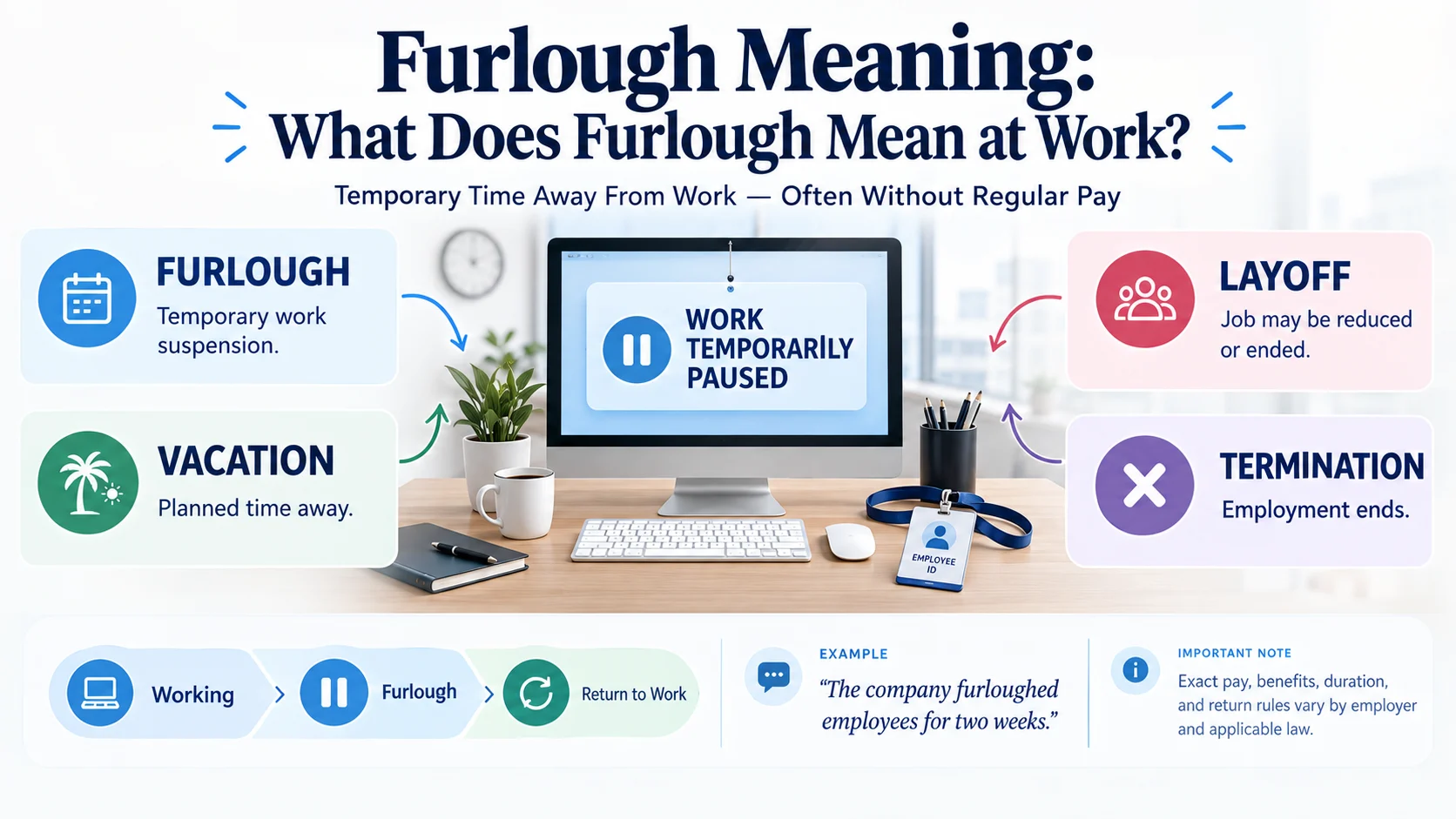
A furlough is a temporary period when an employee is required to stop working, often without regular pay, while remaining connected to the employer. Unlike a termination, a furlough usually keeps the employment relationship in place.
What does furlough mean when you hear it at work or in the news? The term can sound confusing because it relates to employment but does not necessarily mean that someone has lost their job.
The furlough meaning is a temporary period when an employee is required to stop working, often without regular pay, while the employment relationship continues. In other words, a furloughed worker usually remains connected to the employer but does not work during the furlough period.
Companies may use furloughs during periods of reduced business activity, financial pressure, seasonal changes, or other temporary circumstances. Government agencies can also furlough employees when funding issues prevent normal operations.
A furlough is different from a permanent layoff or termination. However, the exact rules can vary by employer, employment contract, and local law. Some furloughs last for a short period, while others may continue until business conditions improve.
Understanding the term becomes easier when you compare it with related words such as layoff, unpaid leave, vacation, and termination.
What Does Furlough Mean?
A furlough is a temporary period when an employee stops working, often without regular pay, while remaining employed by the organization.
For example:
“The company furloughed 50 employees for two weeks.”
This means the employees temporarily stopped working under the company’s furlough arrangement.
A furlough usually differs from termination because the employer expects the employee to return to work.
What Is the Furlough Meaning?
The word furlough generally refers to a temporary period away from work.
In employment, an employer may place an employee on furlough when the employee temporarily stops working.
During a furlough, several things may happen:
- The employee may stop working.
- Regular wages may stop.
- Benefits may continue or change.
- The employee may remain employed.
- The employer may expect the employee to return.
The exact arrangement depends on the employer and applicable employment rules.
Therefore, furlough does not automatically mean that an employee has been fired.
What Does “Furloughed” Mean?
Furloughed means that an employee has been placed on furlough.
For example:
“Several workers were furloughed during the temporary shutdown.”
This means those workers stopped working under a temporary furlough arrangement.
Another example:
“I was furloughed for three weeks.”
This means the speaker temporarily stopped working because of a furlough.
Furlough vs. Furloughed
These forms are related:
- Furlough = the temporary work arrangement or period away from work.
- Furloughed = describes the employee who has been placed on furlough.
For example:
“The company announced a furlough.”
“Several employees were furloughed.”
Why Do Companies Use Furloughs?
Employers may use furloughs when they want to reduce short-term labor costs without permanently ending employment.
Possible reasons include:
Temporary Business Slowdowns
A company may experience a temporary decline in demand.
Instead of permanently eliminating positions, the employer may temporarily reduce working time.
Seasonal Work
Some businesses naturally operate at different levels during different seasons.
A seasonal furlough can temporarily reduce staffing when demand falls.
Financial Pressure
An employer facing temporary financial difficulties may use furloughs as one cost-management measure.
Temporary Closures
A company may furlough workers during a temporary closure.
For example, a facility might close for several weeks because of renovations or another operational issue.
Government Funding Problems
Government employees can also experience furloughs when an agency cannot continue normal operations because of funding restrictions.
The specific rules vary depending on the government system and the circumstances involved.
What Happens During a Furlough?
The practical effect of a furlough depends on the employer’s policy and applicable law.
Typically, a furloughed employee may:
- Stop performing regular work.
- Receive reduced or no regular wages during the furlough.
- Remain an employee.
- Receive instructions about when to return.
- Have certain benefits continue, change, or pause.
An employer should provide employees with clear information about the terms of the furlough.
For example, an employee might receive a notice stating:
“Your furlough will begin on July 1. You will receive further instructions regarding your return date.”
The exact terms matter, so employees should review their employer’s notice and applicable rules.
Does Furlough Mean You Are Fired?
No. A furlough does not necessarily mean that you are fired.
A furlough usually represents a temporary work suspension rather than a permanent end to employment.
However, a furlough can sometimes become longer or lead to other employment actions if business conditions do not improve.
Therefore, employees should not assume that every furlough guarantees a return date.
The employer’s written notice, employment agreement, and applicable law can provide more specific information.
Furlough vs. Layoff
Furlough and layoff are not always used in exactly the same way, so context matters.
| Furlough | Layoff |
|---|---|
| Often temporary | Can be temporary or permanent |
| Employee may remain employed | Employment may end or be suspended |
| Work may stop temporarily | Job may be eliminated |
| Regular pay may stop | Pay generally stops |
| Employer may expect a return | Return may or may not occur |
The biggest practical distinction is often the expected continuation of the employment relationship.
However, employers and jurisdictions can use these terms differently. Therefore, the exact legal meaning depends on the circumstances.
Furlough vs. Termination
A termination generally means the employment relationship has ended.
A furlough generally means the employee remains connected to the employer while temporarily not working.
For example:
Furlough:
“The employee will return when operations resume.”
Termination:
“The employee’s employment has ended.”
This distinction makes furlough different from being fired.
Furlough vs. Unpaid Leave
Furlough and unpaid leave can both involve periods without normal pay, but they usually arise in different situations.
Unpaid leave often refers to an employee taking approved time away from work.
A furlough, by contrast, is commonly initiated by the employer.
For example:
“Maria requested two weeks of unpaid leave.”
Maria chose to take the leave.
Compare that with:
“The company placed Maria on furlough for two weeks.”
The company initiated the temporary work suspension.
Furlough vs. Vacation
A furlough is not the same as vacation.
Vacation is normally an approved period of time off that forms part of an employee’s leave arrangement. Depending on the employer’s policy, vacation may be paid.
A furlough usually comes from an employer’s operational decision and may involve unpaid time.
For example:
“I am taking vacation next week.”
means the employee chose or requested time away.
Meanwhile:
“I was placed on furlough next week.”
suggests that the employer temporarily stopped the employee’s work.
What Is a Government Furlough?
A government furlough is a temporary period during which certain government employees are instructed not to perform their regular duties.
In the United States, the term often appears in discussions about federal government funding.
During certain funding interruptions, some federal employees may be furloughed while other employees continue working under applicable rules.
Government furlough procedures can differ from private-sector furloughs. Therefore, the specific circumstances and legal requirements matter.
Furlough Meaning in the Workplace
In workplace conversations, furlough often appears in sentences such as:
“The company announced a temporary furlough.”
“Employees will be furloughed for two weeks.”
“She returned to work after her furlough.”
These sentences all describe a temporary interruption in normal work.
The word can therefore appear in:
- HR announcements
- Company emails
- News reports
- Employee handbooks
- Workplace discussions
- Government announcements
- Employment documents
Furlough Examples
Here are several simple examples.
Example 1: Company Furlough
“The factory furloughed employees for two weeks.”
Meaning: Employees temporarily stopped working during the two-week period.
Example 2: Individual Employee
“James was furloughed until business conditions improved.”
Meaning: James temporarily stopped working under the company’s furlough arrangement.
Example 3: Government Worker
“Some government employees were placed on furlough.”
Meaning: Those employees were temporarily instructed not to perform their normal duties under the applicable government rules.
Example 4: Seasonal Furlough
“The resort furloughed some workers during the off-season.”
Meaning: Some employees temporarily stopped working when business activity decreased.
Example 5: Returning to Work
“Employees returned after the furlough ended.”
Meaning: Workers resumed their normal jobs after the temporary period away.
How to Use Furlough in a Sentence
Furlough can function as both a noun and a verb.
Furlough as a Noun
“The company announced a furlough.”
Here, furlough refers to the temporary period away from work.
Another example:
“His furlough lasted three weeks.”
Furlough as a Verb
“The company furloughed several employees.”
Here, furloughed describes the action taken by the company.
Another example:
“The agency may furlough workers during the funding interruption.”
Furloughed as an Adjective
You can also use furloughed to describe employees:
“Furloughed employees received instructions about returning to work.”
Common Furlough Phrases
You may encounter several expressions related to furlough.
“Placed on Furlough”
This means an employee has been moved into a temporary non-working status.
“The workers were placed on furlough.”
“Furloughed Employee”
This describes an employee who is currently on furlough.
“Furloughed employees should check their return-to-work instructions.”
“Furlough Period”
This means the time during which the employee remains on furlough.
“The furlough period lasted one month.”
“Furlough Ends”
This means the temporary period is coming to an end.
“The furlough ends on Monday.”
“Return From Furlough”
This means the employee goes back to work after the furlough.
“She returned from furlough last week.”
Can a Furlough Be Paid?
A furlough is often associated with unpaid time, but the exact payment arrangement depends on the employer, contract, and applicable law.
Some arrangements may involve:
- No regular wages
- Reduced wages
- Reduced working hours
- Use of available paid leave
- Other employer-specific arrangements
Therefore, furlough does not have one universal pay rule.
If you are personally affected by a furlough, review the written notice from your employer and the rules that apply to your employment.
How Long Does a Furlough Last?
There is no single standard furlough length.
A furlough might last:
- A few days
- Several weeks
- Several months
- Until a specific business condition changes
The employer may provide a specific return date or explain that the furlough will continue until further notice.
The duration depends on why the furlough occurred and how the employer manages the situation.
Can a Furloughed Employee Work?
Generally, an employee should follow the employer’s specific instructions about whether work is permitted during the furlough.
Some furlough arrangements completely stop work. Others may involve reduced hours rather than a complete work stoppage.
Employees should not assume that they can continue performing normal duties while on furlough.
The employer’s written instructions are important.
Furlough and Remote Work
A furlough can also affect remote employees.
Working from home does not automatically prevent an employer from placing someone on furlough.
If the employee is instructed not to work during the furlough, they should follow those instructions rather than continuing normal remote duties.
Common Misunderstandings About Furlough
Furlough Always Means Permanent Job Loss
Not necessarily.
A furlough generally describes a temporary employment measure. However, circumstances can change, so employees should not assume that every furlough guarantees a return.
Furlough Always Means No Benefits
Not necessarily.
Benefits can depend on the employer’s policy, the benefit plan, and applicable rules.
Furlough Is the Same as Vacation
No.
Vacation is generally planned or requested time away from work. A furlough usually results from an employer decision.
Furlough Always Lasts a Specific Amount of Time
No.
Some employers provide a specific end date, while others provide updates as circumstances change.
Furlough Means You Are Fired
No.
A furloughed employee generally remains connected to the employer, although the exact employment status depends on the arrangement.
Quick Reference: Furlough Meaning
| Term | Simple Meaning |
|---|---|
| Furlough | Temporary period away from work |
| Furloughed | Placed on a temporary work suspension |
| Furlough period | The time spent on furlough |
| Return from furlough | Go back to work after furlough |
| Layoff | Reduction or ending of employment that may or may not be temporary |
| Termination | End of employment |
| Unpaid leave | Approved time away from work without normal pay |
| Vacation | Planned time away from work, often under a leave policy |
Frequently Asked Questions
What does furlough mean in simple terms?
Furlough means a temporary period when an employee stops working, often without regular pay, while remaining connected to the employer.
What does furloughed mean?
Furloughed means that an employee has been placed on furlough.
For example:
“She was furloughed for one month.”
This means she temporarily stopped working under the employer’s furlough arrangement.
Does furlough mean you are fired?
No. A furlough generally means a temporary interruption of work rather than an immediate termination.
Is furlough the same as a layoff?
Not necessarily. A furlough generally keeps the employment relationship in place temporarily, while a layoff can involve the elimination or suspension of a job. Employers and jurisdictions may use these terms differently.
Is furlough the same as unpaid leave?
No. Unpaid leave is often requested or approved for an employee’s absence, while a furlough is generally initiated by the employer.
Is furlough paid?
Often, furlough involves reduced or no regular wages, but payment rules vary. Check the specific furlough arrangement and applicable employment rules.
How long does a furlough last?
There is no universal length. A furlough can last from a few days to several months or longer, depending on the circumstances.
Can you be furloughed from a job?
Yes. Employers can place employees on furlough under certain circumstances and subject to applicable employment rules.
Can a furloughed employee work?
That depends on the furlough arrangement. Employees should follow the employer’s instructions about whether any work is permitted.
What is a government furlough?
A government furlough is a temporary period in which certain government employees are instructed not to perform their regular duties under applicable government rules.
What is a furlough period?
A furlough period is the amount of time an employee remains on furlough.
What does “return from furlough” mean?
It means an employee goes back to work after the temporary furlough ends.
What is the difference between furlough and vacation?
Vacation is normally planned or approved time off. A furlough usually results from an employer’s temporary decision to stop or reduce work.
Conclusion
The furlough meaning is a temporary period when an employee stops working, often without regular pay, while the employment relationship continues. The term can apply to private companies, government agencies, and other organizations.
A furlough differs from a termination because employment usually continues. It also differs from vacation because the employer generally initiates the furlough rather than the employee requesting ordinary time off.
At the same time, furlough rules can vary. Pay, benefits, working restrictions, duration, and return arrangements depend on the employer, employment agreement and applicable laws.
In simple terms, if someone says “I was furloughed,” they usually mean “My employer temporarily stopped me from working.” The employee may then return when the furlough ends or when the employer restores normal operations.

Harry Edwards is a language writer specializing in word meanings, synonyms, and language usage. He creates clear, accurate, and engaging content to help readers improve their vocabulary and communication skills.
1 thought on “Furlough Meaning| What Does Furlough Mean at Work? Definition, Rules, Examples & Employee Rights 2026”