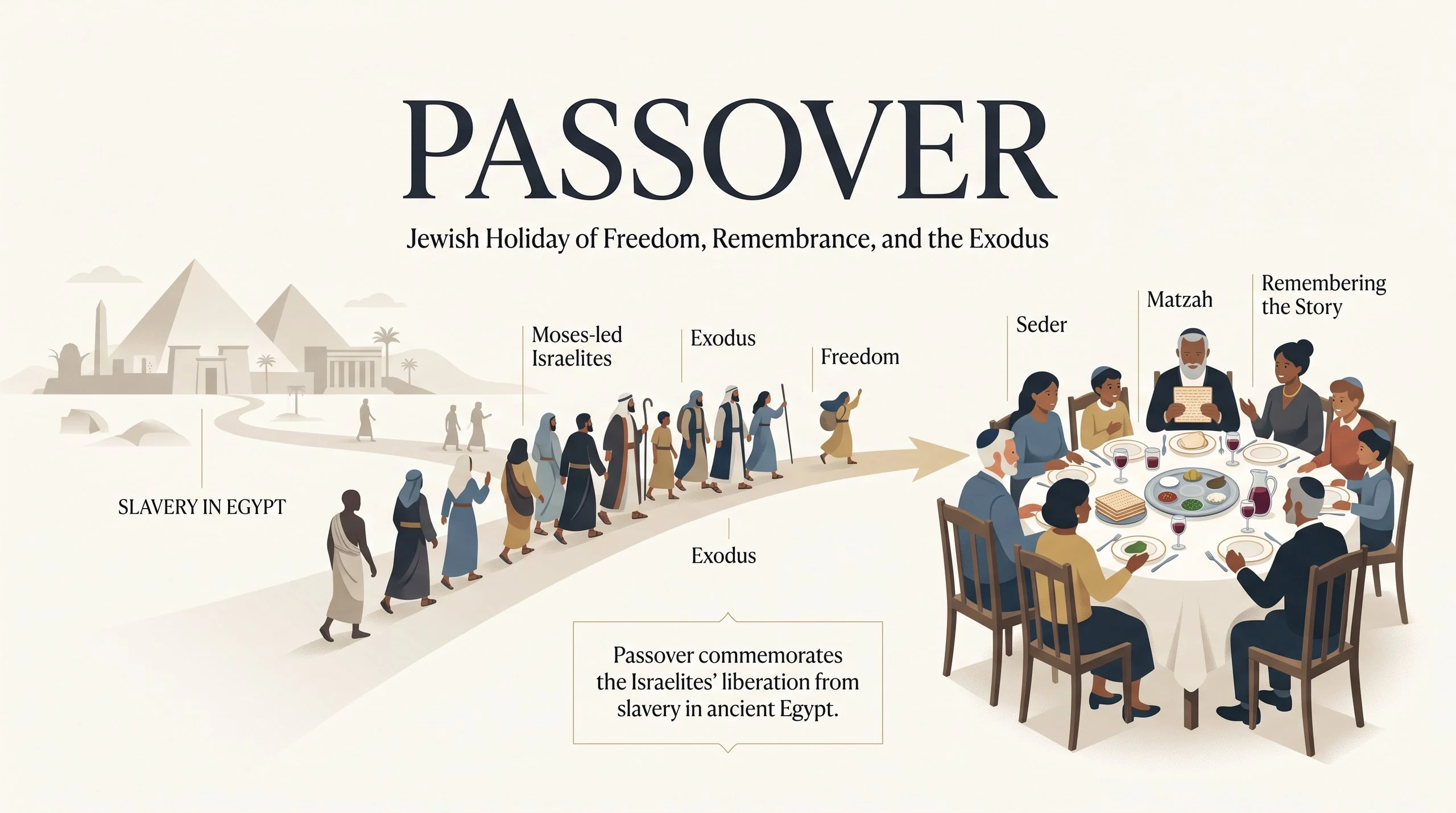
Passover meaning refers to the Jewish holiday commemorating the Israelites’ liberation from slavery in ancient Egypt. The holiday remembers the Exodus and emphasizes freedom, faith, family, and remembrance. Passover is traditionally observed with a special meal called a Seder, during which families retell the Exodus story and eat symbolic foods.
Passover meaning is rooted in one of the most important stories in Jewish history: the liberation of the Israelites from slavery in ancient Egypt. The holiday, known in Hebrew as Pesach, centers on remembering the Exodus and the journey from slavery toward freedom.
For Jewish people, Passover is more than a historical remembrance. It is a major religious and cultural observance that brings families together around food, prayer, storytelling, and tradition. During the holiday, people remember the hardships of slavery while celebrating freedom and deliverance.
One of the most recognizable parts of Passover is the Seder, a special meal held at the beginning of the holiday. During the Seder, participants read from the Haggadah, ask questions, eat symbolic foods, and retell the story of the Exodus.
The holiday also has distinctive dietary rules. In particular, many Jewish people avoid chametz, or leavened foods, during Passover. Instead, they eat matzah, an unleavened bread associated with the Israelites leaving Egypt quickly.
Understanding Passover also means understanding its deeper themes. Freedom, memory, faith, identity, family, and responsibility all play important roles. Therefore, the holiday remains meaningful across generations.
Passover Meaning at a Glance
| Meaning | Context | Primary Platforms | Example | Tone |
|---|---|---|---|---|
| A Jewish holiday remembering the Exodus from Egypt | Judaism, history, family, religion | Conversations, education, celebrations, social media | “My family celebrates Passover every year.” | Respectful, religious, traditional |
What Does Passover Mean?
At its simplest, Passover is a Jewish holiday that commemorates the Exodus of the Israelites from slavery in Egypt.
According to the biblical account in the Book of Exodus, the Israelites were enslaved in Egypt. Moses was chosen to lead them toward freedom. Before the final plague, the Israelites were instructed to mark their homes with the blood of a lamb so that the plague would “pass over” their homes.
This event gives the holiday its English name, Passover.
The Hebrew name Pesach comes from the Hebrew root associated with passing over or sparing. Consequently, the name connects directly to the central story behind the holiday.
However, Passover is not simply a celebration of an ancient event. Jewish tradition encourages each generation to remember the Exodus personally. The Seder therefore focuses on retelling the story as something that continues to shape Jewish identity.
What Is Passover Called in Hebrew?
Passover is called Pesach in Hebrew.
The word appears in Jewish religious traditions and is commonly used when discussing the holiday in Hebrew or Jewish contexts. In English, however, “Passover” is the most familiar name.
Both names refer to the same Jewish festival.
Why Is Passover Important?
Passover is important because it remembers the Israelites’ freedom from slavery.
The holiday also teaches the value of remembering history. Rather than treating the Exodus as a distant story, Jewish tradition encourages people to actively retell and experience its meaning.
Furthermore, Passover connects religious observance with family life. Relatives and friends often gather for the Seder, creating an opportunity for younger generations to learn about Jewish history and traditions.
The Biblical Story Behind Passover
The story of Passover comes primarily from the Book of Exodus in the Hebrew Bible.
According to the biblical narrative, the Israelites lived under oppression in Egypt. Moses confronted Pharaoh and demanded that the Israelites be allowed to leave.
Pharaoh repeatedly refused.
A series of plagues then struck Egypt. The final plague involved the death of the firstborn. The Israelites were instructed to prepare a lamb and mark their doorposts. According to the story, the plague would pass over those homes.
Afterward, Pharaoh allowed the Israelites to leave.
The Israelites departed quickly. Because there was not enough time for their bread to rise, they carried unleavened dough, which became associated with matzah.
This story forms the foundation of Passover.
What Does “Pass Over” Mean?
The phrase “pass over” refers to the biblical account in which God passed over the homes of the Israelites during the final plague.
Therefore, the English name describes a central event in the Exodus story.
The expression can also be understood more broadly as a symbol of protection and deliverance within the biblical narrative.
When Is Passover Celebrated?
Passover begins on the 15th day of the Hebrew month of Nisan.
Because the Hebrew calendar follows a different system from the Gregorian calendar, Passover falls on different dates each year on the standard calendar.
The holiday lasts for several days. The exact length and observance can vary between Jewish communities and traditions.
In many Jewish communities outside Israel, Passover is observed for eight days. In Israel and some Reform Jewish communities, it is commonly observed for seven days.
The first night or nights are especially important because they include the Seder.
What Is a Passover Seder?
The Seder is a special ritual meal held during Passover.
The Hebrew word Seder means “order.” This name reflects the structured sequence of readings, discussions, prayers, songs, foods, and rituals that make up the evening.
During the Seder, participants traditionally use a Haggadah, a text that guides them through the service and retells the Exodus story.
The Seder is both educational and ceremonial.
Children often play an important role because asking questions and learning the story are central elements of the evening.
The Four Questions
One famous part of the Seder involves the Four Questions.
Traditionally, the youngest capable participant asks why this night differs from other nights. The questions introduce a discussion about the special practices of Passover.
This tradition encourages curiosity.
Instead of simply telling children what Passover means, the Seder creates a structure that encourages them to ask why people eat certain foods, why they recline, and why they observe particular rituals.
Passover Symbols and Their Meanings
Passover includes several important symbols. Each one helps communicate part of the holiday’s story.
Matzah
Matzah is unleavened bread.
It is one of the most recognizable foods associated with Passover. According to the Exodus story, the Israelites left Egypt quickly and did not have enough time for their bread to rise.
Matzah therefore represents the haste of the Exodus.
It also serves as a reminder of hardship and simplicity.
Maror
Maror refers to bitter herbs eaten during the Seder.
The bitterness symbolizes the suffering and hardship experienced by the Israelites during slavery.
Common examples include prepared horseradish and other bitter vegetables, depending on family and community traditions.
Charoset
Charoset is a sweet mixture traditionally made from ingredients such as fruit, nuts, spices, and wine or grape juice, although recipes vary.
Its appearance is often associated with the mortar used by the Israelites during forced labor in Egypt.
The sweetness creates an interesting contrast with the bitterness of maror.
Salt Water
Salt water commonly represents tears.
During the Seder, participants may dip certain foods into salt water as a reminder of the sorrow associated with slavery.
Karpas
Karpas is a vegetable or other green food dipped into salt water during the Seder.
It can symbolize spring, renewal, or the tears associated with the Israelites’ suffering.
The Passover Wine or Grape Juice
Wine plays an important role in many Seder traditions.
Participants traditionally drink four cups during the Seder. These cups are connected to expressions of redemption found in the Exodus narrative.
Some participants use grape juice instead of wine.
The Seder Plate
The Seder plate holds several symbolic foods used during the meal.
Its exact arrangement can vary, but it commonly includes items representing the story of slavery, sacrifice, suffering, and freedom.
The plate gives the Seder a visual structure and helps participants connect food with the Exodus narrative.
What Is Forbidden During Passover?
One of the major Passover practices involves avoiding chametz.
Chametz generally refers to foods made from certain grains that have been allowed to ferment or rise. Traditional observance involves avoiding these foods throughout Passover.
The main grains associated with chametz include wheat, barley, rye, oats, and spelt when they have undergone the relevant leavening process.
The rules can be detailed, and different Jewish communities follow somewhat different customs.
Why Is Leavened Bread Avoided?
The avoidance of leavened food connects to the Israelites’ hurried departure from Egypt.
They left before their dough could rise. As a result, unleavened bread became a central symbol of the Exodus.
Avoiding chametz also creates a practical reminder of the holiday’s message. Every meal can become an opportunity to remember the Exodus.
Passover and Freedom
Freedom is one of the most important ideas associated with Passover.
The Exodus story describes a movement from slavery to liberation. Therefore, Passover naturally invites reflection on what freedom means.
For many Jewish families, the holiday offers a chance to discuss justice, oppression, responsibility, and human dignity.
The Seder can also encourage people to think about suffering beyond their own experiences. Some traditions emphasize remembering those who remain oppressed or vulnerable.
As a result, Passover can connect an ancient story with modern ethical questions.
Passover and Family Traditions
Family plays a major role in many Passover celebrations.
Relatives may gather for a Seder meal, prepare traditional foods, read from the Haggadah, sing songs, and tell stories.
However, every family celebrates somewhat differently.
Some families follow highly traditional practices. Others create modern or personalized Seders while keeping the central themes of remembrance and freedom.
Children often receive special attention during the Seder because Passover places strong emphasis on passing the story from one generation to the next.
Real-Life Conversation Examples Using Passover Meaning
Understanding how people use “Passover” in everyday conversation can make the term easier to recognize.
1. Talking About a Family Celebration
Maya: “Are you traveling this weekend?”
Rachel: “Yes. My family is getting together for Passover.”
Maya: “That sounds nice. Is it a big family dinner?”
Rachel: “Yes. We’re having a Seder with everyone.”
Context: Family and religious celebration.
2. Explaining the Holiday
Alex: “I’ve heard of Passover, but I don’t know much about it.”
Sam: “It’s a Jewish holiday that remembers the Exodus from Egypt.”
Alex: “Is that why people eat matzah?”
Sam: “Exactly. Matzah is connected to the Israelites leaving Egypt quickly.”
Context: Educational conversation.
3. Discussing Food
Jordan: “Can you eat regular bread during Passover?”
Leah: “Traditional observance avoids chametz, so many people don’t eat regular leavened bread.”
Jordan: “What do they eat instead?”
Leah: “Matzah is one of the main foods.”
Context: Dietary traditions.
4. Talking About a Seder
Chris: “What happens at a Passover Seder?”
Daniel: “There’s a meal, readings, questions, symbolic foods, and a retelling of the Exodus story.”
Chris: “So it’s partly a meal and partly a religious ceremony?”
Daniel: “Yes. That’s a good way to describe it.”
Context: Learning about religious traditions.
5. Discussing the Meaning of the Holiday
Nina: “What does Passover mean to your family?”
Rachel: “It’s a reminder of freedom and our history. We also use it as a time to be together.”
Nina: “That makes sense. It sounds very meaningful.”
Context: Personal and cultural discussion.
Platform-Specific Breakdown
Although Passover is primarily a religious and cultural observance, people also discuss it online.
Social platforms can help families share recipes, educational information, holiday greetings, photographs, and reflections. However, respectful language matters because Passover has deep religious significance.
How It Is Used on Snapchat
On Snapchat, Passover may appear in private messages, family stories, or photographs of Seder preparations.
People might share pictures of a Seder table, matzah, family gatherings, or holiday meals.
For example:
“Getting ready for our Passover Seder tonight.”
The tone is usually personal, celebratory, or family-focused.
The Role of Passover on TikTok
TikTok can feature educational videos about Passover traditions, recipes, Seder customs, or personal experiences.
Creators may explain the meaning of matzah, demonstrate traditional foods, or discuss what a Seder looks like.
However, viewers should remember that Jewish traditions vary. A single video may not represent every Jewish family or community.
Instagram and Texting Dynamics
Instagram users may post holiday greetings, family photographs, recipes, or educational content.
A person might write:
“Wishing everyone observing Passover a meaningful holiday.”
In texting, people often use simpler language:
“Happy Passover!”
or
“Are you going to the Seder tonight?”
The exact wording depends on the relationship and the person’s familiarity with the holiday.
Passover vs. Easter: Are They the Same?
Passover and Easter are not the same holiday, although they have historical and calendar connections.
Passover is a Jewish festival commemorating the Exodus from Egypt.
Easter is a Christian holiday centered on the resurrection of Jesus.
The two holidays can occur around the same time because of their historical and calendar relationships. The Christian accounts of the final days of Jesus’ life also place events around the time of Passover.
Therefore, it is important not to use the two terms interchangeably.
Passover vs. Pesach
Passover and Pesach refer to the same Jewish holiday.
“Passover” is the common English name, while Pesach is the Hebrew name.
For example:
- Passover — English name
- Pesach — Hebrew name
- Passover Seder — ritual meal and service
- Matzah — unleavened bread associated with the holiday
Both names are correct within their respective linguistic contexts.
Common Misunderstandings About Passover
Several misconceptions can make it difficult to understand the holiday accurately.
Misunderstanding 1: Passover Is Just a Dinner
The Seder includes a meal, but Passover is much more than dinner.
The Seder contains storytelling, discussion, symbolic foods, readings, songs, and religious traditions.
Misunderstanding 2: Everyone Celebrates Passover the Same Way
Jewish communities have different traditions.
Practices can differ based on family customs, denomination, geographic background, and cultural heritage.
Therefore, one family’s Seder may look different from another family’s Seder.
Misunderstanding 3: Passover Is Only About Food
Food plays an important role, but the holiday centers on remembrance and freedom.
Matzah, bitter herbs, charoset, and other foods serve as symbols that help tell the Exodus story.
Misunderstanding 4: Passover and Easter Mean the Same Thing
They do not.
Although the holidays can occur around the same time, they have different religious meanings and traditions.
When Should You Say “Happy Passover”?
“Happy Passover” is a common greeting, especially in casual conversations.
You can also say “Chag Pesach Sameach,” a Hebrew holiday greeting meaning roughly “Happy Passover holiday.”
Another appropriate expression is “Have a meaningful Passover,” particularly when you want a more thoughtful tone.
When speaking with someone you know celebrates Passover, a simple and respectful greeting is usually enough.
How to Talk About Passover Respectfully
Passover has deep religious and cultural importance, so context matters.
If you are unfamiliar with the holiday, asking a respectful question is generally better than making assumptions.
For example:
- “How does your family celebrate Passover?”
- “What does the Seder mean to you?”
- “Are there any Passover traditions your family follows?”
- “What foods are important during your celebration?”
Avoid assuming that every Jewish person observes Passover in exactly the same way.
Additionally, remember that Jewish identity and religious practice are diverse. Some Jewish people observe Passover traditionally, while others follow different or less formal practices.
Alternative Meanings and Language Variations
The word Passover has a specific religious meaning in most contexts.
However, English speakers sometimes use the phrase “pass over” separately from the holiday.
For example:
“The manager decided to pass over the first applicant.”
Here, pass over means to skip, overlook, or choose not to select someone.
That meaning is different from the religious term Passover.
The spelling also matters:
- Passover = the Jewish holiday
- pass over = a verb phrase meaning to skip, overlook, or move across
This distinction can prevent confusion.
How to Explain Passover in Simple Words
If someone asks, “What is Passover?” you can give a short explanation:
Passover is a Jewish holiday that remembers the Israelites’ liberation from slavery in ancient Egypt.
For a slightly longer answer:
Passover is a major Jewish holiday that commemorates the Exodus from Egypt. Families often celebrate with a Seder, symbolic foods, storytelling, and traditions centered on freedom and remembrance.
These explanations work well for school assignments, conversations, or general educational contexts.
Why Is Matzah Important During Passover?
Matzah is important because it represents the Israelites’ hurried departure from Egypt.
According to the Exodus story, the Israelites did not have enough time for their dough to rise. They therefore left with unleavened bread.
During Passover, eating matzah provides a physical reminder of that story.
Matzah also represents simplicity and humility. Consequently, it carries both historical and symbolic significance.
Why Do People Ask Questions During the Seder?
Questions are an important part of the Seder because Passover emphasizes teaching the next generation.
The Four Questions traditionally begin a conversation about why the Passover night differs from other nights.
This approach turns the Seder into an active learning experience.
Rather than simply listening to a story, participants engage with it. Children, in particular, are encouraged to notice the unusual foods and practices.
As a result, the story remains part of family memory.
Passover in Modern Culture
Passover continues to appear in modern books, films, television programs, social media posts, recipes, classrooms, and community events.
However, modern celebrations do not necessarily look identical to ancient practices.
Families may combine inherited traditions with contemporary customs. Some people focus heavily on religious rituals, while others emphasize family history, cultural identity, food, or themes of freedom.
This flexibility helps explain why Passover remains relevant today.
At its heart, the holiday continues to connect the past with the present.
FAQs
1. What is the basic Passover meaning?
The basic Passover meaning is the remembrance of the Israelites’ liberation from slavery in ancient Egypt. The holiday centers on the Exodus and themes of freedom, faith, remembrance, and family.
2. What does Passover celebrate?
Passover celebrates the liberation of the Israelites from slavery in Egypt, according to the biblical Exodus story.
3. What is a Passover Seder?
A Seder is a structured ritual meal and service held during Passover. It includes storytelling, readings, questions, symbolic foods, songs, and discussion.
4. Why do Jewish people eat matzah during Passover?
Matzah represents the unleavened bread associated with the Israelites’ hurried departure from Egypt.
5. What is Pesach?
Pesach is the Hebrew name for Passover. Both terms refer to the same Jewish holiday.
6. How long does Passover last?
Passover lasts seven days in Israel and in some Jewish traditions, while many Jewish communities outside Israel observe it for eight days.
7. What foods are associated with Passover?
Common foods include matzah, bitter herbs, charoset, vegetables, eggs, and other foods prepared according to the family’s Passover traditions.
8. What is chametz?
Chametz generally refers to leavened foods made from certain grains. Traditional Passover observance involves avoiding chametz during the holiday.
9. Can non-Jewish people learn about Passover?
Yes. Learning about Passover can help people understand Jewish history, religion, culture, and traditions. Respectful curiosity is appropriate.
10. Is Passover the same as Easter?
No. Passover is a Jewish holiday commemorating the Exodus from Egypt, while Easter is a Christian holiday commemorating the resurrection of Jesus.
Conclusion
The Passover meaning reaches far beyond the name of a Jewish holiday. At its center, Passover remembers the Exodus and the liberation of the Israelites from slavery in ancient Egypt.
The holiday brings that story into the present through family gatherings, the Seder, symbolic foods, questions, readings, and traditions. Matzah recalls the hurried departure from Egypt, while bitter herbs remember the hardship of slavery. Together, these practices turn history into an experience that families can share across generations.
Passover also carries broader themes of freedom, memory, identity, and responsibility. For many Jewish people, the holiday provides an opportunity to reflect on where their community came from and why remembering that history matters.
At the same time, Passover should not be reduced to a collection of foods or a springtime dinner. Its traditions have deep religious and cultural meaning. The Seder, in particular, creates a space for storytelling, learning, questioning, and connection.
Ultimately, understanding Passover means understanding the importance of remembering the journey from oppression to freedom. Whether you encounter the term in a conversation, classroom, book, holiday greeting, or social media post, its central message remains connected to liberation, remembrance, and the preservation of tradition across generations.