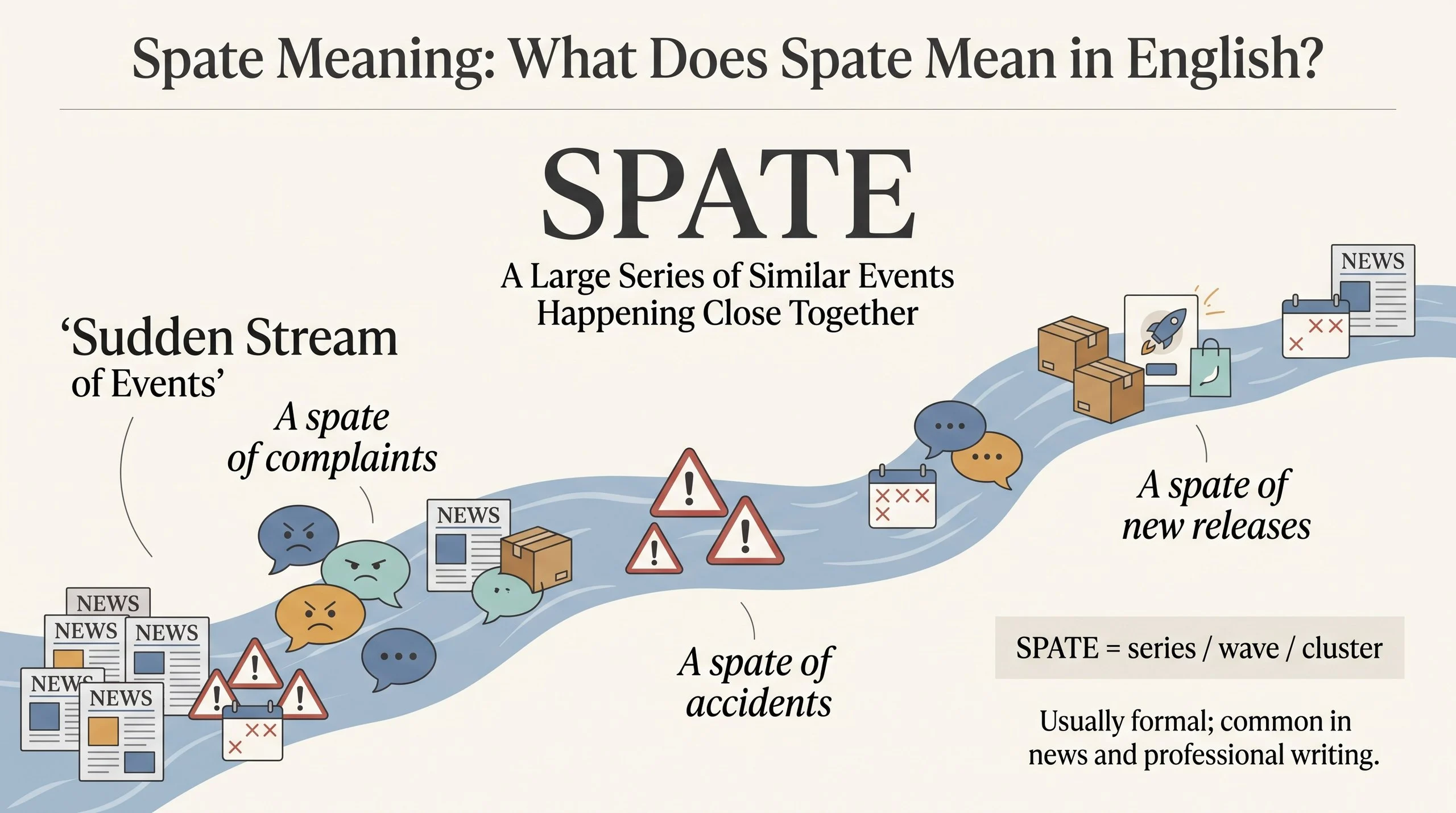
Spate meaning refers to a sudden large number or series of events, actions, or things happening within a short period. It often describes something that occurs repeatedly or in abundance, such as “a spate of complaints,” “a spate of attacks,” or “a spate of new releases.” The word usually suggests an unusually high amount or frequency.
Spate meaning can be confusing because the word is less common in everyday conversation than terms such as “series,” “wave,” or “rush.” However, you will often encounter it in news reports, formal writing, business articles, and discussions about sudden increases in events or activity.
In modern English, spate usually describes a large number of similar things that happen within a relatively short time. For example, if a company receives many complaints in one week, a writer might describe the situation as “a spate of complaints.”
The word often carries a sense of suddenness or unusual frequency. Therefore, “a spate of accidents” does not simply mean several accidents. It suggests that many accidents occurred around the same period.
Spate can also describe a sudden increase in activity. You might read about “a spate of new books,” “a spate of resignations,” or “a spate of storms.” The exact meaning depends on the noun that follows it.
This guide explains the definition, usage, synonyms, examples, common phrases, and subtle differences between spate and similar words.
Spate Meaning at a Glance
| Meaning | Context | Primary Platforms | Example | Tone |
|---|---|---|---|---|
| A sudden large number or series of similar events or things | News, formal writing, business, everyday English | News sites, articles, reports, conversations | “The city experienced a spate of power outages.” | Formal, descriptive |
What Does Spate Mean?
The word spate generally means a large number or series of something occurring within a short period.
For example:
“The company faced a spate of customer complaints.”
This sentence means that the company received many complaints within a relatively short time.
Another example is:
“A spate of storms hit the region.”
Here, the word suggests that several storms occurred close together.
The important idea is concentration. Spate usually describes events that happen in a noticeable cluster rather than being spread evenly over a long period.
Simple Definition of Spate
A simple definition is:
Spate = a sudden or unusually large series of similar events or things.
Depending on the context, you can often replace it with:
- series
- wave
- burst
- rush
- surge
- succession
- outpouring
- string
However, these alternatives do not always have exactly the same tone or meaning.
What Is the Origin of Spate?
The modern noun spate has an interesting history.
Historically, the word was associated with a sudden flood or swelling of a river. That older sense still exists in certain contexts, especially in phrases such as “a spate in the river.”
Over time, the word developed another meaning: a sudden or large amount of something occurring within a short period.
Today, this figurative meaning is especially common in formal English.
For example:
“The country experienced a spate of political protests.”
The word does not mean literal flooding here. Instead, it compares the large number of protests to a sudden rush or flood of activity.
Spate as a Noun
Spate is primarily used as a noun.
It is commonly followed by of + plural noun.
The basic pattern is:
a spate of + plural noun
Examples include:
- a spate of accidents
- a spate of complaints
- a spate of attacks
- a spate of resignations
- a spate of articles
- a spate of new products
- a spate of bad weather
- a spate of questions
This structure is one of the easiest ways to recognize the word.
Why Does “A Spate of” Matter?
The phrase “a spate of” is much more common than simply using “spate” by itself.
For example:
“The newspaper reported a spate of burglaries.”
This sounds natural.
By contrast:
“The newspaper reported a spate.”
That sentence sounds incomplete in modern everyday English unless the context already makes the meaning clear.
Therefore, when learning the word, it is useful to remember the complete expression “a spate of.”
How to Use Spate in a Sentence
Spate usually appears before a noun describing events, actions, problems, or things.
Examples of Natural Usage
“The company received a spate of negative reviews.”
“A spate of wildfires affected the region.”
“The athlete faced a spate of injuries.”
“There has been a spate of new restaurants opening downtown.”
“The website experienced a spate of technical problems.”
Each sentence describes multiple related events or things happening around the same period.
Spate in Formal Writing
Spate is particularly useful in formal writing because it provides a concise way to describe repeated events.
Instead of writing:
“There were many complaints over a short period.”
You can write:
“There was a spate of complaints.”
The second version is shorter and more polished.
Contextual Dynamics & Nuances of the Term
The exact feeling of spate changes according to the noun it describes.
When paired with negative events, the word often suggests concern.
For example:
“A spate of violent incidents shocked the community.”
Here, spate highlights the unusually high frequency of the incidents.
However, the word can also describe neutral or positive developments.
For example:
“A spate of new restaurants opened in the neighborhood.”
This simply means that many restaurants opened within a relatively short period.
Similarly:
“The author released a spate of books.”
The sentence suggests a high level of output.
Spate Does Not Always Mean “Bad”
This is an important distinction.
People often see spate in phrases involving accidents, crimes, complaints, or problems. As a result, they may assume that the word itself has a negative meaning.
It does not.
The noun following spate determines the emotional tone.
Compare:
- a spate of robberies → negative
- a spate of complaints → negative or concerned
- a spate of new products → neutral or positive
- a spate of creative projects → positive or neutral
- a spate of questions → neutral
So, spate mainly describes quantity and timing, not emotional value.
Spate vs. Series
Spate and series can both describe multiple events.
However, they emphasize different ideas.
A series simply means that things happen one after another or are connected.
A spate usually suggests that many similar things happen within a relatively short period, often unexpectedly.
Compare:
“The company released a series of reports.”
This tells us that multiple reports were released.
“The company released a spate of reports.”
This suggests that an unusually large number of reports appeared over a short period.
Therefore, series is more neutral, while spate often emphasizes abundance or sudden frequency.
Spate vs. Wave
Wave is another close synonym.
Both words can describe a sudden increase in events.
For example:
“The city experienced a wave of protests.”
“The city experienced a spate of protests.”
Both sentences suggest many protests.
However, wave often creates a stronger image of something rising and spreading. It can also imply movement from one place or group to another.
Spate focuses more on the number or succession of events.
Easy Difference
- Spate → a large number of similar events in a short period
- Wave → a sudden increase or spread of something
- Series → several connected or sequential events
Spate vs. Surge
Surge usually describes a rapid increase in amount, level, or intensity.
For example:
“There was a surge in demand.”
Here, demand increased sharply.
Spate works differently:
“There was a spate of new orders.”
This emphasizes the number of orders arriving over a short period.
In short:
Surge = rapid increase
Spate = large series or cluster
Spate vs. String
String can also describe a succession of similar events.
For example:
“The team suffered a string of losses.”
You could also say:
“The team suffered a spate of losses.”
Both work, but string is often more conversational.
Spate sounds more formal and is especially common in journalism.
Real-Life Conversation Examples Using Spate Meaning
Although spate is more common in writing than casual speech, people do use it in conversation.
1. Discussing News
Emma: “Did you see the news about the city?”
Ryan: “Yes. There’s been a spate of car thefts recently.”
Emma: “That’s worrying. Has the police department responded?”
Ryan: “They increased patrols in several neighborhoods.”
Context: News and public safety.
2. Talking About Work
Daniel: “Why has everyone been so busy this week?”
Mia: “We’ve had a spate of new orders.”
Daniel: “That explains why the warehouse is packed.”
Context: Business and workplace conversation.
3. Discussing Weather
Alex: “Why has the weather been so unpredictable?”
Jordan: “We’ve had a spate of storms this month.”
Alex: “Hopefully things settle down soon.”
Context: Weather discussion.
4. Talking About Customer Feedback
Sarah: “The manager called a meeting this morning.”
Olivia: “Why?”
Sarah: “We’ve received a spate of customer complaints.”
Olivia: “I hope they figure out what’s causing them.”
Context: Customer service and business.
5. Discussing Books
Noah: “That author has published several books lately.”
Ethan: “Yes, there’s been a spate of new releases.”
Noah: “They must be incredibly productive.”
Context: Publishing and entertainment.
Platform-Specific Breakdown
The word spate is more common in formal digital writing than in casual internet slang. You may see it in news articles, blogs, professional reports, and social media posts that discuss current events.
How It Is Used on Snapchat
Spate is relatively uncommon in casual Snapchat messages.
Most users would probably say:
“There have been so many storms lately.”
Instead of:
“There has been a spate of storms lately.”
Still, someone sharing a news story or discussing a serious event might use the word.
The Role of Spate on TikTok
TikTok creators may use spate when discussing trends, scandals, product launches, or repeated events.
For example:
“There’s been a spate of celebrity announcements this week.”
However, casual creators often choose simpler words such as “wave,” “rush,” or “a lot.”
Therefore, spate sounds more polished than typical TikTok slang.
Instagram and Texting Dynamics
Instagram captions and direct messages can use spate, particularly when the topic is formal.
For example:
“A spate of new fashion launches has changed the market.”
In a casual text, however, someone might simply write:
“There have been so many new launches lately.”
The difference comes down to tone.
Common Phrases With Spate
Several expressions frequently appear with spate.
A Spate of Complaints
This means many complaints occurring within a relatively short period.
“The company received a spate of complaints after the update.”
A Spate of Attacks
This describes multiple attacks occurring close together.
“The region experienced a spate of attacks.”
A Spate of Accidents
This means several accidents occurred around the same time.
“A spate of accidents caused concern among residents.”
A Spate of Resignations
This refers to multiple people leaving their positions within a short period.
“The organization faced a spate of resignations.”
A Spate of New Releases
This describes many new products, songs, films, books, or other releases arriving in a relatively short period.
“The summer brought a spate of new movie releases.”
A Spate of Questions
This means someone asks many questions, often one after another.
“The interview prompted a spate of questions from reporters.”
Common Synonyms for Spate
The best synonym depends on context.
| Synonym | Best Use | Example |
|---|---|---|
| Series | Several related events | “A series of meetings” |
| Wave | Sudden increase or spread | “A wave of protests” |
| String | Sequence of events | “A string of victories” |
| Rush | Sudden large amount | “A rush of customers” |
| Surge | Rapid increase | “A surge in demand” |
| Burst | Short period of intense activity | “A burst of creativity” |
| Succession | Events following one another | “A succession of changes” |
| Outpouring | Large amount expressed or produced | “An outpouring of support” |
Among these, series, wave, and string are often the closest alternatives.
Is Spate a Positive or Negative Word?
Spate is neutral by itself.
Its emotional tone comes from the thing being described.
For example:
“A spate of violent crimes”
has a strongly negative tone.
Meanwhile:
“A spate of successful novels”
has a positive tone.
Likewise:
“A spate of new products”
is generally neutral.
Therefore, do not automatically interpret spate as negative.
Is Spate Formal or Informal?
Spate is generally considered formal or moderately formal.
It appears frequently in:
- News articles
- Academic writing
- Business reports
- Government statements
- Journalism
- Professional writing
- Literary writing
It is less common in casual texting.
For everyday conversation, speakers often choose words such as:
- many
- several
- lots of
- a series of
- a wave of
- a bunch of
Using spate in casual speech is not incorrect. It simply sounds more formal.
Common Mistakes When Using Spate
Mistake 1: Using It for One Event
Spate generally implies multiple events or things.
Incorrect:
“There was a spate of one accident.”
Better:
“There was a spate of accidents.”
Mistake 2: Assuming It Always Means Something Negative
Spate does not automatically mean problems.
You can say:
“A spate of successful product launches boosted the company.”
Mistake 3: Confusing It With “Spit”
The words look somewhat similar, but they have completely different meanings.
Spate refers to a large series or sudden amount.
Spit can refer to saliva or the act of ejecting saliva.
Mistake 4: Using It When “Surge” Is Better
A surge describes an increase in quantity or level.
A spate describes a cluster or series of events.
For example:
“A surge in demand”
is natural.
“A spate of demand”
usually sounds unnatural.
Mistake 5: Overusing the Word
Because spate has a formal tone, repeating it throughout an article can make the writing feel unnatural.
Use it when you want to emphasize a concentrated series of events. Otherwise, choose a simpler synonym.
How to Remember the Meaning of Spate
A simple memory trick is:
Spate = a sudden “stream” of similar things.
Think of a river suddenly swelling with water. That image connects with the word’s older literal sense and makes the modern figurative meaning easier to remember.
For example:
- A spate of complaints = a sudden stream of complaints.
- A spate of accidents = a sudden stream of accidents.
- A spate of new releases = a sudden stream of new releases.
This is not a dictionary definition, but it is a useful way to remember the concept.
How to Explain Spate in Simple English
If someone asks, “What does spate mean?” you can answer:
Spate means a large number or series of similar things happening within a short period.
For a simpler version:
Spate means many similar events happening close together.
For example:
“A spate of accidents” means several accidents happened within a short period.
These explanations work well for students, English learners, and anyone reading formal news or professional writing.
Alternative Meanings and NLP Variations of the Phrase
The word spate has two major senses worth knowing.
1. A Large Number or Series
This is the most common modern meaning.
“A spate of complaints followed the announcement.”
It means many complaints appeared within a short period.
2. A Sudden Flood or Rise in a River
The older literal meaning refers to a sudden rise in the level or flow of a river.
For example:
“Heavy rain caused a spate in the river.”
This sense is less common in everyday American English.
Therefore, context determines which meaning applies.
Why Writers Use Spate
Writers often choose spate because it combines several ideas into one word.
Compare:
“Many similar incidents happened within a short time.”
with:
“A spate of similar incidents occurred.”
The second version is more concise.
Moreover, spate often adds a sense of unusual frequency. It tells readers that the events did not merely happen repeatedly; they appeared in a noticeable cluster.
That makes the word especially useful in journalism.
Spate in News Headlines
News writing frequently uses phrases such as:
- “Spate of layoffs hits industry”
- “Spate of storms causes delays”
- “Spate of complaints prompts investigation”
- “Spate of new businesses opens downtown”
The compact structure makes the word useful for headlines and reports.
However, readers who are unfamiliar with formal vocabulary may find it less accessible than “wave” or “series.”
FAQs
1. What is the spate meaning?
Spate meaning is a large number or series of similar events or things occurring within a short period. It often suggests unusual frequency or concentration.
2. What does spate mean in simple English?
Spate means many similar things happening close together in time.
3. What does “a spate of” mean?
“A spate of” means a large number or series of similar events occurring within a relatively short period.
4. Is spate a negative word?
No. Spate is neutral. The noun following it determines whether the overall expression sounds positive, negative, or neutral.
5. Is spate a noun?
Yes. Spate is primarily used as a noun, especially in the expression “a spate of.”
6. What is a synonym for spate?
Common synonyms include series, wave, string, rush, succession, burst, and surge, although the best choice depends on context.
7. Is spate formal English?
Yes. Spate is generally more formal than everyday expressions such as “a lot of” or “so many.”
8. What is an example of spate?
“A spate of complaints followed the company’s announcement” means that many complaints appeared within a short period.
9. What is the difference between spate and surge?
A surge is a rapid increase in an amount or level, while a spate is a large series or cluster of events or things.
10. What does “spate of attacks” mean?
“A spate of attacks” means several attacks occurred within a relatively short period, often suggesting an unusually high frequency.
Conclusion
The word spate describes a large number or series of similar events or things happening within a relatively short period. Its core idea is not simply “many,” but many occurring close together or in a noticeable cluster.
The expression “a spate of” is especially common in formal English. You may encounter it in news reports, business writing, professional articles, and other contexts where writers need a concise way to describe repeated events.
For example, a spate of complaints means many complaints appeared within a short period. Likewise, a spate of storms describes several storms occurring around the same time.
Importantly, spate itself is not a negative word. Its tone depends on the noun that follows it. A spate of accidents sounds concerning, while a spate of successful books can sound positive.
The word also has an older literal connection to a sudden rise or flood of water. That historical sense helps explain why its modern figurative meaning suggests a sudden stream or rush of events.
Ultimately, understanding spate meaning can make formal English much easier to read. When you see “a spate of,” think of a noticeable stream, series, or cluster of similar things happening within a short time. That simple idea captures the word’s most common modern use.