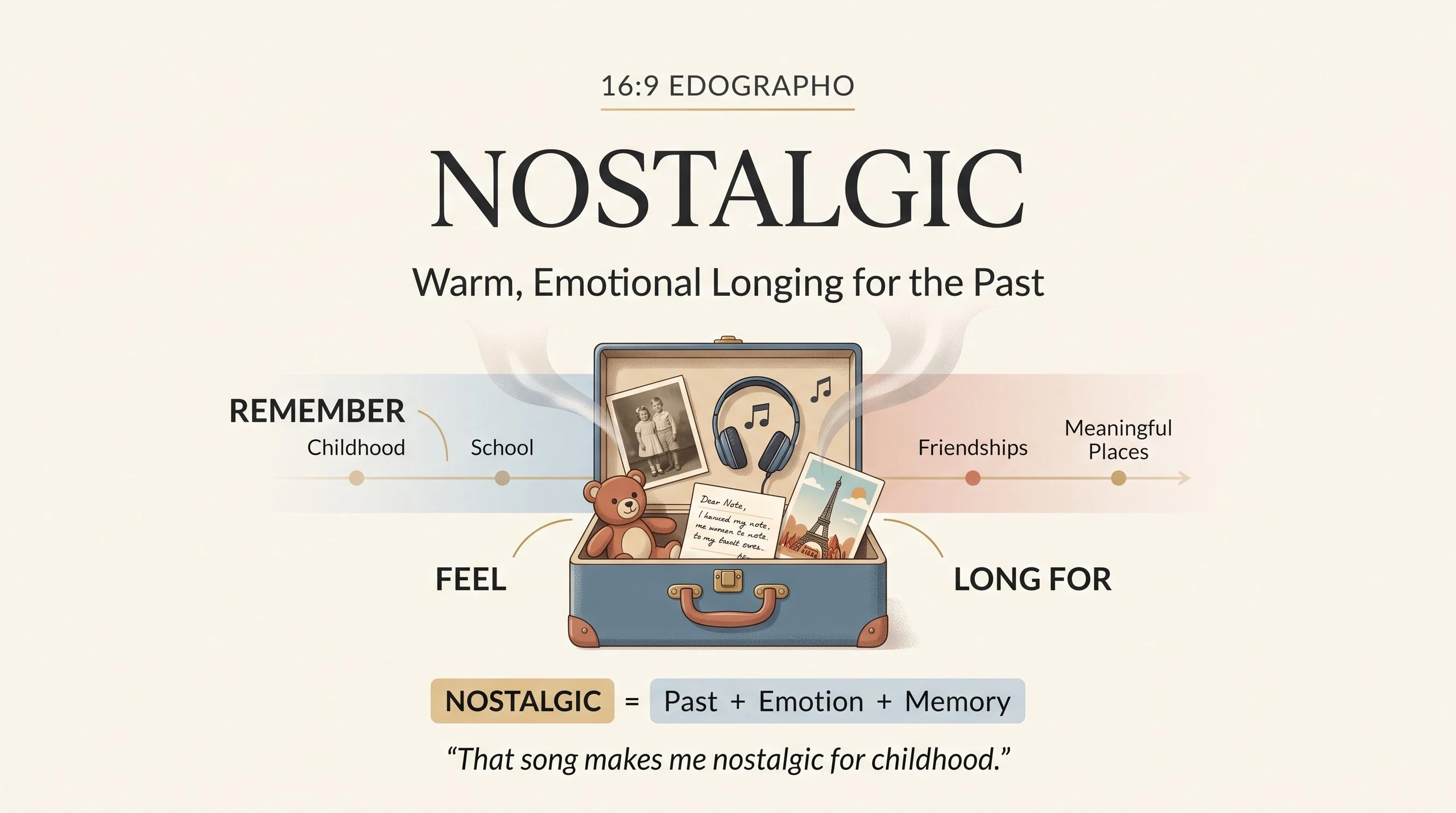
Nostalgic meaning refers to feeling a warm, sentimental longing for the past. Someone may feel nostalgic when remembering childhood, old friendships, past experiences, familiar places, music, photographs, or earlier stages of life. Nostalgia can feel happy and comforting, but it may also include sadness because the past cannot be fully recovered.
Nostalgic meaning describes the emotional feeling that arises when something reminds you of the past. A song from childhood, an old photograph, a familiar smell, or a visit to a former home can suddenly bring back powerful memories.
Usually, nostalgia involves more than simply remembering something. A nostalgic feeling often combines affection, warmth, longing, and a touch of sadness. You may enjoy remembering a special time while also wishing you could experience it again.
For example, hearing a song you loved as a teenager might make you think about old friends, school days, or places you used to visit. You may smile at the memory while also feeling that those days are gone. That mixture is what makes nostalgia distinctive.
The word nostalgic can describe people, feelings, experiences, music, movies, photographs, places, and even styles that remind us of an earlier period. It appears frequently in everyday conversation, social media captions, entertainment, advertising, and personal writing.
Understanding this word also helps explain why certain memories feel emotionally powerful. Nostalgia can connect the present with the past and make ordinary reminders feel deeply meaningful.
Nostalgic Meaning at a Glance
| Meaning | Context | Primary Platforms | Example | Tone |
|---|---|---|---|---|
| Feeling sentimental longing for the past | Memories, childhood, relationships, music, places, culture | Conversations, social media, entertainment, writing | “That song makes me nostalgic for high school.” | Warm, sentimental, sometimes bittersweet |
What Does Nostalgic Mean?
Nostalgic means having a sentimental or emotional longing for the past.
In simple English:
Nostalgic = remembering the past with strong, often warm feelings.
For example:
“I feel nostalgic whenever I hear that song.”
This means the song brings back emotional memories of an earlier time.
Another example is:
“Looking through my childhood photos made me nostalgic.”
Here, the photographs create feelings connected to childhood.
Nostalgia does not always mean that someone wants to return permanently to the past. Instead, it often means that a memory feels especially meaningful because of the emotions attached to it.
Is Nostalgic a Positive or Negative Word?
Nostalgic is usually emotionally positive or bittersweet.
It often describes pleasant memories, such as:
- Childhood summers
- Old friendships
- Family traditions
- Favorite movies
- School memories
- First jobs
- Former homes
- Old music
- Past vacations
However, nostalgia can also contain sadness.
For instance:
“I felt nostalgic looking at pictures of my grandparents.”
The memory may be comforting, yet it could also remind the person of someone they no longer see.
Therefore, nostalgia often combines happiness and longing.
Nostalgic vs. Nostalgia
The words nostalgic and nostalgia are closely related, but they have different grammatical roles.
Nostalgic
Nostalgic is an adjective.
It describes a person, feeling, object, experience, or atmosphere.
“I feel nostalgic.”
“That movie has a nostalgic feeling.”
“The old neighborhood looks nostalgic.”
Nostalgia
Nostalgia is a noun.
It refers to the emotional feeling itself.
“The song filled me with nostalgia.”
“I felt a strong sense of nostalgia.”
An easy way to remember the difference is:
Nostalgia = the feeling
Nostalgic = describing the feeling or something that creates it
What Causes Nostalgic Feelings?
Almost anything connected to meaningful memories can trigger nostalgia.
Music
Music is one of the strongest triggers.
A song can remind you of a specific year, person, place, or stage of life. Even a few seconds of a familiar melody can bring back memories that you have not thought about in years.
For example:
“That song makes me nostalgic for my college days.”
Smells and Food
Certain smells can bring back memories surprisingly quickly.
The smell of freshly baked cookies might remind someone of their grandmother’s kitchen. A particular spice might bring back memories of family gatherings.
Food can therefore create nostalgia through both taste and smell.
Photographs
Old photographs provide a visual connection to the past.
Looking at pictures from childhood, school, vacations, or family events can make people remember details that had faded from everyday awareness.
Places
Returning to an old neighborhood, school, restaurant, or hometown can create strong nostalgic feelings.
A familiar street may look different while still reminding you of how it felt years ago.
Movies and Television
Older movies and TV shows can also create nostalgia.
People may rewatch childhood programs because they connect entertainment with a particular period of life.
Objects
An old toy, book, video game, piece of clothing, or family item can carry emotional meaning.
The object itself may have little practical value, yet it can feel precious because of the memories attached to it.
Contextual Dynamics & Nuances of Nostalgic
The word nostalgic can describe several slightly different experiences.
1. Missing a Past Time
Someone may feel nostalgic because they miss a particular period.
“I’m nostalgic for my college years.”
This expresses longing for an earlier stage of life.
2. Remembering a Happy Experience
Nostalgia can also happen without actively wishing to return.
“That photo made me nostalgic.”
The person may simply feel emotionally connected to the memory.
3. Appreciating an Older Style
Nostalgic can describe something designed to resemble the past.
“The restaurant has a nostalgic 1980s atmosphere.”
Here, nostalgic describes the style rather than a person’s emotional state.
4. Feeling Bittersweet
Nostalgia can contain both happiness and sadness.
“I felt nostalgic walking through my old school.”
The person may enjoy the memories while recognizing that the time has passed.
Real-Life Conversation Examples Using Nostalgic Meaning
1. An Old Song
Emma: “Why are you smiling?”
Liam: “This song reminds me of high school.”
Emma: “So you’re feeling nostalgic?”
Liam: “Exactly. I haven’t heard it in years.”
Context: Music and memories.
2. Childhood Photos
Sarah: “I found our old school photos yesterday.”
Maya: “Really? Send them to me!”
Sarah: “I did. Looking at them made me so nostalgic.”
Maya: “Same. We looked so different back then.”
Context: Childhood memories.
3. Returning Home
Daniel: “How was your trip back to your hometown?”
Chris: “Amazing. It made me really nostalgic.”
Daniel: “Did you visit your old school?”
Chris: “Yes. That brought back so many memories.”
Context: Places and personal history.
4. An Old Video Game
Alex: “Why are you playing that old game?”
Noah: “I used to play it every weekend as a kid.”
Alex: “Nostalgic?”
Noah: “Very. It reminds me of spending summers with my friends.”
Context: Entertainment and childhood.
5. Family Traditions
Olivia: “Why do you still make that dessert every holiday?”
Rachel: “My mom used to make it when I was little. It makes me nostalgic.”
Olivia: “I understand. Some foods bring back entire memories.”
Context: Food, family, and tradition.
Platform-Specific Breakdown
The word nostalgic is common online because social media frequently encourages people to revisit older photos, songs, trends, games, and cultural moments.
How It Is Used on Snapchat
Snapchat users may use nostalgic when sharing old photographs or memories.
For example:
“Found this picture from 2015. Feeling nostalgic today.”
Another common style is:
“This brought back so many memories.”
Snapchat often encourages personal nostalgia because users can share old memories with friends and family.
The Role of Nostalgic on TikTok
TikTok has a strong nostalgia culture.
Creators may post videos about:
- Childhood toys
- Old cartoons
- Early social media
- School memories
- Older video games
- Past fashion trends
- Childhood snacks
- Music from previous decades
A caption might say:
“This song is making everyone nostalgic.”
The word can also appear in comments:
“This is so nostalgic.”
or:
“Instant nostalgia.”
Instagram and Texting Dynamics
Instagram frequently uses nostalgic language in captions and photo collections.
For example:
“Throwback to one of my favorite summers. Feeling nostalgic.”
In texting, people usually use the word casually:
“That picture made me nostalgic.”
“I’m feeling nostalgic today.”
“This movie is so nostalgic.”
The meaning remains the same: something has triggered emotional memories of the past.
Nostalgic vs. Sentimental
- Nostalgic and sentimental overlap, but they are not identical.
- Nostalgic specifically connects emotion to the past.
Sentimental refers more broadly to strong tender or emotional feelings.
For example:
“I feel nostalgic when I visit my old school.”
The emotion comes from remembering the past.
Meanwhile:
“I kept the letter because it is sentimental.”
The letter may have emotional value without necessarily creating nostalgia.
Simple Difference
Nostalgic: emotional connection to the past.
Sentimental: emotional attachment or tenderness.
Nostalgic vs. Melancholic
These words can overlap because nostalgia sometimes contains sadness.
However, they describe different emotional experiences.
Nostalgic means feeling emotionally connected to the past.
Melancholic means feeling thoughtful, subdued, or sad.
For example:
“The old song made me nostalgic.”
This focuses on memories.
“The rainy evening made me melancholic.”
This focuses on a subdued emotional state.
Nostalgia can be happy, sad, or bittersweet. Melancholy generally carries a stronger sense of sadness.
Nostalgic vs. Homesick
These words are also different.
Homesick means missing home, especially while away from it.
Nostalgic means longing for or emotionally remembering the past.
For example:
“I felt homesick while studying abroad.”
The person misses home.
“I felt nostalgic when I saw photos from my childhood.”
The person misses or remembers an earlier period.
Someone can feel both at the same time, but the terms are not interchangeable.
Nostalgic vs. Retro
Retro usually describes a style inspired by the past.
Nostalgic describes an emotional connection to the past.
For example:
“The restaurant has a retro design.”
This describes its visual style.
“The restaurant makes me nostalgic.”
This describes how the restaurant makes someone feel.
Something can be retro without making everyone nostalgic. Likewise, something modern can create nostalgia if it reminds someone of a personal memory.
Common Examples of Nostalgic Things
Many everyday experiences can feel nostalgic.
Nostalgic Music
Songs from an important period in your life can create powerful memories.
Nostalgic Movies
Older films can remind viewers of childhood, adolescence, family traditions, or earlier cultural moments.
Nostalgic Games
Classic video games can remind players of childhood weekends or time spent with friends.
Nostalgic Fashion
Older styles can return decades later and evoke memories of previous eras.
Nostalgic Places
A former home, school, restaurant, park, or neighborhood can bring back memories.
Nostalgic Food
A familiar recipe can connect people with family members, holidays, or childhood.
Nostalgic Smells
Scents can trigger memories because smell has a strong connection with memory and emotion.
Common Synonyms for Nostalgic
The best synonym depends on the context.
| Synonym | Meaning | Example |
|---|---|---|
| Sentimental | Emotionally attached | “She felt sentimental about the old house.” |
| Reminiscent | Bringing something from the past to mind | “The music was reminiscent of childhood.” |
| Reflective | Thoughtful about past experiences | “He became reflective while looking at old photos.” |
| Longing | Strong desire for something absent | “She felt longing for her hometown.” |
| Wistful | Gently sad or longing | “He gave a wistful smile.” |
| Bittersweet | Both happy and sad | “The reunion felt bittersweet.” |
| Retrospective | Looking back at the past | “The exhibition offered a retrospective view.” |
Nostalgic is often closest to sentimental, wistful, or reminiscent, depending on the sentence.
Is Nostalgic Always About Childhood?
No.
Childhood is one of the most common sources of nostalgia, but people can feel nostalgic about any period of their lives.
Someone might feel nostalgic about:
- College
- Their first job
- A previous relationship
- A former home
- A memorable vacation
- A particular decade
- A favorite sports season
- A past friendship
- An earlier stage of adulthood
Therefore, nostalgia is not limited to childhood.
Can You Feel Nostalgic for Something You Never Experienced?
Yes, in some contexts.
People can develop nostalgia-like feelings toward periods they did not personally experience. This can happen through movies, music, family stories, photographs, fashion, or cultural imagery.
For example, someone born in the 2000s might enjoy the style of the 1980s and describe it as nostalgic, even though they did not live through that decade.
More precisely, this can involve vicarious nostalgia or an imagined connection to a past era.
Why Does Nostalgia Feel So Powerful?
Nostalgia can feel powerful because memories are connected with emotions, people, places, and sensory experiences.
A single reminder can therefore activate several memories at once.
For example, an old song might remind someone of:
- A particular friend
- A specific summer
- A former home
- A family trip
- A favorite activity
The emotional response can feel surprisingly immediate.
Nostalgia also allows people to connect their present identity with earlier versions of themselves.
Can Nostalgia Be Sad?
Yes.
Nostalgia often feels bittersweet because the memory may be pleasant while the person knows that the moment has passed.
For example:
“I felt nostalgic looking at photos from my childhood.”
The person may feel happy remembering those experiences. At the same time, they may feel sadness because childhood cannot be recreated.
That combination is a central feature of many nostalgic experiences.
How to Use Nostalgic in a Sentence
Here are several natural examples:
- “This song makes me nostalgic.”
- “I feel nostalgic whenever I visit my hometown.”
- “That movie has a nostalgic quality.”
- “Looking through old photos made her nostalgic.”
- “The smell of fresh bread made him nostalgic for his grandmother’s kitchen.”
- “The game has a nostalgic 1990s feel.”
- “We spent the evening sharing nostalgic stories.”
- “The old neighborhood made me feel nostalgic.”
- “That television show is incredibly nostalgic.”
- “She became nostalgic while talking about college.”
Common Mistakes When Using Nostalgic
Mistake 1: Using Nostalgic to Mean “Old”
Something can be old without being nostalgic.
“This is an old building.”
does not necessarily mean:
“This is a nostalgic building.”
Nostalgic implies an emotional connection to the past.
Mistake 2: Assuming Nostalgia Is Always Happy
Nostalgia can be joyful, sad, or bittersweet.
It often combines pleasant memories with awareness that the past is gone.
Mistake 3: Confusing Nostalgic With Homesick
Homesickness specifically involves missing home.
Nostalgia has a broader connection to the past.
Mistake 4: Confusing Nostalgic With Retro
Retro describes an old-fashioned or past-inspired style.
Nostalgic describes an emotional response or something that creates that response.
Mistake 5: Saying “I Am Nostalgia”
“Nostalgia” is a noun, while nostalgic is the adjective.
Correct:
“I feel nostalgic.”
Also correct:
“I feel nostalgia.”
Incorrect:
“I am nostalgia.”
How to Respond When Someone Says They Feel Nostalgic
If someone says:
“I’m feeling nostalgic today.”
A natural response could be:
“What brought back the memories?”
Or:
“I know that feeling. What are you remembering?”
You could also say:
“Old memories can be powerful.”
The best response depends on the situation and your relationship with the person.
Alternative Meanings and Language Variations
The word nostalgic has a relatively stable meaning in modern English. However, its use has expanded beyond personal memories.
It can describe:
A Person
“She felt nostalgic about her childhood.”
An Object
“That old camera has a nostalgic charm.”
A Place
“The neighborhood has a nostalgic atmosphere.”
A Sound
“The song has a nostalgic quality.”
A Visual Style
“The advertisement uses nostalgic imagery.”
A Cultural Trend
“The show is part of a nostalgic revival of 1990s culture.”
In each case, the central idea remains a connection to the past.
Nostalgic in Modern Internet Culture
Online communities frequently use nostalgic to describe older trends and cultural moments.
People may post:
“Who remembers this?”
“This unlocked a memory.”
“Instant nostalgia.”
“This takes me back.”
These expressions often communicate the same basic idea as nostalgic.
Social media has also made nostalgia easier to share. A person can upload an old photograph, song, game, or television clip and immediately invite thousands of people to remember the same cultural moment.
As a result, nostalgia has become an important part of online culture.
Nostalgic Captions for Social Media
People often use nostalgic language in captions for throwback posts.
Examples include:
- “Feeling nostalgic today.”
- “A little throwback nostalgia.”
- “Take me back.”
- “Old memories, familiar feelings.”
- “This one brought back so many memories.”
- “Forever nostalgic for those days.”
- “Some memories never get old.”
These expressions work particularly well with childhood photographs, travel memories, old friendships, and milestone events.
FAQs
1. What is the nostalgic meaning?
The nostalgic meaning refers to feeling sentimental or emotionally connected to the past. It often involves warmth, longing, happiness, or bittersweet sadness.
2. What does nostalgic mean in simple words?
Nostalgic means missing or warmly remembering something from the past.
3. What is an example of nostalgic?
“This song makes me nostalgic” means the song brings back emotional memories of an earlier time.
4. Is nostalgic a positive word?
Usually, yes. Nostalgic often describes warm or pleasant feelings, although it can also include sadness or longing.
5. What is the difference between nostalgic and nostalgia?
Nostalgic is an adjective that describes a feeling or something that creates it. Nostalgia is the noun for the feeling itself.
6. Is nostalgic the same as sentimental?
They are similar but not identical. Nostalgic specifically connects emotion with the past, while sentimental can describe emotional attachment more broadly.
7. Can you feel nostalgic for childhood?
Yes. Childhood memories are one of the most common sources of nostalgia.
8. Can a song make you nostalgic?
Yes. Songs often trigger nostalgia because they can be strongly associated with specific people, places, and periods of life.
9. What is another word for nostalgic?
Depending on the context, alternatives include sentimental, wistful, reminiscent, reflective, and longing.
10. What does “feeling nostalgic” mean?
“Feeling nostalgic” means experiencing warm, emotional, or sometimes bittersweet feelings while remembering the past.
Conclusion
The word nostalgic describes a powerful emotional connection to the past. It often appears when a memory, song, photograph, place, food, or object brings back feelings from an earlier period of life.
Unlike simply remembering something, nostalgia usually carries emotion. You might feel warmth when thinking about childhood, happiness when hearing an old favorite song, or sadness when realizing that a special time has passed. Because of this mixture, nostalgic feelings are often described as bittersweet.
The word can describe people as well as things that trigger memories. Someone can feel nostalgic about college, while a movie can have a nostalgic atmosphere. Similarly, an old-fashioned design can create a nostalgic feeling even if the person never experienced the period it represents.
It is also useful to distinguish nostalgic from similar words. Nostalgia is the feeling itself, while nostalgic describes that feeling or something that brings it about. Sentimental is broader, homesick focuses on missing home, and retro usually describes a style inspired by the past.
Ultimately, understanding nostalgic meaning comes down to one simple idea: an emotional connection to something from the past. Whether it comes from an old song, childhood photograph, familiar place, or family tradition, nostalgia helps people reconnect with memories that still matter in the present.