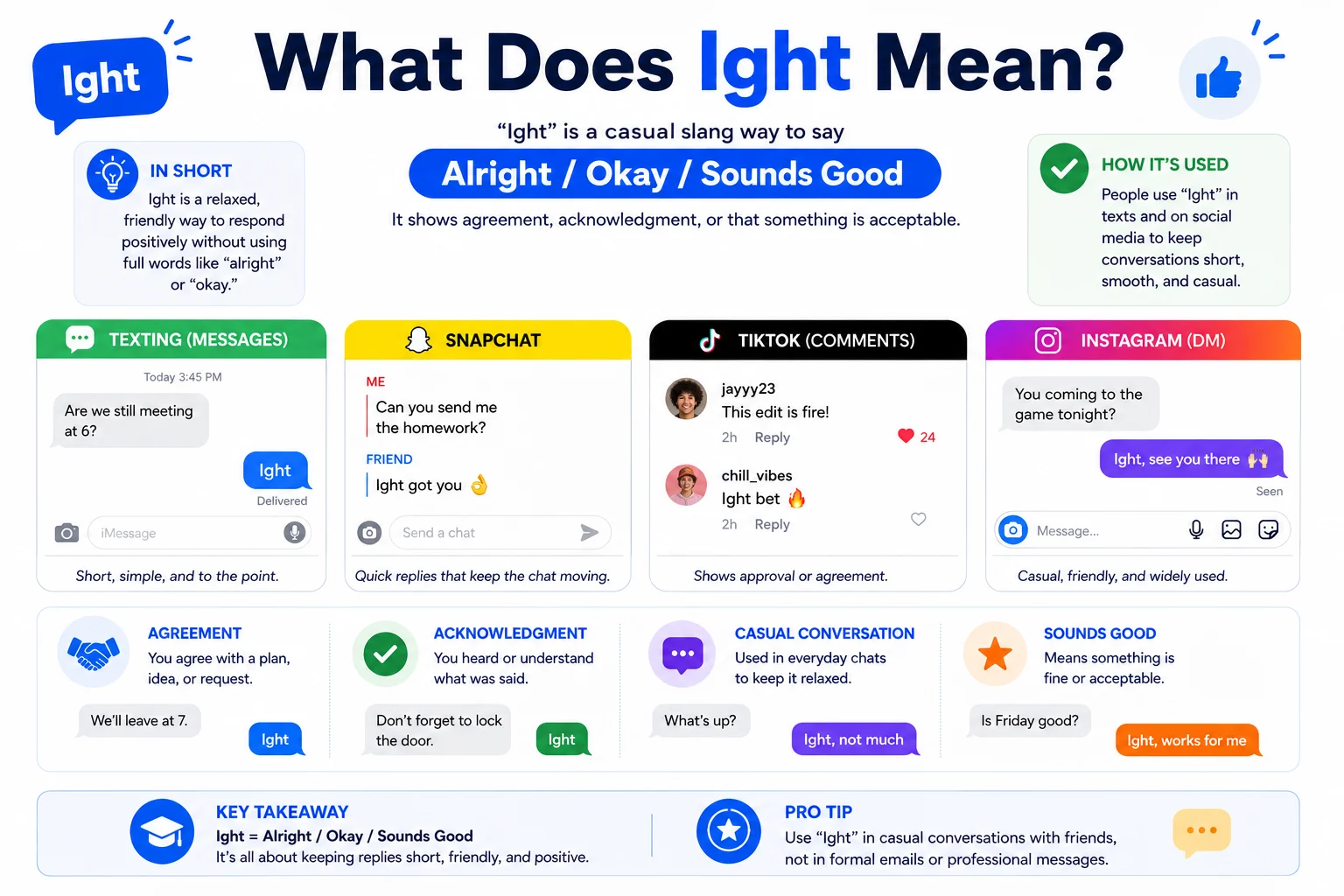
“Ight” is informal internet slang meaning “alright,” “okay,” or “sounds good.” People use it in texts and social media to agree, acknowledge something, or end a conversation. Depending on context, it can sound casual, friendly, neutral, dismissive, or slightly annoyed.
What does ight mean? In most online conversations, “ight” means “alright” or “okay.” It is a casual spelling that people use when they want to agree, acknowledge a message, or show that they understand.
The expression appears frequently in texting and social media. However, its exact tone depends heavily on context. A simple “ight” from a friend may mean “okay, got it.” In another conversation, the same word can sound short or dismissive.
The spelling also varies. You may see ight, aight, aight bet, or ight bet. These forms share a similar conversational purpose. Still, they can carry slightly different attitudes.
For example, someone might text:
“I’ll pick you up at 8.”
You could answer:
“Ight.”
That usually means “Okay” or “Sounds good.”
Furthermore, people often use the term because it feels faster and more relaxed than writing “alright.” It fits the informal style of modern digital communication.
The expression does not usually require a formal response. In most cases, you can answer naturally with “okay,” “bet,” “cool,” “sounds good,” or another casual acknowledgment.
QUICK ANSWER BOX
| Meaning | Context | Primary Platforms | Example | Tone |
| Alright | Agreement | Texting | “Ight, I’ll come.” | Casual |
| Okay | Acknowledgment | Snapchat | “Ight, got you.” | Friendly |
| Sounds good | Accepting a plan | “Ight, see you later.” | Positive | |
| Fine | Accepting reluctantly | Texting | “Ight, whatever.” | Potentially annoyed |
| Understood | Confirming information | TikTok comments | “Ight, I get it.” | Neutral |
What Does what does ight mean Mean?
At its simplest, ight means “alright” or “okay.” It functions as an informal conversational response rather than a formal English word.
People commonly use it to acknowledge information. They may also use it to accept a suggestion or confirm a plan.
For example:
Person A: “Meet me outside at 7.”
Person B: “Ight.”
Here, the response communicates agreement.
However, context changes the meaning. Consider this exchange:
Person A: “You need to finish that today.”
Person B: “Ight.”
The second speaker may simply acknowledge the instruction. Yet the response could also sound slightly irritated, depending on the relationship and previous messages.
Where the Expression Comes From
“Ight” is generally understood as a shortened, phonetic form of “alright” or “aight.” The spelling removes sounds from the longer expression and creates a quick form suited to casual speech and writing.
The form “aight” has a longer history in informal American speech and popular culture. Internet users later adopted and spread related spellings such as “ight.”
Importantly, there is no single moment when the term suddenly appeared. Informal language evolves gradually. Music, television, online communities, texting, gaming, and social media all contribute to how slang spreads.
The expression also reflects a broader pattern in digital language. People frequently shorten words to make conversations quicker.
Examples include:
| Standard expression | Informal form |
| Alright | Ight |
| Okay | K |
| Because | Cuz |
| Going to | Gonna |
| Probably | Prolly |
| I do not know | IDK |
These forms serve different purposes. They are generally conversational rather than appropriate for formal writing.
Is “Ight” a Real Word?
“Ight” is best treated as informal slang, not standard formal English.
You may encounter it in dictionaries, slang references, social media, or informal dialogue. Nevertheless, that does not make it appropriate for every situation.
For example, you could use it when messaging a close friend:
“Ight, I’ll see you tomorrow.”
You would normally avoid it in a professional email:
“Ight, I’ll send the report tomorrow.”
Instead, write:
“Alright, I’ll send the report tomorrow.”
The difference comes down to audience and setting.
Contextual Dynamics and Nuances of the Term
The biggest mistake people make with this slang is assuming that it always carries exactly the same emotion.
It does not.
Tone depends on the surrounding words, punctuation, relationship, and conversation.
Friendly Agreement
Sometimes the expression simply means “sure.”
“Want to grab food later?”
“Ight.”
The response sounds relaxed. There is no obvious negative emotion.
Confirmation
It can also mean “I understand.”
“Send me the address when you get there.”
“Ight.”
Here, the speaker confirms that they received the instruction.
Acceptance
Another common use involves accepting a proposal.
“We can meet at 6 instead.”
“Ight, that works.”
The second message clearly signals agreement.
Conversation Closure
People sometimes use the word to close a discussion.
“I gotta go. Talk later.”
“Ight, later.”
In this case, it functions almost like “okay, see you later.”
Possible Annoyance
Context can make the expression sound irritated.
“Are you still coming?”
“Ight.”
If the person previously gave longer answers, the sudden short response may suggest frustration.
However, you should not automatically assume anger. Text messages remove vocal tone and facial expressions. Therefore, a short message can be difficult to interpret.
Why Punctuation Matters
Compare these messages:
“ight”
“ight.”
“IGHT”
“ight lol”
They can feel different.
Lowercase “ight” usually feels relaxed.
“Ight.” may feel more final.
“IGHT” can appear emphatic, excited, or irritated.
“Ight lol” usually softens the message and makes it feel more playful.
Consequently, punctuation and surrounding words matter almost as much as the slang itself.
Real Life Conversation Examples Using what does ight mean
Example 1: Making Plans
Alex: You free Friday night?
Jordan: Yeah, what’s up?
Alex: We’re going to the movies at 8.
Jordan: Ight, I’m down.
Here, the expression communicates agreement. “I’m down” reinforces the positive meaning.
Example 2: Confirming Instructions
Maya: Can you send me the address when you leave?
Chris: Ight, I got you.
This use means “Okay, I understand.”
The phrase “I got you” removes most ambiguity. It makes the response sound cooperative.
Example 3: Ending a Conversation
Sam: I have to study now.
Taylor: Ight, good luck.
Sam: Thanks.
In this conversation, the slang acknowledges the other person and helps end the interaction naturally.
Example 4: Slight Frustration
Chris: You said you were coming at 6.
Alex: I know.
Chris: It’s already 7.
Alex: Ight, I’m leaving now.
Here, the word could carry a defensive or slightly annoyed tone. The surrounding situation creates that interpretation.
Example 5: Friendly Banter
Dylan: Bet you can’t beat my score.
Marcus: Ight, watch me.
This example has a competitive tone. The expression means something like “Alright, challenge accepted.”
The words that follow are important. “Watch me” makes the response confident rather than dismissive.
Platform Specific Breakdown
How It Is Used on Snapchat
Snapchat encourages short, fast conversations. Therefore, brief slang expressions fit naturally into the platform.
A user might send:
“Ight, send your location.”
Or:
“Ight 😂”
The meaning usually depends on the conversation.
Snapchat also uses visual context. A message may accompany a photo, video, emoji, or reaction. Consequently, users can communicate tone without writing a complete sentence.
For example:
“Ight 😭”
can feel humorous or exaggerated.
Meanwhile:
“ight.”
may feel more serious.
Snapchat users also commonly combine slang with emojis. Those combinations can make a short response feel warmer.
The Role of what does ight mean on TikTok
On TikTok, slang can spread quickly through comments, captions, memes, and videos.
Someone might comment:
“Ight bro 😂”
This could mean “Alright, bro,” but the exact interpretation depends on the video.
For example, if a creator makes an unbelievable claim, another user might write:
“Ight bro 💀”
Here, the phrase can express disbelief or playful skepticism.
The expression can also appear in humorous comment chains. Users often use short slang because TikTok comments favor quick reactions.
However, you should not assume that every occurrence has the same meaning. Internet slang changes according to communities, trends, and individual personalities.
Instagram and Texting Dynamics
Instagram DMs work similarly to ordinary texting. Friends may use “ight” as a quick acknowledgment.
For example:
“I’ll call you after work.”
“Ight.”
The exchange is simple and neutral.
In a more playful conversation, someone might write:
“Ighttt 😂”
The repeated letters stretch the sound and can make the message feel more expressive.
Similarly:
“Aight bet”
often communicates stronger acceptance.
Texting also gives users freedom to modify spelling. You may therefore see “ight,” “aight,” “ightt,” or “aighttt.”
These variations are not necessarily separate slang terms. Often, they simply represent different spellings or attempts to communicate tone.
Alternative Meanings and NLP Variations of the Phrase
When analyzing the expression linguistically, several related forms deserve attention.
Ight
This is the shorter spelling. It usually corresponds to “alright” or “okay.”
Aight
“Aight” is another common informal spelling. It can sound slightly more like the spoken version.
For example:
“Aight, let’s go.”
The meaning is essentially “Alright, let’s go.”
Aight Bet
This combination adds a stronger sense of agreement.
“Aight bet.”
It can mean:
“Okay, sounds good.”
It may also mean:
“Alright, challenge accepted.”
Ight Bet
This version works similarly.
“Ight bet, see you there.”
The speaker confirms the plan.
Alright
“Alright” is the standard spelling for ordinary informal and neutral communication.
It works in many situations where slang might feel inappropriate.
Okay
“Okay” is even more broadly applicable.
It can express acknowledgment, acceptance, agreement, or understanding. Unlike slang forms, it works comfortably in professional contexts.
Sounds Good
“Sounds good” carries a clearer positive tone.
Compare:
“Ight.”
with:
“Sounds good!”
The second response communicates enthusiasm more clearly.
Therefore, use a more explicit phrase when tone matters.
Misinterpretations: When NOT to Use what does ight mean
Although the slang is common, it does not fit every situation.
Avoid It in Formal Writing
Do not normally use it in academic papers, business reports, applications, or formal correspondence.
Instead, choose standard language.
Use:
“Alright, I understand.”
rather than:
“Ight, I understand.”
Avoid It When Speaking to Someone Who May Not Know Slang
Not everyone recognizes internet slang.
If the recipient is unfamiliar with the expression, they may wonder whether it is a typo.
In those cases, “okay” is clearer.
Be Careful With Authority Figures
Messages to a manager, professor, client, or interviewer require more deliberate wording.
For example:
“Ight, I’ll send it.”
can sound too casual.
A better option is:
“Sure, I’ll send it shortly.”
The second version communicates respect and clarity.
Do Not Assume It Means Agreement Every Time
A short “ight” may indicate reluctant acceptance.
Consider:
“Can you stay late tonight?”
“Ight.”
That does not necessarily mean the person feels happy about staying late.
The surrounding conversation provides the missing information.
Watch for Sarcasm
Internet slang can become sarcastic.
Someone may respond:
“Ight bro 😂”
after hearing an obviously exaggerated claim.
In that situation, the speaker may not actually agree.
Therefore, read the entire conversation instead of translating one word in isolation.
How to Respond in Chat Comfortably
If someone sends you “ight,” you usually do not need to overthink the response.
Your reply should match the context.
When They Are Agreeing
You can say:
“Cool.”
“Bet.”
“Sounds good.”
“Perfect.”
When They Are Ending the Conversation
Try:
“Later.”
“Talk soon.”
“See you.”
When You Are Unsure About Their Tone
Ask a simple question.
“All good?”
This works especially well when the previous conversation felt tense.
When You Want to Keep Things Casual
You can mirror their style.
For example:
“Ight 😂”
Or:
“Bet, see you then.”
Mirroring informal language can make conversations feel natural. However, avoid forcing slang that does not match your normal speaking style.
When the Situation Is Professional
Switch to standard wording.
Instead of responding with “ight,” use:
“Okay, understood.”
or:
“Sounds good. I’ll take care of it.”
Clear communication matters more than sounding trendy.
FAQs
1. What does ight mean in texting?
It usually means “alright,” “okay,” or “sounds good.” The sender may use it to acknowledge information, agree to a plan, or close a conversation.
2. Is “ight” the same as “alright”?
Generally, yes. “Ight” is an informal slang spelling associated with “alright.” However, the slang form feels more casual and works best in relaxed conversations.
3. What does “ight bet” mean?
“Ight bet” usually means “okay, sounds good” or “alright, deal.” In competitive conversations, it can also communicate “challenge accepted.”
4. Is “ight” rude?
Not automatically. The word itself is usually casual rather than rude. However, a very short response can sound dismissive depending on the conversation, punctuation, and relationship.
5. What does “aight” mean?
“Aight” is another informal spelling of “alright.” It has essentially the same basic meaning and appears frequently in casual speech, texting, music, memes, and social media.
6. Can I use the slang in professional messages?
It is better to avoid it in professional communication. Use “okay,” “alright,” “understood,” or “sounds good” instead. These options communicate the same basic idea with less ambiguity.
7. Why do people write “ight” instead of “alright”?
People use shortened spellings because they are quick, casual, and expressive. Digital conversations often favor brief forms that resemble everyday speech.
8. Does the term always show agreement?
No. It can indicate acknowledgment, acceptance, resignation, or even mild annoyance. Context determines the emotional meaning.
9. Is “ight” different from “okay”?
The basic function can be similar. However, “ight” feels more informal and slangy. “Okay” works across a much wider range of situations.
10. How should I respond when someone sends this slang?
Match the context. “Cool,” “bet,” “sounds good,” “alright,” and “later” can all work. If the message seems unusually short or tense, ask whether everything is okay.
Conclusion
Understanding what does ight mean becomes much easier when you look at the context rather than the spelling alone.
The expression generally means “alright,” “okay,” or “sounds good.” People use it to acknowledge information, accept plans, respond casually, or end conversations.
However, tone can change dramatically.
A friendly “ight” can communicate agreement. An “ight bet” can signal enthusiasm or confidence. Meanwhile, “ight.” may feel more final or distant.
The same principle applies to many forms of internet slang. Words rarely operate in isolation. Emojis, punctuation, timing, relationships, and surrounding messages all influence interpretation.
Furthermore, digital language continues to evolve. Platforms such as Snapchat, TikTok, Instagram, and messaging apps encourage fast, expressive communication. As a result, shortened spellings continue to develop and spread.
“Ight” is therefore best understood as a flexible piece of informal language. It is useful when the situation is casual. Yet, standard alternatives remain better when clarity or professionalism matters.
If you encounter the expression in a text or social media conversation, the safest interpretation is usually simple: “Okay” or “alright.” Then, look at the surrounding conversation to determine the speaker’s actual tone.
Discover More Articles
- what does pmo mean on tiktok| The Ultimate Guide and Meaning
- what does uwu mean| The Ultimate Guide and Meaning

Charlotte Wilson is a language writer passionate about word meanings, synonyms, and clear communication. She creates accurate and engaging content to help readers expand their vocabulary and language skills.