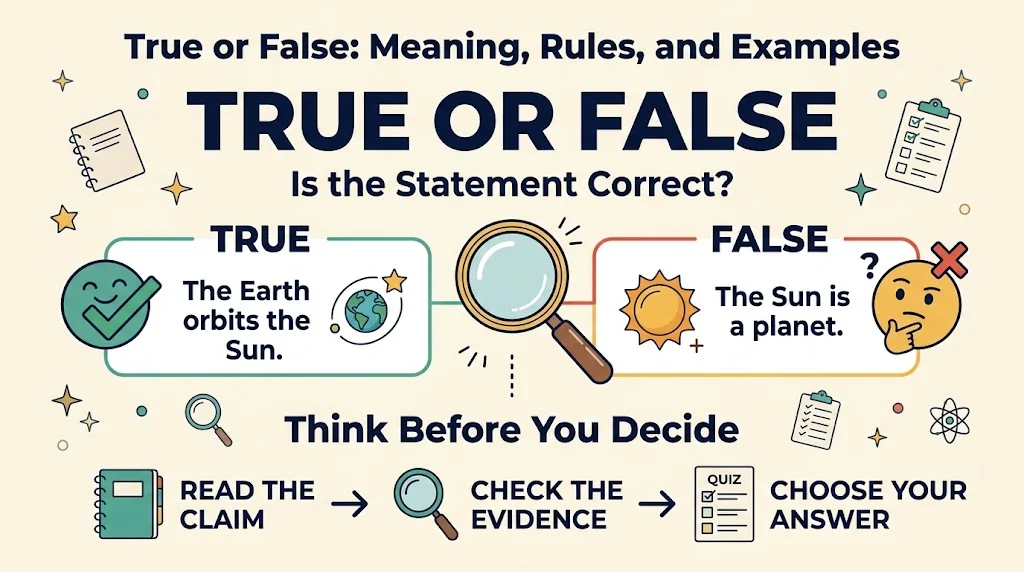
True or false is an expression used to determine whether a statement is correct or incorrect. “True” means the statement agrees with the facts, while “false” means it does not. The phrase is commonly used in quizzes, exams, debates, surveys, and everyday conversations.
The phrase true or false appears in classrooms, online quizzes, exams, conversations, and everyday discussions. It asks whether a statement is correct or incorrect based on facts, evidence, or a particular set of rules. Because the phrase is short and direct, it is one of the easiest ways to test knowledge or check a claim.
For example, a teacher might ask, “Water freezes at 0°C under standard atmospheric pressure: true or false?” The student must decide whether the statement is accurate. Similarly, someone discussing a rumor might ask, “Is that story true or false?” to find out whether it reflects reality.
Although the expression sounds simple, its meaning can change slightly depending on the context. In school, it usually refers to a question format. In logic and computing, it can describe two possible truth values. During everyday conversations, it often asks someone to verify information.
This guide explains what true or false means, how to use it correctly, common examples, and the differences between truth, accuracy, opinions, and misleading claims.
| Meaning | Context | Primary Platforms | Example | Tone |
|---|---|---|---|---|
| A choice between a correct statement and an incorrect one | Education, logic, conversations, quizzes | Classrooms, online tests, surveys, social media | “The Earth revolves around the Sun: true or false?” | Neutral and direct |
What Does True or False Mean?
True or false refers to two possible judgments about a statement.
- True: The statement is correct, accurate, or consistent with the relevant facts.
- False: The statement is incorrect, inaccurate, or inconsistent with the relevant facts.
For example:
- “The Earth orbits the Sun.” — True.
- “Humans have three hearts.” — False.
- “A triangle has three sides.” — True.
- “All birds can fly.” — False.
The phrase does not always mean that someone is deliberately telling the truth or lying. A person can make a false statement because they misunderstood something or received incorrect information.
Therefore, it is useful to distinguish between a statement’s accuracy and the speaker’s intention.
How to Use True or False in a Sentence
The phrase works in several common situations.
Asking Whether Something Is Correct
Use it when you want someone to confirm or reject a statement.
Examples:
- Is this information true or false?
- Can you tell me whether the claim is true or false?
- The teacher asked us to decide if each statement was true or false.
- I want to know whether the rumor is true or false.
Creating a Quiz Question
Teachers and quiz creators use the expression to test knowledge.
Examples:
- True or false: The Pacific Ocean is the largest ocean on Earth.
- True or false: A square has five sides.
- True or false: Plants need light to carry out photosynthesis.
- True or false: Every prime number is odd.
The last statement is false because 2 is a prime number and is even.
Checking a Claim in Conversation
People also use the phrase to verify something they have heard.
Examples:
- Is it true or false that the store is closing?
- I heard that the event was canceled. Is that true or false?
- Can you check whether this news is true or false?
- The post makes a bold claim, but I don’t know if it’s true or false.
In these cases, the phrase asks for verification rather than simply a personal opinion.
True or False Examples
Here are common examples with answers and brief explanations.
| Statement | Answer | Explanation |
|---|---|---|
| The Earth orbits the Sun. | True | Earth travels around the Sun. |
| A week has seven days. | True | A standard week contains seven days. |
| Fish are mammals. | False | Fish and mammals are different animal groups. |
| A square has four equal sides. | True | This is a defining property of a square. |
| The Sun is a planet. | False | The Sun is a star. |
| All insects have eight legs. | False | Insects have six legs; spiders have eight. |
| Water is made of hydrogen and oxygen. | True | A water molecule contains hydrogen and oxygen. |
| Every month has 30 days. | False | Months have different lengths. |
| The human heart pumps blood. | True | The heart circulates blood through the body. |
| All birds can fly. | False | Some birds, including penguins and ostriches, cannot fly. |
These examples show how the expression works in educational settings.
True or False in Everyday Conversations
Outside a classroom, the phrase can sound more conversational.
Example 1: Checking a Rumor
Person A: I heard the concert was postponed.
Person B: Is that true or false?
The question asks whether the information is accurate.
Example 2: Verifying a Message
Person A: Someone told me the office is closed tomorrow.
Person B: Let’s check whether that’s true or false before making plans.
Here, the speakers want reliable information before acting.
Example 3: Testing a Friend’s Knowledge
Person A: Let’s play a true-or-false game.
Person B: Sure. Give me your first statement.
In this situation, the expression names a game or activity.
True or False in Education
True-or-false questions are common in school tests because they can assess knowledge quickly.
A teacher presents a statement, and students choose one of two answers. The format is especially useful for checking definitions, basic facts, and understanding of concepts.
However, a true-or-false test can sometimes encourage guessing. Students may also misunderstand a question if it contains vague wording or an absolute word such as “always” or “never.”
For better results, questions should be clear and factually precise.
For example:
- Clear: “A square has four sides.”
- Potentially misleading: “A square is always larger than a rectangle.”
The second statement is not a sound general rule because a square is a special type of rectangle, and size is not determined by the shape’s name.
True or False in Logic and Mathematics
In logic, statements can be evaluated according to whether they are true or false.
For example:
- “5 is greater than 3.” — True.
- “10 is less than 4.” — False.
- “A number is both even and odd.” — False for ordinary integers under standard definitions.
Mathematical reasoning often depends on carefully defining terms and conditions. A statement that appears true in one setting may be false if its assumptions change.
For instance, “The number is positive” cannot be evaluated without knowing which number is being discussed.
True or False in Computing
Computers and programming languages often use the Boolean values true and false.
These values help programs make decisions.
For example, a program might check whether a user has entered the correct password. The result of that check can be represented as true or false.
A simple logical condition might be:
age >= 18If age is 20, the expression evaluates to True. If age is 15, it evaluates to False.
In programming, these values have precise meanings within the language and the expression being evaluated.
True or False vs. Right or Wrong
The expressions are similar, but they can have different uses.
| True or False | Right or Wrong |
|---|---|
| Often evaluates a statement or claim | Can evaluate actions, answers, decisions, or behavior |
| Common in quizzes and logic | Common in moral, practical, and educational discussions |
| Focuses on truth or accuracy | Can refer to correctness, suitability, or fairness |
| Example: “Is the statement true or false?” | Example: “Was it right or wrong to ignore the warning?” |
A factual statement can be false without the person who said it doing anything morally wrong. Likewise, a decision can be ethically questionable even when the facts used to explain it are accurate.
True or False vs. Fact or Opinion
A fact is a claim that can be checked against evidence. An opinion expresses a personal view, preference, or judgment.
Examples:
- “The Earth has one natural moon.” — A factual claim.
- “Summer is the best season.” — An opinion.
- “Chocolate tastes better than vanilla.” — Usually a matter of preference.
- “Water boils at 100°C at standard atmospheric pressure.” — A factual claim under specified conditions.
Not every sentence can be classified easily without context. Some claims combine facts with opinions, while others depend on definitions or changing circumstances.
Therefore, before choosing true or false, identify exactly what the statement claims.
Common Mistakes When Using True or False
Mistake 1: Treating an Opinion as an Objective Fact
Consider the statement, “Blue is the most beautiful color.”
This expresses a preference rather than a universally verifiable fact. Without a defined standard, it cannot be judged objectively in the same way as a mathematical statement.
Mistake 2: Confusing a False Statement With a Lie
A false statement is inaccurate. A lie generally involves knowingly communicating something untrue with an intention to deceive.
Someone who repeats a false rumor without realizing it is inaccurate may be mistaken rather than lying.
Mistake 3: Ignoring Important Conditions
Some statements are true only under specific conditions.
For example, “Water boils at 100°C” describes water at standard atmospheric pressure. Changes in pressure can change its boiling point.
Adding the relevant conditions makes a statement more precise.
Mistake 4: Assuming Every Question Has Enough Information
Consider: “The number is even.”
Without knowing which number is being discussed, you cannot determine whether the statement is true or false.
In these situations, ask for more information instead of guessing.
Mistake 5: Relying on Popularity Instead of Evidence
A claim does not become true simply because many people share it online.
Check reliable evidence, original sources, and relevant context before accepting a claim as accurate.
Advantages and Disadvantages of True-or-False Questions
| Advantages | Disadvantages |
|---|---|
| Quick and easy to answer | Guessing can affect results |
| Simple to score | May test recognition more than deep understanding |
| Useful for checking basic facts | Poor wording can cause confusion |
| Works well for large groups | Complex ideas may not fit two choices |
| Can highlight misconceptions | Students may focus on absolute words instead of meaning |
True-or-false questions are useful when statements are clear and the subject genuinely supports a two-way judgment.
Practice Exercise: True or False
Decide whether each statement is true or false.
- The Earth is a planet.
- A triangle has four sides.
- All mammals lay eggs.
- A square has four equal sides.
- The Sun is a star.
- Every month has exactly 30 days.
- Spiders are insects.
- A year usually has 12 months.
- All birds can fly.
- Water contains hydrogen and oxygen.
Answers and Explanations
- True: Earth is a planet in our solar system.
- False: A triangle has three sides.
- False: Most mammals give birth to live young, although a few, such as the platypus, lay eggs.
- True: A square has four equal sides and four right angles.
- True: The Sun is a star.
- False: Months have 28, 29, 30, or 31 days.
- False: Spiders are arachnids, not insects.
- True: A standard calendar year has 12 months.
- False: Some birds, including penguins and ostriches, cannot fly.
- True: Water molecules contain hydrogen and oxygen.
Frequently Asked Questions
What does true or false mean?
It means deciding whether a statement is correct or incorrect. The phrase is common in quizzes, logic, education, and everyday conversations.
Is true or false a question?
It can be part of a question, such as “Is this true or false?” It can also describe a question format, as in a true-or-false test.
What is an example of true or false?
“The Earth orbits the Sun: true or false?” is an example. The correct answer is true.
What is the difference between true and false?
True means a statement is accurate under the relevant conditions. False means the statement is inaccurate or contradicts the relevant facts.
Can an opinion be true or false?
Some opinions contain factual claims that can be checked. However, a personal preference, such as “Vanilla tastes better than chocolate,” does not usually have one objectively correct answer.
What does true or false mean in programming?
In programming, true and false are Boolean values used to represent logical results. They help software evaluate conditions and make decisions.
Is a false statement always a lie?
No. A false statement can result from confusion, a mistake, outdated information, or an incorrect assumption. A lie generally involves a deliberate attempt to deceive.
How do you write true or false?
Write it as three words: true or false. When it describes a type of test before a noun, the hyphenated form “true-or-false” is often used, as in “a true-or-false quiz.”
Why are true-or-false questions used in exams?
They are easy to score and can quickly assess knowledge of definitions and basic facts. However, they may not fully measure a student’s ability to explain complex ideas.
How can you tell whether information is true or false?
Check the original source, look for reliable evidence, consider the context, and compare the claim with trustworthy sources. Avoid relying on popularity or repetition alone.
Key Takeaway & Summary
True or false is a simple expression used to evaluate whether a statement is correct or incorrect. It appears in school tests, logical reasoning, programming, and everyday discussions.
Remember that not every claim can be judged without context. Opinions, incomplete information, and statements with unclear conditions may require further explanation before you can reach a reliable conclusion.
Conclusion
The phrase true or false helps people check information, test knowledge, and evaluate statements clearly. Its meaning is straightforward: “true” indicates correctness, while “false” indicates inaccuracy under the relevant conditions.
However, making a good judgment involves more than choosing an answer. You should understand the statement, identify any conditions, and check the available evidence. This is especially important when evaluating rumors, online posts, scientific claims, or complicated questions.
Whether you are studying for an exam, writing a quiz, or checking something you heard, a careful approach will help you distinguish facts from errors and opinions.