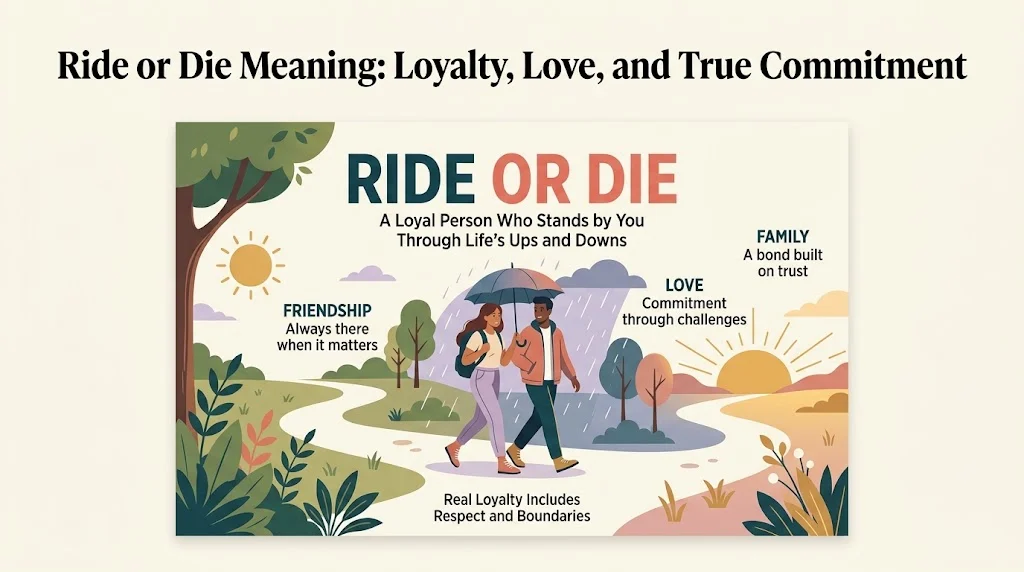
Ride or die describes a deeply loyal person who stands by someone through difficult times, challenges, and setbacks. The phrase commonly refers to a trusted friend, romantic partner, or family member who offers unwavering support. However, genuine loyalty does not mean accepting abuse, dishonesty, or harmful behavior.
The phrase ride or die is a popular expression used to describe someone who remains loyal when life becomes difficult. Whether it refers to a best friend, a romantic partner, or a family member, the phrase suggests a powerful bond built on trust, commitment, and mutual support.
For example, someone might call their best friend their ride or die because that friend shows up during hard times, keeps private conversations confidential, and offers support without hesitation. Similarly, couples may use the expression to describe a relationship in which both people face challenges together.
Today, the phrase appears frequently in social media captions, text messages, relationship conversations, and popular culture. It can express deep affection, playful friendship, or a serious promise of loyalty.
However, ride or die does not mean someone must tolerate everything another person does. Healthy loyalty includes honesty, boundaries, and accountability. Understanding this distinction helps you use the expression naturally while recognizing what genuine support should look like.
| Meaning | Context | Primary Platforms | Example | Tone |
|---|---|---|---|---|
| A loyal person who stands by someone through good and bad times | Friendship, romance, family, slang | TikTok, Instagram, Snapchat, text messages | “She’s my ride or die. She always has my back.” | Affectionate, loyal, supportive |
What Does Ride or Die Mean?
Ride or die means a person who is extremely loyal and willing to stand by someone through difficult circumstances.
The phrase communicates more than ordinary friendship. It suggests that a person can be trusted when situations become uncomfortable, stressful, or uncertain.
A ride-or-die person may:
- Support you during difficult periods.
- Keep your private information confidential.
- Celebrate your achievements without jealousy.
- Tell you the truth when you need to hear it.
- Help you work through problems.
- Remain dependable when others disappear.
For example:
“My sister is my ride or die because she supports me through every major challenge.”
This sentence describes someone whose loyalty has been demonstrated through actions rather than words alone.
The expression can also describe a romantic partner who remains committed during life’s ups and downs. In that context, it often suggests a strong emotional connection and a willingness to work through challenges together.
Where Did Ride or Die Come From?
The expression has roots in American slang and is closely associated with loyalty, solidarity, and commitment in relationships and social groups.
The word ride can suggest traveling together or staying alongside someone. Meanwhile, die adds an intense sense of commitment, implying loyalty even when the stakes are high.
The phrase became especially recognizable through hip-hop culture, music, films, and popular entertainment. Over time, its meaning expanded beyond its earlier associations and became common in everyday conversations about friendship and romance.
Today, people frequently use it in affectionate or humorous ways. A person might call a friend their ride or die because they always attend concerts together, help each other through breakups, or share years of memories.
Although the phrase can have intense associations, modern usage is often much more casual.
Ride or Die Meaning in a Relationship
In a romantic relationship, ride or die describes a partner who remains supportive, committed, and dependable through different stages of life.
This person does not disappear whenever problems arise. Instead, they communicate, work through disagreements, and try to build a stable relationship.
Signs of a Ride-or-Die Partner
1. They show up when life gets difficult.
A supportive partner offers practical and emotional help during stressful situations. They do not expect the relationship to feel perfect every day.
2. They communicate honestly.
Real commitment involves telling the truth, even when a conversation feels uncomfortable.
3. They respect your individuality.
A loyal partner supports your goals and friendships without trying to control every part of your life.
4. They celebrate your success.
Rather than competing with you, they feel happy when you accomplish something meaningful.
5. They accept responsibility.
Every relationship experiences mistakes. A dependable partner acknowledges their actions and makes a genuine effort to improve.
Example of Ride or Die in Love
“My husband is my ride or die. We face challenges together and never stop communicating.”
This sentence expresses partnership, emotional security, and mutual commitment.
However, the phrase should not be used to excuse controlling behavior, repeated betrayal, or abuse. Love and loyalty do not require you to sacrifice your safety or self-respect.
Ride or Die Meaning in Friendship
Among friends, ride or die describes someone who stays dependable through changing circumstances.
This person might be your childhood friend, closest college companion, trusted coworker, or longtime confidant.
A ride-or-die friend is not necessarily someone who agrees with everything you say. Instead, they care enough to support you while helping you make better decisions.
Examples of Ride-or-Die Friendship
- “She’s been my ride or die since high school.”
- “My best friend is a real ride or die. She never leaves me alone when things get tough.”
- “We have been through so much together that he’s basically my ride or die.”
- “Everyone needs a ride-or-die friend who tells the truth and keeps their promises.”
The phrase can also appear in humorous situations.
For example, “My best friend is my ride or die because she drives me to get snacks at midnight.”
Here, the expression playfully emphasizes friendship and reliability rather than a serious promise.
Ride or Die Meaning in Text Messages
In text messages, ride or die often expresses affection, gratitude, or appreciation for someone’s loyalty.
The phrase can stand alone as a compliment or appear in a longer message.
| Text Message | Meaning |
|---|---|
| “You’re my ride or die ❤️” | You are someone I deeply trust. |
| “My ride or die forever.” | I expect our bond to last. |
| “Thanks for being my ride or die.” | I appreciate your support. |
| “Need my ride or die tonight 😂” | I want my trusted friend with me. |
| “That’s my ride or die fr.” | That person is genuinely loyal to me. |
The exact meaning depends on the relationship and conversation. A heart emoji may communicate romantic affection, while a laughing emoji can make the phrase playful.
Ride or Die Meaning on TikTok and Instagram
On TikTok and Instagram, people often use ride or die in captions, videos, stories, and posts celebrating close relationships.
Common examples include:
- A photo with a best friend: “My ride or die since day one.”
- A couple’s anniversary post: “Through every season, you’re my ride or die.”
- A family picture: “My sister, my best friend, my ride or die.”
- A travel video: “Every adventure is better with my ride or die.”
The expression also appears in humorous videos about friends who participate in spontaneous plans, late-night food trips, shopping adventures, or embarrassing situations together.
Social media usage often emphasizes the emotional connection more than the phrase’s literal wording.
Ride or Die Meaning in Pop Culture
Popular music, movies, television, and online entertainment have helped make ride or die a widely recognized expression.
In pop culture, the phrase often describes a character who stays loyal to another person despite danger, conflict, or difficult choices.
Romantic stories may use it to portray a devoted couple. Meanwhile, action films and crime dramas sometimes use it to describe loyalty within a close-knit group.
These portrayals can make the phrase sound dramatic or absolute. Everyday usage, however, is often less intense.
Calling someone your ride or die may simply mean that you trust them, enjoy their company, and know they will be there when you need support.
Examples of Ride or Die in Everyday Situations
Here are examples that show how the phrase works in different contexts.
For Best Friends
- “She’s my ride or die because she has supported me for years.”
- “My ride or die knows all my secrets.”
- “We might argue sometimes, but he’s still my ride or die.”
- “Shout-out to my ride or die for always checking on me.”
For Romantic Partners
- “I found my ride or die, and I couldn’t be happier.”
- “A real ride or die builds a future with you.”
- “He’s my ride or die because we face problems as a team.”
- “You are my ride or die, today and always.”
For Family Members
- “My brother is my ride or die through every challenge.”
- “My mom has always been my ride or die.”
- “Family means having a ride or die who believes in you.”
- “My sister is my ride or die and my lifelong best friend.”
For Funny or Casual Situations
- “My roommate is my ride or die because she shares her fries.”
- “Who is my ride or die? The friend who brings coffee.”
- “My ride or die agreed to go shopping even though we have no money.”
- “Everyone needs a ride or die for spontaneous road trips.”
These examples demonstrate that the phrase can express serious commitment or lighthearted affection.
Ride or Die vs. Loyal Friend
Both expressions describe dependable people, but their emotional intensity differs.
| Ride or Die | Loyal Friend |
|---|---|
| Suggests an especially strong bond | Describes general trust and reliability |
| Often sounds emotional or emphatic | Usually sounds straightforward |
| Common in slang and social media | Common in everyday and formal English |
| Example: “She’s my ride or die.” | Example: “She’s a loyal friend.” |
A loyal friend may be reliable and trustworthy without being described as a ride or die. The latter phrase usually emphasizes a particularly close or enduring bond.
Ride or Die vs. Soulmate
These phrases can overlap in romantic relationships, but they are not interchangeable.
A soulmate is someone believed to have a deep, special, or unusually compatible connection with you. The word often emphasizes emotional or spiritual closeness.
A ride or die emphasizes loyalty and commitment through challenges.
For example:
- “He’s my soulmate because we understand each other deeply.”
- “He’s my ride or die because he stands by me during difficult times.”
One person can be both, but each expression highlights a different quality.
Ride or Die vs. Partners in Crime
Partners in crime is an informal expression for people who enjoy doing things together, especially playful, adventurous, or mischievous activities.
Despite its wording, it often has no connection to actual criminal behavior.
A ride or die is primarily associated with loyalty and support, while partners in crime emphasizes shared adventures and fun.
For example:
“My sister is my ride or die, but my college roommate is my partner in crime for every travel adventure.”
Both phrases communicate closeness, but they focus on different aspects of a relationship.
Is Ride or Die a Compliment?
Yes, ride or die is usually a compliment.
Calling someone your ride or die tells them that you trust their loyalty and appreciate their presence in your life. It can be especially meaningful when the person has supported you through a difficult period.
For example:
“Thank you for being my ride or die when everything felt overwhelming.”
This statement recognizes the person’s emotional support and reliability.
Still, the phrase can become unhealthy if someone uses it to demand unquestioning obedience or silence about harmful behavior. Genuine loyalty leaves room for honesty, personal boundaries, and accountability.
Is Ride or Die Romantic or Platonic?
It can be either.
In romantic relationships, the phrase often describes a committed partner who shares responsibilities and faces challenges with you.
In platonic relationships, it usually refers to a close friend who remains supportive and trustworthy.
Family members can also be described as ride or die.
The context makes the meaning clear. A romantic anniversary caption may suggest a partner, while a funny best-friend post may refer to a platonic relationship.
What Does Ride or Die Mean for a Woman or Man?
The phrase does not have a different core meaning based on gender.
A woman, man, or person of any gender can be described as a ride or die if they demonstrate strong loyalty and commitment.
Examples:
- “She’s my ride or die because she always supports me.”
- “He’s my ride or die, even when life gets complicated.”
- “They’re my ride or die, and I know I can trust them.”
In some contexts, people use the phrase to describe a partner who stays committed during hardship. However, it should not imply that one person must tolerate mistreatment or carry the entire relationship.
Common Mistakes When Using Ride or Die
Mistake 1: Assuming It Always Refers to a Romantic Partner
The phrase can describe a best friend, sibling, parent, or romantic partner.
Better understanding: Look at the relationship and context.
Mistake 2: Thinking It Means Agreeing With Everything
A genuine ride-or-die person does not need to approve of every choice you make.
Better understanding: Loyalty can include honest advice and respectful disagreement.
Mistake 3: Using It to Excuse Harmful Behavior
The phrase should not become a reason to tolerate manipulation, abuse, or repeated betrayal.
Better understanding: Healthy commitment includes mutual respect and personal boundaries.
Mistake 4: Treating It as a Formal Expression
The phrase is informal and works best in casual conversation, personal messages, captions, and creative writing.
Better understanding: In a professional report, words such as “dependable,” “committed,” or “trustworthy” may be more suitable.
Advantages and Disadvantages of the Phrase
| Advantages | Disadvantages |
|---|---|
| Expresses deep appreciation | Can sound overly intense in some situations |
| Communicates trust and loyalty | May be misunderstood as unconditional obedience |
| Works for friends, partners, and family | Is too informal for many professional settings |
| Fits social media captions and messages | Can be used to romanticize unhealthy relationships |
| Creates an affectionate, memorable expression | Meaning depends on context |
Use the phrase when you want to express a close bond. At the same time, remember that the healthiest relationships combine loyalty with mutual care and accountability.
Practice Exercise: Ride or Die
Choose the best meaning for each example.
1. “She’s my ride or die. She stood by me during my hardest year.”
A. A casual acquaintance
B. A deeply loyal person
C. Someone who dislikes you
2. “My ride or die agreed to join me on a last-minute road trip.”
A. A trusted companion
B. A stranger
C. A business competitor
3. “He says I’m his ride or die, so I must accept everything he does.”
A. A healthy understanding of loyalty
B. An expectation that may create unhealthy pressure
C. A formal business agreement
4. “My brother is my ride or die.”
A. He is a dependable, trusted person
B. He is always wrong
C. He is an unknown person
Answers
- B — A deeply loyal person. The example emphasizes support during hardship.
- A — A trusted companion. The phrase highlights closeness and shared adventures.
- B — An expectation that may create unhealthy pressure. Loyalty does not require accepting harmful behavior.
- A — He is a dependable, trusted person. The expression can describe family relationships.
Frequently Asked Questions
What does ride or die mean in slang?
In slang, ride or die means someone who is extremely loyal and stands by you through difficult situations. It commonly describes a best friend or romantic partner.
What does ride or die mean in a relationship?
It describes a partner who remains committed, supportive, and dependable through life’s challenges. Healthy commitment still includes respect, honesty, and boundaries.
What does ride or die mean from a girl?
If a girl calls you her ride or die, she usually means that she trusts you deeply and considers you a loyal, dependable person. Whether it is romantic depends on your relationship and the surrounding conversation.
What does ride or die mean from a guy?
If a guy calls you his ride or die, he is generally expressing trust, affection, or loyalty. The phrase can be romantic or platonic, depending on the context.
Is ride or die a good thing?
Usually, yes. It is generally a compliment that recognizes loyalty and support. However, it should never be used to justify abuse, control, or harmful behavior.
Can your best friend be your ride or die?
Absolutely. The phrase is very common for close friendships, particularly when someone has consistently supported you through good times and bad.
Does ride or die mean forever?
It often suggests lasting loyalty, but it is not a literal promise that a relationship can never change. People can care deeply about one another while still recognizing personal boundaries or changing circumstances.
What is another word for ride or die?
Depending on the context, alternatives include loyal friend, trusted companion, devoted partner, dependable person, and steadfast supporter.
Is ride or die romantic?
It can be romantic, but it does not have to be. Friends and family members can also be described as ride or die.
How do you use ride or die in a sentence?
You can say, “My best friend is my ride or die because she always supports me.” The phrase works naturally in casual conversations, messages, and social media captions.
Is ride or die the same as partners in crime?
Not exactly. Ride or die emphasizes loyalty and support, while partners in crime usually emphasizes shared adventures, fun, or mischief.
What is the difference between ride or die and soulmate?
A soulmate describes a deep or special connection, while ride or die emphasizes loyalty through challenges. Someone can be both.
Key Takeaway & Summary
Ride or die is an informal expression for a person who demonstrates deep loyalty, trust, and support through life’s ups and downs. It commonly describes close friends, romantic partners, and family members.
The phrase is usually affectionate and positive. Nevertheless, real loyalty does not mean accepting every decision or remaining in a harmful relationship. The strongest bonds make room for honesty, mutual respect, and healthy boundaries.
Conclusion
The phrase ride or die captures the value of having someone who stands beside you when life becomes difficult. Whether it describes your best friend, romantic partner, sibling, or another trusted person, it communicates a strong sense of loyalty and connection.
Today, the expression appears throughout social media, text messages, music, and everyday conversations. People use it for everything from heartfelt relationship declarations to funny captions about friends who join every spontaneous adventure.
Ultimately, a true ride-or-die relationship is built on more than words. It grows through consistent support, honest communication, trust, and mutual respect. The best kind of loyalty helps both people feel safe, valued, and free to grow.