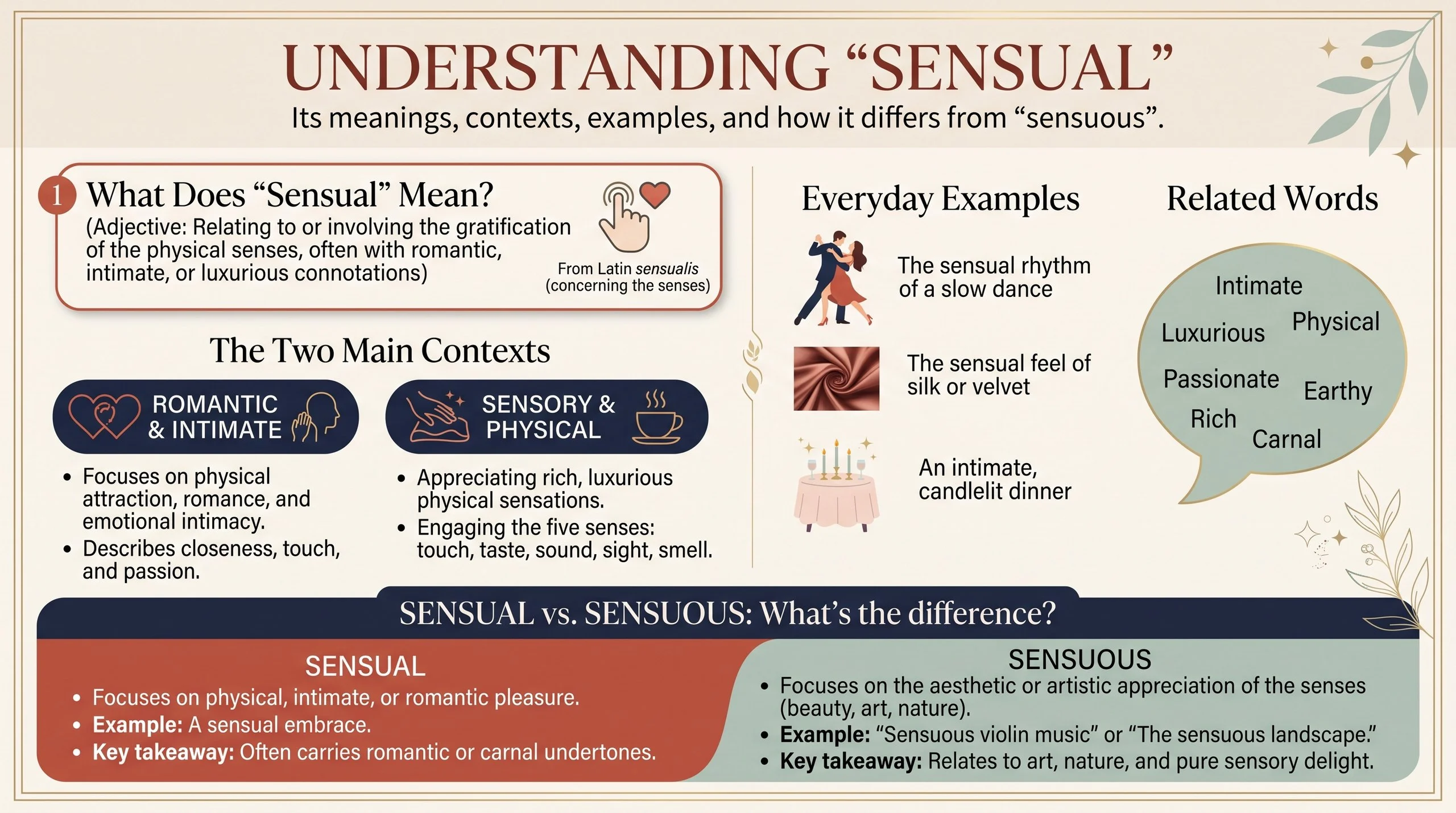
Sensual meaning refers to something connected with physical pleasure or the senses, often with a romantic or sexual suggestion. The word can describe attraction, touch, appearance, music, food, art, or an atmosphere that creates a strong physical feeling.
Sensual meaning describes language, behavior, art, appearance, or experiences connected with physical pleasure and the senses. The word often carries a romantic or sexual suggestion, but it does not automatically mean something explicit or sexual. Context matters greatly.
For example, someone might describe a person’s voice as sensual because it sounds warm, intimate, and attractive. A restaurant might create a sensual atmosphere through soft lighting, music, fragrance, and carefully prepared food. Likewise, a painting can feel sensual because it focuses strongly on touch, texture, color, or physical beauty.
The word can therefore cover a surprisingly broad range of situations. However, its strongest everyday association is usually physical attraction or pleasure. Cambridge defines the adjective as expressing or suggesting physical, especially sexual, pleasure or satisfaction. Oxford similarly connects it with physical feelings and physical pleasure, especially sexual pleasure. Cambridge Dictionary
This guide explains the word in clear American English. It covers definitions, emotional shades, texting, social media, common misunderstandings, examples, related vocabulary, and practical ways to interpret it.
Quick Answer Box
| Meaning | Context | Primary Platforms | Example | Tone |
| Connected with physical pleasure or the senses | Attraction, romance, art, food, music, appearance | Instagram, TikTok, Snapchat, texting | “Her voice has a sensual quality.” | Romantic, intimate, expressive |
| Suggesting physical or sexual attraction | Dating, flirting, relationships | Texting, DMs, dating apps | “That was a sensual photo.” | Flirty or suggestive |
| Pleasing to the physical senses | Food, fragrance, fashion, music, design | Instagram, Pinterest, lifestyle content | “The restaurant created a sensual experience.” | Elegant, artistic |
| Showing physical appeal | Appearance, movement, voice, style | Social media and conversation | “The dance looked sensual.” | Admiring, sometimes intimate |
What Does Sensual Meaning Mean?
At its core, the word refers to something that appeals strongly to physical sensation or physical pleasure. In modern American English, it frequently suggests sexual attraction, although that is not its only possible interpretation.
Oxford gives two especially useful senses. The first relates to physical feelings and pleasure. The second describes something that suggests an interest in physical pleasure, particularly sexual pleasure. Oxford Learner’s Dictionaries
Cambridge makes a similar distinction. Its American English definition emphasizes physical pleasure, while its broader definition includes physical, especially sexual, pleasure or satisfaction. Cambridge Dictionary
The word can therefore describe both an experience and the quality of an experience.
Consider these examples:
- “The perfume has a sensual fragrance.”
Here, the emphasis can be on a rich and pleasurable smell.
- “His voice sounds sensual.”
This usually suggests an attractive, intimate, or sexually appealing quality.
- “The movie has a sensual atmosphere.”
This may suggest romance, intimacy, physical attraction, or an emotionally charged setting.
- “The food was a sensual experience.”
Here, the meaning can focus on taste, smell, texture, temperature, and enjoyment.
The historical development of the word also helps explain this range. Oxford traces it to late Middle English, from Late Latin sensualis, connected with Latin sensus, meaning a faculty of feeling, thought, or meaning, and ultimately sentire, meaning to feel. Oxford Learner’s Dictionaries
Older dictionary traditions also connected the term with the senses, bodily appetites, and physical gratification. Modern usage has narrowed or shifted in many everyday situations toward physical and sexual associations. Webster’s Dictionary 1828
Is It Always Sexual?
No. This is one of the most important distinctions.
A sensual experience can involve physical pleasure without being explicitly sexual. Food, fragrance, fabric, music, dance, architecture, and lighting can all create a sensory experience that someone describes this way.
However, context changes the interpretation.
If someone says, “This chocolate is sensual,” the phrase may simply describe rich physical enjoyment. If someone says, “You look sensual tonight,” the comment is much more likely to communicate physical attraction.
Consequently, the safest interpretation comes from the surrounding words, relationship, setting, and speaker’s intention.
Sensual Versus Sensuous
These words overlap, but they are not always interchangeable.
| Word | Main Association | Common Example | Typical Impression |
| Sensual | Physical pleasure, often sexual | “a sensual look” | Romantic or intimate |
| Sensuous | Pleasure through the physical senses | “sensuous music” | Artistic or sensory |
| Sexual | Directly related to sex or sexuality | “sexual attraction” | Explicitly sexual |
| Romantic | Love, affection, emotional intimacy | “a romantic gesture” | Loving and emotional |
| Attractive | Pleasing or appealing | “an attractive style” | Broad and neutral |
Oxford defines sensuous as giving pleasure to the senses and notes that it can suggest sexual pleasure in some contexts. Oxford Learner’s Dictionaries Cambridge likewise describes it primarily through physical sensory pleasure. Cambridge Dictionary
Therefore, sensuous can be the better choice when you want to emphasize sensory beauty without creating a strong sexual implication.
Contextual Dynamics and Nuances of the Term
Words rarely have one emotional meaning in every situation. This word is especially dependent on context.
A dictionary can explain its basic definition, but a real conversation requires more interpretation.
When It Describes a Person
When someone calls a person sensual, they usually mean that the person creates an impression of physical attractiveness, intimacy, confidence, or sexual appeal.
For example:
“Her style is very sensual.”
This could refer to clothing, movement, facial expression, confidence, or overall presence.
Importantly, the statement does not necessarily describe the person’s personality. It may describe how their appearance or behavior is perceived.
When It Describes a Voice
A sensual voice often sounds warm, smooth, intimate, slow, expressive, or emotionally engaging.
For example:
“His voice has a sensual quality.”
That sentence usually carries a stronger romantic implication than:
“His voice sounds pleasant.”
The first focuses on attraction and physical impression. The second focuses mainly on sound quality.
When It Describes Art
Artists, critics, and lifestyle writers can use the term in a broader way.
A painting may be called sensual because it emphasizes skin, movement, color, texture, bodies, light, or emotional intimacy.
Similarly, photography can be described this way without being explicit. Lighting, posture, facial expression, composition, and atmosphere can all contribute to the impression.
When It Describes Food
Food provides an interesting example because the meaning does not have to involve sexuality.
A rich dessert can create a strong physical experience through taste, smell, temperature, texture, and appearance. In this context, the word can emphasize pleasure experienced through the senses.
For example:
“The warm chocolate dessert was a sensual experience.”
The sentence can sound sophisticated and literary rather than sexual.
When It Describes Music
Music can also create an intimate physical response.
A slow rhythm, soft vocals, deep bass, or expressive performance may lead someone to describe a song as sensual. Here, the term often blends emotional attraction with sensory enjoyment.
Therefore, the surrounding topic determines whether the word feels artistic, romantic, or sexual.
Emotional Intensity
The word generally carries more intensity than “pleasant” or “attractive.”
Compare:
| Expression | Emotional Strength | Likely Meaning |
| Pleasant | Low | Generally enjoyable |
| Attractive | Moderate | Visually or generally appealing |
| Beautiful | Moderate | Strong aesthetic appeal |
| Romantic | Moderate to strong | Connected with love |
| Sensual | Strong | Physical or intimate appeal |
| Sexy | Strong | Direct sexual attraction |
| Erotic | Very strong | Explicitly sexual or sexually stimulating |
The choice depends on what you want to communicate. If you want a neutral compliment, “attractive” may be safer. If you want an intimate compliment, “sensual” communicates considerably more.
Real Life Conversation Examples Using Sensual Meaning
The following examples show how people might interpret the word in everyday communication. The goal is not to make every use romantic. Instead, these scenarios demonstrate how context changes meaning.
Example 1: Complimenting a Voice
Person A: “Your voice sounds really sensual.”
Person B: “Oh, I wasn’t expecting that compliment.”
Here, the speaker is probably expressing physical or romantic attraction. The compliment may feel intimate because voices can create a strong emotional and physical impression.
Example 2: Talking About Photography
Person A: “The photographer used a really sensual style.”
Person B: “Yeah, the lighting makes the whole shoot feel intimate.”
In this situation, the term describes artistic direction. It does not necessarily imply explicit content.
Example 3: Discussing Food
Person A: “That dessert looks sensual.”
Person B: “The texture looks incredible.”
This is a playful use. The speaker focuses on visual and physical pleasure rather than direct sexuality.
Example 4: Discussing a Dance
Person A: “That dance was very sensual.”
Person B: “The slow movements definitely created that feeling.”
Here, the word describes movement, rhythm, expression, and physical presence.
Example 5: A Romantic Text
Person A: “That picture has such a sensual vibe.”
Person B: “I was going for something elegant and confident.”
In texting, the phrase can function as a strong compliment. Depending on the relationship, it may also communicate attraction.
The key lesson is simple: the same adjective can shift from artistic to romantic to sexual depending on what it describes.
Platform Specific Breakdown
Social platforms do not give the word one universal meaning. Instead, users interpret it according to captions, images, comments, hashtags, relationships, and surrounding language.
How It Is Used on Snapchat
Snapchat communication tends to be personal and visual. Because messages often involve selfies, videos, private stories, and direct replies, context becomes especially important.
If someone replies to a selfie with “You look sensual,” they are likely expressing attraction.
However, if someone comments on a food video with “That looks sensual,” they may simply be using playful language to describe indulgent sensory appeal.
Snapchat also encourages short responses. Therefore, a single adjective can carry more emotional weight than it would in a longer conversation.
For example:
“Okay, that look is sensual.”
This sounds flirtatious.
By contrast:
“This whole setup feels sensual.”
This could refer to lighting, music, clothing, or atmosphere.
The Role of Sensual Meaning on TikTok
TikTok adds another layer because trends, audio clips, captions, comments, and visual aesthetics influence interpretation.
Creators may use the word to describe:
- Dance performances
- Fashion
- Makeup
- Fragrance
- Food
- Music
- Cinematic visuals
- Romantic scenes
- Photography
- Body language
A TikTok caption such as “sensual energy” often communicates confidence, elegance, physical attraction, or mature aesthetic appeal.
Still, viewers should avoid assuming that the creator intends a sexual message simply because the word appears. A fashion video and a romantic video can both use the same vocabulary while communicating very different ideas.
Instagram and Texting Dynamics
Instagram often combines visual content with short captions. Therefore, the term can describe an aesthetic rather than a direct sexual message.
For example:
“Soft lighting and sensual details.”
This sounds like an aesthetic description.
“Your eyes look so sensual.”
That sounds more personal and flirtatious.
Texting is even more dependent on the relationship between two people. A close partner may interpret the word naturally. A coworker or casual acquaintance may find the same compliment unexpectedly intimate.
Consequently, relationship context matters more than the platform itself.
Alternative Meanings and NLP Variations of the Phrase
From a language perspective, the word connects with several semantic fields.
Physical Pleasure
This is the broadest category.
Related expressions include:
| Expression | Meaning |
| Physical pleasure | Enjoyment felt through the body |
| Sensory pleasure | Enjoyment involving sight, sound, taste, touch, or smell |
| Bodily enjoyment | Pleasure associated with physical experience |
| Physical attraction | Feeling drawn toward someone’s appearance or presence |
| Intimacy | Emotional or physical closeness |
| Sexual attraction | Attraction specifically related to sexuality |
Romantic Attraction
The word can imply romantic interest without directly stating sexual desire.
For example:
“She has a sensual presence.”
That can suggest confidence, warmth, elegance, and attraction simultaneously.
Sexual Suggestion
In many modern contexts, the strongest interpretation involves sexuality.
That does not automatically make the word explicit. Instead, it can suggest physical attraction without describing sexual activity.
This distinction is useful when writing captions, reviews, compliments, or creative descriptions.
Aesthetic Pleasure
Writers frequently use the term for art, photography, design, music, fashion, and food.
This broader use gives the word a sophisticated quality.
For example:
“The designer created a sensual palette of warm colors.”
The phrase focuses on aesthetic experience rather than a person’s sexuality.
Useful Related Terms
Several nearby words can help writers choose the right level of intensity.
| Term | Best Use |
| Attractive | General appeal |
| Appealing | Broad positive impression |
| Alluring | Strong attraction or mysterious appeal |
| Seductive | Stronger suggestion of sexual attraction |
| Erotic | Clearly sexual or sexually stimulating |
| Sensuous | Strong sensory or artistic pleasure |
| Intimate | Emotional or physical closeness |
| Romantic | Love and affection |
| Sultry | Hot, intense, and sexually attractive |
| Provocative | Designed to stimulate a strong reaction |
| Elegant | Refined visual appeal |
| Enchanting | Captivating emotional or aesthetic appeal |
Misinterpretations: When Not to Use Sensual Meaning
Although the word is flexible, it is not appropriate for every compliment.
The biggest issue is unwanted intimacy.
Calling a stranger’s appearance sensual can feel overly personal. The same comment can also sound inappropriate in professional settings.
Avoid It in Most Workplace Compliments
Instead of:
“Your presentation style was sensual.”
Choose:
“Your presentation style was engaging.”
Instead of:
“That outfit looks sensual.”
Choose:
“That outfit looks polished.”
Professional communication usually benefits from clear, respectful vocabulary.
Be Careful With Acquaintances
A person you barely know may interpret a sensual compliment as flirtation.
For example:
“You have a sensual smile.”
That statement is much more intimate than:
“You have a great smile.”
If you do not want to imply attraction, choose the neutral version.
Do Not Assume Everyone Interprets It the Same Way
Language varies across cultures, generations, communities, and relationships.
One person may hear “sensual” and think “beautiful and sophisticated.” Another may hear it and immediately think “sexually attractive.”
Therefore, intent and interpretation can differ.
Consider the Medium
A public Instagram comment has a different social effect from a private message.
A private message may feel personal. A public comment can feel more exposing.
Likewise, a professional email requires much more neutral vocabulary than a dating conversation.
When Another Word Is Better
Use “sensuous” when you want to emphasize sensory beauty.
Use “romantic” when you mean affection or love.
Use “attractive” when you want a broad compliment.
Use “sexy” when direct sexual attraction is genuinely intended and appropriate.
Use “elegant” when you want refined visual appreciation.
This small vocabulary distinction can prevent major communication misunderstandings.
How to Respond to Sensual Meaning in Chat
If someone uses the word toward you, your best response depends on whether you welcome the implication.
If You Like the Compliment
You can respond warmly:
“Thank you, I’ll take that compliment.”
This keeps the mood light.
If You Want to Flirt Back
Try:
“Is that your way of flirting with me?”
This invites the person to clarify their intention while keeping the exchange playful.
If You Are Unsure
Ask directly:
“What do you mean by sensual?”
This is one of the clearest options. It gives the other person space to explain.
If You Want to Keep Things Friendly
Say:
“Thanks, I appreciate that.”
It acknowledges the compliment without encouraging a more intimate conversation.
If You Feel Uncomfortable
You can set a simple boundary:
“I’d rather keep the conversation respectful and casual.”
That communicates your preference without escalating the situation.
If the Context Is Artistic
If someone says your photo, painting, or design looks sensual, you can discuss the creative meaning.
For example:
“Thanks. I was trying to create a warm and intimate atmosphere.”
This response accepts the artistic interpretation without necessarily making the conversation sexual.
The most important rule is to match your response to your comfort level. You do not owe anyone a flirty reply simply because they used a flattering word.
FAQs
What does sensual meaning refer to?
It refers to physical pleasure, sensory enjoyment, or an impression of physical attraction. In modern everyday English, it often carries a romantic or sexual suggestion, but the exact meaning depends on context. Cambridge Dictionary
Is sensual the same as sexual?
Not exactly. Sexuality directly relates to sex or sexuality. Sensuality can suggest sexual attraction, but it can also describe physical pleasure involving food, music, fragrance, touch, art, or other sensory experiences.
Does sensual mean attractive?
It can imply attractiveness, especially physical attractiveness. However, it usually adds an element of physical or intimate appeal that the simpler word “attractive” does not necessarily communicate.
What does sensual mean in a text message?
In texting, the word often signals attraction or flirtation when it describes a person, photo, voice, or appearance. However, it can describe an aesthetic or sensory experience when the surrounding conversation is about art, food, fashion, or music.
Is calling someone sensual a compliment?
Usually, yes, but it is an intimate compliment. Some people may appreciate it, while others may find it too personal. Relationship, setting, and individual boundaries all matter.
What is the difference between sensual and sensuous?
Sensuality often carries a stronger association with physical or sexual pleasure. Sensuous more naturally emphasizes pleasure through the physical senses, especially in artistic or descriptive contexts. Oxford Learner’s Dictionaries
Can food be described as sensual?
Yes. Food can create pleasure through taste, smell, texture, temperature, and appearance. Writers may use the word to describe an especially rich sensory experience.
Can music be sensual?
Yes. Music may feel sensual because of its rhythm, vocals, instrumentation, atmosphere, or emotional intensity. The description does not necessarily mean the music is explicitly sexual.
Is sensual appropriate in professional writing?
It can be appropriate in fields such as fashion, beauty, art, food, fragrance, photography, and entertainment. However, it is usually unsuitable for ordinary workplace compliments about someone’s appearance or body.
How can I politely ask what someone means by sensual?
A simple question works well: “What do you mean by that?” You can also ask, “Do you mean it in an artistic way or a romantic way?” This removes ambiguity without creating unnecessary tension.
Conclusion
Understanding sensual meaning requires more than memorizing one dictionary definition. The word sits between physical sensation, aesthetic pleasure, romance, attraction, and sexuality. As a result, its interpretation changes according to context.
A sensual description of food can sound artistic. A sensual description of a person can sound flirtatious. A sensual description of photography can describe mood, lighting, movement, or composition.
The safest approach is to consider who is speaking, what they are describing, where the conversation happens, and what emotional message the surrounding words create. When you need a neutral compliment, choose words such as attractive, elegant, beautiful, or appealing. When physical attraction is genuinely intended, the stronger word can communicate that feeling clearly.
Ultimately, good communication depends on precision. Choosing the right word helps your message sound natural, respectful, and intentional.