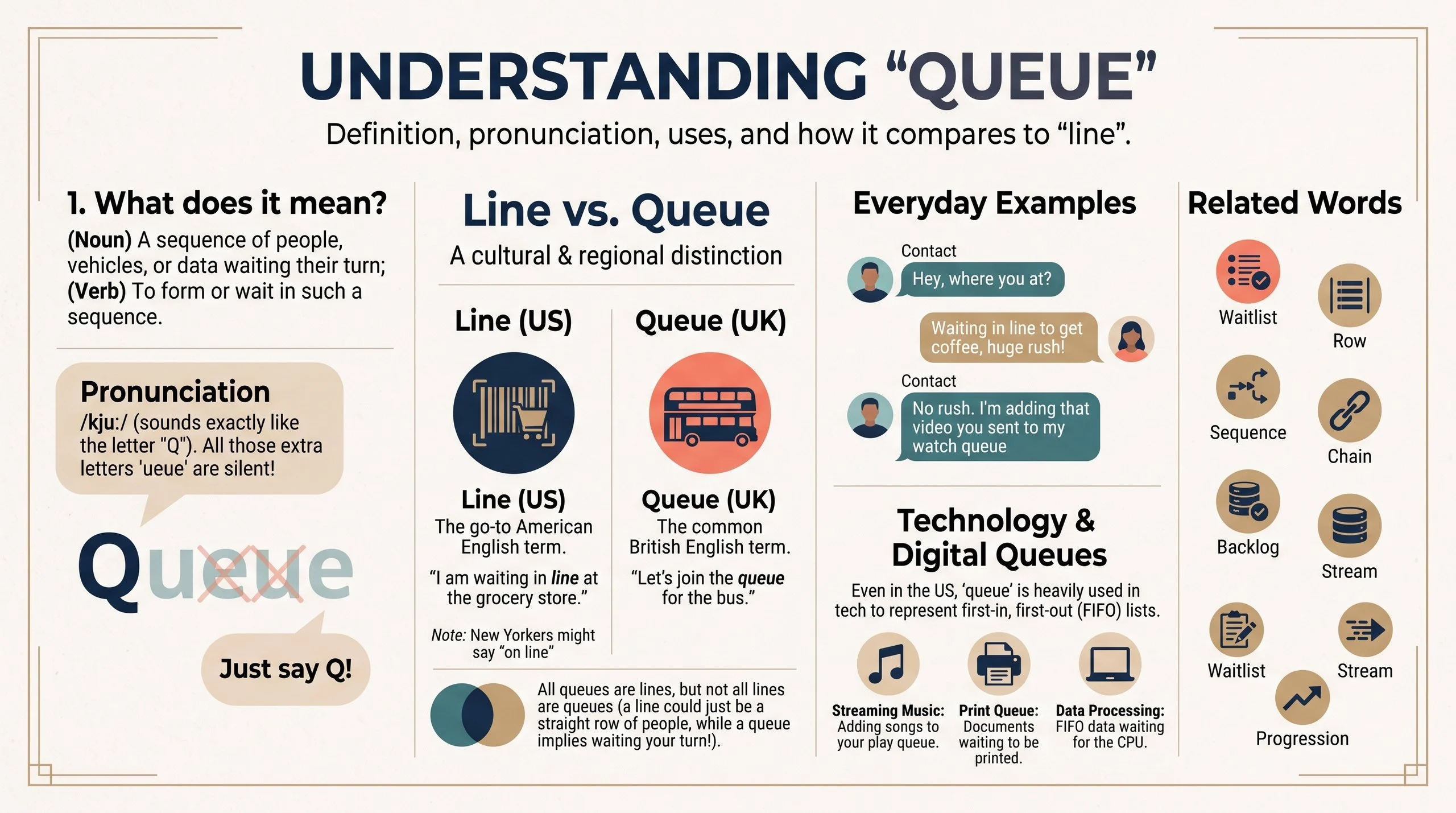
Queue meaning is a line or sequence of people, vehicles, tasks, or digital requests waiting for something. In everyday American English, it usually means people waiting their turn. In technology, it means items waiting to be processed.
queue meaning is simple: it describes a line of people or things waiting for their turn. For example, you might join a queue at a coffee shop, wait in a queue at an airport, or place a document in a digital queue for printing. However, American English often uses the word line instead.
The term appears in everyday conversation, workplace communication, gaming, software, customer service, and online communities. Therefore, understanding the context matters more than memorizing one definition.
You may also see the word in messages such as “I am in the queue,” “Your request is in the queue,” or “That song is next in my queue.” Each sentence carries the same basic idea: something is waiting for its turn.
Interestingly, the word also has a long linguistic history. Its modern sense developed from the idea of a tail or a line extending behind something. Today, it can describe both physical waiting lines and invisible digital systems.
This guide explains the definition, pronunciation, origin, conversational use, online context, technical meanings, synonyms, common misunderstandings, and practical examples.
Quick Answer Box
| Meaning | Context | Primary Platforms | Example | Tone |
| A line or sequence waiting for its turn | Everyday conversation | Texting, messaging, workplaces | “I am in the queue.” | Neutral |
| Items waiting to be processed | Technology | Apps, software, websites | “Your request is in the queue.” | Technical |
| A list of upcoming media | Entertainment | Spotify, YouTube, streaming apps | “Add this song to the queue.” | Casual |
| A waiting line | Public places | Shops, airports, events | “The queue is long.” | Neutral |
| A sequence of players or tasks | Gaming and online services | Games and platforms | “You are next in the queue.” | Casual |
What Does Queue Mean?
The basic queue meaning is a line or sequence in which people or things wait for their turn.
Consider a busy restaurant. Several customers may wait before receiving a table. Those customers form a queue. Similarly, cars waiting at a toll booth can form a queue.
The concept does not always involve people. A printer can have a queue of documents. A customer service system can have a queue of callers. A computer can have a queue of tasks waiting for processing.
Simple Definition
A queue is an ordered group of people or items waiting for an action, service, opportunity, or process.
The key idea is order. Something enters the queue, waits, and eventually reaches its turn.
For example:
- “There are ten people in the queue.”
- “Your file is in the print queue.”
- “Add the movie to my queue.”
- “The support request is waiting in the queue.”
In each case, something waits before moving forward.
Queue Pronunciation
The word is pronounced like “cue.”
Both words sound identical, although their meanings differ.
| Word | Pronunciation | Meaning |
| Queue | “cue” | A line or waiting sequence |
| Cue | “cue” | A signal to begin an action |
This similarity often surprises English learners. However, the spelling of the queue contains several letters that do not create additional sounds.
Is It Common in American English?
Yes, but there is an important regional difference.
In the United States, people usually say lines when talking about people waiting.
For example, an American is more likely to say:
“I am standing in line.”
Someone using British English may say:
“I am standing in a queue.”
Both sentences communicate the same basic idea.
Therefore, queue is completely understandable in American English, but line often sounds more natural in everyday American conversation.
Queue Versus Line
| Expression | Typical American Usage | Meaning |
| Stand in line | Very common | Wait with other people |
| Wait in line | Very common | Remain in an ordered waiting group |
| Join the queue | Understandable but less common | Enter a waiting line |
| Join the line | Very common | Enter a waiting line |
| Waiting queue | Less natural | A group waiting |
| Waiting line | Very common | A group waiting |
The difference is mainly one of regional preference. The underlying concept remains the same.
Contextual Dynamics and Nuances of the Term
The meaning changes slightly depending on where you encounter the word.
Everyday Physical Queues
In ordinary situations, a queue refers to people or vehicles waiting.
Examples include:
- A queue outside a restaurant
- A queue at an airport
- A queue at a ticket counter
- A queue at a supermarket
- A queue at a concert
- A queue at a government office
The word emphasizes organized waiting. Usually, people enter in sequence and receive service according to their position.
Workplace Communication
Businesses often use queue language because many tasks require organized processing.
A manager might say:
“Several requests are still in the queue.”
A customer service representative might say:
“Your ticket has entered the support queue.”
A developer might say:
“The deployment is waiting in the queue.”
In these examples, the word sounds professional and neutral.
Digital and Technical Context
Technology uses the concept extensively.
A digital queue contains tasks waiting for a system to process them. The system usually handles those tasks according to specific rules.
For example, a print queue can contain several documents. The printer processes them one at a time.
Similarly, an email platform might process thousands of messages through a queue. A server can also place requests into a queue before handling them.
Entertainment Context
Streaming platforms and music services often use queue language.
You might add several songs to a listening queue. You could also place videos or episodes into a viewing queue.
For example:
“I added three songs to the queue.”
Here, the word does not suggest a physical line. Instead, it means an ordered list of content waiting to play.
Gaming Context
Games frequently use queues for matchmaking.
Players may enter a matchmaking queue while the system searches for suitable opponents or teammates.
For example:
“We have been in the matchmaking queue for five minutes.”
In this context, the queue represents waiting time and processing order.
Real Life Conversation Examples Using queue meaning
The word works differently depending on the situation. These examples show how people might naturally use it.
Example 1: Coffee Shop
Person A: “Is this the queue for coffee?”
Person B: “Yeah. It starts right here.”
Person A: “Thanks. I almost waited in the wrong spot.”
Here, the word refers to a physical line. In casual American speech, “line” would probably sound more natural.
Example 2: Customer Support
Customer: “Has my request been received?”
Agent: “Yes. It is currently in the support queue.”
Customer: “Okay, so someone will review it soon?”
Agent: “Correct. It is waiting for the next available agent.”
This example uses the term in a professional setting.
Example 3: Music
- Friend A: “What are you listening to?”
- Friend B: “A playlist I made yesterday.”
- Friend A: “Can you add that song to the queue?”
- Friend B: “Sure. It is next.”
Here, the queue means upcoming content rather than people.
Example 4: Gaming
Player A: “Are we playing now?”
Player B: “Not yet. We are still in the matchmaking queue.”
Player A: “How long has it been?”
Player B: “About three minutes.”
The term describes a digital waiting process.
Example 5: Workplace Tasks
Coworker A: “Did you review my document?”
Coworker B: “Not yet. It is in my queue.”
Coworker A: “No worries. When do you think you can check it?”
Coworker B: “Probably this afternoon.”
Here, the queue means a list of pending tasks.
Platform Specific Breakdown
Online platforms use queue language in several ways. However, it is important not to assume that the word has a special secret slang meaning on every platform.
How It Is Used on Snapchat
On Snapchat, the word usually keeps its standard meaning.
A person might use it when discussing an event, customer service, gaming, or another situation involving waiting.
For example:
“We are still in the queue.”
The message could refer to waiting for entry at a concert or waiting for a service.
Snapchat itself does not give the ordinary word a universal slang definition. Therefore, context matters.
A friend could also say:
“That video is in my queue.”
In this case, they probably mean the video is waiting to be watched or shared.
The Role of queue meaning on TikTok
TikTok conversations can use the word in casual, humorous, or technical contexts.
Someone might joke about a long waiting line by saying:
“The queue is wild today.”
Another person could discuss videos waiting to be watched:
“My queue is already full.”
However, users should not assume that queue automatically represents a special TikTok slang term.
Social media often gives ordinary words new meanings temporarily. Those meanings can spread quickly through memes and comments. Nevertheless, the standard definition remains the safest interpretation unless the surrounding conversation clearly suggests something different.
Instagram and Texting Dynamics
Instagram messages and regular texting generally use the ordinary meaning.
For example:
“I have five shows in my queue.”
Or:
“We have been in the queue forever.”
In casual American texting, the line often feels more natural when talking about people.
For digital content, however, the queue can sound completely natural.
Compare these sentences:
| Sentence | Naturalness in American English |
| “I am waiting in line.” | Very natural |
| “I am waiting in the queue.” | Correct, but less common |
| “Add the song to the queue.” | Natural |
| “The request is in the queue.” | Natural |
| “The queue is moving slowly.” | Correct |
| “The line is moving slowly.” | Very natural |
The platform does not fundamentally change the word. Instead, the surrounding situation determines its meaning.
Alternative Meanings and NLP Variations of the Phrase
A strong understanding requires more than one dictionary style definition.
The word connects to several semantic ideas.
Synonyms for a Physical Queue
Depending on the context, useful alternatives include:
| Alternative | Best Context |
| Line | American everyday English |
| Waiting line | Clear everyday description |
| Row | Certain organized arrangements |
| Sequence | Ordered items |
| Group | General description |
| List | Digital or organizational context |
| Waiting list | People waiting for availability |
| Order | Processing sequence |
Not every synonym works in every sentence.
For example, “I am standing in a line” sounds natural. “I am standing in a sequence” does not.
Queue as a Verb
The word can also function as a verb.
For example:
“The system queued the request.”
This means the system placed the request into a waiting sequence.
You might also see:
“The videos are queued.”
That means the videos have been placed in an ordered list for later processing or playback.
Queueing and Queued
Two common forms are queueing and queuing.
Examples include:
- “The files are queued for printing.”
- “The system is queueing new requests.”
- “Several customers are queued outside.”
American technical writing may also use “queuing” depending on the style and context. Both spelling forms appear in English usage.
Queue in Computing
Computing gives the concept a precise technical meaning.
A queue is commonly an ordered data structure. Items enter at one end and leave at another according to the rules of the system.
A basic queue often follows first in, first out, commonly called FIFO.
That means the first item added usually becomes the first item processed.
| Position | Task |
| First | Task A |
| Second | Task B |
| Third | Task C |
| Fourth | Task D |
If the system follows FIFO rules, Task A gets processed before Task B.
However, not every real world system follows simple first in, first out rules. Some systems prioritize urgent requests, premium users, emergency tasks, or other conditions.
Therefore, the broader meaning is an ordered waiting system, while the exact processing rules depend on the application.
Misinterpretations: When NOT to Use queue meaning
Although the word is useful, it does not belong in every situation.
Do Not Assume It Is Social Media Slang
A major mistake is treating every online word as slang.
Queue is primarily a standard English word. Social media users may use it casually, but the word does not automatically carry a secret internet meaning.
If someone writes:
“I am in the queue.”
The safest interpretation is that they are waiting for something.
Do Not Confuse Queue With Cue
These words sound identical.
However, their meanings differ.
| Word | Meaning | Example |
| Queue | A waiting line or sequence | “The files are in the queue.” |
| Cue | A signal or prompt | “That was my cue to leave.” |
This distinction is especially important in writing.
Do Not Use Queue When You Mean a Signal
If you mean that someone gave you a signal, use cue.
Correct:
“That was my cue.”
Incorrect:
“That was my queue.”
The second sentence changes the meaning completely.
Do Not Assume Queue Always Means People
The term can describe people, objects, requests, media, jobs, or data.
Therefore, interpreting it only as a line of people can create confusion.
Do Not Force It Into Casual American Speech
If you are writing for a general American audience, the line often sounds more conversational.
For example:
“I waited in line for twenty minutes.”
That sentence sounds very natural in the United States.
By contrast:
“I waited in the queue for twenty minutes.”
It is still correct, but it may sound more British or formal.
How to Respond in Chat Comfortably
When someone uses the word in a message, your response should depend on what they mean.
If They Mean a Physical Line
You can respond naturally:
“How long is the line?”
Or:
“Are you almost at the front?”
If They Mean Customer Service
Try:
“Hopefully they get to your request soon.”
Or:
“What position are you in?”
If They Mean Gaming
You might say:
“How long have we been waiting?”
Or:
“Let me know when the match starts.”
If They Mean Music
You can say:
“Add my song next.”
Or:
“What is currently playing?”
If You Are Unsure
Ask directly:
“Do you mean a waiting line?”
That simple question prevents unnecessary confusion.
Casual Texting Responses
Here are natural responses for different situations.
| Situation | Comfortable Response |
| Long waiting line | “That line must be huge.” |
| Customer support | “Hopefully they get to you soon.” |
| Gaming | “Tell me when we get a match.” |
| Music | “Put my song next.” |
| Work tasks | “No rush, just let me know when you get to it.” |
| Event entry | “How close are you to the front?” |
The best response depends on context rather than the word alone.
10 High Intent FAQs About the Slang
What does queue mean in simple English?
It means a line or ordered group waiting for its turn. It can describe people, vehicles, tasks, computer requests, songs, videos, or other items.
Is queue an American word?
Yes. Americans understand and use the word. However, line is usually more common in everyday American conversation when referring to people waiting.
What is the queue meaning in texting?
In texting, it usually means a waiting line or an ordered list of things. For example, someone may say that a song is in their queue or that a request is waiting in a queue.
Does queue mean the same as line?
Usually, yes, when discussing people waiting. However, queue has broader technical uses. A digital system can have a queue of tasks, requests, files, or data.
Is queue the same as cue?
No. They sound alike but have different meanings. Queue means a waiting sequence, while cue means a signal or prompt.
Why does the queue have so many letters?
The spelling reflects its historical development through French and English. The letters do not represent separate sounds in modern pronunciation.
Is the queue formal or informal?
The word itself is neutral. However, the line often sounds more casual in American English when talking about people waiting.
Can queue be used as a verb?
Yes. To queue something means to place it into an ordered waiting sequence. For example, a system can queue a request for later processing.
What is a queue in technology?
In technology, it is a collection of tasks or requests waiting to be processed. The system may process items according to arrival order, priority, or another set of rules.
Why do British speakers say queue instead of line?
British English commonly uses a queue for a line of people waiting. American English commonly uses lines for the same situation. Both forms are standard English.
The History and Origin of the Word
The history behind the word adds useful context.
The English word developed from the French queue, which historically referred to a tail. That connection makes sense because a line can extend behind something in a shape resembling a tail.
The word eventually developed its modern English sense of a line of people or objects waiting in an organized order.
This historical connection also explains why the spelling looks unusual to modern English readers.
The pronunciation became much simpler than the spelling. As a result, queue and cue sound exactly alike in standard English pronunciation.
The technical meaning came much later as computers began using organized waiting systems.
Today, the word works across several domains:
| Historical or Modern Domain | Meaning |
| Earlier physical sense | Tail or extending line |
| Everyday English | People waiting |
| Business | Pending work |
| Customer service | Waiting requests |
| Computing | Tasks awaiting processing |
| Entertainment | Upcoming content |
| Gaming | Players waiting for matchmaking |
The central concept remains consistent: something waits for its turn.
Common Expressions and Phrases
Several phrases appear frequently with the word.
In the Queue
This means something or someone is waiting.
Example:
“Your request is in the queue.”
Join the Queue
This means entering the waiting line.
Example:
“Please join the queue near the entrance.”
At the Front of the Queue
This means being close to receiving service.
Example:
“We are finally at the front of the queue.”
At the Back of the Queue
This means being last or near the end.
Example:
“Everyone who arrived later went to the back of the queue.”
Queue Up
This means enter or create an ordered waiting sequence.
Example:
“The players queued up for the tournament.”
Clear the Queue
This means removing pending items from the waiting sequence.
Example:
“I cleared the print queue because the files were outdated.”
Common Mistakes English Learners Make
Mistake One: Confusing Queue and Cue
This is the most common spelling problem.
Remember:
Queue = waiting
Cue = signal
Mistake Two: Assuming Queue Always Means People
It can describe digital items too.
A printer queue contains documents. A music queue contains songs. A server queue can contain requests.
Mistake Three: Assuming Line Is Always Wrong
It is not.
In American English, line is often the preferred everyday word.
Mistake Four: Treating It as Internet Slang
The word can appear online, but its standard meaning remains unchanged.
Mistake Five: Ignoring Context
A sentence such as “It is in the queue” does not tell you exactly what is waiting.
You need the surrounding conversation to identify whether the speaker means a person, task, file, song, player, or request.
Queue, Line, List, and Sequence Compared
These words overlap, but they are not interchangeable in every situation.
| Word | Core Idea | Typical Use |
| Queue | Ordered waiting | People, tasks, requests |
| Line | People or things arranged one after another | Everyday American speech |
| List | Collection of items | Tasks, names, content |
| Sequence | Ordered arrangement | Technical or formal contexts |
For example, a grocery store usually has a line, while a computer printer usually has a queue.
A manager may keep a list of tasks, while a technical system may process those tasks through a queue.
The distinction depends on function.
Why the Word Matters in Modern Digital Communication
Modern technology has expanded the concept beyond physical waiting.
People now wait for:
- Downloads
- Video processing
- Customer support
- Game matchmaking
- File uploads
- Music playback
- Software updates
- Server requests
- Online orders
- Content moderation
- Data processing
Therefore, the idea behind a queue has become part of everyday digital life.
You may never see the actual queue. Nevertheless, the system can still place your request behind other requests.
For example, when thousands of people attempt to access a service simultaneously, a system may organize requests into a queue. This helps prevent the service from becoming overloaded.
Consequently, the word has become especially common in technical communication.
How Context Changes the Tone
The word itself is neutral. The surrounding sentence determines the emotional tone.
| Context | Example | Likely Tone |
| Restaurant | “The queue is long.” | Neutral |
| Customer support | “Your ticket is in the queue.” | Professional |
| Gaming | “We are in the queue.” | Casual |
| Music | “Put it in the queue.” | Casual |
| Workplace | “It is next in my queue.” | Professional |
| Complaint | “I have been in this queue forever.” | Frustrated |
A speaker can therefore use the same word in friendly, professional, humorous, or frustrated communication.
A Practical Guide for Choosing the Right Word
- Use a line when you are talking casually about people waiting in American English.
- Use queue when you are discussing technology, organized processing, customer service systems, media playback, gaming, or British English.
- Use list when you simply mean an organized collection without emphasizing waiting.
- Use sequence when order is important and the context is technical or formal.
- Use cue when you mean a signal.
This simple distinction prevents most usage mistakes.
Conclusion
The central queue meaning is a line or ordered sequence waiting for its turn. Although the word appears frequently in digital communication, it is not inherently internet slang. Instead, it is a standard English term with applications ranging from everyday waiting lines to software systems.
In American English, the line usually sounds more natural for people waiting. However, queue remains common in technology, gaming, customer service, entertainment, and professional communication.
The most important distinction is context. A person can stand in a queue, a file can wait in a queue, a song can sit in a queue, and a computer can process a queue of requests.
Once you understand that central idea, the word becomes easy to recognize and use. Just remember the key spelling difference: queue means a waiting sequence, while cue means a signal.