The diva meaning describes a glamorous, confident, or highly demanding woman. Originally linked to a celebrated female opera singer, the word now can be complimentary, playful, teasing, or critical depending on context, tone, and relationship.
The diva meaning changes depending on who says it, why they say it, and how the word fits the conversation. In everyday American English, a diva can describe a glamorous woman with strong confidence and high standards. However, it can also describe someone who acts demanding, dramatic, or difficult.
The word has an interesting history. It once carried a strong connection to celebrated female opera performers. Over time, popular culture expanded its meaning. Today, people use it in conversations, captions, memes, comments, group chats, and casual texting.
For example, a friend might call you a diva after you spend an hour choosing an outfit. That comment may be affectionate rather than insulting. Likewise, someone might call a celebrity a diva because of their demanding behavior.
Therefore, context matters more than the dictionary meaning alone. The same word can sound like praise in one sentence and criticism in another.
Quick Answer Box
| Meaning | Context | Primary Platforms | Example | Tone |
| A glamorous, confident, or demanding woman | Casual conversation | TikTok, Instagram, Snapchat, texting | “She is such a diva.” | Playful, admiring, or critical |
| A celebrated female performer | Music and entertainment | Interviews, articles, media | “The opera diva performed tonight.” | Respectful |
| Someone with high standards | Friends and social settings | Texting and social media | “I am being a diva today.” | Usually humorous |
| Someone acting difficult or demanding | Conflict or criticism | Work, relationships, conversations | “He thinks she is acting like a diva.” | Negative |
What Does Diva Mean?
The word diva has several related meanings. Its most recognizable modern sense describes a woman who appears glamorous, confident, demanding, dramatic, or particular about what she wants.
However, that broad description needs context.
The Original Meaning
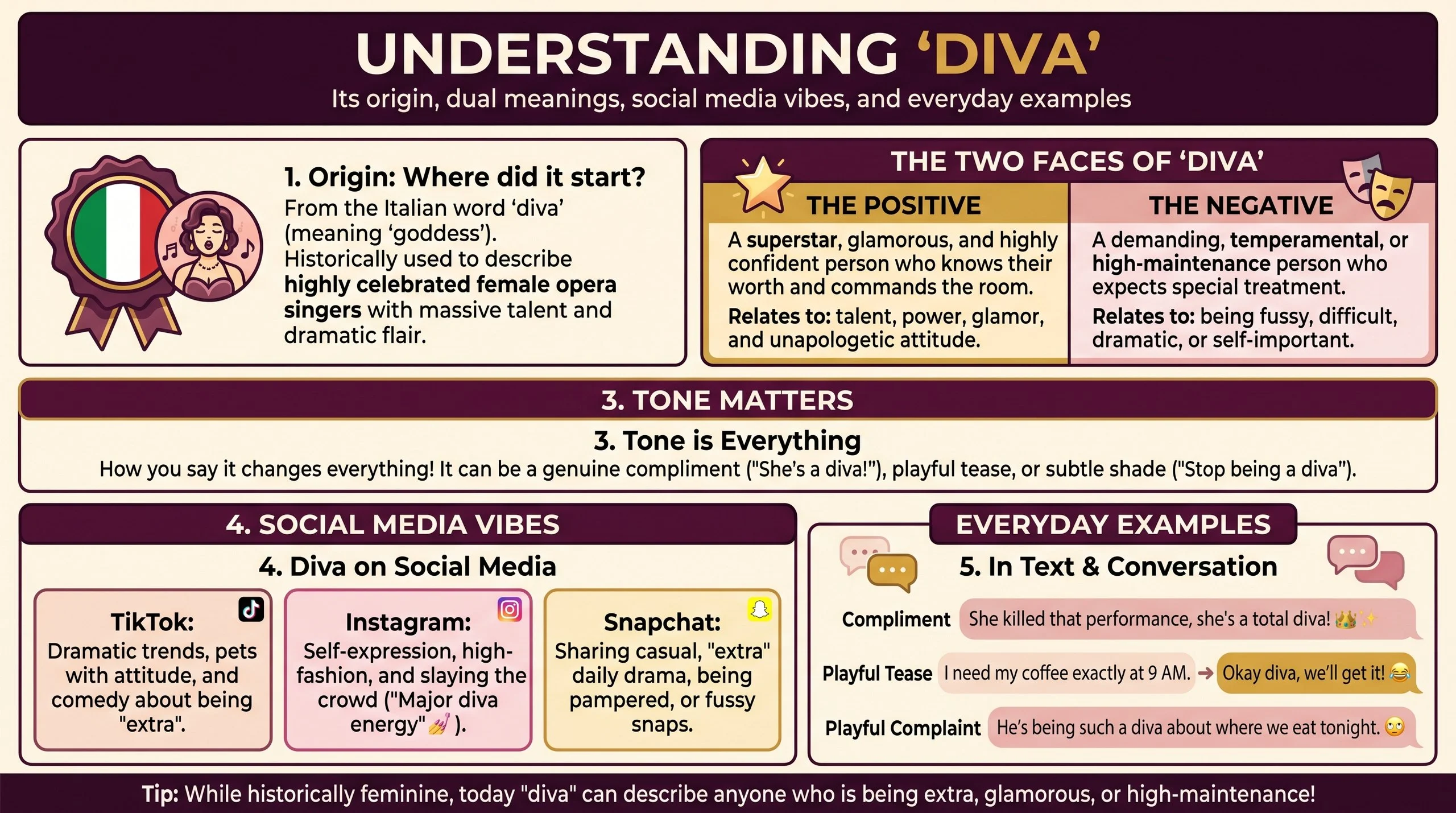
Diva comes from Italian and literally relates to the feminine form of a word meaning divine. English adopted the term in connection with celebrated female singers, especially leading opera performers.
Historically, calling someone a diva could signal exceptional artistic status. The word carried admiration and prestige. It suggested that the performer possessed remarkable talent, presence, or fame.
Over time, the meaning became broader.
Popular culture began using diva for women who displayed demanding personalities or expected special treatment. As a result, the word developed both positive and negative associations.
The Modern Meaning
Today, diva can describe several personality traits at once:
- Glamorous
- Confident
- Stylish
- Particular
- High maintenance
- Dramatic
- Demanding
- Self assured
- Attention seeking
The important point is that none of these traits automatically defines every use.
For example, “She is a diva on stage” can suggest confidence and exceptional performance. In contrast, “She is acting like a diva at work” can suggest unreasonable demands.
Is Diva a Compliment?
Sometimes it absolutely is.
A friend might say, “You look like a total diva tonight.” They may mean that you look polished, glamorous, and confident.
Likewise, fans may describe an entertainer as a diva because she has a powerful stage presence.
However, the word can become negative when it focuses on entitlement or unreasonable demands. Therefore, the speaker’s tone and surrounding words matter.
Diva as a Slang Expression
Modern slang often uses diva in an exaggerated or humorous way. Someone might call themselves a diva because they have a specific coffee order, need quiet time, or refuse to leave home without perfect hair.
In these situations, the speaker usually exaggerates their behavior for comedy.
That playful use has become especially common online. Social media encourages short labels that communicate personality quickly. Diva works well because one word can suggest confidence, glamour, drama, humor, and attitude.
Contextual Dynamics and Nuances of the Term
Understanding diva requires more than memorizing one definition. The emotional meaning changes with context.
Positive Diva
A positive use focuses on confidence, beauty, talent, or strong personal standards.
Example:
“She walked into the room like a diva.”
This could suggest that she looked powerful, stylish, and completely confident.
Similarly:
“She is a diva on stage.”
Here, the word can communicate admiration for performance quality and stage presence.
Playful Diva
Friends often use diva as affectionate teasing.
Example:
“Do you need your iced coffee before noon? Okay, diva.”
The speaker probably does not mean that the person is genuinely difficult. Instead, the comment exaggerates a small preference.
This use works especially well among people who understand each other’s humor.
Negative Diva
The negative sense focuses on unreasonable behavior.
Example:
“He is acting like a diva because the meeting started five minutes late.”
Here, diva suggests someone is being overly demanding or dramatic.
Consequently, the word can become insulting when used during an argument.
Glamorous Diva
Fashion and entertainment contexts often emphasize glamour.
A celebrity wearing an elaborate outfit may receive comments such as:
“She looks like a diva.”
The intended meaning may involve elegance, confidence, beauty, and star power.
Dramatic Diva
Another common meaning involves exaggerated reactions.
For example:
“You are being such a diva about this tiny problem.”
That sentence usually means the person is making a bigger deal out of something than necessary.
High Standards Versus Entitlement
These ideas are related, but they are not identical.
Someone can have high standards without being entitled. A person may care deeply about quality, appearance, timing, or presentation.
The word diva becomes more negative when those expectations turn into demands for special treatment.
Therefore, context determines whether the label feels flattering or unfair.
Real Life Conversation Examples Using diva meaning
Real conversations show the difference better than definitions alone. The following examples demonstrate how people may use the term naturally.
Conversation 1: Fashion
Maya: “Why are you taking so long to get ready?”
Ava: “Because everything has to look perfect.”
Maya: “Okay, diva, I see you.”
Here, the diva is playful. Maya is teasing Ava about being particular with her appearance.
Conversation 2: Celebrity Performance
Jordan: “Did you watch her performance last night?”
Chris: “Yes. She absolutely owned that stage.”
Jordan: “She is a total diva.”
In this situation, diva sounds complimentary. The word highlights confidence, talent, and star presence.
Conversation 3: Food Preferences
Sam: “Can we get pizza without onions?”
Alex: “You always have a special request.”
Sam: “I know. I am a diva.”
Here, Sam uses the word about themselves. The self aware tone makes the statement humorous rather than offensive.
Conversation 4: Workplace Behavior
Taylor: “Why did the meeting take an extra thirty minutes?”
Morgan: “Because he refused to continue until everyone followed his exact format.”
Taylor: “That sounds a little diva like.”
This example carries criticism. The speaker is describing demanding behavior rather than glamour.
Conversation 5: Friendly Compliment
Nina: “I finally got my hair done.”
Lena: “Let me see!”
Nina: “Do you like it?”
Lena: “Girl, you look like a diva.”
This use is strongly positive. The word communicates confidence, beauty, and style.
Platform Specific Breakdown
Online platforms have helped expand the modern use of diva. However, each platform gives the word a slightly different social flavor.
How It Is Used on Snapchat
Snapchat encourages quick, informal communication. Users may call themselves or their friends divas in captions, snaps, or private messages.
For example:
“Diva behavior today.”
“Sorry, I am in my diva era.”
“Serving diva energy.”
These expressions usually communicate confidence or humor.
Because Snapchat conversations often happen between friends, the word tends to feel casual. Still, tone depends on the relationship.
A message from a close friend may sound affectionate. The same message from a stranger could sound sarcastic.
The Role of diva meaning on TikTok
TikTok has helped turn diva into a highly flexible internet expression. Creators can use it to describe fashion, personality, confidence, dramatic reactions, celebrity behavior, or humorous situations.
A creator might caption a video:
“POV: I became a diva after getting one compliment.”
The joke comes from exaggeration.
TikTok also uses diva as part of identity and aesthetic language. Phrases such as “diva energy” can suggest confidence, glamour, boldness, and self expression.
However, TikTok slang changes quickly. Meaning can shift according to trends, communities, creators, and memes.
Therefore, a viewer should consider the surrounding video before interpreting the word literally.
Instagram and Texting Dynamics
Instagram commonly uses diva in captions, comments, Stories, and direct messages.
Examples include:
“Diva vibes.”
“Main character diva energy.”
“She understood the assignment. Diva.”
In these contexts, diva often has a positive or playful meaning.
Texting is even more flexible. Friends may use the word sarcastically, affectionately, or dramatically.
For example:
“Girl, you changed outfits four times. Diva.”
That sentence could be teasing rather than genuinely critical.
Alternative Meanings and NLP Variations of the Phrase
Language models and search systems need to recognize the semantic range around diva. People rarely search for only one rigid definition.
Common related expressions include:
| Expression | Likely Meaning |
| Diva energy | Strong confidence, glamour, or dramatic personality |
| Diva vibes | A noticeable glamorous or confident attitude |
| Diva behavior | Demanding, dramatic, or high maintenance behavior |
| Diva attitude | Strong confidence or difficult behavior |
| Diva moment | A dramatic or demanding moment |
| Diva personality | Glamorous, confident, particular, or demanding personality |
| Diva era | A period of embracing confidence and glamour |
| Total diva | Strong emphasis on diva qualities |
| Such a diva | Often playful teasing |
| Acting like a diva | Usually suggests demanding behavior |
| Diva queen | Intensified playful or admiring expression |
| Pop diva | Highly successful female pop performer |
| Opera diva | Celebrated female opera singer |
| Diva style | Glamorous or striking personal style |
Semantic Neighbors
Several words overlap with diva, but they do not mean exactly the same thing.
Glamorous focuses on attractiveness and style.
Confidence focuses on self belief.
Dramatic focuses on exaggerated emotion or behavior.
High maintenance focuses on needing considerable attention, effort, or specific treatment.
Demanding focuses on expectations.
Iconic focuses on cultural impact or memorable status.
Star focuses on fame or exceptional performance.
Therefore, replacing diva with one of these words can change the emotional meaning.
Diva Versus Queen
Queen often functions as a direct compliment. It can express admiration, encouragement, or celebration.
Diva has a wider range. It can praise someone, tease them, or criticize their behavior.
For example:
“You look like a queen.”
This almost always sounds positive.
“You look like a diva.”
This can be positive, but context has greater influence.
Diva Versus High Maintenance
High maintenance usually emphasizes the amount of effort someone expects from others or from a situation.
Diva can imply that behavior, but it can also suggest glamour, confidence, talent, or theatrical personality.
Therefore, the words overlap without being interchangeable.
Misinterpretations: When NOT to Use diva meaning
The word can be harmless among friends, but it is not appropriate in every situation.
Avoid It During Serious Workplace Conflict
Calling a coworker a diva may sound insulting or dismissive.
If you need to address difficult behavior professionally, describe the behavior instead.
Instead of:
“You are being a diva.”
Try:
“The repeated changes are making the project harder to complete.”
The second sentence identifies the problem without labeling the person.
Avoid Assuming It Means Glamorous
Diva does not automatically mean beautiful or fashionable.
Sometimes the speaker focuses entirely on difficult behavior.
Therefore, do not interpret every use as a compliment.
Be Careful With Strangers
Humor depends on shared context.
Calling a close friend a diva may be funny. Calling a stranger a diva could sound disrespectful.
Avoid Using It to Dismiss Legitimate Concerns
Someone who expresses a concern is not automatically being dramatic.
For example, a customer who reports a genuine problem is not necessarily acting like a diva.
Labels can hide the actual issue. Consequently, it is better to evaluate the behavior itself.
Consider Gender and Social Expectations
Diva is traditionally associated with women. Modern speakers sometimes use it more broadly or humorously, but the traditional association remains strong.
Because of that history, the word can sometimes reinforce stereotypes about women being demanding or dramatic.
Context and intention matter, especially in professional or unfamiliar settings.
How to Respond in Chat Comfortably
If someone calls you a diva, your response should match the tone.
When It Is Clearly a Compliment
You can respond confidently:
“Thank you, I will accept that.”
“Exactly the energy I was going for.”
“I knew you understood the assignment.”
These replies keep the interaction playful.
When It Is Friendly Teasing
Try:
“Caught me.”
“Guilty.”
“I prefer the term high standards.”
“Let me have my moment.”
These answers acknowledge the joke without becoming defensive.
When You Are Unsure
Ask for clarification:
“Diva in a good way, right?”
That simple question can prevent unnecessary tension.
When It Feels Insulting
You can stay calm:
“What do you mean by that?”
“I am not sure how you meant that.”
“Are you joking, or are you actually upset?”
These responses create space for clarification.
When You Want a Funny Reply
Try:
“Diva? No. Professional icon.”
“I prefer luxury behavior.”
“Standards are expensive.”
“I cannot help being iconic.”
The best response depends on the relationship. A close friend usually allows more humor. A coworker or stranger calls for greater caution.
FAQs
What does diva mean in texting?
In texting, diva can describe someone who is glamorous, confident, demanding, dramatic, or particular. Friends often use it playfully, especially when someone makes a big deal about a small preference.
Is diva a compliment?
Yes, diva can be a compliment. It may praise confidence, glamour, talent, or strong personal style. However, the word can also criticize demanding behavior, so the surrounding conversation determines the intended tone.
Is calling someone a diva rude?
It can be. The word becomes more likely to sound rude when it is directed at someone during an argument or used to criticize their behavior. Among close friends, however, it can function as harmless teasing.
What does diva mean on TikTok?
On TikTok, diva often represents confidence, glamour, attitude, humor, or exaggerated personality. Expressions such as “diva energy” frequently celebrate someone who appears bold, stylish, dramatic, or self assured.
What is diva energy?
Diva energy describes a confident, glamorous, bold, or dramatic presence. Depending on the situation, it can be positive and empowering or humorous and exaggerated.
Can men be called divas?
Yes. Although the traditional term is associated with women, modern casual speech can apply diva humorously to anyone who behaves in a glamorous, demanding, dramatic, or highly particular way.
What is a diva personality?
A diva personality may combine confidence, strong preferences, glamour, theatrical behavior, and high expectations. The label can sound positive when it emphasizes confidence and negative when it emphasizes entitlement.
What does diva behavior mean?
Diva behavior usually refers to demanding, dramatic, particular, or high maintenance conduct. However, speakers sometimes use the phrase humorously for ordinary preferences or exaggerated reactions.
Is diva the same as high maintenance?
Not exactly. High maintenance focuses on the effort or attention someone requires. Diva can include that idea, but it may also suggest glamour, confidence, talent, or star quality.
What is a good synonym for diva?
The best synonym depends on context. Possible alternatives include star, celebrity, icon, glamorous woman, performer, queen, drama queen, or high maintenance person. Each alternative carries a different tone.
Conclusion
The diva meaning has evolved far beyond its original connection to celebrated female performers. Today, the word can describe glamour, confidence, talent, drama, demanding behavior, or playful self expression.
That flexibility explains why diva remains useful in modern conversation. A friend may use it as a joke. A fan may use it as praise. A critic may use it as an insult.
Ultimately, context decides the message.
When someone says “diva,” look at the surrounding words, relationship, platform, and tone. If the conversation feels playful, the word may celebrate confidence or personality. If the situation feels tense, it may criticize demanding behavior.
Understanding those differences helps you interpret internet slang more accurately and respond without unnecessary confusion.