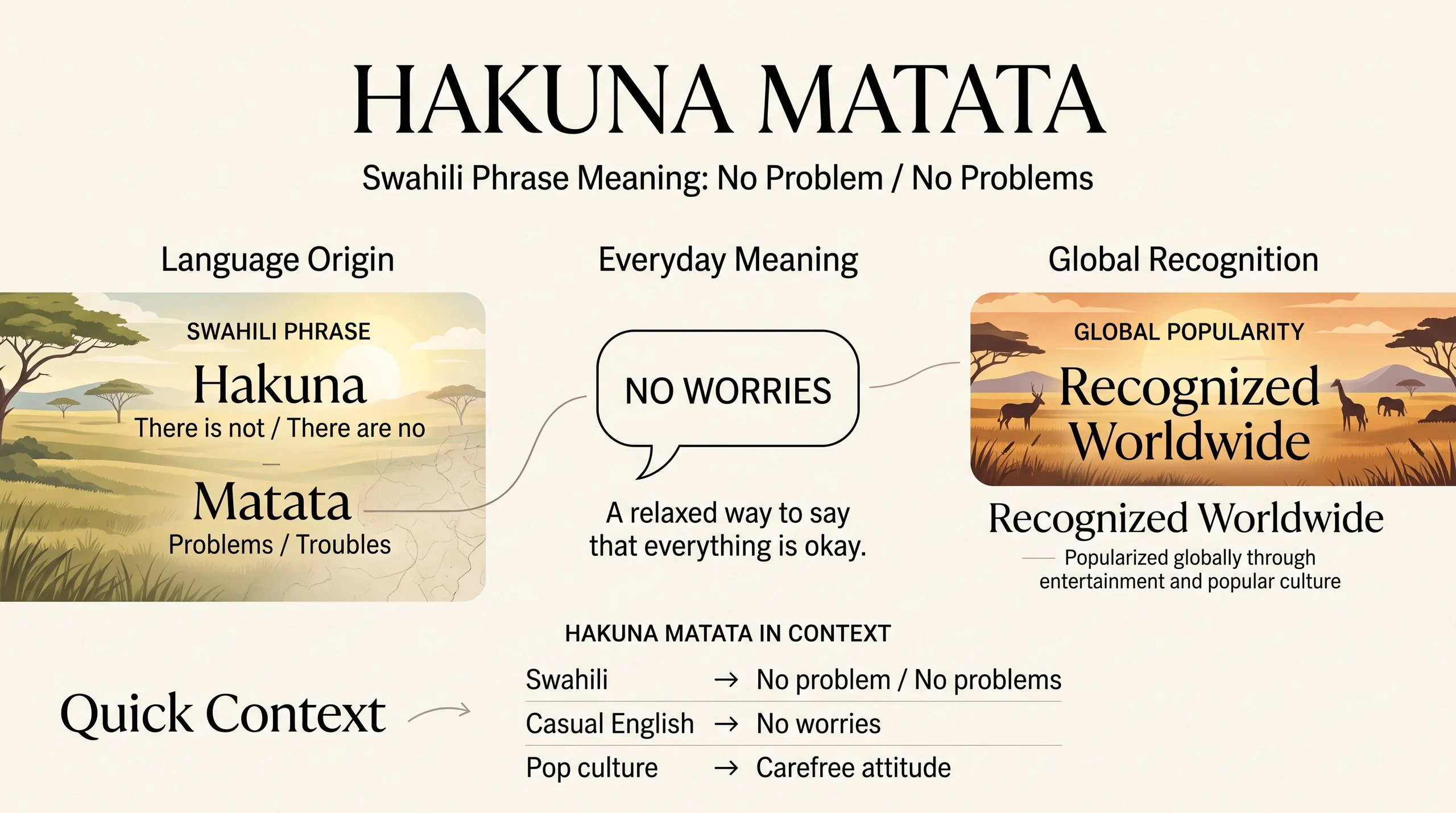
Hakuna matata is a Swahili phrase meaning “no problem” or “there are no problems.” It expresses a relaxed, reassuring attitude toward difficulties. The phrase became globally famous through Disney’s The Lion King, but it existed in Swahili before the film.
Hakuna matata meaning is “no problem” or “there are no problems” in Swahili. The phrase expresses the idea of staying calm, not worrying too much, and accepting that a problem can be handled.
Today, many English speakers recognize the expression because of Disney’s The Lion King. However, the phrase is not originally a Disney invention. It comes from Swahili, a widely spoken language in East Africa.
In everyday English, people often use Hakuna Matata playfully to communicate a carefree attitude. For example, someone might say it after a friend apologizes for a small mistake. In that situation, it can mean something like “Don’t worry about it.”
The phrase also carries cultural and linguistic context. Therefore, understanding its original Swahili meaning helps explain why it became such a memorable expression in global popular culture.
QUICK ANSWER BOX
| Meaning | Language | Common Context | Example | Tone |
|---|---|---|---|---|
| No problem | Swahili | Everyday conversation | “Hakuna matata.” | Relaxed |
| There are no problems | Swahili | Reassurance | “Hakuna matata, rafiki.” | Friendly |
| Don’t worry | English usage | Casual speech | “You forgot it? Hakuna matata!” | Playful |
| Carefree attitude | Popular culture | Movies, memes, captions | “Hakuna matata today.” | Cheerful |
What Does Hakuna Matata Mean?
The phrase Hakuna Matata comes from Swahili.
Its basic meaning is:
“There are no problems.”
It can also be naturally understood as:
“No problem.”
The phrase consists of two main parts:
| Swahili | Meaning |
|---|---|
| Hakuna | There is not / there are no |
| Matata | Problems / troubles |
Together, hakuna matata communicates the absence of problems or troubles.
Is Hakuna Matata a Real Swahili Phrase?
Yes.
The phrase existed in Swahili before its famous appearance in The Lion King. Swahili is spoken across several parts of East Africa, including Tanzania, Kenya, Uganda, the Democratic Republic of the Congo, and other regions.
Consequently, the expression should not be treated as a fictional Disney phrase.
What Does “Hakuna” Mean?
Hakuna is commonly used to express the idea that something is absent or does not exist.
For example, it can appear in phrases that communicate “there isn’t” or “there aren’t.”
What Does “Matata” Mean?
Matata refers to problems, troubles, or difficulties.
Therefore, combining the two words produces the general sense of:
“There are no problems.”
The exact English translation can vary slightly depending on context.
Hakuna Matata in Swahili Culture
The expression belongs to a broader Swahili linguistic and cultural context.
Swahili developed through centuries of interaction among communities along the East African coast. It has influences from several languages, including Arabic, while remaining a Bantu language.
Because Swahili serves as a major lingua franca in East Africa, phrases from the language can appear in different cultural settings.
A Phrase About Reassurance
When someone uses hakuna matata, the intended feeling can be reassuring.
For example, imagine a friend apologizes for arriving late.
You might respond:
“Hakuna matata.”
In an English-speaking conversation, that could communicate:
“No worries.”
However, the phrase does not necessarily mean that every problem literally disappears. Instead, it can express a relaxed response to a relatively minor difficulty.
Hakuna Matata vs. “No Worries”
The two expressions overlap, but they are not identical in every context.
| Hakuna Matata | No worries |
|---|---|
| Swahili phrase | English phrase |
| Literally relates to having no problems | Commonly reassures someone |
| Strongly associated with The Lion King in global culture | Common everyday English |
| Often playful in English | Often casual and natural |
Therefore, “no worries” is often the closest conversational equivalent in American English.
The Disney Connection
For millions of English speakers, the phrase became familiar through Disney’s The Lion King.
The 1994 animated film featured a song titled “Hakuna Matata.” The song presented the phrase as a carefree philosophy centered on leaving worries behind.
The phrase returned prominently in the 2019 photorealistic-style adaptation of The Lion King.
Why Did Disney Make It Famous?
Before The Lion King, Swahili speakers already knew the phrase. However, Disney introduced it to a huge international audience.
The film connected the expression with:
- Friendship
- Optimism
- Relaxation
- Adventure
- Letting go of unnecessary worry
As a result, many English speakers learned the phrase through the movie rather than through Swahili.
Is Hakuna Matata a Disney Phrase?
Not originally.
Disney popularized the expression globally, but hakuna matata is a pre-existing Swahili phrase.
This distinction matters because people sometimes assume that Disney created it.
The company gave the phrase enormous cultural visibility. However, the underlying expression predates the film.
Real-Life Conversation Examples
Example 1: Small Mistake
Alex: Sorry, I forgot to bring the snacks.
Jordan: Hakuna matata. We can get some later.
Here, the phrase means something close to “No problem.”
Example 2: Being Late
Maya: Sorry I’m ten minutes late.
Chris: Hakuna matata!
The speaker uses the phrase playfully to reassure the other person.
Example 3: Social Media Caption
“Plans changed, but hakuna matata.”
Here, the writer communicates a carefree attitude.
Example 4: Travel Conversation
Sam: We missed the first bus.
Taylor: Hakuna matata. Another one comes in twenty minutes.
The phrase expresses calmness rather than panic.
Example 5: Pop Culture Reference
Leo: Everything is going wrong today.
Nina: Hakuna matata. Let’s take a break.
In this example, the phrase draws on its popular cultural association with optimism.
How to Pronounce Hakuna Matata
A common English approximation is:
huh-KOO-nuh muh-TAH-tuh
The exact pronunciation can vary depending on the speaker’s accent and familiarity with Swahili.
The phrase has four syllables in each word:
ha-ku-na ma-ta-ta
| Part | Approximate sound |
|---|---|
| Ha | huh |
| Ku | koo |
| Na | nah |
| Ma | mah |
| Ta | tah |
| Ta | tah |
For learners, listening to native Swahili speakers provides a better pronunciation model than relying only on English phonetic spelling.
Contextual Meanings and Nuances
The hakuna matata meaning can shift slightly when translated into English.
Depending on the situation, it may communicate:
- No problem
- No worries
- Don’t worry
- Everything is okay
- There is nothing to worry about
- Take it easy
However, these are contextual translations rather than separate dictionary definitions.
“No Problem”
This is one of the closest direct interpretations.
If someone apologizes for a minor inconvenience, hakuna matata can reassure them.
“Don’t Worry”
The phrase can also communicate a relaxed attitude toward a situation.
For example:
“We forgot the tickets.”
“Hakuna matata. We’ll figure it out.”
The response means something like:
“Don’t worry. We’ll handle it.”
“Everything Is Fine”
In casual popular usage, the phrase can represent a broader optimistic mindset.
That interpretation became particularly strong because of The Lion King.
Still, the original phrase should not be reduced entirely to a Disney catchphrase.
What Does Hakuna Matata Mean on Social Media?
On social media, people often use Hakuna Matata as a cheerful caption.
For example:
“Beach day. Hakuna Matata.”
Or:
“No stress, just hakuna matata.”
The phrase can communicate:
- Relaxation
- Travel
- Happiness
- Vacation
- Positive thinking
- Humor
- Carefree living
Its recognizable connection to The Lion King also makes it popular in memes and nostalgic posts.
Instagram captions may use the phrase alongside travel, beach, vacation, friendship, or lifestyle photos.
For example:
“Sunshine, good friends, and hakuna matata.”
The phrase adds a relaxed and playful mood.
TikTok
TikTok users may use the phrase in humorous videos or nostalgic references to The Lion King.
It can also appear when someone wants to emphasize a “don’t stress” attitude.
Texting
In text messages, Hakuna Matata can work as a playful response.
For example:
“Sorry I forgot!”
“Hakuna matata 😂”
The phrase makes the response sound lighthearted.
Common Misunderstandings
Hakuna Matata Does Not Literally Mean “No Worries” in Every Context
“No worries” is a useful English equivalent. However, the literal structure centers on the absence of problems.
Therefore, translations can vary based on context.
It Is Not Only a Disney Expression
The phrase existed in Swahili before The Lion King.
Disney popularized it internationally, but the linguistic expression itself has a much older history.
It Does Not Mean Ignoring Serious Problems
In popular culture, Hakuna Matata can suggest carefree living.
Real-life problems, however, still require appropriate action.
Saying “hakuna matata” does not magically solve a serious issue. Instead, the phrase can express calmness or reassurance.
Hakuna Matata vs. Similar Expressions
| Expression | Language | General Meaning | Tone |
|---|---|---|---|
| Hakuna Matata | Swahili | No problem / no problems | Cheerful |
| No worries | English | Don’t worry | Casual |
| It’s okay | English | The situation is acceptable | Reassuring |
| Don’t stress | English | Stay calm | Informal |
| No problem | English | The issue is not serious | Casual |
| Take it easy | English | Relax | Informal |
These expressions overlap, but their cultural associations differ.
Hakuna Matata has a particularly strong connection with East African language and The Lion King.
When Should You Use Hakuna Matata?
You can use the phrase when the context is casual and the intended meaning is clear.
Good situations include:
- Friendly conversations
- Travel captions
- Social media posts
- Pop culture discussions
- Lighthearted responses
- Conversations about The Lion King
For example:
“Thanks for helping me!”
“Hakuna matata!”
This use communicates warmth and reassurance.
When Should You Avoid It?
A serious or formal situation may require more precise language.
For example, responding to a serious personal problem with “Hakuna Matata” could sound dismissive.
Instead, consider:
“I’m sorry you’re dealing with that.”
or:
“Let’s figure out how we can help.”
Context and tone matter.
FAQs
1. What does Hakuna Matata mean?
Hakuna Matata is a Swahili phrase meaning “no problem” or “there are no problems.”
2. What language is Hakuna Matata?
Hakuna Matata comes from Swahili, a major language of East Africa.
3. Does Hakuna Matata mean “no worries”?
It can be translated naturally as “no worries” in many casual English contexts. However, its literal meaning relates to having no problems.
4. Is Hakuna Matata from The Lion King?
The phrase existed in Swahili before Disney’s The Lion King. The 1994 movie popularized it internationally through its famous song.
5. Is Hakuna Matata a real phrase?
Yes. It is a genuine Swahili expression. It is not a phrase invented for Disney.
6. What does Hakuna mean in Swahili?
Hakuna generally expresses the idea that something is absent or does not exist.
7. What does Matata mean?
Matata means problems, troubles, or difficulties.
8. How do you pronounce Hakuna Matata?
A common English approximation is huh-KOO-nuh muh-TAH-tuh. Native pronunciation may vary by speaker and regional accent.
9. Can I use Hakuna Matata in a text?
Yes. In casual texting, it can work as a playful way to say “no problem” or “don’t worry.”
10. What is another way to say Hakuna Matata?
Depending on the context, natural English alternatives include “no worries,” “no problem,” “don’t worry,” “it’s okay,” and “take it easy.”
Conclusion
The hakuna matata meaning is fundamentally connected to the Swahili idea of having no problems or troubles. In natural English, “no problem” and “no worries” often communicate the closest everyday meaning.
The phrase became internationally famous through Disney’s The Lion King. However, its linguistic history goes beyond the movie. Swahili speakers used the expression before Disney introduced it to a worldwide audience.
Today, people use Hakuna Matata in conversations, captions, memes, and pop culture references. Its meaning can suggest reassurance, calmness, or a carefree attitude.
Ultimately, context determines the best translation. In a casual conversation, “no worries” may sound most natural. In a language discussion, “there are no problems” better reflects the original structure.
The phrase remains popular because it combines a simple message with a memorable cultural identity: don’t let every problem become a reason to worry.