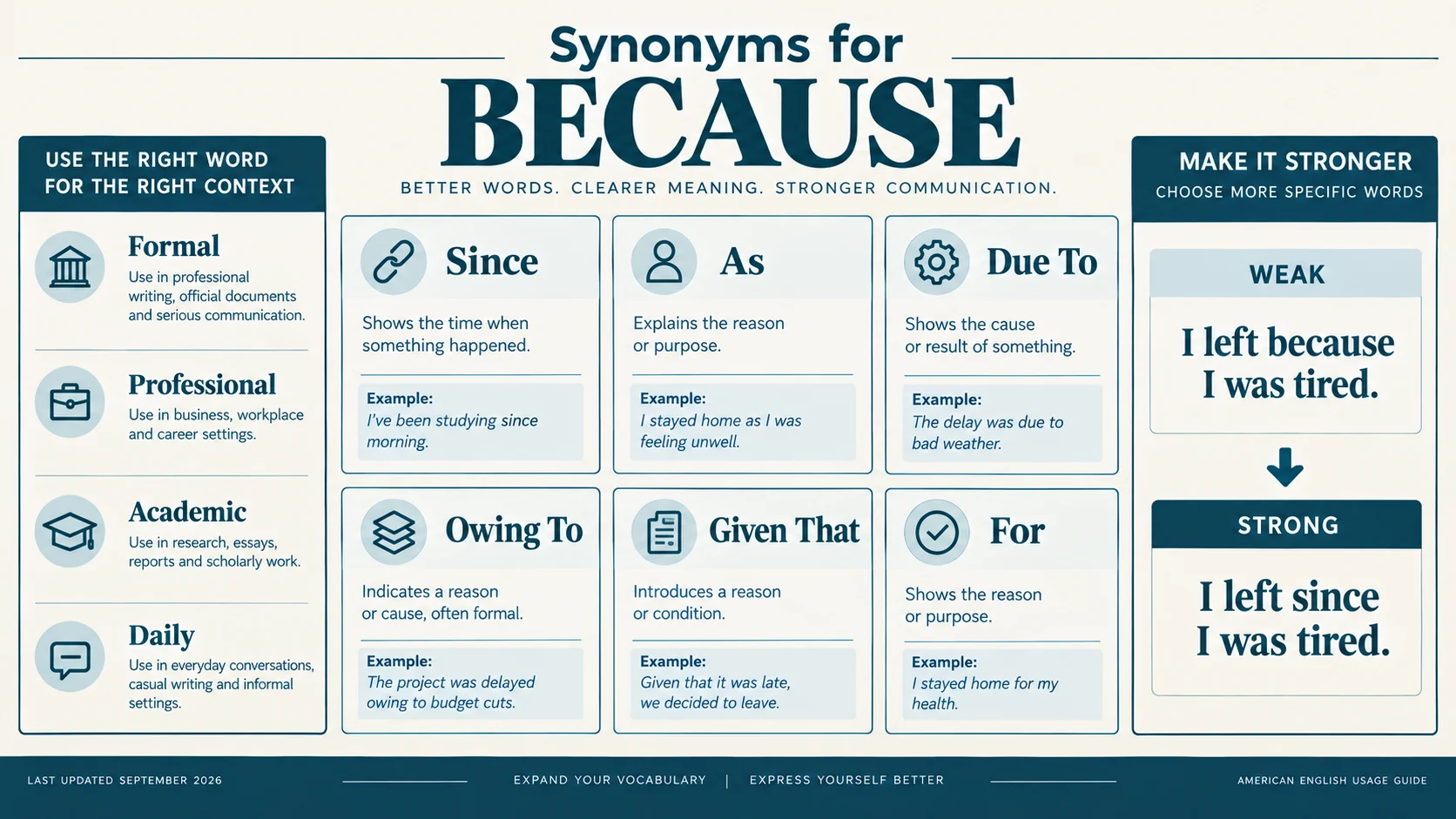
The best synonym for because depends on your sentence structure. For formal writing, use since, as, or given that. For cause-and-effect emphasis, choose due to or owing to. For academic writing, as a result of or owing to the fact that work well. In casual conversation, ’cause or since feel natural.
What Does Because Mean?
Definition
Because is a subordinating conjunction that introduces a reason or cause. It connects an effect to its explanation, answering the question “why?” When you say “I stayed home because it was raining,” you’re linking an action to its cause.
The word has been part of English since the 14th century, evolving from the phrase “by cause” (meaning “by reason of”). It remains one of the most common connectors in American English, which is precisely why writers seek alternatives repetition weakens prose.
Common Uses
| Usage Type | Meaning | Example |
|---|---|---|
| Cause and effect | Explains why something happened | “She left early because she felt sick.” |
| Justification | Provides a reason for a decision | “We chose this option because it costs less.” |
| Emphasis | Highlights a key reason | “I love this city because of its people.” |
| Negative reason | Explains why not | “He didn’t call because he lost his phone.” |
The word works in every register of English. You’ll find it in casual texts, business emails, academic papers, and legal documents. That versatility makes it indispensable, but also overused.
Best Synonyms for Because
| Synonym | Meaning | Best Used When | Example |
|---|---|---|---|
| Since | For the reason that | The reason is already known | “Since you’re here, let’s begin.” |
| As | Because, for the reason that | Formal or literary contexts | “As it was raining, we stayed inside.” |
| Due to | As a result of | Noun phrases and formal writing | “The delay was due to heavy traffic.” |
| Owing to | Because of | Formal British and academic writing | “Owing to budget cuts, the program ended.” |
| Given that | Considering the fact that | Logical reasoning and arguments | “Given that demand is rising, we should expand.” |
| Because of | By reason of | Noun phrases, casual and formal | “The game was canceled because of rain.” |
| For | Because, since | Literary and formal writing | “She wept, for she was overcome with joy.” |
| In that | Because, in the sense that | Precise academic explanation | “The plan succeeded in that it saved money.” |
| Now that | Since, given the current situation | Referring to changed circumstances | “Now that you mention it, I agree.” |
| Seeing that | Considering that | Informal reasoning | “Seeing that you’re free, let’s grab lunch.” |
Synonyms by Context
Formal Writing
Formal writing favors precise connectors. Since, as, and given that all carry authority without sounding casual.
| Word | Example |
|---|---|
| Since | “Since the evidence is inconclusive, further study is warranted.” |
| As | “As the deadline approaches, we must prioritize.” |
| Given that | “Given that resources are limited, we must choose carefully.” |
| Owing to | “Owing to unforeseen circumstances, the event was postponed.” |
| Inasmuch as | “Inasmuch as the contract was breached, legal action may follow.” |
Professional Writing
In business communication, clarity matters most. Due to, because of, and as a result of keep messages direct and professional.
| Word | Example |
|---|---|
| Due to | “The shipment was delayed due to a supplier issue.” |
| Because of | “Because of your efforts, we exceeded our target.” |
| As a result of | “As a result of the audit, we revised our procedures.” |
| Given | “Given the timeline, we need additional resources.” |
| Since | “Since you raised the concern, we’ve implemented changes.” |
Academic Writing
Academic writing demands precision and variety. Avoid repeating “because” and use these formal alternatives.
| Word | Example |
|---|---|
| Owing to | “Owing to methodological limitations, the findings are preliminary.” |
| In that | “The model is useful in that it predicts long-term trends.” |
| As a consequence of | “As a consequence of deregulation, competition increased.” |
| For the reason that | “The hypothesis was rejected for the reason that data contradicted it.” |
| Given that | “Given that the sample was small, caution is advised.” |
Daily Conversation
In everyday speech, contractions and simple connectors feel natural.
| Word | Example |
|---|---|
| ‘Cause | “I’m late ’cause traffic was terrible.” |
| Since | “Since you’re going out, grab some milk.” |
| Seeing that | “Seeing that it’s late, let’s call it a night.” |
Professional Alternatives for Because
When writing resumes, emails, or reports, replace “because” with stronger connectors:
| Word | Best For | Example |
|---|---|---|
| Due to | Reports and emails | “Revenue increased due to improved retention.” |
| As a result of | Business writing | “As a result of the merger, operations expanded.” |
| Given | Proposals and analysis | “Given the market shift, we recommend a new strategy.” |
| Since | Professional emails | “Since the client approved, we can proceed.” |
| Owing to | Formal business documents | “Owing to increased demand, we extended hours.” |
Simple Alternatives
If you want a plainer, more conversational word:
| Simple Word | Example |
|---|---|
| Since | “Since you asked, I’ll explain.” |
| As | “As it’s raining, bring an umbrella.” |
| So | “It was late, so we left.” |
Note that so reverses the structure: it introduces the effect, not the cause.
Stronger Alternatives
When you need emphasis or formal weight:
| Strong Word | Example |
|---|---|
| Inasmuch as | “Inasmuch as the terms were unclear, we sought legal advice.” |
| For | “He resigned, for he could no longer support the policy.” |
| On account of | “On account of the storm, all flights were grounded.” |
| By reason of | “By reason of his experience, he was chosen to lead.” |
Difference Between Similar Synonyms
Understanding nuance separates competent writing from excellent writing.
Because vs. Since: Both introduce reasons, but “since” often implies the reason is already known or less central. “Because” emphasizes cause more strongly. Compare: “Since you’re here, let’s start” (reason is obvious) versus “We started because you arrived” (cause emphasized).
Because vs. As: “As” is more formal and often appears at the start of a sentence. It can also mean “while,” which creates ambiguity. “As it rained, we stayed in” works, but “because” is clearer.
Because vs. Due to: “Due to” is not a conjunction—it follows a noun or verb. “The delay was due to rain” is correct. “Due to it rained” is wrong. Use “because” for clauses and “due to” for noun phrases.
Because vs. Owing to: Nearly identical to “due to,” but “owing to” is more common in British English and formal American writing. Both require noun phrases.
Because vs. Given that: “Given that” introduces a premise rather than a direct cause. It suggests reasoning from known facts. “Given that costs are rising, we should budget more” means the fact of rising costs leads to the conclusion.
Opposite Words
Since “because” introduces causes, its opposites are words that deny causation or introduce contrast.
| Antonym | Meaning | Example |
|---|---|---|
| Despite | In spite of | “Despite the rain, we played.” |
| Although | Even though | “Although he tried, he failed.” |
| However | Nevertheless | “It was late; however, we continued.” |
| Regardless | Without considering | “Regardless of cost, we proceeded.” |
| Even so | Nevertheless | “It was risky; even so, she agreed.” |
FAQs
What is another word for because?
Since, as, due to, owing to, and given that are the most common replacements. Choose based on formality and sentence structure.
What is a formal synonym for because?
Owing to, inasmuch as, for the reason that, and as a consequence of are the most formal options.
What is a professional alternative for because?
Due to, as a result of, and given work best in business writing.
What word can replace because in a sentence?
| Original | Replacement |
|---|---|
| “I left because I was tired.” | “I left since I was tired.” |
| “It failed because of poor planning.” | “It failed due to poor planning.” |
| “She smiled because she was happy.” | “She smiled, for she was happy.” |
Can I start a sentence with because?
Yes, in informal and modern writing. “Because it was raining, we stayed inside” is grammatically correct. Some traditional style guides discourage it in formal writing, but modern usage accepts it.
Is because of one word or two?
“Because of” is two words. It functions as a prepositional phrase, not a conjunction.
Conclusion
Because is one of the most useful words in English, but its frequency makes it easy to overuse. Varying your connectors improves rhythm and clarity. For formal writing, reach for since, as, or owing to. In business contexts, due to and as a result of are reliable. For academic work, in that and given that add precision. And in casual conversation, ’cause or since keep things natural.
Match your connector to your sentence structure. Use “because” for clauses, “due to” for noun phrases, and “given that” for logical premises. That attention to detail is what separates polished writing from prose that merely gets the job done.