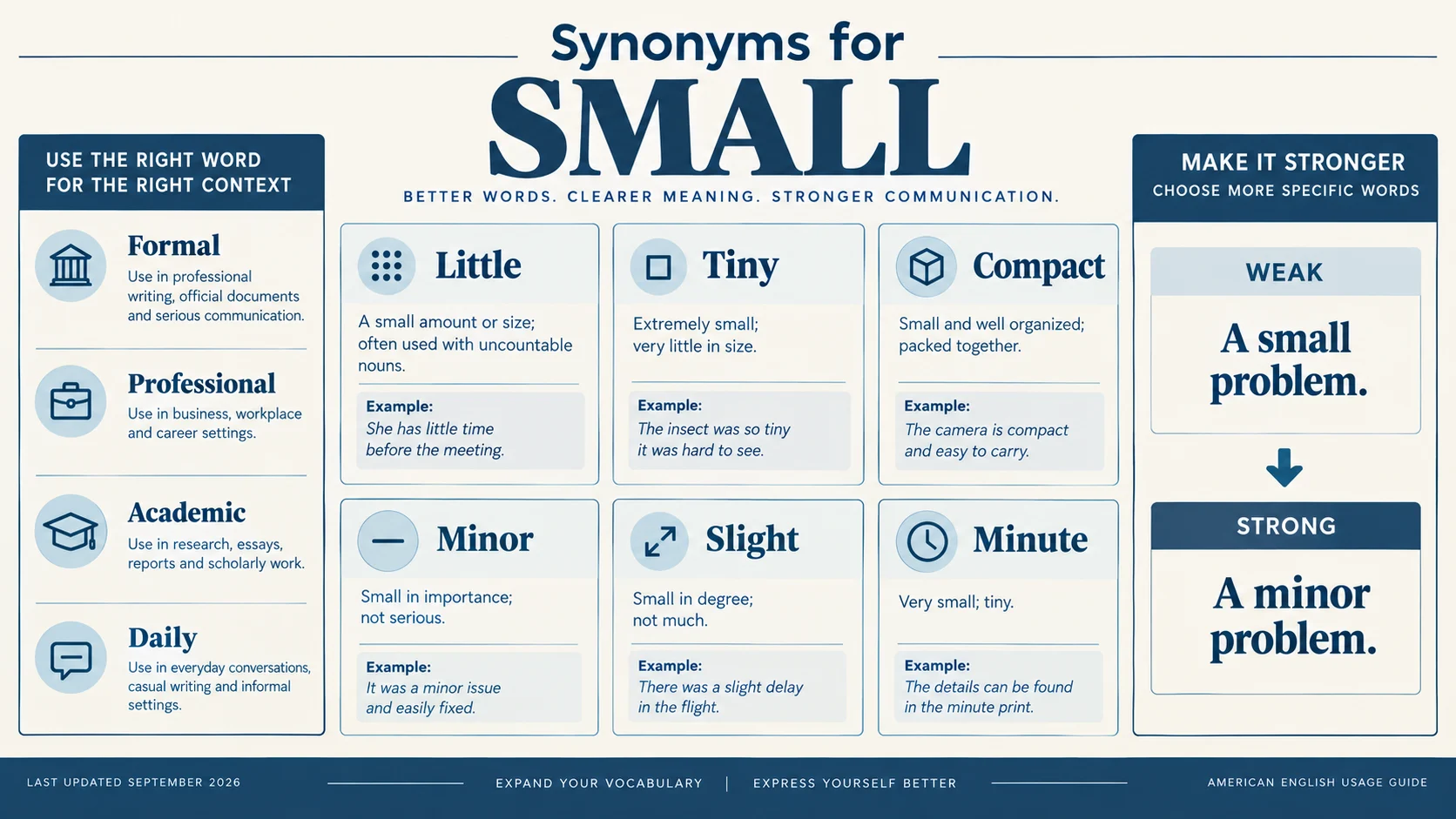
The best synonym for small depends on what you’re describing. For size, use little, tiny, or compact. For amount, choose minor, slight, or modest. For importance, minor or insignificant fit best. In formal writing, minute, diminutive, or negligible add precision.
What Does Small Mean?
Definition
Small is an adjective describing something limited in size, amount, degree, or importance. It applies to physical dimensions, quantities, significance, and even sound. The word comes from Old English smæl, meaning slender or narrow, and has been part of English for over a thousand years.
Small carries no inherent judgment. A small business can be thriving. A small detail can be critical. Context determines whether small suggests modesty, insignificance, or simple measurement.
Common Uses
| Usage Type | Meaning | Example |
|---|---|---|
| Physical size | Limited dimensions | “She lives in a small apartment.” |
| Quantity | Low amount | “Only a small number applied.” |
| Importance | Minor significance | “It was a small mistake.” |
| Degree | Slight intensity | “There was a small improvement.” |
| Sound | Quiet volume | “He spoke in a small voice.” |
Best Synonyms for Small
| Synonym | Meaning | Best Used When | Example |
|---|---|---|---|
| Little | Small in size or amount | Everyday description, often affectionate | “A little dog ran across the yard.” |
| Tiny | Extremely small | Emphasizing miniature size | “A tiny insect landed on the leaf.” |
| Compact | Small but efficiently arranged | Products, cars, living spaces | “The compact car fits easily in tight spots.” |
| Miniature | Much smaller than normal | Models, replicas, versions | “She collects miniature furniture.” |
| Minute | Extremely small | Formal or technical writing | “The difference was minute but measurable.” |
| Minor | Low in importance | Problems, issues, changes | “We fixed a few minor errors.” |
| Slight | Small in degree | Changes, differences, movements | “There was a slight delay.” |
| Modest | Moderate, not large | Amounts, homes, success | “They live in a modest house.” |
| Diminutive | Very small | Formal description of size | “The diminutive statue sat on the shelf.” |
| Negligible | Too small to matter | Technical or analytical contexts | “The impact was negligible.” |
Synonyms by Context
Formal Writing
Formal writing favors precision over casual description.
| Word | Example |
|---|---|
| Minute | “The committee noted a minute discrepancy in the records.” |
| Diminutive | “The diminutive structure stood at the edge of the property.” |
| Modest | “The organization operates on a modest budget.” |
| Slight | “There was a slight increase in applications.” |
| Marginal | “The improvement was marginal at best.” |
Professional Writing
Business and workplace communication needs words that sound measured and credible.
| Word | Example |
|---|---|
| Minor | “We encountered minor delays during implementation.” |
| Modest | “The team achieved modest but steady growth.” |
| Limited | “We have limited space for additional vendors.” |
| Compact | “The compact design saves valuable office space.” |
| Negligible | “The cost difference is negligible.” |
Academic Writing
Academic writing demands precision. Avoid casual words like tiny or little.
| Word | Example |
|---|---|
| Minute | “The sample showed minute variations across trials.” |
| Negligible | “The effect size was negligible.” |
| Marginal | “The correlation was marginal and not statistically significant.” |
| Slight | “A slight deviation was observed in the control group.” |
| Diminutive | “The diminutive specimen measured under two centimeters.” |
Daily Conversation
Everyday speech allows warmth and simplicity.
| Word | Example |
|---|---|
| Little | “We have a little time before the movie starts.” |
| Tiny | “Their apartment is tiny but cozy.” |
| Itsy-bitsy | “There’s an itsy-bitsy spider on the wall.” |
| Pint-sized | “He’s pint-sized but full of energy.” |
| Teeny | “Just a teeny bit more sugar, please.” |
Professional Alternatives for Resume and Business Writing
In resumes and business documents, small sounds weak. Use stronger replacements:
| Word | Example Sentence |
|---|---|
| Minor | “Resolved minor technical issues without escalation.” |
| Modest | “Managed a modest budget with full accountability.” |
| Limited | “Worked with limited resources to meet tight deadlines.” |
| Focused | “Led a focused team of five specialists.” |
| Niche | “Built a niche practice serving local clients.” |
Simple Alternatives
When you need a plain, easy word:
| Simple Word | Example |
|---|---|
| Little | “A little problem came up.” |
| Tiny | “The room was tiny.” |
| Short | “It was a short meeting.” |
| Light | “A light rain fell all afternoon.” |
| Low | “Sales were low this month.” |
Stronger Alternatives
When you need to emphasize extreme smallness:
| Strong Word | Example |
|---|---|
| Minuscule | “The error was minuscule.” |
| Microscopic | “The cracks were microscopic.” |
| Negligible | “The difference was negligible.” |
| Infinitesimal | “The risk was infinitesimal.” |
| Diminutive | “The diminutive figure barely reached the counter.” |
Difference Between Similar Synonyms
Small vs. Little: Small measures size objectively. Little adds emotional warmth or affection. “A small house” is a factual description. “A little house” sounds fond or charming.
Small vs. Tiny: Tiny means extremely small. Small is neutral; tiny is emphatic. A small dog could weigh twenty pounds. A tiny dog fits in a handbag.
Small vs. Minor: Small describes size. Minor describes importance. A small problem may still matter. A minor problem does not.
Small vs. Compact: Compact implies efficient use of space. A compact car is small but designed well. A small car is simply not large.
Small vs. Minute: Minute (pronounced my-NOOT) means extremely small and often appears in technical writing. Small is general.
Opposite Words
| Antonym | Meaning | Example |
|---|---|---|
| Large | Big in size | “They bought a large house.” |
| Huge | Extremely big | “The crowd was huge.” |
| Enormous | Very large | “An enormous wave hit the shore.” |
| Massive | Imposing size | “The massive bridge spans the river.” |
| Significant | Important in degree | “The change was significant.” |
| Substantial | Considerable in amount | “They made a substantial profit.” |
FAQs
What is another word for small?
Little, tiny, compact, minor, and slight are common replacements. Choose based on whether you mean size, amount, or importance.
What is a formal synonym for small?
Minute, diminutive, modest, and negligible suit formal writing best.
What is a professional alternative for small?
Minor, modest, limited, and focused work well in business and resume writing.
What word can replace small in a sentence?
| Original | Replacement |
|---|---|
| “A small problem.” | “A minor problem.” |
| “A small apartment.” | “A compact apartment.” |
| “A small change.” | “A slight change.” |
| “A small business.” | “A modest business.” |
Is small a formal word?
Small is neutral and acceptable in most contexts, but in academic and technical writing, minute or negligible add precision.
What is a stronger word than small?
Minuscule, microscopic, and infinitesimal are stronger alternatives that emphasize extreme smallness.
Conclusion
Small is a workhorse word, but it rarely carries the precision that strong writing demands. Whether you’re describing a physical object, an amount, or a level of importance, the right synonym sharpens your meaning. For formal writing, choose minute or diminutive. For professional contexts, minor and modest sound credible. In daily conversation, little and tiny feel natural. And when you need emphasis, minuscule or microscopic deliver real impact.
Match the word to your audience, and your writing will be clearer and more effective.