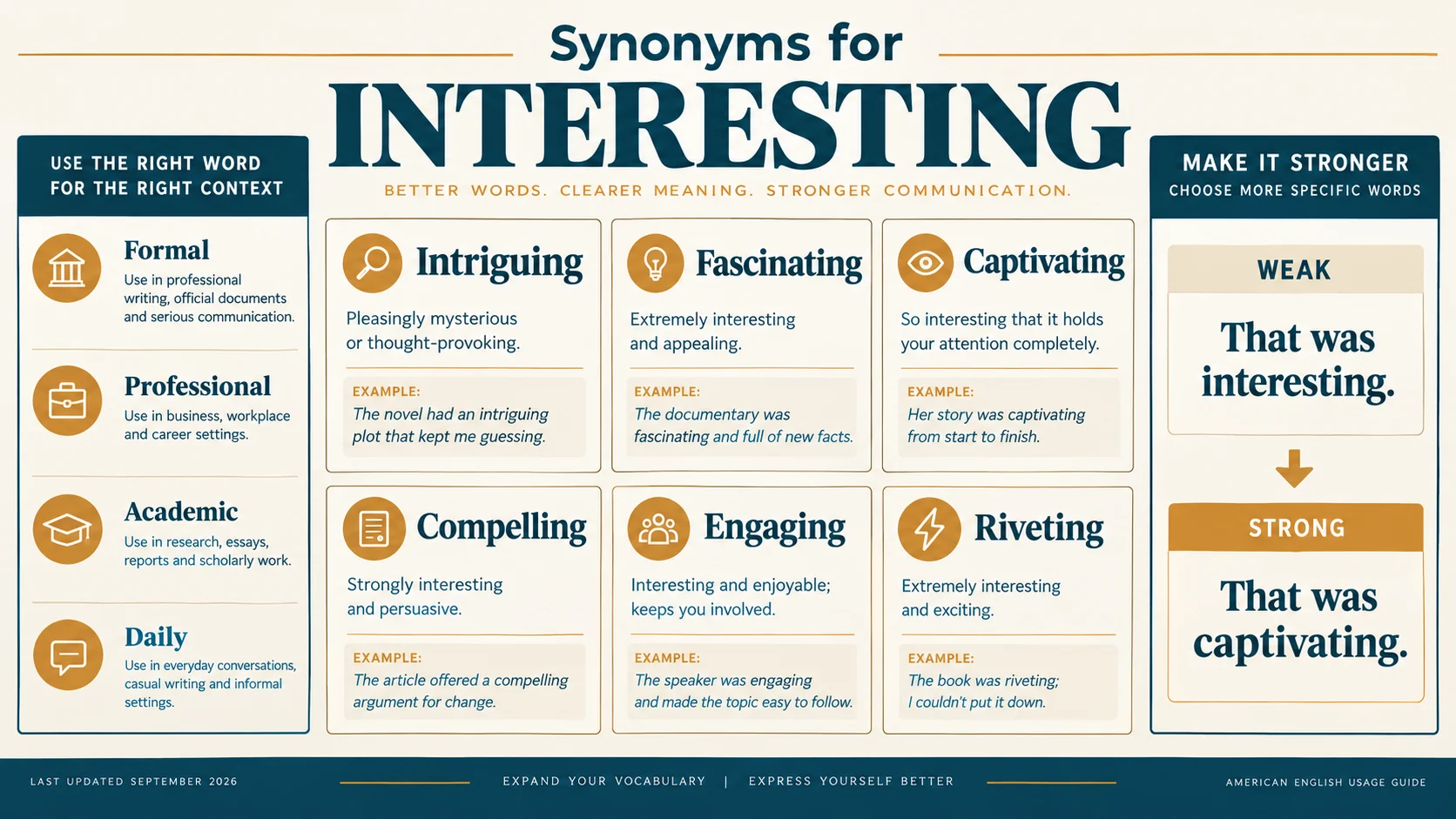
The best synonym for interesting depends on what you’re describing. For something that grabs attention, use intriguing or captivating. For intellectual appeal, fascinating or compelling work best. In formal writing, choose noteworthy or significant. For casual conversation, cool or engaging feel natural.
What Does Interesting Mean?
Definition
Interesting is an adjective that describes something holding your attention, sparking curiosity, or engaging your mind. The word suggests a moderate level of attraction. It does not imply excitement like “thrilling” or beauty like “beautiful.” Instead, it points to mental engagement. Something interesting makes you want to know more.
The word comes from the Latin “interesse,” meaning to be between or to make a difference. That root survives in the modern sense. Something interesting sits between the ordinary and the extraordinary. It makes a difference to your attention.
Common Uses
| Usage Type | Meaning | Example |
|---|---|---|
| Ideas | Thought-provoking | “She shared an interesting theory.” |
| People | Engaging personality | “He is an interesting person to talk to.” |
| Events | Worth attending | “The conference had several interesting sessions.” |
| Books and media | Holds attention | “It was an interesting read.” |
| News | Noteworthy | “There was an interesting development today.” |
The word appears everywhere, from casual chats to academic papers. Its flexibility is both a strength and a weakness. Because it covers so much ground, it often feels vague. That vagueness is exactly why writers search for sharper alternatives.
Best Synonyms for Interesting
| Synonym | Meaning | Best Used When | Example |
|---|---|---|---|
| Intriguing | Arouses curiosity | Something mysterious or unusual | “She made an intriguing proposal.” |
| Fascinating | Extremely interesting | Deep, sustained attention | “The documentary was fascinating.” |
| Captivating | Holds attention completely | Something hard to look away from | “The speaker gave a captivating talk.” |
| Compelling | Convincing and engaging | Arguments, stories, evidence | “He presented a compelling case.” |
| Engaging | Draws you in | People, writing, activities | “The teacher made the lesson engaging.” |
| Absorbing | Takes all your attention | Books, tasks, experiences | “It was an absorbing novel.” |
| Stimulating | Arouses thought | Discussions, ideas, environments | “We had a stimulating conversation.” |
| Noteworthy | Worth attention | Formal observations | “There was a noteworthy shift in policy.” |
| Provocative | Sparks strong thought | Ideas that challenge | “She asked a provocative question.” |
| Riveting | Completely engrossing | Stories, performances | “The final chapter was riveting.” |
Synonyms by Context
Formal Writing
Formal writing favors measured, precise language. Words like noteworthy, significant, and compelling carry weight without sounding casual.
| Word | Example |
|---|---|
| Noteworthy | “The report highlighted several noteworthy trends.” |
| Significant | “This marks a significant shift in policy.” |
| Compelling | “The author makes a compelling argument.” |
| Salient | “We should focus on the salient points.” |
| Pertinent | “That raises a pertinent question.” |
Professional Writing
In business settings, choose words that convey genuine value. Compelling, valuable, and relevant work well in emails, reports, and proposals.
| Word | Example |
|---|---|
| Compelling | “We have a compelling offer for your consideration.” |
| Valuable | “This was a valuable discussion for the team.” |
| Relevant | “The data is highly relevant to our strategy.” |
| Insightful | “She provided insightful feedback.” |
| Noteworthy | “We want to flag a noteworthy development.” |
Academic Writing
Academic writing avoids emotional language. Use measured terms that describe intellectual merit without exaggeration.
| Word | Example |
|---|---|
| Significant | “The study produced significant findings.” |
| Noteworthy | “There was a noteworthy correlation between the variables.” |
| Salient | “The salient feature of the data is its consistency.” |
| Pertinent | “This is pertinent to the broader debate.” |
| Substantive | “The paper offers a substantive contribution.” |
Daily Conversation
In everyday speech, you have the most freedom. These natural alternatives keep things lively:
| Word | Example |
|---|---|
| Cool | “That’s a cool idea.” |
| Neat | “I learned something neat today.” |
| Fascinating | “That’s fascinating, tell me more.” |
| Wild | “That’s a wild story.” |
| Curious | “That’s a curious detail.” |
Professional Alternatives for Resume and Business Writing
When writing a resume or professional document, interesting is too vague. Use these instead:
| Word | Example Sentence |
|---|---|
| Compelling | “Developed compelling marketing copy that drove engagement.” |
| Insightful | “Delivered insightful analysis that shaped company strategy.” |
| Valuable | “Led valuable cross-functional initiatives.” |
| Relevant | “Curated relevant industry research for leadership.” |
| Impactful | “Produced impactful presentations for key stakeholders.” |
Simple Alternatives
If you want a clearer, more accessible word:
| Simple Word | Example |
|---|---|
| Cool | “That was a cool discovery.” |
| Neat | “What a neat little trick.” |
| Fun | “It was a fun lecture.” |
| Good | “That’s a good question.” |
| Nice | “That’s a nice detail.” |
Stronger Alternatives
When you need real impact, reach for these:
| Strong Word | Example |
|---|---|
| Riveting | “The memoir was absolutely riveting.” |
| Gripping | “It was a gripping account of survival.” |
| Spellbinding | “Her performance was spellbinding.” |
| Mesmerizing | “The visuals were mesmerizing.” |
| Enthralling | “The series was utterly enthralling.” |
| Absorbing | “The game was completely absorbing.” |
Difference Between Similar Synonyms
Understanding nuance separates good writing from great writing. Here is how the closest synonyms differ.
Interesting vs. Fascinating: Interesting suggests moderate attention. Fascinating suggests deep, sustained attention. An interesting article holds your attention for a few minutes. A fascinating article keeps you reading for hours.
Interesting vs. Intriguing: Interesting is broad and neutral. Intriguing adds a hint of mystery or curiosity. Something intriguing makes you want to investigate. Something interesting simply holds your attention.
Interesting vs. Engaging: Interesting describes the quality of the thing. Engaging describes its effect on you. A lecture can be interesting in content but not engaging in delivery. Engaging implies active participation.
Interesting vs. Compelling: Compelling suggests you cannot look away or disagree. It carries a sense of force. Interesting is milder. A compelling argument convinces you. An interesting argument makes you think.
Interesting vs. Captivating: Captivating implies charm and hold. It suggests something takes you prisoner in a pleasant way. Interesting is broader and less intense.
Opposite Words
| Antonym | Meaning | Example |
|---|---|---|
| Boring | Dull, no attention | “The lecture was boring.” |
| Dull | Lacking interest | “It was a dull afternoon.” |
| Tedious | Tiresome and long | “The process was tedious.” |
| Monotonous | Repetitive and flat | “The work felt monotonous.” |
| Uninteresting | Not worth attention | “The topic was uninteresting.” |
| Bland | Flat and uninspiring | “The presentation was bland.” |
FAQs
What is another word for interesting?
Intriguing, fascinating, captivating, compelling, and engaging are all strong replacements. Choose based on context and tone.
What is a formal synonym for interesting?
Noteworthy, significant, compelling, and salient work best in formal writing.
What is a professional alternative for interesting?
Compelling, insightful, valuable, and relevant suit professional documents and workplace communication.
What word can replace interesting in a sentence?
| Original | Replacement |
|---|---|
| “That’s an interesting idea.” | “That’s an intriguing idea.” |
| “She gave an interesting talk.” | “She gave a captivating talk.” |
| “It was an interesting book.” | “It was an absorbing book.” |
| “He made an interesting point.” | “He made a compelling point.” |
Is interesting a formal word?
Interesting is acceptable in most contexts but leans neutral. In academic and formal business writing, noteworthy or significant are better choices.
What is a stronger word than interesting?
Riveting, gripping, spellbinding, and mesmerizing all carry more intensity than interesting.
What is the difference between interesting and intriguing?
Interesting holds your attention. Intriguing arouses curiosity and makes you want to investigate further. Intriguing is slightly more active and mysterious.
Conclusion
Interesting is a useful word, but its broadness often makes it feel flat. Whether you are writing a resume, an essay, or a text message, choosing a sharper synonym makes your meaning clearer and your writing more memorable. For formal contexts, use noteworthy or compelling. For professional writing, choose insightful or valuable. In conversation, cool and fascinating feel natural. And when you need maximum impact, reach for riveting or captivating.
The right word depends on your audience and purpose. Match your synonym to your context, and your writing will carry more weight.