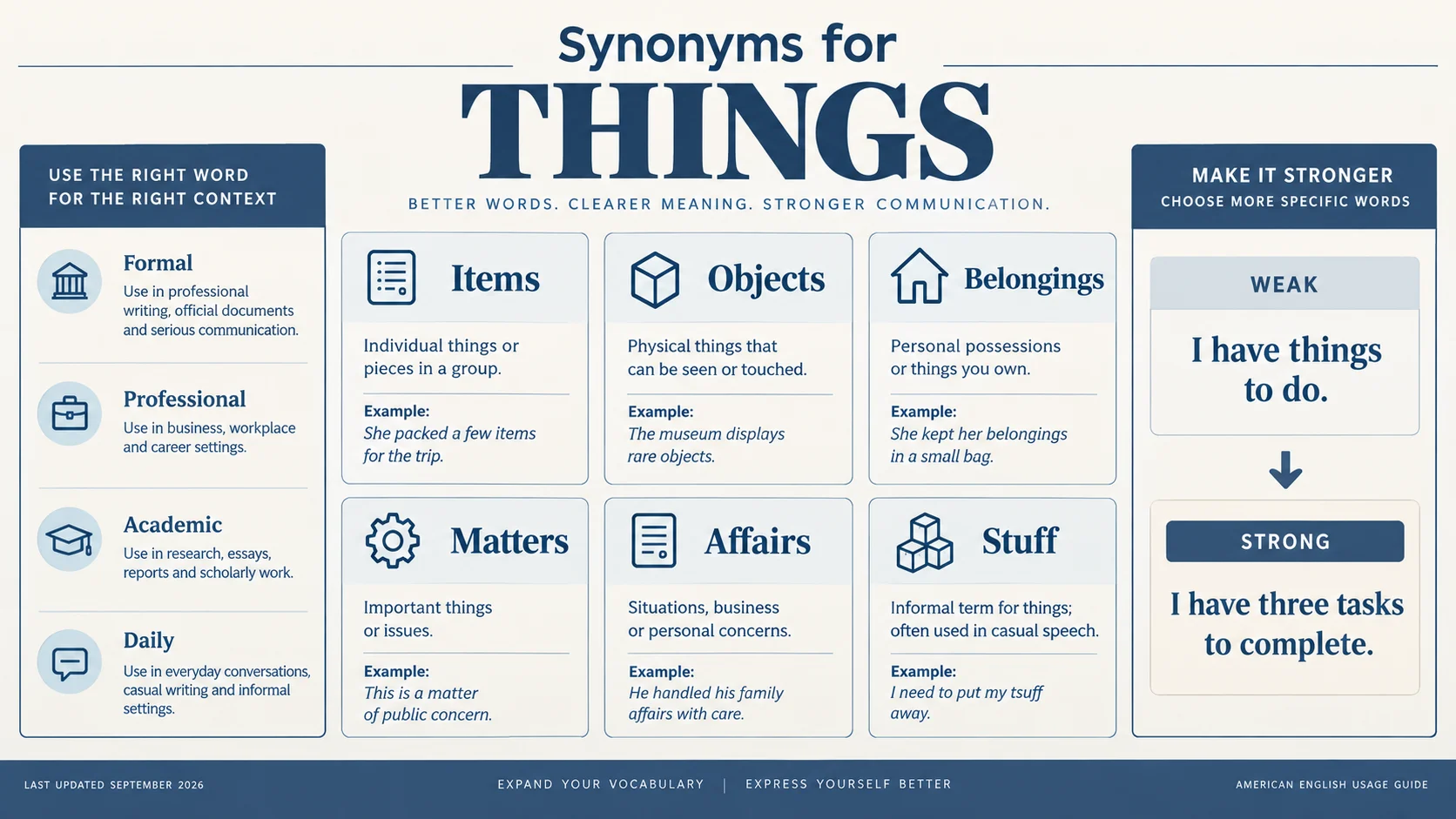
The best synonym for things depends on what you’re referring to. For physical objects, use items, objects, or belongings. For abstract matters, choose matters, issues, or affairs. For personal possessions, belongings or stuff (informal) work best.
What Does Things Mean?
Definition
Things is a broad, flexible noun with several distinct meanings. It refers to physical objects, personal possessions, matters or situations, and events or circumstances. The word is one of the most versatile in English because it covers almost anything you can name.
The problem with “things” is its vagueness. When you write “I have things to do,” the reader learns nothing. Choosing a precise synonym forces clarity and makes writing stronger.
Common Uses
| Usage Type | Meaning | Example |
|---|---|---|
| Physical objects | Tangible items | “Put your things in the car.” |
| Possessions | Personal belongings | “She packed her things.” |
| Situations | Circumstances or matters | “Things are looking up.” |
| Tasks | Activities to complete | “I have things to finish today.” |
| Abstract concepts | Ideas or topics | “We discussed many things.” |
Best Synonyms for Things
| Synonym | Meaning | Best Used When | Example |
|---|---|---|---|
| Items | Individual objects | Listing objects | “Please review the items on the list.” |
| Objects | Physical entities | Describing tangible things | “Strange objects filled the room.” |
| Belongings | Personal possessions | Referring to what someone owns | “She gathered her belongings.” |
| Matters | Topics or situations | Discussing issues | “We have urgent matters to address.” |
| Affairs | Business or personal concerns | Formal contexts | “He manages his affairs carefully.” |
| Stuff | General collection | Informal conversation | “Move your stuff off the table.” |
| Elements | Components or parts | Technical or formal writing | “The key elements of the plan.” |
| Details | Specific facts | Precision matters | “Check the details before signing.” |
| Possessions | Owned items | Formal or legal contexts | “All possessions must be declared.” |
| Circumstances | Conditions or situations | Formal description of events | “Under these circumstances, we agree.” |
Synonyms by Context
Formal Writing
Formal writing avoids vague language. Replace “things” with precise nouns that match your meaning.
| Word | Example |
|---|---|
| Matters | “Several matters require the board’s attention.” |
| Affairs | “The department handles international affairs.” |
| Circumstances | “Under no circumstances should this occur.” |
| Particulars | “Please provide the particulars of the agreement.” |
| Elements | “The proposal contains several problematic elements.” |
Professional Writing
Business writing demands specificity. Vague words like “things” waste your reader’s time.
| Word | Example |
|---|---|
| Items | “Please confirm the items in your order.” |
| Deliverables | “The team completed all deliverables on time.” |
| Priorities | “Let’s align on our top priorities this week.” |
| Metrics | “Review the metrics before the meeting.” |
| Objectives | “We met all quarterly objectives.” |
Academic Writing
Academic writing requires precision above all. “Things” has no place in a research paper.
| Word | Example |
|---|---|
| Variables | “The study controlled for several variables.” |
| Factors | “Multiple factors contributed to the outcome.” |
| Phenomena | “The observed phenomena require explanation.” |
| Components | “The model includes three essential components.” |
| Concepts | “These concepts underpin the theoretical framework.” |
Daily Conversation
In casual speech, “things” is perfectly fine. When you want variety, try these natural alternatives.
| Word | Example |
|---|---|
| Stuff | “I have so much stuff to organize.” |
| Belongings | “Don’t forget your belongings.” |
| Gear | “Pack your camping gear.” |
| Goods | “They sell local goods at the market.” |
Professional Alternatives for Resume and Business Writing
On a resume, “things” is fatal. It tells the reader nothing about your skills. Use action-oriented, specific nouns instead.
| Professional Word | Example Sentence |
|---|---|
| Initiatives | “Led three strategic initiatives that cut costs by 15%.” |
| Deliverables | “Managed all project deliverables within deadline.” |
| Operations | “Oversaw daily operations for a 20-person team.” |
| Assets | “Protected company assets worth $2M.” |
| Resources | “Allocated resources across five departments.” |
| Outcomes | “Delivered measurable outcomes for every client.” |
Simple Alternatives
When you need a plain, clear word:
| Simple Word | Example |
|---|---|
| Items | “Pack these items first.” |
| Objects | “Move those objects aside.” |
| Stuff | “Grab your stuff.” |
| Goods | “The goods arrived on time.” |
| Bits | “Pick up the little bits.” |
Stronger Alternatives
When you need precision and impact:
| Strong Word | Example |
|---|---|
| Particulars | “The particulars of the case remain unclear.” |
| Specifics | “Give me the specifics.” |
| Fundamentals | “Focus on the fundamentals first.” |
| Essentials | “Pack only the essentials.” |
| Components | “Each component must be tested.” |
Difference Between Similar Synonyms
Understanding nuance helps you choose the right word.
Things vs. Items: Items implies a countable, organized set. Things is vague. Use items when listing or categorizing.
Things vs. Stuff: Stuff is informal and uncountable. Things works in both formal and casual contexts. Never use stuff in professional writing.
Things vs. Belongings: Belongings refers only to personal possessions. Things is broader and can include tasks, ideas, or situations.
Things vs. Matters: Matters refers to issues or topics, not physical objects. Use matters when discussing business, legal, or personal concerns.
Things vs. Elements: Elements refers to parts of a whole. Use it in technical, scientific, or structured contexts.
Opposite Words
| Antonym | Meaning | Example |
|---|---|---|
| Nothing | Absence of anything | “There was nothing left.” |
| Void | Empty space | “The room was a void.” |
| Abstractions | Non-physical concepts | “We dealt only in abstractions.” |
| Concepts | Ideas, not objects | “The discussion stayed on concepts.” |
Note that “things” has few true opposites because it is so broad. The best antonyms depend on which meaning you intend.
FAQs
What is another word for things?
Items, objects, belongings, matters, and stuff are the most common alternatives. Choose based on whether you mean physical objects, possessions, or abstract concerns.
What is a formal synonym for things?
Matters, affairs, circumstances, and particulars work best in formal writing.
What is a professional alternative for things?
Deliverables, initiatives, priorities, assets, and outcomes suit professional documents and resumes.
What word can replace things in a sentence?
| Original | Replacement |
|---|---|
| “Put your things here.” | “Put your belongings here.” |
| “We discussed many things.” | “We discussed many matters.” |
| “I have things to do.” | “I have tasks to complete.” |
| “Those things are expensive.” | “Those items are expensive.” |
Is things a formal word?
No. “Things” is informal and vague. In formal, academic, or professional writing, replace it with a precise noun.
Why should I avoid the word things?
Because it is vague. “Things” forces your reader to guess your meaning. Precise nouns make writing clearer, stronger, and more credible.
Conclusion
Things is one of the most overused words in English. It works in casual conversation, but in writing that matters, it weakens your message. For physical objects, use items or objects. For possessions, choose belongings. For abstract concerns, use matters, affairs, or circumstances. On a resume, always replace it with specific, action-oriented nouns like initiatives or deliverables.
The right synonym depends entirely on what you actually mean. Choose the precise word, and your writing instantly becomes clearer and more professional.