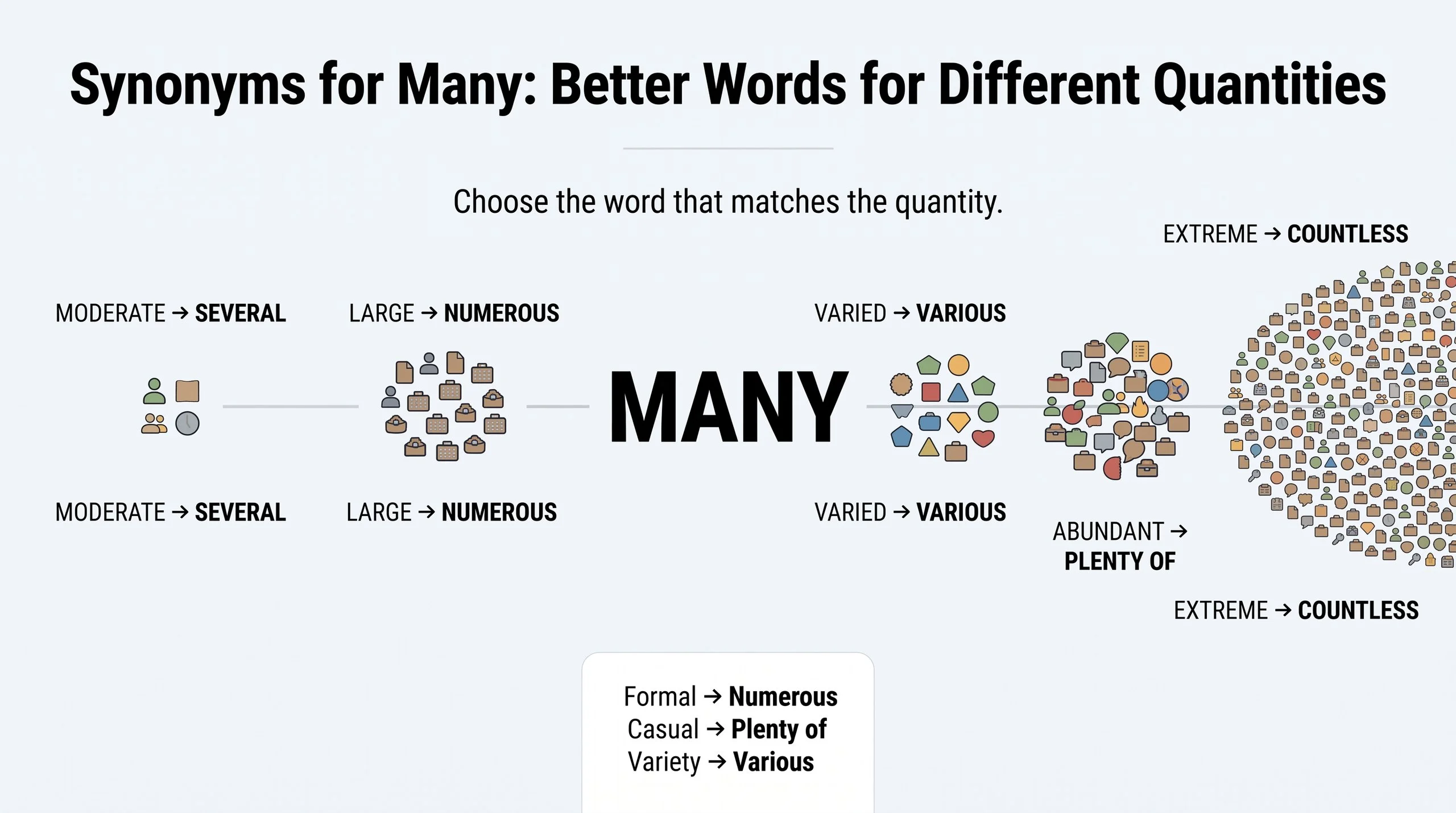
The best synonyms for many include numerous, several, countless, multiple, plenty of, a great number of, a large number of, various, abundant, numerous, and a multitude of. However, the best alternative depends on whether you mean a large number, an unspecified amount, a wide variety, or an extremely high quantity.
The word many is one of the most common ways to describe a large number of people, objects, ideas, or events. While it is useful in everyday English, repeated use can make writing feel basic or repetitive. Fortunately, several precise alternatives can help you communicate quantity more effectively.
For example, numerous works well in formal writing, while plenty of sounds natural in conversation. Similarly, several suggests more than two but usually not a very large number. Meanwhile, countless emphasizes an extremely large or seemingly unmeasurable number.
Therefore, choosing the right synonym for many depends on the quantity, tone, and context you want to express.
What Does “Many” Mean?
Many is a determiner or pronoun used with countable plural nouns to indicate a large or unspecified number.
Examples include:
- many people
- many books
- many opportunities
- many reasons
- many questions
The exact quantity remains unspecified. As a result, many can describe anything from a moderately large number to a very large number, depending on context.
Best Synonyms for Many
| Synonym | Meaning | Tone | Difficulty | Frequency | Best For |
|---|---|---|---|---|---|
| Numerous | A large number | Formal | Easy | Very Common | Essays & reports |
| Several | More than two, but not many | Neutral | Easy | Very Common | General writing |
| Multiple | More than one | Neutral | Easy | Very Common | Business & technical |
| Countless | Too many to count | Strong | Easy | Common | Descriptive writing |
| Plenty of | More than enough | Casual | Easy | Very Common | Conversation |
| Various | Several different types | Neutral | Easy | Very Common | General writing |
| A multitude of | A very large number | Formal | Medium | Common | Essays |
| A great number of | A large quantity | Formal | Easy | Common | Academic writing |
| A large number of | Many | Neutral/Formal | Easy | Very Common | General writing |
| A wide range of | Many different types | Neutral | Easy | Very Common | Business & academic |
| A host of | Many | Formal | Medium | Common | Professional writing |
| Scores of | Many groups of twenty | Literary | Medium | Less Common | Descriptive writing |
| A wealth of | A large amount of valuable things | Formal | Medium | Common | Ideas/resources |
| Abundant | Existing in large quantities | Formal | Medium | Common | Resources |
| Ample | More than enough | Formal | Medium | Common | Resources/time |
| Loads of | A lot of | Casual | Easy | Common | Conversation |
| Tons of | A very large amount | Casual | Easy | Very Common | Informal writing |
| A bunch of | A group or large amount | Casual | Easy | Very Common | Conversation |
| Countless numbers of | Extremely many | Strong | Easy | Less Common | Emphasis |
| A multitude of | A very large collection | Formal | Medium | Common | Academic writing |
1. Numerous
Numerous is one of the closest formal synonyms for many. It means a large number of people or things.
Examples:
- Numerous studies support the finding.
- The company received numerous applications.
- She has written numerous articles.
Because it sounds polished, numerous works especially well in academic, professional, and formal writing.
2. Several
Several means more than two but usually less than a large or indefinite number.
For example:
- I have several questions.
- We visited several cities.
- Several employees attended the meeting.
However, several does not necessarily mean “a very large number.” Therefore, it is useful when you want to suggest a moderate quantity.
3. Multiple
Multiple means more than one.
Examples:
- The system has multiple features.
- She received multiple offers.
- The report identifies multiple causes.
Unlike many, multiple does not always imply a large number. It simply emphasizes that more than one exists.
4. Countless
Countless describes something so numerous that counting it would be difficult or impossible.
Examples:
- She has helped countless people.
- The internet offers countless opportunities.
- Countless stars filled the sky.
As a result, countless is stronger and more expressive than ordinary many.
5. Plenty of
Plenty of means more than enough.
Examples:
- We have plenty of time.
- There are plenty of options available.
- She has plenty of experience.
This phrase sounds natural and conversational. Therefore, it is especially useful in everyday English.
6. Various
Various means several different types or kinds.
The store sells various products.
Researchers considered various explanations.
Notice the difference: many emphasizes quantity, while various emphasizes differences within the group.
7. A Multitude of
A multitude of means a very large number or collection.
Examples:
- A multitude of factors influenced the decision.
- The website provides a multitude of resources.
- Visitors faced a multitude of choices.
Because it sounds formal, this phrase works well in essays, reports, and professional content.
8. A Great Number of
A great number of is a formal way to emphasize a large quantity.
Examples:
- A great number of students participated.
- A great number of people attended the event.
- A great number of businesses use the platform.
It is particularly useful when you want to emphasize quantity without using an informal phrase.
9. A Large Number of
A large number of is a direct and clear alternative to many.
For example:
A large number of customers preferred the new design.
This phrase is especially useful in reports and analytical writing because it sounds precise and neutral.
10. A Wide Range of
A wide range of means many different types or options.
Examples:
- The store offers a wide range of products.
- The course covers a wide range of topics.
- Customers can choose from a wide range of services.
Therefore, use this phrase when variety matters as much as quantity.
11. A Host of
A host of means many or a large number of people or things.
Examples:
- The decision created a host of new challenges.
- The website contains a host of useful resources.
- The company introduced a host of improvements.
It has a polished tone, although it can sound slightly more literary than many.
12. Scores of
Scores of traditionally means groups of twenty, although it can also simply suggest a large number.
For example:
Scores of fans gathered outside the stadium.
This expression has a somewhat literary or dramatic tone. Consequently, it is less common in everyday modern writing.
13. A Wealth of
A wealth of describes a large amount of something valuable, useful, or desirable.
Examples:
- The report provides a wealth of information.
- She has a wealth of experience.
- The website offers a wealth of resources.
Unlike many, this phrase often carries a positive sense of abundance.
14. Abundant
Abundant means existing in large quantities.
Examples:
- The region has abundant natural resources.
- Fresh water is abundant in the area.
- The website contains abundant information.
This word is especially useful when describing resources, supplies, opportunities, or natural features.
15. Ample
Ample means enough or more than enough.
Examples:
- We have ample time to finish.
- The room provides ample space.
- There is ample evidence to support the claim.
Therefore, ample is not simply a synonym for “many.” It emphasizes sufficiency or abundance.
Synonyms for Many People
When many refers to people, you can use:
- Numerous people
- Several people
- Countless people
- A large number of people
- A multitude of people
- A host of people
- Crowds
- Scores of people
- Large groups
Example
Basic:
Many people attended the event.
Better:
Thousands of people attended the event.
Or, when the exact number is unknown:
A large number of people attended the event.
The best choice depends on whether you know the actual quantity.
Synonyms for Many Things
For objects or items, consider:
- Numerous
- Multiple
- Several
- Countless
- Various
- A multitude of
- A wide range of
- A large number of
Example
The store sells many products.
More precise:
The store sells a wide range of products.
Here, the second version emphasizes variety as well as quantity.
Synonyms for Many Opportunities
Useful alternatives include:
- Numerous opportunities
- Plenty of opportunities
- Countless opportunities
- A wealth of opportunities
- A range of opportunities
- Multiple opportunities
Example
The program offers many opportunities.
Better:
The program offers a wealth of opportunities.
This choice suggests both abundance and value.
Synonyms for Many Reasons
Consider:
- Numerous reasons
- Several reasons
- Multiple reasons
- Various reasons
- A number of reasons
- A multitude of reasons
Example
There are many reasons to learn another language.
More polished:
There are numerous reasons to learn another language.
Formal Synonyms for Many
For essays, reports, and professional writing, consider:
- Numerous
- Multiple
- Several
- A large number of
- A great number of
- A multitude of
- A host of
- A wide range of
- A wealth of
- Various
Example
Basic:
Many studies have examined this issue.
Formal:
Numerous studies have examined this issue.
The second version is concise and professional.
Casual Synonyms for Many
In everyday conversation, natural alternatives include:
- Plenty of
- Lots of
- Loads of
- Tons of
- A bunch of
- A whole lot of
- So many
Example
There are many restaurants nearby.
Casual alternatives include:
There are lots of restaurants nearby.
Or:
There are plenty of restaurants nearby.
However, avoid highly casual expressions in formal academic writing.
Many vs. Numerous
Both words indicate a large number.
Many students attended.
Numerous students attended.
The main difference is tone. Many is neutral and extremely common, while numerous sounds more formal and polished.
Therefore, numerous can be useful when you want to reduce repetition in professional writing.
Many vs. Several
These words describe different quantities.
Many generally suggests a large or unspecified number.
Several usually means more than two but not necessarily a large number.
Compare:
Many people responded.
Several people responded.
The first statement suggests a larger group, while the second suggests a smaller one.
Many vs. Multiple
Multiple simply means more than one.
The report identified multiple causes.
This does not necessarily mean that there were a large number of causes.
By contrast:
The report identified many causes.
Here, the writer emphasizes quantity.
Many vs. Various
The difference is also important.
Many focuses on quantity.
Various focuses on differences.
The company offers many products.
The company offers various products.
The first emphasizes how many products exist. The second emphasizes that the products are different types.
Many vs. Plenty of
Plenty of means more than enough.
We have many options.
We have plenty of options.
The second sentence suggests that the available options are sufficient or abundant.
Before-and-After Examples
Example 1: Academic Writing
Before:
Many studies support this conclusion.
After:
Numerous studies support this conclusion.
Example 2: Business Writing
Before:
Many customers use the service.
After:
A large number of customers use the service.
Example 3: Casual Writing
Before:
There are many things to do.
After:
There are plenty of things to do.
Example 4: Variety
Before:
The store sells many products.
After:
The store sells a wide range of products.
Example 5: Strong Emphasis
Before:
Many people have benefited from the program.
After:
Countless people have benefited from the program.
Use the stronger version only when the context supports that level of emphasis.
Common Mistakes When Using Synonyms for Many
1. Using “Numerous” With Uncountable Nouns
Numerous works with countable plural nouns.
Correct:
Numerous students attended.
For an uncountable noun, use a phrase such as a large amount of or a great deal of.
Correct:
A great deal of information was available.
2. Confusing Many With Much
Use many with countable plural nouns:
many books
many people
many ideas
Use much with uncountable nouns:
much information
much time
much money
3. Using “Several” for Extremely Large Numbers
Several usually suggests a moderate number. Therefore, it may understate the quantity when you mean a very large group.
4. Using “Countless” Without Meaning
Countless creates strong emphasis. Consequently, it should not replace many automatically.
5. Using Casual Phrases in Formal Writing
Expressions such as tons of, loads of, and a bunch of work well in conversation. However, numerous, multiple, or a large number of usually fit formal writing better.
Synonym Analysis: Many
Word: Many
Part of Speech: Determiner / Pronoun
Core Meaning: A large or unspecified number of countable people or things.
Best General Synonyms
Numerous, several, multiple, various, plenty of
Best Formal Alternatives
Numerous, a large number of, a great number of, a multitude of, a host of
Best Casual Alternatives
Plenty of, lots of, loads of, tons of, a bunch of
Best Alternatives for Variety
Various, a wide range of, a selection of
Best Alternatives for Strong Emphasis
Countless, a multitude of, scores of
Best Strategy
First decide whether you want to emphasize quantity, variety, abundance, or sufficiency. Then select the synonym that expresses that specific idea.
Frequently Asked Questions
What is the best synonym for many?
Numerous is one of the closest formal synonyms for many. However, several, multiple, various, plenty of, and countless may be better depending on the context.
What is another word for many?
Common alternatives include numerous, several, multiple, countless, various, plenty of, a large number of, and a multitude of.
What is a formal synonym for many?
Good formal alternatives include numerous, multiple, a large number of, a great number of, a multitude of, and a host of.
What is a casual synonym for many?
In casual English, you can use lots of, plenty of, loads of, tons of, or a bunch of.
Is numerous the same as many?
Yes, both can describe a large number. However, numerous sounds more formal and is often preferred in academic or professional writing.
What is the difference between many and several?
Many generally suggests a large number, while several usually indicates more than two but not necessarily a very large number.
What is the difference between many and various?
Many focuses on quantity, whereas various emphasizes different types or kinds.
Can “many” be used for uncountable nouns?
No. Many normally modifies countable plural nouns. For uncountable nouns, use much, a great deal of, a large amount of, or another suitable expression.
Key Takeaway
The best synonyms for many include numerous, several, multiple, countless, various, plenty of, a large number of, a multitude of, and a wide range of.
However, these words do not all communicate exactly the same idea. Numerous emphasizes a large quantity, several suggests a moderate number, various highlights differences, and plenty of suggests more than enough.
By matching the synonym to your intended meaning, you can make your writing more precise, varied, and natural.
Conclusion
Many is a useful everyday word, but it can become repetitive when used throughout an article, essay, or report. Fortunately, English provides many alternatives that express different shades of quantity and variety.
For formal writing, numerous, multiple, and a large number of are reliable choices. Meanwhile, plenty of, lots of, and loads of work better in casual conversation. When you want to emphasize variety, choose various or a wide range of. If the number is exceptionally large, countless can provide stronger emphasis.
Ultimately, the best replacement is the one that communicates the exact quantity or idea you have in mind.