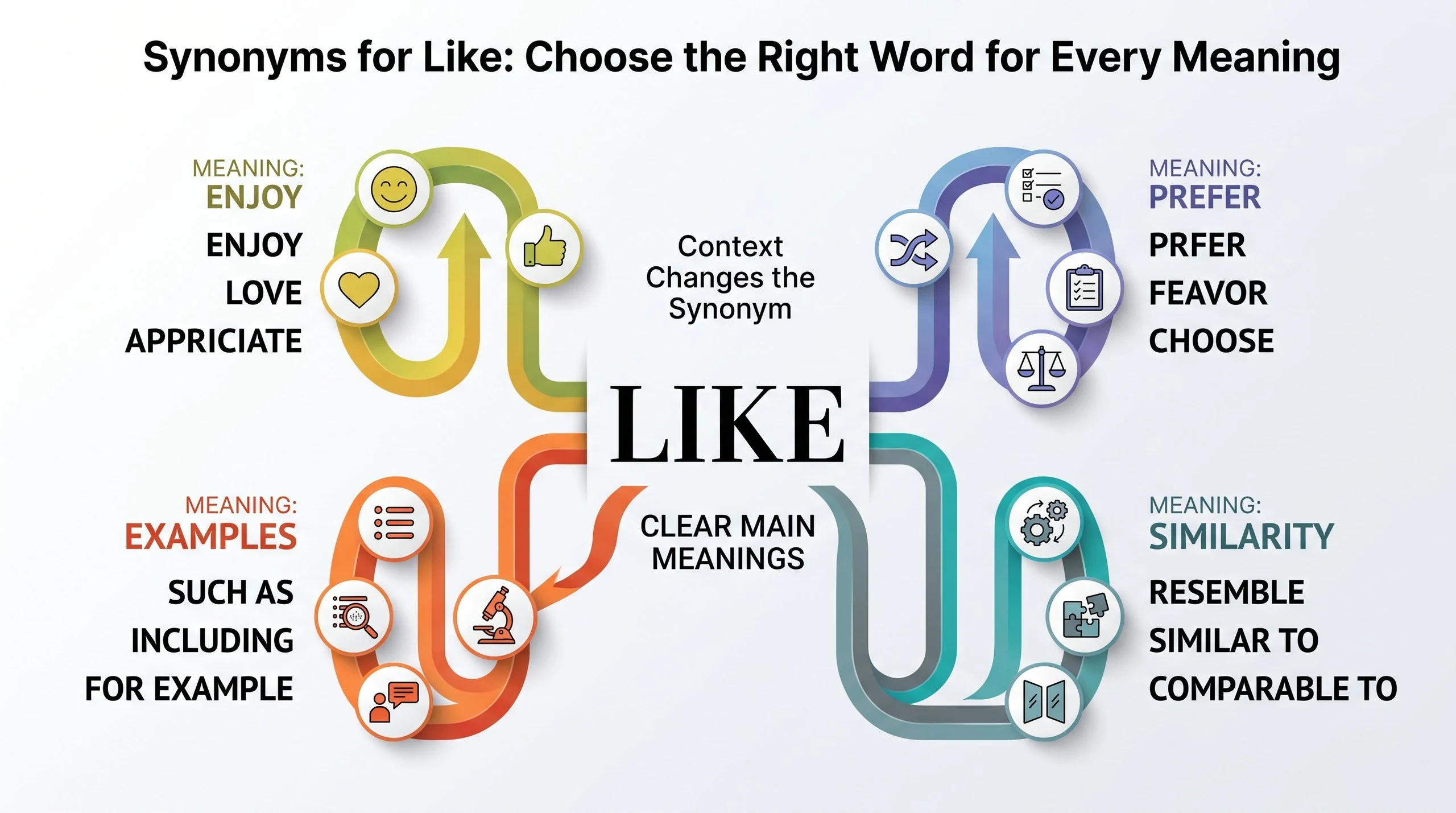
The best synonyms for like depend on how the word is used. When like means enjoying something, use enjoy, love, appreciate, prefer, or favor. When it means being similar, use similar to, resemble, comparable to, or akin to. In casual speech, like can also introduce an example, where words such as such as, including, or for example may work better.
The word like appears constantly in everyday English. It can express enjoyment, preference, similarity, comparison, or an example. Because of that, finding the right synonyms for like requires more than choosing one replacement.
For example, “I like this movie” means that you enjoy it, so enjoy is a natural alternative. On the other hand, “She looks like her mother” describes similarity, making resembles a better choice. Similarly, “I enjoy outdoor activities like hiking” uses like to introduce an example.
Therefore, the best replacement depends on the exact meaning, grammar, and tone of your sentence.
What Does “Like” Mean?
Like has several common meanings in English.
1. To Enjoy Something
I like this song.
Here, like means to enjoy, appreciate, or have a positive feeling toward something.
2. To Prefer Something
I like tea more than coffee.
In this context, like expresses preference.
3. To Be Similar
She looks like her sister.
Here, like means similar to or resembling.
4. To Introduce an Example
Outdoor sports, like tennis and soccer, can be enjoyable.
In this use, like means “such as.”
5. To Make a Comparison
It feels like summer.
The word creates a comparison between two things.
Best Synonyms for Like
| Synonym | Meaning | Tone | Difficulty | Frequency | Best For |
|---|---|---|---|---|---|
| Enjoy | Take pleasure in | Neutral | Easy | Very Common | General writing |
| Love | Like very strongly | Emotional | Easy | Very Common | Personal writing |
| Appreciate | Value or recognize positively | Formal | Medium | Very Common | Business & academic |
| Prefer | Like one option more | Neutral | Easy | Very Common | Comparisons |
| Favor | Prefer or support | Formal | Medium | Common | Business & formal |
| Admire | Respect or value highly | Positive | Easy | Common | People & qualities |
| Adore | Love deeply | Emotional | Easy | Common | Personal writing |
| Enjoyment | Pleasure from something | Neutral | Easy | Common | Noun form |
| Relish | Enjoy greatly | Expressive | Medium | Less Common | Descriptive writing |
| Treasure | Value deeply | Emotional | Medium | Common | Relationships & memories |
| Appreciate | Recognize value | Neutral/Formal | Medium | Very Common | Professional writing |
| Resemble | Look or seem similar | Formal | Medium | Common | Similarity |
| Echo | Closely resemble | Literary | Medium | Less Common | Descriptive writing |
| Mirror | Closely reflect | Neutral | Medium | Common | Ideas & behavior |
| Parallel | Correspond closely | Formal | Advanced | Less Common | Academic writing |
| Akin to | Similar in nature | Formal | Advanced | Less Common | Essays |
| Similar to | Almost the same | Neutral | Easy | Very Common | General writing |
| Comparable to | Similar enough to compare | Formal | Medium | Common | Academic/business |
| Such as | Introduces examples | Neutral | Easy | Very Common | Formal writing |
| Including | Gives examples within a group | Neutral | Easy | Very Common | General writing |
Synonyms for Like When You Mean “Enjoy”
When like expresses positive feelings toward something, these alternatives work well.
1. Enjoy
Enjoy is one of the closest and most natural alternatives to like.
I like reading.
I enjoy reading.
The meaning remains almost identical.
However, enjoy often sounds more precise because it clearly describes pleasure.
Examples
- I enjoy classical music.
- She enjoys cooking.
- They enjoyed the concert.
2. Love
Love expresses a stronger feeling than like.
I like this book.
I love this book.
Therefore, do not use love as a perfect replacement when you want to preserve a moderate level of enthusiasm.
3. Appreciate
Appreciate means to recognize the value, quality, or importance of something.
I appreciate your help.
She appreciates good design.
This word works especially well in professional and formal writing.
4. Admire
Use admire when you respect or value someone or something.
I admire her dedication.
He admires the artist’s work.
Consequently, admire is more specific than like when respect is involved.
5. Adore
Adore means to like or love something very strongly.
She adores her children.
He adores Italian food.
This word is more emotional and expressive than ordinary like.
6. Relish
Relish means to enjoy something greatly.
She relishes a good challenge.
He relished the opportunity to compete.
Because it has a stronger literary feel, relish works particularly well in descriptive writing.
7. Treasure
Treasure means to value something deeply.
I treasure our friendship.
She treasures those childhood memories.
Therefore, it is useful when like involves strong emotional value.
Synonyms for Like When You Mean “Prefer”
Sometimes like expresses a choice or preference.
Prefer
Prefer is the clearest alternative.
I like tea more than coffee.
I prefer tea to coffee.
The second version directly communicates a preference.
Favor
Favor can also mean to prefer one option.
Many customers favor the cheaper option.
It sounds more formal than like, making it useful in business and analytical writing.
Synonyms for Like When You Mean “Similar To”
The meaning changes significantly when like describes similarity.
1. Similar To
This design is similar to the previous version.
This is one of the simplest replacements.
2. Resemble
Resemble means to look or seem similar to something.
She resembles her mother.
Instead of:
She looks like her mother.
The second version sounds more direct and formal.
3. Comparable To
Comparable to means similar enough to be meaningfully compared.
The new model is comparable to premium devices.
This phrase works especially well in professional or technical writing.
4. Akin To
Akin to means similar in nature or character.
The experience was akin to a dream.
Because it sounds formal, this phrase fits essays, analysis, and sophisticated descriptive writing.
5. Echo
Echo can describe something that strongly resembles another idea, style, or quality.
The new design echoes the company’s earlier work.
This choice is more creative than a direct synonym such as similar to.
Synonyms for Like When Giving Examples
In formal writing, like can introduce examples.
Outdoor activities like hiking and cycling can improve fitness.
Here, alternatives include:
- Such as
- Including
- For example
- For instance
- Among them
- In particular
Example
Casual:
Fruits like apples and oranges are easy to find.
More formal:
Fruits such as apples and oranges are easy to find.
Therefore, such as is often preferable in academic and professional writing.
Synonyms for Like in Different Contexts
For People
When you mean positive feelings:
- Enjoy
- Appreciate
- Admire
- Respect
- Adore
- Value
Example:
I like my teacher.
Depending on your meaning, you could write:
I respect my teacher.
or:
I admire my teacher.
For Food
Use:
- Enjoy
- Love
- Prefer
- Favor
- Relish
Example:
I like spicy food.
More specific:
I enjoy spicy food.
Or, for a stronger preference:
I love spicy food.
For Activities
Useful alternatives include:
- Enjoy
- Love
- Prefer
- Appreciate
- Relish
She likes hiking.
She enjoys hiking.
The second sentence sounds natural while avoiding repetition.
For Ideas
When discussing ideas, use:
- Appreciate
- Support
- Favor
- Prefer
- Approve of
- Value
I like this idea.
More precise:
I favor this approach.
For Appearance or Similarity
Use:
- Resemble
- Similar to
- Comparable to
- Akin to
- Echo
- Mirror
The building looks like a castle.
The building resembles a castle.
The second sentence is more concise and descriptive.
Formal Synonyms for Like
Professional and academic writing often benefits from more precise alternatives.
Consider:
- Appreciate
- Prefer
- Favor
- Admire
- Value
- Resemble
- Comparable to
- Similar to
- Such as
- Including
Example
Informal:
Customers like this product because it is affordable.
More formal:
Customers favor this product because it is affordable.
Another example:
Informal:
Materials like steel and aluminum are commonly used.
Formal:
Materials such as steel and aluminum are commonly used.
Casual Synonyms for Like
In everyday English, natural choices include:
- Enjoy
- Love
- Adore
- Dig
- Be into
- Be fond of
- Prefer
- Appreciate
Some of these are informal.
For example:
I’m really into photography.
This means:
I really like photography.
However, be into is best reserved for casual conversation.
Stronger Synonyms for Like
If you want to express a stronger positive feeling, consider:
| Like | Stronger Alternative |
|---|---|
| Like | Love |
| Like | Adore |
| Like | Enjoy greatly |
| Like | Treasure |
| Like | Cherish |
| Like | Relish |
| Like | Be passionate about |
| Like | Be enthusiastic about |
For example:
She likes her new job.
A stronger version could be:
She loves her new job.
Or:
She is passionate about her work.
Like vs. Love
Like and love both express positive feelings, but their intensity differs.
I like this song.
I love this song.
The first sentence expresses approval or enjoyment. Meanwhile, the second communicates stronger enthusiasm.
Therefore, use love when the emotional intensity genuinely fits.
Like vs. Enjoy
These words frequently overlap.
I like swimming.
I enjoy swimming.
Both sentences are correct. However, enjoy specifically emphasizes pleasure, while like can express a broader positive preference.
Like vs. Appreciate
Appreciate often involves recognizing value.
I like your help.
I appreciate your help.
The second sentence is more natural when expressing gratitude.
Similarly:
I appreciate your patience.
is more appropriate than:
I like your patience.
Like vs. Resemble
These words have completely different grammatical functions.
Like can show similarity:
He looks like his father.
Resemble is a verb:
He resembles his father.
Therefore, you cannot simply substitute one for the other without changing the sentence structure.
Before-and-After Examples
Example 1: Enjoyment
Before:
I like classical music.
After:
I enjoy classical music.
Example 2: Strong Feeling
Before:
She likes her new apartment.
After:
She loves her new apartment.
Example 3: Appreciation
Before:
I like your help.
After:
I appreciate your help.
Example 4: Similarity
Before:
This house looks like a castle.
After:
This house resembles a castle.
Example 5: Formal Comparison
Before:
The new product is like the older model.
After:
The new product is similar to the older model.
Example 6: Examples
Before:
We sell outdoor products like tents and sleeping bags.
After:
We sell outdoor products such as tents and sleeping bags.
Common Mistakes When Using Synonyms for Like
1. Treating Every Meaning the Same
The word like has multiple meanings. Therefore, enjoy, resemble, and such as cannot replace it in the same sentence.
First identify what like means. Then select the appropriate alternative.
2. Using “Love” Too Freely
Love is stronger than like. Consequently, replacing every instance of like with love can exaggerate the original meaning.
3. Confusing “Like” With “Such As”
When introducing examples, such as is often more appropriate in formal writing.
Colors such as red and blue are common.
4. Using “Resemble” Incorrectly
Resemble is a verb and does not need to.
Correct:
She resembles her mother.
Incorrect:
She resembles to her mother.
5. Choosing a Formal Word for Casual Speech
Words such as akin to and comparable to can sound overly formal in everyday conversation. Instead, use similar to when you want a simple, natural expression.
Synonym Analysis: Like
Word: Like
Part of Speech: Verb, adjective, preposition, conjunction, or other grammatical uses depending on context.
When Like Means Enjoy
Enjoy, love, appreciate, admire, adore, relish, treasure
When Like Means Prefer
Prefer, favor, choose, value
When Like Means Similar To
Resemble, mirror, echo, parallel, similar to, comparable to, akin to
When Like Introduces Examples
Such as, including, for example, for instance
Best General Alternatives
Enjoy, appreciate, prefer, resemble, similar to, such as
The most important rule is simple: identify the meaning of “like” before selecting a synonym.
Frequently Asked Questions
What is the best synonym for like?
The best synonym depends on the meaning. Enjoy works well when “like” means taking pleasure in something, prefer expresses choice, and resemble works when “like” means being similar.
What is another word for like?
Common alternatives include enjoy, love, appreciate, prefer, favor, admire, adore, resemble, and resemble. For examples, such as can replace “like” in many formal sentences.
What is a formal synonym for like?
Depending on context, formal alternatives include appreciate, prefer, favor, admire, resemble, comparable to, similar to, and such as.
What is a stronger word than like?
For stronger positive feelings, use love, adore, cherish, treasure, relish, or be passionate about.
What is another word for “I like”?
You could say I enjoy, I appreciate, I love, I prefer, I admire, or I favor, depending on your intended meaning.
What is a synonym for like when comparing things?
Use similar to, comparable to, akin to, resembles, mirrors, or echoes.
What can I use instead of like in an essay?
For formal writing, consider such as, including, for example, similar to, comparable to, appreciate, prefer, or resemble, depending on the sentence.
Is enjoy the same as like?
Enjoy is a close synonym when like means taking pleasure in something. However, like has several other meanings that enjoy does not have.
Key Takeaway
The best synonyms for like depend on the meaning of the word. Use enjoy, love, appreciate, admire, or adore when you mean positive feelings. Choose prefer or favor when you mean preference.
For similarity, use resemble, similar to, comparable to, or akin to. When like introduces examples, such as or including often works better, particularly in formal writing.
Conclusion
The word like is simple, but its many meanings make synonym selection more complex. A good replacement should preserve both the original meaning and the tone of the sentence.
For positive feelings, enjoy is a natural choice, while love and adore express stronger emotions. In contrast, resemble and similar to describe similarity. Meanwhile, such as provides a more formal way to introduce examples.
Ultimately, replacing like is not about finding one perfect synonym. Instead, it is about identifying what the word means in context and selecting the most precise alternative.