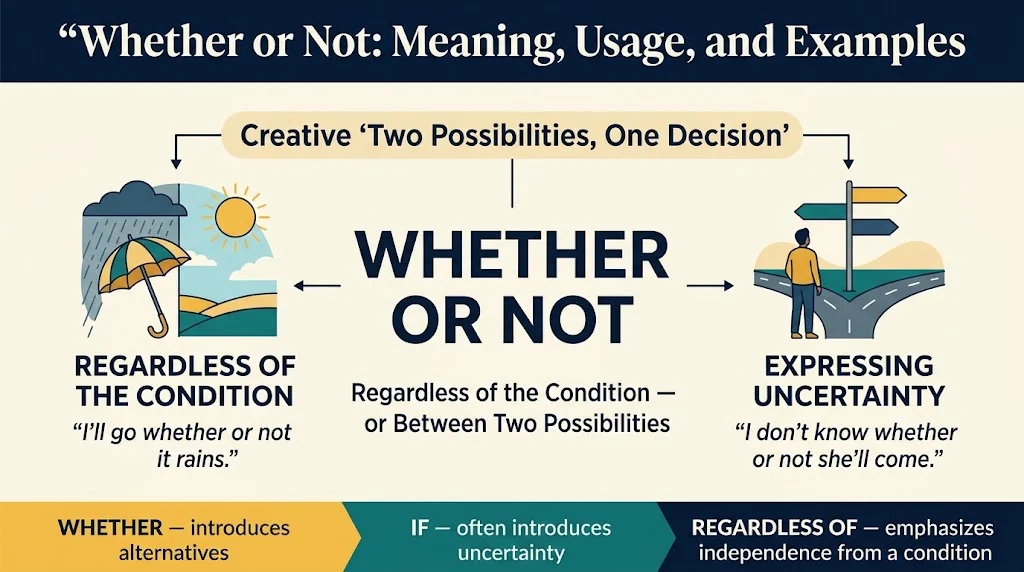
“Whether or not” means regardless of whether something happens or is true. It can also introduce two possibilities when the outcome is uncertain. For example, “I’ll go whether or not it rains” means I’ll go in both situations.
The phrase whether or not is common in everyday English, professional communication, academic writing, and casual conversation. It helps speakers explain choices, describe uncertain situations, and show that an outcome will remain the same regardless of a particular condition.
For example, someone might say, “I’ll support you whether or not you agree with me.” This means the support will continue in both situations. Similarly, “I don’t know whether or not she received the message” expresses uncertainty about what happened.
Although the phrase looks simple, it can sometimes be confused with “if,” “whether,” and “regardless of.” These expressions overlap, but they do not always work in exactly the same way.
Understanding whether or not makes it easier to write clear sentences and avoid common grammar mistakes. In this guide, you’ll learn its meaning, grammatical uses, differences from similar expressions, and practical examples for everyday and formal situations.
| Meaning | Context | Primary Platforms | Example | Tone |
|---|---|---|---|---|
| Regardless of a condition, or introducing alternatives | Everyday English, writing, speaking | Conversations, emails, essays, professional writing | “We’ll continue whether or not he arrives.” | Neutral |
What Does Whether or Not Mean?
Whether or not has two main uses.
1. Regardless of Whether Something Happens
In this use, the phrase means that something will happen no matter what the circumstances are.
Examples:
- I’ll attend the meeting whether or not it rains.
- She plans to apply whether or not her friends join her.
- We must finish the project whether or not the manager is available.
- He will keep practicing whether or not he wins the competition.
In each sentence, the main action does not depend on the condition.
2. Expressing Two Possibilities
The phrase can also introduce uncertainty about two possible situations.
Examples:
- I don’t know whether or not he is coming.
- She asked whether or not the store was open.
- We need to decide whether or not this plan will work.
- They discussed whether or not the event should be postponed.
Here, the speaker or writer has not confirmed which possibility is true or preferred.
How to Use Whether or Not in a Sentence
The correct use depends on what you want to communicate.
Use Whether or Not to Show Determination
When your decision stays the same under different circumstances, whether or not emphasizes that determination.
Examples:
- I will finish the assignment whether or not I feel tired.
- She will pursue her dream whether or not others support her.
- We are going on vacation whether or not the weather improves.
- He will tell the truth whether or not people believe him.
This construction is particularly useful when emphasizing commitment or independence.
Use Whether or Not to Express Uncertainty
When you are unsure about something, the phrase can introduce an indirect question or an uncertain possibility.
Examples:
- I wonder whether or not they know the answer.
- She cannot remember whether or not she locked the door.
- We need to confirm whether or not payment was received.
- He asked whether or not he could bring a guest.
Notice that indirect questions use normal statement word order.
Correct: “I wonder whether or not she is ready.”
Incorrect: “I wonder whether or not is she ready.”
Use Whether or Not in Formal Writing
The phrase works well in essays, reports, workplace messages, and official communication.
Examples:
- The committee will review the proposal whether or not additional documents arrive.
- Employees must follow the policy whether or not they agree with it.
- Researchers examined whether or not the results supported the hypothesis.
- The application must be submitted whether or not the applicant has previous experience.
In formal writing, make sure the phrase connects logically to the rest of the sentence.
Whether or Not vs. Whether
The word whether often introduces alternatives or an indirect question. Adding or not can emphasize the second possibility, but it is not always necessary.
| Whether | Whether or Not |
|---|---|
| I don’t know whether she will come. | I don’t know whether or not she will come. |
| We must decide whether to leave. | We must decide whether or not to leave. |
| She asked whether he was ready. | She asked whether or not he was ready. |
Both versions can be grammatically correct in these examples.
However, the best choice depends on emphasis and sentence structure. Use “whether” alone when the meaning is already clear. Add “or not” when you want to make both possibilities explicit or emphasize that the outcome does not depend on the condition.
Whether or Not vs. If
Whether and if sometimes introduce similar kinds of uncertainty.
For example:
- I don’t know whether she is coming.
- I don’t know if she is coming.
Both sentences are natural English.
Nevertheless, “whether” is generally the safer choice when presenting alternatives, particularly with “or not,” “either,” or “whether … or.”
Examples:
- We need to decide whether to stay or leave.
- She asked whether or not the report was complete.
- I don’t know whether he agrees or disagrees.
In some indirect questions, “if” works perfectly well. However, it cannot replace “whether” in every grammatical construction.
For instance, “We discussed whether to cancel the trip” is standard. “We discussed if to cancel the trip” is not standard English.
Whether or Not vs. Regardless Of
Both expressions can communicate that an outcome will not change because of a particular condition.
| Whether or Not | Regardless Of |
|---|---|
| I’ll go whether or not it rains. | I’ll go regardless of the weather. |
| She continued whether or not people supported her. | She continued regardless of people’s support. |
| We will proceed whether or not he agrees. | We will proceed regardless of his agreement. |
The main grammatical difference is that regardless of is usually followed by a noun, pronoun, or an -ing form.
Correct: “Regardless of whether he agrees, we will proceed.”
Incorrect: “Regardless whether he agrees, we will proceed” in standard formal usage.
Whether or Not Examples in Everyday English
Here are practical examples from common situations.
1. At Home
- I’ll cook dinner whether or not everyone arrives on time.
- We need to clean the house whether or not guests visit.
- She will water the plants whether or not it rains today.
- He wants to know whether or not the package arrived.
2. At School
- I’ll study whether or not my friends join me.
- The teacher asked whether or not everyone had completed the assignment.
- We must submit the project whether or not it is perfect.
- She is unsure whether or not she passed the examination.
3. At Work
- We will meet the deadline whether or not the client responds.
- The manager asked whether or not the report was ready.
- Employees must attend the training whether or not they have prior experience.
- The team will evaluate whether or not the new strategy is effective.
4. In Relationships
- I will care about you whether or not we agree.
- She wants to know whether or not he is serious about the relationship.
- True friends support each other whether or not they share the same opinions.
- He promised to help whether or not things became difficult.
5. In Social Media and Text Messages
- I’ll post the video whether or not it gets many views.
- Do you know whether or not she saw my message?
- I’m going to the concert whether or not my friends come.
- Let me know whether or not you’re interested.
Common Mistakes With Whether or Not
Mistake 1: Using Whether or Not When Whether Is Enough
Sometimes, writers add unnecessary words.
Wordy: “I don’t know whether or not we should possibly consider leaving.”
Clearer: “I don’t know whether we should leave.”
The longer version is not automatically incorrect, but removing unnecessary words can improve clarity.
Mistake 2: Confusing Whether With Weather
These words sound alike, but they have different meanings.
- Whether: Introduces alternatives or uncertainty.
- Weather: Refers to atmospheric conditions.
Correct: “I’ll go whether or not the weather improves.”
Incorrect: “I’ll go weather or not the weather improves.”
Mistake 3: Using Incorrect Word Order
Indirect questions use statement word order rather than question word order.
Correct: “She asked whether or not he was available.”
Incorrect: “She asked whether or not was he available.”
Mistake 4: Using If to Introduce Every Alternative
“If” is common in indirect questions, but “whether” is preferable in some constructions.
Correct: “We need to decide whether to accept or decline.”
Incorrect: “We need to decide if to accept or decline.”
Mistake 5: Creating an Unclear Sentence
Place the phrase near the condition it relates to whenever possible.
Unclear: “Whether or not she will attend, the report was submitted by the team.”
Clearer: “The team submitted the report whether or not she attended.”
The second sentence makes the relationship between the condition and the action easier to understand.
Advantages and Disadvantages of Using Whether or Not
| Advantages | Disadvantages |
|---|---|
| Clearly presents two possibilities | Can make a sentence wordy |
| Emphasizes determination | May be unnecessary when “whether” is enough |
| Works in formal and informal writing | Can create confusion if the sentence structure is awkward |
| Helps express uncertainty | Can be confused with “weather” |
| Makes conditions explicit | Repetition can make writing feel heavy |
Use the phrase when it adds meaning or emphasis. Otherwise, a shorter construction may be more natural.
Practice Exercises: Whether or Not
Choose the correct word or phrase to complete each sentence.
- I’ll attend the event ______ it rains.
- She asked ______ the office was open.
- We must decide ______ to accept the offer or decline it.
- I don’t know ______ he received the email.
- He will keep trying ______ he succeeds immediately.
Answers
- Whether or not
- Whether or not
- Whether
- Whether or not
- Whether or not
Other answers may also be correct in some sentences depending on the intended meaning and context.
Frequently Asked Questions
What does whether or not mean?
It means “regardless of whether something happens” or introduces two possible situations. The exact meaning depends on the sentence.
Is whether or not grammatically correct?
Yes. It is a standard English expression used in everyday speech, professional writing, and academic contexts.
Is whether or not one word or three words?
It is three separate words: whether or not.
Should I use whether or not or if?
Both can introduce uncertainty in many sentences. However, “whether” is generally preferred when explicitly presenting alternatives or using constructions such as “whether to stay or leave.”
Can I start a sentence with whether or not?
Yes. For example, “Whether or not we agree, we should treat each other respectfully.” The phrase introduces a condition that does not change the main point.
Is whether or not formal?
It works in both formal and informal English. In formal writing, use it when it improves clarity rather than adding it automatically.
What is another way to say whether or not?
Depending on the sentence, alternatives include “regardless of whether,” “no matter if,” and “irrespective of whether.” The grammar may change when you replace the original phrase.
Is whether or not redundant?
Sometimes. In “I don’t know whether or not she is coming,” the phrase is natural, but “I don’t know whether she is coming” is also correct. In other sentences, “or not” adds emphasis or clarifies that both outcomes are included.
What is the difference between whether and weather?
“Whether” introduces alternatives or uncertainty. “Weather” describes conditions such as rain, sunshine, wind, or snow.
Can whether or not be used in an essay?
Yes. It is appropriate for essays, reports, and academic writing when it expresses alternatives or emphasizes that a result remains unchanged.
Key Takeaway & Summary
Whether or not expresses uncertainty between possibilities or shows that something will happen regardless of a condition.
Use it when you want to emphasize both outcomes, make a decision independent of circumstances, or introduce an indirect question. In many sentences, “whether” alone is sufficient, so choose the version that sounds clearest.
Conclusion
The phrase whether or not is a useful part of everyday English because it helps communicate uncertainty, alternatives, and determination. From casual messages to professional reports, it allows you to explain what happens in different circumstances.
Remember the key distinction: use “whether or not” to make both possibilities clear or emphasize that a condition does not change the outcome. When the extra words add no value, “whether” alone may be enough.
With a little practice, you can use this phrase naturally, avoid common grammar mistakes, and write clearer sentences.