The DEI meaning is Diversity, Equity, and Inclusion. The acronym describes an approach that focuses on creating environments where people with different backgrounds and experiences can participate, have fair opportunities, and feel respected and included.
Each letter represents a different idea:
- D = Diversity
- E = Equity
- I = Inclusion
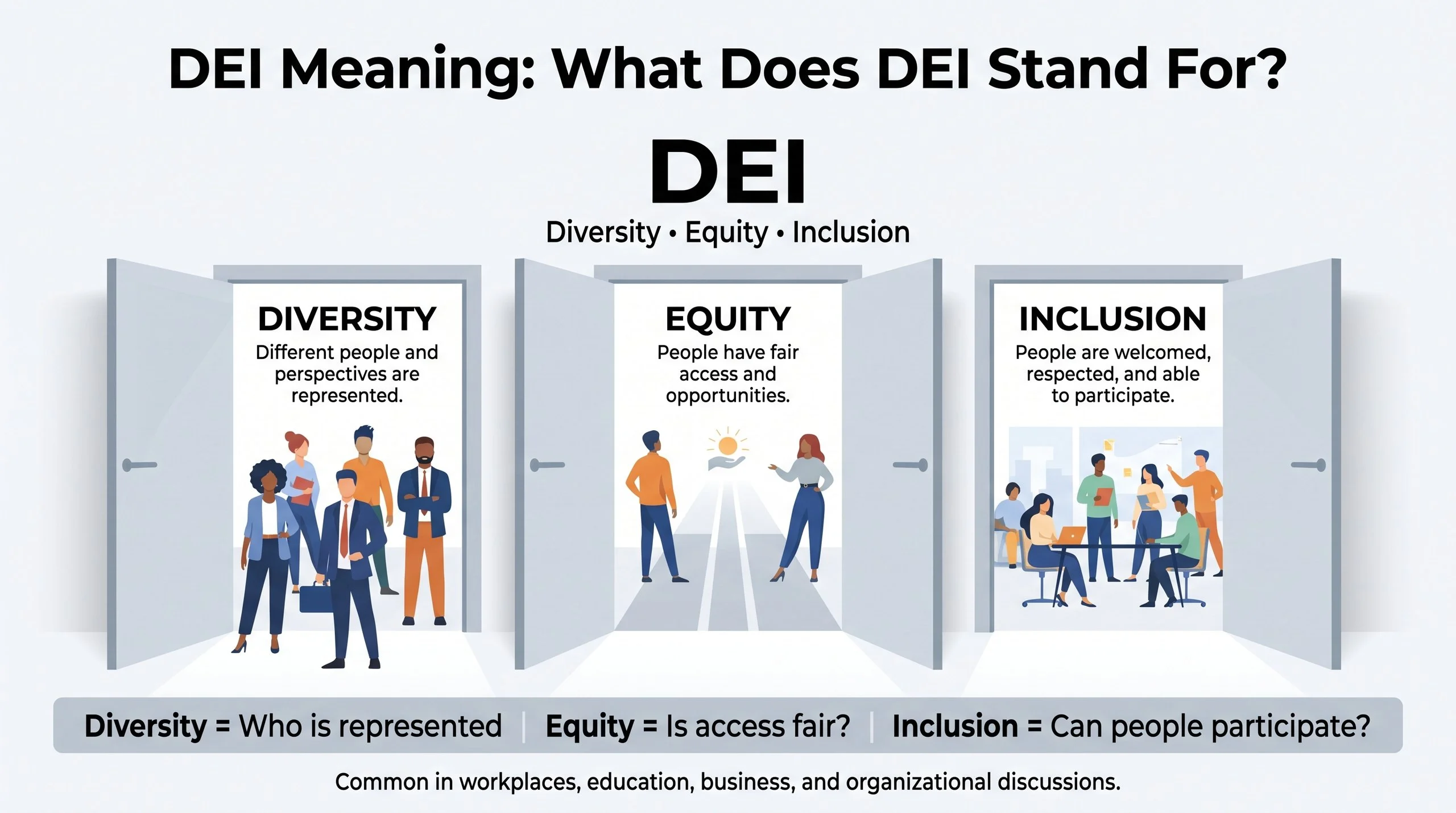
Although these concepts are connected, they are not identical. Diversity focuses on who is represented. Equity focuses on fair access and opportunities. Inclusion focuses on whether people are welcomed, respected, and able to participate.
DEI is commonly discussed in workplaces, schools, nonprofits, government organizations, and other institutions.
In simple terms, DEI is about creating fair and inclusive environments where different people can participate and have meaningful opportunities.
What Does DEI Mean?
DEI stands for Diversity, Equity, and Inclusion.
It is commonly used to describe policies, practices, and goals designed to improve:
- representation
- fairness
- access
- participation
- respect
- belonging
- workplace or community culture
For example, a company might review its hiring process to make sure qualified candidates have fair opportunities.
Another organization might improve accessibility so that more people can participate fully.
Therefore, DEI is broader than simply hiring people from different backgrounds. It can involve workplace culture, leadership, policies, accessibility, communication, and opportunities.
What Does DEI Stand For?
DEI stands for:
D — Diversity
Diversity refers to the presence of differences among people.
Those differences can include areas such as:
- age
- cultural background
- nationality
- educational experience
- socioeconomic background
- disability status
- professional experience
- perspectives
- life experiences
The exact definition can vary by organization and context.
E — Equity
Equity focuses on fairness and access to opportunities.
It recognizes that people may face different circumstances or barriers. Therefore, treating everyone fairly may sometimes require addressing those differences.
I — Inclusion
Inclusion means creating an environment where people are respected, welcomed, and able to participate meaningfully.
A workplace can be diverse without being inclusive.
For example, an organization might have employees from many backgrounds, yet some employees may feel that their ideas are ignored.
That is why diversity and inclusion are related but different concepts.
DEI Meaning in Simple Words
In simple language:
Diversity = Different people are represented.
Equity = People have fair access and opportunities.
Inclusion = People are welcomed and able to participate.
Think of DEI as three connected questions:
Who is here? → Diversity
Do people have fair opportunities? → Equity
Do people feel included and able to participate? → Inclusion
Together, these ideas help organizations think about how people experience an environment.
What Is Diversity?
Diversity describes the variety of people, experiences, perspectives, and backgrounds within a group.
For example, a workplace may have employees with different:
- ages
- cultures
- educational backgrounds
- professional experiences
- geographic backgrounds
- perspectives
Diversity can strengthen a group by bringing different viewpoints to discussions and decisions.
However, simply having a diverse group does not automatically create an inclusive environment.
People also need opportunities to contribute.
What Is Equity?
Equity focuses on fairness and access.
The concept recognizes that people may start from different circumstances.
For example, imagine a workplace where an important training course is available only during a time when some employees cannot reasonably attend.
An equity-focused approach might consider alternative access, such as another session or a recorded option.
The goal is not necessarily to give every person exactly the same thing.
Instead, equity asks whether people have a fair opportunity to access resources and participate.
What Is Inclusion?
Inclusion focuses on whether people are welcomed, respected, and able to contribute.
For example, a team may include employees from many backgrounds.
However, if meetings consistently allow only a few people to speak, the team may have diversity without strong inclusion.
An inclusive environment encourages participation and respectful communication.
As a result, inclusion turns representation into meaningful participation.
Diversity vs. Equity vs. Inclusion
These three concepts are easy to confuse.
| ConceptMain QuestionSimple Meaning | ||
|---|---|---|
| Diversity | Who is represented? | Variety of people and perspectives |
| Equity | Is access fair? | Fair opportunities and support |
| Inclusion | Can people participate? | People feel respected and welcomed |
A useful example is a workplace meeting.
Diversity: Different people are present.
Equity: Everyone has a fair chance to contribute.
Inclusion: People feel comfortable sharing ideas and are treated with respect.
DEI Meaning in the Workplace
The phrase DEI in the workplace refers to efforts to create a work environment that supports diversity, fairness, and inclusion.
Workplace DEI can involve:
- hiring practices
- employee development
- leadership opportunities
- accessibility
- workplace policies
- communication
- employee resource groups
- training
- recruitment
- promotion processes
- workplace culture
For example, a company may review its promotion process to determine whether employees have fair access to advancement opportunities.
Another company may improve workplace accessibility.
The specific approach depends on the organization’s goals and circumstances.
DEI Examples in the Workplace
Here are several practical examples.
1. Inclusive Hiring
A company can review job descriptions and recruitment processes to make sure qualified applicants are not unnecessarily excluded.
2. Accessible Workplaces
Organizations can provide reasonable accessibility features so employees can perform their jobs effectively.
3. Fair Promotion Processes
Companies can establish clear criteria for advancement rather than relying only on informal networks.
4. Inclusive Meetings
Managers can create opportunities for different team members to contribute.
5. Diverse Recruitment
Organizations can expand recruitment efforts to reach a broader range of qualified candidates.
6. Employee Resource Groups
Employees may form voluntary groups around shared interests, experiences, or communities.
These examples can look very different across organizations.
Why Is DEI Important?
Supporters of DEI often argue that inclusive environments can help organizations create fairer opportunities and make better use of different perspectives.
DEI can focus attention on issues such as:
- access
- representation
- workplace fairness
- employee participation
- accessibility
- organizational culture
- equal opportunity
For businesses, DEI can also be connected to employee experience and organizational practices.
However, the effectiveness of a particular DEI program depends on how it is designed and implemented.
A slogan alone does not create an inclusive environment.
DEI in Business
Businesses may use DEI strategies as part of their workplace and organizational policies.
These efforts can involve:
- recruitment
- employee development
- leadership
- workplace accessibility
- internal communication
- organizational culture
- employee feedback
For instance, a company may create transparent promotion criteria.
Another business might examine whether its workplace facilities are accessible.
In both cases, the focus is on how organizational systems affect participation and opportunity.
DEI Meaning in Education
DEI is also used in education.
Schools, colleges, and universities may discuss diversity, equity, and inclusion in relation to:
- student access
- classroom participation
- accessibility
- campus culture
- curriculum
- student support
- faculty recruitment
- educational opportunities
For example, an educational institution might improve accessibility for students with disabilities.
Another institution may review whether students have equitable access to academic resources.
The exact policies vary by institution and location.
DEI Initiatives
A DEI initiative is an action or program intended to address diversity, equity, or inclusion.
Examples include:
- accessibility improvements
- inclusive leadership training
- employee resource groups
- mentorship programs
- recruitment outreach
- workplace policy reviews
- employee feedback programs
- inclusive communication guidance
A strong initiative should have a clear purpose.
It should also be evaluated based on its actual outcomes rather than its name alone.
DEI Policies
A DEI policy is a formal organizational rule or framework related to diversity, equity, and inclusion.
Policies may address areas such as:
- hiring
- workplace conduct
- accessibility
- professional development
- promotion
- employee participation
- discrimination and harassment
The details depend on the organization.
Therefore, there is no single DEI policy that every organization must use.
DEI and Equal Opportunity
DEI and equal opportunity are closely related, but they are not exactly the same.
Equal opportunity generally focuses on ensuring people are not unfairly excluded from opportunities.
DEI can include equal opportunity while also focusing on representation, participation, belonging, accessibility, and organizational culture.
In simple terms:
Equal opportunity → Fair access
DEI → Fair access + representation + inclusion
The concepts can overlap significantly.
DEI vs. Equality
Equality and equity are often confused.
Equality generally means providing the same treatment or opportunity.
Equity focuses more closely on fairness while considering different circumstances or barriers.
For example, imagine three employees who need to access the same workplace resource.
An equality-based approach might provide the same resource to everyone.
An equity-based approach might consider whether additional accessibility support is needed for some employees.
The distinction depends on context, but the basic idea is that equity focuses on fairness of access and outcomes rather than simply identical treatment.
DEI vs. Inclusion
Inclusion is one part of DEI.
Inclusion focuses on whether people are welcomed, respected, and able to participate.
DEI is broader because it also includes diversity and equity.
Therefore:
Inclusion ⊂ DEI
In simple terms, inclusion is one piece of the larger DEI framework.
DEI vs. Belonging
Belonging is another term commonly used alongside DEI.
In an organizational context, belonging describes whether people feel accepted, valued, and connected to the group.
A simple distinction is:
Diversity: Different people are represented.
Equity: People have fair access.
Inclusion: People can participate.
Belonging: People feel accepted and valued.
Some organizations therefore use the expanded term DEIB, meaning Diversity, Equity, Inclusion, and Belonging.
What Is DEIB?
DEIB stands for Diversity, Equity, Inclusion, and Belonging.
It adds Belonging to the traditional DEI framework.
The four concepts can be summarized as:
- Diversity: representation of differences
- Equity: fairness and access
- Inclusion: meaningful participation
- Belonging: feeling accepted and valued
DEIB is not a completely separate concept from DEI.
Instead, it expands the framework by emphasizing belonging.
DEI in Everyday Language
The acronym DEI is usually used in professional, educational, political, or organizational discussions.
Examples include:
“The company announced a new DEI initiative.”
“Our team is reviewing its DEI policies.”
“The university has a DEI office.”
“DEI training is part of the organization’s employee development program.”
In casual conversation, people may simply say “diversity and inclusion” instead.
Common DEI Terms
Several terms frequently appear alongside DEI.
Diversity
The presence of differences within a group.
Equity
Fairness in access, opportunities, and participation.
Inclusion
Creating an environment where people can participate and feel respected.
Belonging
A sense of being accepted and valued.
Accessibility
Making environments, services, and information usable by people with different needs.
Representation
The presence of people from different groups or backgrounds within an organization or institution.
Equal Opportunity
The principle that people should have fair access to opportunities without unfair exclusion.
Common Misconceptions About DEI
1. DEI Means Hiring Anyone Regardless of Qualifications
That is not an accurate definition of DEI.
DEI generally concerns fairness, representation, access, and inclusion. Specific hiring standards still depend on the role and organization.
2. Diversity and Inclusion Mean the Same Thing
They do not.
Diversity concerns representation, while inclusion concerns participation and treatment.
3. Equity Means Everyone Gets the Same Thing
Not necessarily.
Equity focuses on fairness and access, which can require considering different circumstances.
4. DEI Is Only About Race
DEI can involve many forms of difference and access, depending on the context.
5. DEI Is Only for Large Companies
Organizations of many types can discuss DEI, including schools, nonprofits, government institutions, and small businesses.
6. DEI Automatically Creates Better Results
Not automatically.
Programs need clear goals, appropriate implementation, and evaluation.
Is DEI Political?
The answer depends on context.
The concepts of diversity, fairness, and inclusion can appear in political debates. However, DEI itself is primarily an organizational framework rather than a single political ideology.
Different people and organizations may disagree about:
- which policies should be used
- how programs should operate
- what outcomes should be measured
- which practices are effective
Therefore, it is useful to distinguish the general meaning of DEI from debates about particular DEI policies.
Is DEI the Same as Affirmative Action?
No.
DEI is a broad framework covering diversity, equity, and inclusion.
Affirmative action refers to specific policies or practices that have been used in some contexts to address historical or continuing inequalities, particularly in education and employment.
The two concepts can overlap in public discussions, but they are not synonyms.
A DEI program does not automatically mean affirmative action.
How to Use DEI Correctly in a Sentence
Here are some natural examples:
- The company created a new DEI program.
- DEI has become an important topic in workplace discussions.
- The organization is reviewing its DEI policies.
- She works on DEI initiatives at the university.
- The team discussed diversity, equity, and inclusion.
Because DEI is an acronym, it is often written in capital letters.
DEI Grammar and Pronunciation
DEI is an initialism formed from the first letters of:
Diversity, Equity, and Inclusion.
People commonly pronounce the letters individually:
D-E-I
rather than treating “DEI” as one ordinary word.
Examples:
“DEI policies”
“DEI training”
“DEI initiatives”
“DEI strategy”
The acronym normally remains capitalized.
When Should You Use DEI?
Use DEI when discussing diversity, equity, and inclusion in an organizational or social context.
It works especially well in:
- business writing
- workplace communication
- education
- policy discussions
- organizational reports
- human resources discussions
- social discussions
If your audience may not know the acronym, spell it out the first time:
Diversity, Equity, and Inclusion (DEI)
After that, you can use DEI throughout the text.
When Should You Avoid the Acronym?
Avoid unexplained acronyms when writing for a general audience.
For example, this sentence may confuse some readers:
“Our DEI strategy is expanding.”
A clearer first reference is:
“Our Diversity, Equity, and Inclusion (DEI) strategy is expanding.”
After introducing the term, the shorter acronym becomes easier to understand.
DEI Quick Reference
| Term | Meaning |
|---|---|
| DEI | Diversity, Equity, and Inclusion |
| D | Diversity |
| E | Equity |
| I | Inclusion |
| DEIB | Diversity, Equity, Inclusion, and Belonging |
| DEI initiative | A program or action related to DEI |
| DEI policy | An organizational policy addressing DEI |
| DEI workplace | A workplace approach focused on diversity, equity, and inclusion |
| DEI training | Training related to DEI topics |
| DEI strategy | An organization’s broader DEI plan |
FAQs
1. What does DEI mean?
DEI stands for Diversity, Equity, and Inclusion. It refers to approaches that focus on representation, fairness, access, participation, and inclusion.
2. What does DEI stand for?
DEI stands for Diversity, Equity, and Inclusion.
3. What does DEI mean in the workplace?
In the workplace, DEI generally refers to practices and policies designed to support diversity, fair opportunities, accessibility, and an inclusive work environment.
4. What does the D in DEI stand for?
The D stands for Diversity, which refers to differences and representation within a group.
5. What does the E in DEI stand for?
The E stands for Equity, which focuses on fairness and access to opportunities.
6. What does the I in DEI stand for?
The I stands for Inclusion, which focuses on creating an environment where people are respected and able to participate.
7. What is DEI in simple words?
In simple terms, DEI means different people are represented, people have fair opportunities, and people can participate in a respectful environment.
8. What is an example of DEI?
Examples include accessible workplaces, transparent promotion criteria, inclusive meetings, broader recruitment efforts, and employee development programs.
9. Is DEI the same as diversity?
No. Diversity is one part of DEI. DEI also includes equity and inclusion.
10. Is DEI the same as equality?
No. Equality generally focuses on equal treatment or opportunity, while equity focuses on fairness and access while considering different circumstances.
11. What does DEIB mean?
DEIB stands for Diversity, Equity, Inclusion, and Belonging. It adds belonging as an additional concept.
12. Is DEI only about race?
No. Depending on the context, DEI can address many types of diversity, access, representation, and inclusion.
13. Is DEI political?
DEI can become part of political debates, but the acronym itself refers to Diversity, Equity, and Inclusion. Specific DEI policies can vary widely.
14. Is DEI the same as affirmative action?
No. DEI is a broad framework, while affirmative action refers to particular policies or practices used in some settings.
15. How do you use DEI in a sentence?
You can say, “The company introduced a new DEI initiative to improve workplace inclusion.”
Conclusion
The DEI meaning is Diversity, Equity, and Inclusion. The term describes a broad approach to representation, fairness, access, participation, and inclusion.
Each part has a distinct role. Diversity focuses on who is represented. Equity focuses on fair access and opportunity. Inclusion focuses on whether people are welcomed, respected, and able to participate.
DEI is commonly discussed in workplaces, schools, businesses, nonprofits, and other organizations. Specific DEI programs can range from accessibility improvements and inclusive hiring practices to employee development and workplace policy reviews.
The simplest way to remember the acronym is:
D = Different people are represented.
E = People have fair opportunities.
I = People can participate and feel respected.
Together, these three ideas form the basic meaning of DEI.

Harry Edwards is a language writer specializing in word meanings, synonyms, and language usage. He creates clear, accurate, and engaging content to help readers improve their vocabulary and communication skills.