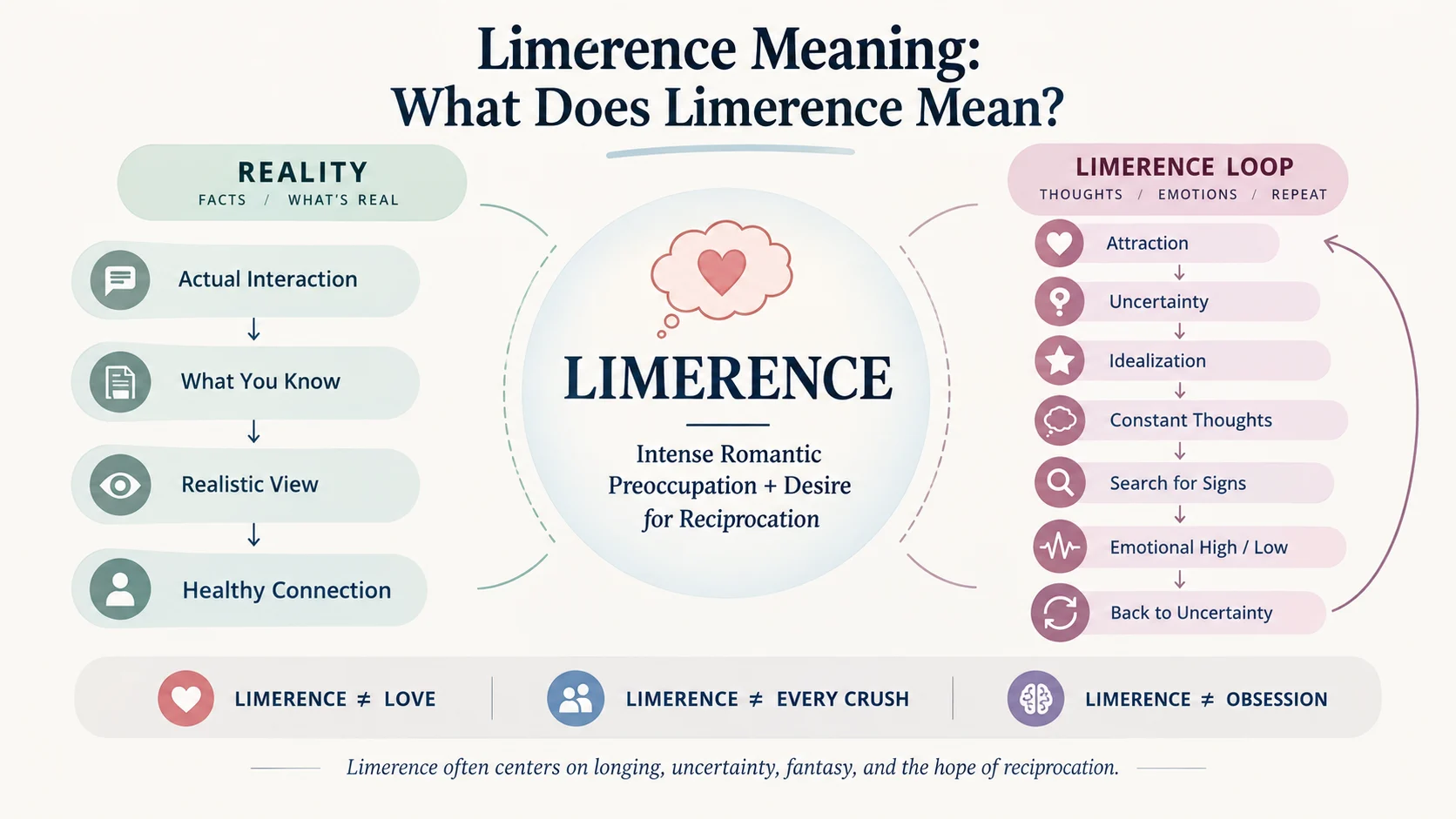
The limerence meaning describes an intense emotional state in which a person becomes highly focused on someone they find romantically attractive. The experience often includes persistent thoughts, strong longing, idealization, and a deep desire to know whether the other person feels the same way.
Unlike ordinary attraction, limerence can make one person feel unusually important in your thoughts and emotions. A small text, glance, compliment, or change in tone may feel highly meaningful. As a result, uncertainty about the other person’s feelings can make the experience even stronger.
Psychologist Dorothy Tennov introduced the term limerence in her 1979 book Love and Limerence: The Experience of Being in Love. She used the word to describe a particular form of intense romantic preoccupation.
Importantly, limerence is not simply another word for love. Love can develop through trust, familiarity, care, commitment, and shared experiences. Limerence often centers more strongly on longing, uncertainty, fantasy, and the hope of reciprocation.
So, what does limerence mean? It means an intense state of romantic infatuation and emotional preoccupation with another person, especially when you strongly want their feelings to be returned.
What Does Limerence Mean?
Limerence is an intense form of romantic infatuation that can cause persistent thoughts about another person and a strong need for their affection or reciprocation.
Someone experiencing limerence may:
- Think about the person repeatedly
- Feel excited by small signs of attention
- Search for hidden meaning in messages
- Idealize the person
- Fantasize about a future together
- Feel anxious about rejection
- Experience emotional highs and lows
- Want clear proof that the attraction is mutual
The key feature is often uncertainty about reciprocation.
What Is Limerence?
Limerence is a state of intense romantic or emotional preoccupation with another person.
The person experiencing it may become highly focused on whether the other person returns their feelings.
For example, imagine someone develops a strong crush on a coworker. The coworker sends a friendly message one evening. That small interaction makes the person feel extremely happy.
The next day, however, the coworker responds briefly.
Now the person worries that the coworker has lost interest.
That emotional swing can become part of limerence.
The person may repeatedly replay conversations, examine text messages, imagine future scenarios, and look for signs that the attraction is mutual.
Who Coined the Term Limerence?
Psychologist Dorothy Tennov introduced the term limerence.
She developed the concept after studying people’s experiences of romantic attraction and infatuation.
Tennov’s work focused on the intense mental and emotional state that can occur when someone becomes strongly attached to the possibility of romantic reciprocation.
The word became particularly useful because ordinary terms such as crush, infatuation, and being in love do not always capture this specific experience.
What Does Limerent Mean?
Limerent describes a person experiencing limerence.
For example:
“She became limerent after developing a strong attraction to him.”
The person receiving the limerent person’s attention can sometimes be described as the limerent object.
That phrase does not mean the other person is an object in the ordinary sense. Instead, it refers to the person who becomes the focus of the limerent person’s romantic preoccupation.
Common Signs of Limerence
Limerence can look different from person to person. Still, several patterns appear frequently.
1. Constant Thoughts
You may think about the person far more often than you intended.
Their name, messages, social-media posts, voice, or past conversations may repeatedly enter your mind.
2. Strong Desire for Reciprocation
You may care deeply about whether the person likes you back.
Their feelings can seem almost as important as your own.
3. Idealization
You may focus heavily on the person’s positive qualities.
At the same time, you may minimize their flaws or explain away behaviors that would normally concern you.
4. Reading Into Small Signals
A simple emoji can suddenly feel significant.
Likewise, a delayed reply might make you worry about rejection.
This pattern can turn ordinary interactions into emotionally loaded events.
5. Emotional Highs and Lows
A positive interaction can create intense excitement.
Conversely, distance or uncertainty can produce disappointment, anxiety, or sadness.
6. Fantasy
You may imagine dates, conversations, a relationship, marriage, or an entire future together.
These fantasies can feel emotionally vivid even when the actual relationship remains limited.
7. Replaying Interactions
You might repeatedly remember something the person said.
You may also analyze their facial expressions, body language, messages, or tone.
8. Sensitivity to Rejection
Even minor signs of distance can feel unusually painful.
The fear of rejection may become a major part of the experience.
Limerence and Uncertainty
Uncertainty often plays an important role in limerence.
When you know exactly how someone feels, the uncertainty decreases.
However, when their feelings remain unclear, your mind may continue searching for answers.
For example:
“They liked my story. Does that mean they like me?”
Or:
“They said they were busy. Are they actually avoiding me?”
The lack of a clear answer can keep the person mentally engaged.
That does not mean uncertainty automatically creates limerence. Instead, uncertainty can reinforce the cycle for someone already experiencing intense romantic preoccupation.
Limerence vs. Love
- Limerence and love are not the same thing.
Limerence often emphasizes:
- Longing
- Uncertainty
- Idealization
- Excitement
- Reciprocation
- Intrusive thoughts
- Fantasy
Love can involve:
- Trust
- Care
- Respect
- Emotional closeness
- Acceptance
- Commitment
- Shared experiences
- Realistic knowledge of another person
A person can experience limerence at the beginning of a relationship.
Over time, that intense state may change as the person gains a more realistic understanding of their partner.
However, not every intense attraction develops into lasting love.
Limerence vs. Infatuation
These terms overlap.
Infatuation generally describes intense but often short-lived passion or admiration.
Limerence refers more specifically to intense romantic preoccupation, especially when the person strongly wants reciprocation.
For example, you might feel infatuated with a celebrity because you find them incredibly attractive.
Limerence usually involves a stronger personal focus on whether the other person returns your feelings.
Therefore, limerence can be viewed as a more specific concept than ordinary infatuation.
Limerence vs. Attraction
Attraction is broader.
You can feel attracted to someone’s appearance, personality, intelligence, humor, values, or other qualities.
Attraction does not necessarily consume your thoughts.
Limerence, by contrast, can involve persistent mental focus and emotional dependence on signs of reciprocation.
So:
Attraction = “I am drawn to this person.”
Limerence = “I cannot stop thinking about this person, and I desperately want to know whether they feel the same way.”
Limerence vs. Obsession
- Limerence and obsession can overlap, but they are not identical concepts.
Obsession refers broadly to persistent thoughts or preoccupations.
Limerence specifically concerns intense romantic or emotional attraction.
Someone can become obsessed with a hobby, celebrity, idea, or activity without experiencing romantic attraction.
Therefore, limerence describes a narrower experience.
Limerence vs. Healthy Romantic Love
Healthy romantic love can include strong attraction.
However, it usually develops through real interaction and knowledge of the other person.
Limerence may rely more heavily on:
- Fantasy
- Hope
- Uncertainty
- Idealization
- Interpreting signals
For example, someone might feel deeply connected to a person they barely know because they have created an idealized image of them.
That feeling can be powerful.
Yet the actual relationship may not match the imagined one.
Does Limerence Mean You Are in Love?
Not necessarily.
Limerence can feel like love because the emotions may be intense.
However, intensity alone does not prove that a relationship has developed into mature love.
Love usually involves knowing the person more realistically.
- You see their strengths and weaknesses.
- You experience ordinary moments together.
- You build trust.
- You learn how to handle disagreements.
Limerence can happen before those experiences exist.
What Causes Limerence?
There is no single cause of limerence.
Several factors may contribute to intense romantic preoccupation.
Uncertainty
Not knowing how someone feels can maintain emotional tension.
Strong Attraction
A powerful initial attraction can make someone occupy more mental space.
Idealization
When you focus heavily on someone’s positive traits, your feelings can intensify.
Emotional Needs
A strong desire for connection, validation, affection, or belonging may influence how someone experiences romantic attraction.
Fantasy
Imagining a future with someone can strengthen emotional attachment even before a relationship develops.
Intermittent Attention
Occasional attention mixed with periods of distance can feel especially emotionally powerful.
However, these factors do not mean that limerence has one simple psychological cause.
Can Limerence Happen Without a Relationship?
Yes.
Limerence does not require an established romantic relationship.
A person may experience it toward:
- A coworker
- A classmate
- A friend
- An acquaintance
- A celebrity
- A former partner
- Someone they met briefly
- Someone who does not know about their feelings
The important feature is the person’s intense emotional and mental focus.
Limerence and Social Media
Social media can create many opportunities for interpreting small signals.
For example, someone experiencing limerence might repeatedly check:
- Instagram stories
- Likes
- Comments
- Snapchat activity
- TikTok interactions
- Profile views
- Message timing
- Online status
A simple interaction can feel highly meaningful.
For instance:
“They liked my old photo. Maybe they were looking through my profile.”
That interpretation might be correct.
It might also have a completely ordinary explanation.
The uncertainty can encourage more checking and analysis.
Limerence in Texting
Texting can intensify uncertainty because messages lack many face-to-face cues.
A person may analyze:
“Hey 😊”
versus:
“Hey.”
The difference might feel important.
Likewise, someone might wonder why a person took three hours to respond.
However, response time rarely provides enough information to determine someone’s feelings.
Therefore, texting can create an environment where limerent thinking easily focuses on small details.
Limerence Examples
Example 1: New Crush
Someone meets a person at a party.
Afterward, they repeatedly think about the conversation.
They check the person’s social media and imagine another meeting.
When the person sends a message, they feel extremely excited.
That pattern may reflect limerence.
Example 2: Coworker
A person develops feelings for a coworker.
The coworker sometimes chats with them during lunch.
Those conversations become the highlight of their day.
They begin analyzing every interaction and wondering whether the coworker feels the same way.
Example 3: Former Partner
Someone continues thinking about an ex months after the relationship ended.
They repeatedly check the ex’s social media.
A new post creates hope that the ex might still care.
The person then spends hours imagining reconciliation.
This can involve limerent patterns, although continued feelings after a breakup do not automatically mean limerence.
Example 4: Celebrity
Someone becomes intensely focused on a celebrity.
They watch interviews, follow every update, and imagine what a relationship might be like.
Because there is little or no reciprocal relationship, this example can overlap with parasocial attachment and fantasy.
Limerence Stages
People often describe limerence as developing through several broad phases.
These are useful descriptions rather than a universal medical sequence.
Stage 1: Attraction
You notice someone and feel unusually drawn to them.
Stage 2: Intensification
Your thoughts about the person become more frequent.
Stage 3: Idealization
You begin focusing heavily on their positive qualities.
Stage 4: Uncertainty
You start wondering whether they feel the same way.
Stage 5: Preoccupation
The person occupies a large amount of your mental attention.
Stage 6: Reciprocation or Rejection
Clear evidence of mutual interest can change the experience.
Likewise, rejection can eventually reduce the uncertainty that maintained the limerent state.
However, emotions do not always follow a neat sequence.
How Long Does Limerence Last?
There is no fixed timeline for limerence.
Some experiences may fade relatively quickly.
Others can continue for much longer, especially when uncertainty remains.
The duration can depend on factors such as:
- Contact with the person
- Reciprocation
- Rejection
- Fantasy
- Relationship status
- Emotional circumstances
- Personal patterns of attachment
Therefore, there is no universal number of days, months, or years that defines limerence.
Can Limerence Turn Into Love?
Yes, limerence can sometimes occur during the early stages of a relationship and later develop into a deeper bond.
As people spend more time together, they learn about each other’s real personalities.
The relationship may then develop through:
- Trust
- Communication
- Shared experiences
- Mutual support
- Commitment
- Realistic expectations
However, limerence does not guarantee lasting love.
A powerful attraction can fade once idealization gives way to a fuller understanding of the person.
Can You Have Limerence for Someone You Barely Know?
Yes.
In fact, limited information can leave more room for imagination.
When you know little about someone, your mind may fill the gaps.
You might imagine that they have exactly the qualities you want in a partner.
As you learn more about them, your perception may change.
This explains why limerence can feel incredibly strong even when the actual relationship remains limited.
Is Limerence a Mental Illness?
Limerence is not generally treated as a standalone mental disorder in major diagnostic systems.
The term describes an experience of intense romantic preoccupation.
However, if someone experiences severe distress, intrusive thoughts, anxiety, depression, or problems functioning in daily life, professional support may help.
It is also important not to diagnose yourself based on a social-media checklist.
Strong romantic feelings can occur without indicating a mental disorder.
Is Limerence Always Unhealthy?
Not necessarily.
The word often appears in conversations about distressing romantic obsession, but intense attraction itself is not automatically harmful.
The important question involves its impact.
If romantic thoughts remain enjoyable and do not interfere with daily life, relationships, work, or personal boundaries, the experience may simply represent a strong attraction.
On the other hand, constant checking, severe anxiety, inability to focus, or ignoring someone’s boundaries can create problems.
How to Deal With Limerence
If limerence feels overwhelming, several strategies may help.
Reduce Constant Checking
Repeatedly checking someone’s social media or messages can keep your attention focused on them.
Creating some distance can interrupt that cycle.
Separate Facts From Assumptions
Write down what you actually know.
Then separate those facts from what you imagine.
For example:
Fact: “They replied to my message.”
Assumption: “They replied because they secretly want a relationship.”
That distinction can bring more clarity.
Focus on Real Interaction
Try to evaluate the actual relationship rather than an imagined version of it.
Ask yourself what you genuinely know about the person.
Reconnect With Your Own Life
Spend time on:
- Friends
- Family
- Work
- School
- Hobbies
- Exercise
- Personal goals
A wider life can reduce the amount of mental space given to one person.
Accept Uncertainty
You may not always know how someone feels.
Instead of repeatedly analyzing every signal, accept that some questions require direct communication or may never have a clear answer.
Consider Professional Support
If the experience causes major distress or interferes with everyday functioning, a qualified mental-health professional can help you explore the underlying patterns and develop useful coping strategies.
Common Misconceptions About Limerence
“Limerence Means True Love”
Not necessarily.
Limerence describes intense romantic preoccupation. It does not automatically prove that the relationship is deep or lasting.
“Limerence Always Becomes a Relationship”
No.
Someone can experience limerence without receiving romantic interest in return.
“You Must Date Someone to Experience Limerence”
No.
Limerence can develop toward someone you barely know.
“Limerence Means You Are Obsessed”
The concepts overlap, but they are not identical.
Limerence specifically involves intense romantic or emotional preoccupation.
“Limerence Lasts Exactly a Certain Amount of Time”
There is no universal timeline.
“Every Strong Crush Is Limerence”
No.
A normal crush can involve excitement and attraction without the intense preoccupation and uncertainty associated with limerence.
Limerence and Attachment
Limerence can also appear in discussions about attachment.
Attachment refers to emotional bonds between people.
Limerence, meanwhile, focuses more specifically on intense romantic preoccupation and the desire for reciprocation.
A person’s attachment experiences may influence how they approach relationships, but limerence should not automatically be reduced to one attachment style.
People experience relationships in different ways.
Limerence and Rejection
Rejection can feel especially painful during limerence.
When reciprocation becomes the central emotional goal, rejection can affect more than romantic expectations.
It may also challenge the idealized future someone imagined.
For that reason, accepting rejection can take time.
Importantly, rejection does not mean the person’s feelings were fake.
It simply means the desired relationship is not mutual.
Limerence and No Contact
People sometimes use no contact after a breakup or difficult attachment.
The goal can involve creating emotional distance and reducing repeated triggers.
For someone experiencing limerence, continued exposure to messages, social-media posts, or intermittent attention may keep the emotional cycle active.
Creating distance can therefore make it easier to redirect attention.
However, no-contact strategies depend on the situation. Necessary communication, work, family responsibilities, or shared commitments may make complete separation impossible.
Limerence in Everyday Language
The word limerence has become increasingly common online.
You may see statements such as:
“I thought it was love, but it was actually limerence.”
Or:
“I can’t stop thinking about them. Is this limerence?”
Online discussions often use the term to describe intense crushes, attachment to unavailable people, or repeated romantic thoughts.
However, internet definitions can oversimplify the concept.
Not every crush, breakup, or strong attraction represents limerence.
Grammar and Usage
Limerence is a noun.
Examples:
- “She experienced limerence after meeting him.”
- “The limerence gradually faded.”
- “He researched the meaning of limerence.”
- “Uncertainty can intensify limerence.”
Limerent is an adjective and noun related to the experience.
Examples:
- “He described himself as limerent.”
- “Limerent thoughts occupied much of her attention.”
The word is usually used in psychology, relationship discussions, and informal writing rather than everyday casual conversation.
Quick Reference Table
| Term | Meaning |
|---|---|
| Limerence | Intense romantic preoccupation with a strong desire for reciprocation |
| Limerent | Experiencing or relating to limerence |
| Crush | Strong romantic attraction, often informal |
| Infatuation | Intense but often temporary passion or admiration |
| Attraction | Feeling drawn toward someone |
| Love | Deep emotional bond involving care, trust, intimacy, or commitment |
| Obsession | Persistent preoccupation that can involve many different subjects |
| Attachment | Emotional bond or connection between people |
Frequently Asked Questions
What does limerence mean?
Limerence means an intense state of romantic infatuation and emotional preoccupation, often marked by persistent thoughts about someone and a strong desire for that person’s feelings to be returned.
What is a limerent person?
A limerent person is someone experiencing limerence. They may think frequently about another person, idealize them, and closely monitor signs of romantic reciprocation.
Is limerence the same as love?
No. Limerence often centers on longing, uncertainty, idealization, and reciprocation. Love can involve deeper knowledge, trust, care, acceptance, and commitment.
Is limerence the same as a crush?
Not exactly. A crush can involve strong attraction without intense preoccupation. Limerence usually describes a more consuming romantic focus.
What causes limerence?
There is no single cause. Strong attraction, uncertainty, idealization, fantasy, emotional needs, and intermittent attention may contribute to the experience.
Can you experience limerence without dating someone?
Yes. Limerence can happen toward a coworker, friend, acquaintance, former partner, celebrity, or someone you barely know.
How long does limerence last?
There is no fixed duration. It can fade relatively quickly or continue for a much longer period depending on the circumstances.
Can limerence turn into love?
Yes, sometimes. An intense early attraction can develop into a deeper relationship as two people build trust and learn about each other. However, limerence does not guarantee lasting love.
Is limerence unhealthy?
Not automatically. The experience becomes more concerning when it causes significant distress, disrupts daily functioning, or leads to unhealthy behavior or boundary violations.
Is limerence a mental disorder?
Limerence is not generally recognized as a standalone mental disorder. It describes a particular experience of romantic preoccupation.
Can social media make limerence stronger?
Social media can provide frequent opportunities to check profiles, messages, likes, and other signals. For some people, this repeated checking can maintain uncertainty and emotional focus.
What is the difference between limerence and obsession?
Obsession is a broad concept involving persistent preoccupation. Limerence is specifically connected to intense romantic or emotional attraction and the desire for reciprocation.
What does limerent mean?
Limerent describes someone who is experiencing limerence or something related to that state.
Conclusion
The limerence meaning refers to an intense state of romantic infatuation in which someone becomes highly preoccupied with another person and strongly wants their feelings to be returned.
The experience can include constant thoughts, idealization, fantasy, emotional highs and lows, and close attention to small signs of interest or rejection. In many cases, uncertainty plays an important role because the person wants clear confirmation that the attraction is mutual.
Limerence can resemble love, but the two concepts are not identical. Love often develops through real experiences, trust, care, communication, and realistic knowledge of another person. Limerence can instead focus heavily on longing, possibility, uncertainty, and an idealized image.
Most importantly, having intense feelings does not automatically mean something is wrong. However, if romantic preoccupation begins to interfere with daily life, relationships, boundaries, or emotional well-being, creating distance and seeking professional support may help.
In simple terms:
Limerence = intense romantic preoccupation + strong longing + desire for reciprocation.
Understanding that distinction can make it easier to recognize what you are actually feeling and separate real connection from fantasy or uncertainty.

Jack Murphy is a language writer with a passion for word meanings, synonyms, and effective communication. He creates informative and easy to understand content to help readers enhance their vocabulary and language skills.





2 thoughts on “Limerence Meaning| What Does Limerence Mean? Definition, Signs, Causes & Examples 2026”