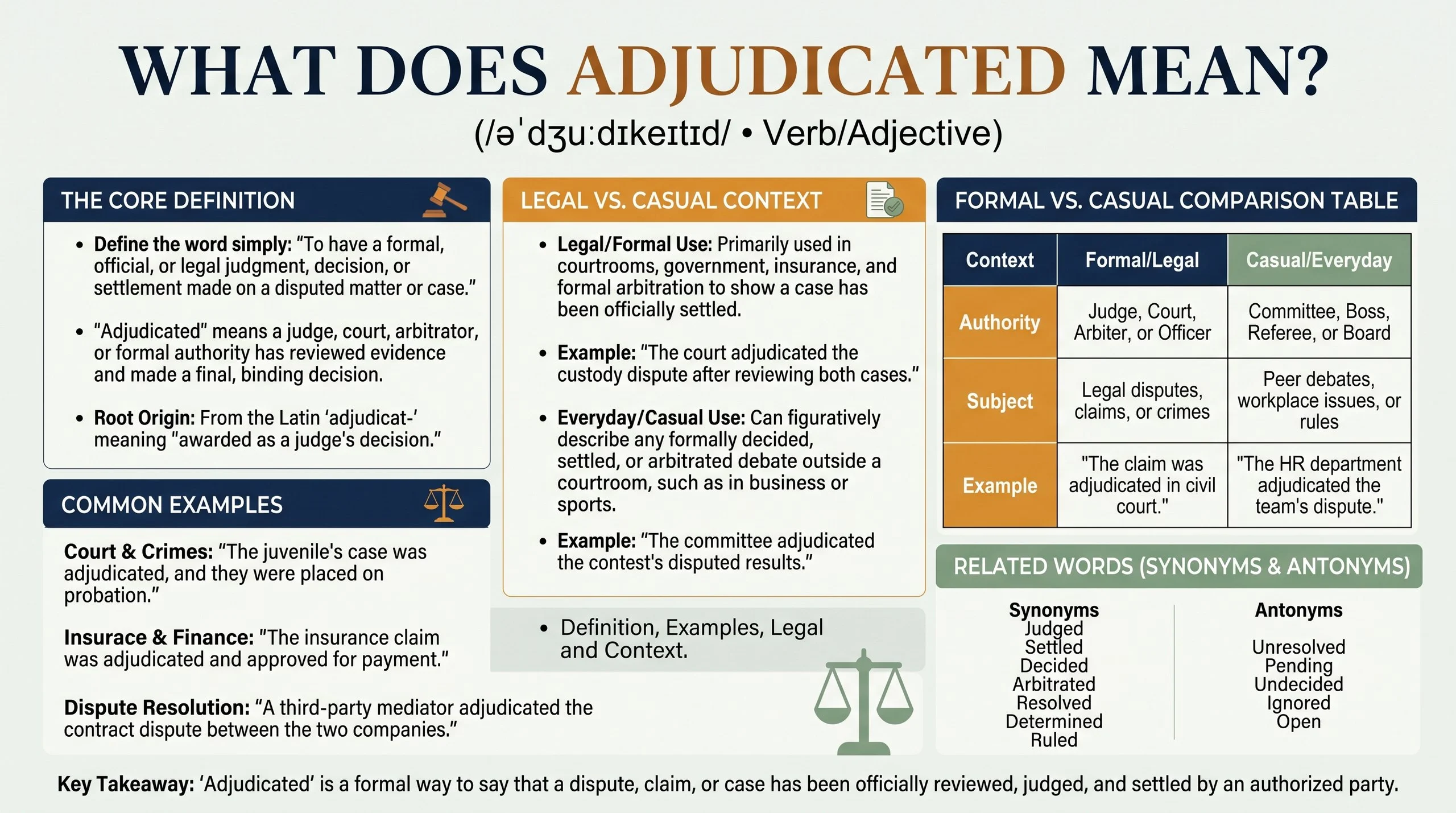
The adjudicated meaning refers to something that has been formally decided or settled by a court, judge, tribunal, or authorized decision maker. It usually describes a matter that received an official judgment after reviewing relevant facts, evidence, arguments, or claims.
The adjudicated meaning describes something that has been officially decided after a formal review, judgment, or legal process. You may encounter this word in court documents, insurance claims, government decisions, contracts, employment disputes, or other formal settings. However, many people see the term and wonder whether it simply means “decided.” In everyday language, that is close, but the word carries a more specific sense. It usually suggests that an authorized person or body examined an issue and reached a formal determination. Therefore, understanding the term requires more than memorizing one dictionary style definition. Context matters. The surrounding words can tell you whether the decision concerns a lawsuit, claim, dispute, application, or another matter. This guide explains the meaning, usage, examples, related expressions, common misunderstandings, and practical ways to understand the term in American English.
Quick Answer Box
| Meaning | Context | Primary Platforms | Example | Tone |
| Officially decided or settled | Courts, claims, disputes, government, formal decisions | Legal documents, email, websites, social posts, texting | The court adjudicated the dispute. | Formal |
| Determined by an authorized decision maker | Legal or administrative proceedings | Professional communication and documents | The claim was adjudicated after review. | Professional |
| Resolved through formal judgment | Disputes involving evidence or competing positions | Court records and official notices | The matter has been adjudicated. | Legal |
What Does Adjudicated Meaning Mean?
The simplest adjudicated meaning is “formally decided.” The word generally appears when an authorized person, court, tribunal, agency, or other decision making body determines the outcome of a matter.
For example, imagine two parties disagree about a contract. They take the dispute to court. The judge reviews the evidence and arguments, then issues a decision. At that point, the dispute has been adjudicated.
The term comes from the verb adjudicate, which means to make an official judgment or decision about a matter. The related noun adjudication refers to the process through which that decision occurs. Therefore, these three forms are closely connected:
| Word | Basic meaning | Typical use |
| Adjudicate | To formally decide a matter | The court will adjudicate the dispute. |
| Adjudicated | Formally decided | The claim was adjudicated. |
| Adjudication | The formal decision process | The case went through adjudication. |
The word often appears in legal English because courts regularly decide disputes. However, its use is not necessarily limited to traditional courtrooms. Administrative bodies, tribunals, insurance systems, and other authorized organizations can also adjudicate matters.
For example, an insurance company may adjudicate a claim. An agency may adjudicate an application or dispute. A tribunal may adjudicate a complaint.
The important idea is formal determination. Someone with recognized authority evaluates the matter and reaches a decision.
Is adjudication always about court cases?
Not necessarily. Court proceedings provide one of the clearest examples, but the word can describe other formal decision processes.
For instance, an insurance claim may be adjudicated after an organization examines the submitted information. Similarly, an administrative dispute may be adjudicated by an authorized agency.
Still, context matters. If someone says, “We finally adjudicated the argument about where to eat,” the sentence sounds humorous because the word is much more formal than the situation requires.
Contextual Dynamics and Nuances of the Term
Understanding the adjudicated meaning becomes easier when you examine how the word behaves in different situations.
The term usually carries three important ideas: authority, review, and decision.
First, there is normally an authorized decision maker. Second, the matter receives some form of formal consideration. Finally, a determination follows.
That does not mean every adjudicated matter looks exactly the same. The procedure can vary significantly depending on the setting.
Legal disputes
Legal disputes are the most familiar context. A court may adjudicate a disagreement between individuals, companies, organizations, or government entities.
For example:
The judge adjudicated the dispute after reviewing the evidence.
Here, the word emphasizes the formal nature of the judge’s decision.
Insurance claims
Insurance language frequently uses the term as well. A claim may go through an adjudication process before the organization determines whether payment should be made.
For example:
The insurance claim was adjudicated after the company reviewed the submitted records.
In this context, the word does not necessarily mean that a courtroom made the decision. Instead, it describes a formal determination within the relevant process.
Administrative decisions
Government agencies and administrative bodies can also make formal determinations.
For example:
The agency adjudicated the applicant’s appeal.
The sentence suggests that the agency had authority to evaluate the matter and issue a decision.
Employment disputes
Formal workplace disputes may involve adjudication through an authorized body or procedure.
For example:
The employment dispute was adjudicated by the appropriate tribunal.
However, you would usually not use the word for an ordinary workplace conversation.
Saying “My manager adjudicated our disagreement about the meeting time” sounds overly formal unless an official process actually occurred.
Formal versus everyday language
This distinction is important.
In ordinary conversation, people usually say:
We decided on the issue.
In a formal setting, someone might write:
The issue was adjudicated.
Both communicate a decision, but the second expression suggests an official process.
Therefore, the adjudicated meaning carries more institutional weight than simply “decided.”
Real Life Conversation Examples Using adjudicated meaning
The word can sound intimidating at first. However, these examples show how it works naturally in different settings.
Example 1: Court dispute
Maya: Did the court make a decision about the contract dispute?
Jordan: Yes. The matter was adjudicated last week.
Maya: So the judge reached a final decision?
Jordan: Exactly.
Meaning: Here, the word indicates that an authorized court formally decided the dispute.
Example 2: Insurance claim
Alex: Did your insurance company process the claim?
Sam: Yes. They said it has been adjudicated.
Alex: Does that mean they decided whether to pay it?
Sam: Yes, that is what they meant.
Meaning: In insurance language, the expression can describe a claim that has gone through a formal review and determination.
Example 3: Government application
Taylor: Did you hear back about your appeal?
Morgan: Yes. The agency adjudicated it yesterday.
Taylor: What was the result?
Morgan: They approved the appeal.
Meaning: The word indicates that the authorized agency reviewed the matter and issued a decision.
Example 4: Explaining a document
Chris: What does “adjudicated” mean on this notice?
Dana: It means the matter was formally decided.
Chris: So someone with authority reviewed it?
Dana: Right.
Meaning: This conversation shows the simplest practical explanation of the term.
Example 5: Casual joke
Jamie: Who gets the last slice of pizza?
Riley: I hereby adjudicate that you get it.
Jamie: Since when are you a judge?
Riley: Since this pizza dispute became extremely serious.
Meaning: The speaker uses the formal word humorously to make an ordinary disagreement sound like a legal case.
Platform Specific Breakdown
The term appears differently depending on where you encounter it. Formal documents usually preserve their precise meaning. Social platforms often simplify or exaggerate it for humor.
How It Is Used on Snapchat
Snapchat conversations tend to favor short, informal language. As a result, people rarely use the term seriously unless they are discussing a legal, administrative, insurance, or professional matter.
For example, someone might jokingly send:
“I have adjudicated the situation. You were right.”
That usage creates a playful contrast between serious legal language and a casual disagreement.
Another example could be:
“The group chat has adjudicated the dinner location.”
Here, nobody has actually conducted a formal legal proceeding. The word simply makes the decision sound official and dramatic.
Therefore, Snapchat usage depends heavily on tone. In serious contexts, the word retains its formal meaning. In casual contexts, it can function as humorous exaggeration.
The Role of adjudicated meaning on TikTok
TikTok often turns formal vocabulary into conversational humor. A creator may use legal sounding words to describe ordinary experiences.
For example:
“My friends adjudicated the argument, and somehow I still lost.”
The joke comes from treating a normal disagreement like a formal case.
However, educational creators may use the word literally. A legal education video could explain what happens when a court adjudicates a dispute.
Therefore, TikTok content can contain two very different uses:
| Use | Purpose | Example |
| Literal | Explain a formal decision | The court adjudicated the dispute. |
| Humorous | Make a normal event sound official | The group chat adjudicated our dinner plans. |
The surrounding content determines which interpretation makes sense.
Instagram and Texting Dynamics
Instagram captions, comments, and direct messages usually favor conversational language. Consequently, the word can sound unusual when used outside a formal topic.
Someone might write:
“After extensive research, I have decided that coffee is necessary.”
That sentence is intentionally exaggerated.
In a professional Instagram post, however, the term could appear naturally when discussing law, government, insurance, or another formal field.
Texting follows the same pattern. If someone sends “The dispute has been adjudicated,” the message sounds serious. If they send “I adjudicated the snack situation,” the tone is probably playful.
Alternative Meanings and NLP Variations of the Phrase
The word has a fairly stable core meaning, but related words can change the shade of meaning.
Formal synonyms
Several alternatives can work depending on the context.
| Alternative | Main idea | Formality |
| Decided | Reached a decision | Medium |
| Determined | Established an outcome | Medium to high |
| Ruled on | Made an official decision | High |
| Resolved | Settled an issue | Medium |
| Settled | Brought a dispute to an end | Medium |
| Judged | Reached a judgment | High |
| Determined by a court | Officially decided by a court | Very high |
| Reviewed and decided | Examined and resolved | Medium |
These words are not always perfect replacements.
For example, “resolved” can suggest that a problem ended without necessarily emphasizing a formal judgment. “Ruled on” usually sounds strongly connected to a court or judge.
Adjudicated versus decided
“Decided” is broader.
A person can decide what restaurant to visit. A manager can decide whether to approve vacation time. A court can decide a case.
By contrast, adjudication normally implies a formal or authoritative process.
Therefore:
The judge decided the case.
works naturally.
The judge adjudicated the case.
also works, but sounds more formal and technical.
Adjudicated versus resolved
“Resolved” emphasizes the ending of a problem or dispute.
“Adjudicated” emphasizes the formal decision process.
For example:
The dispute was resolved through negotiation.
This does not necessarily involve a judge.
Meanwhile:
The dispute was adjudicated by the tribunal.
suggests a formal determination by an authorized body.
Adjudicated versus approved
These words are not interchangeable.
An application may be approved after review. Yet approval describes the outcome, while adjudication describes the formal decision process.
A claim can therefore be adjudicated and then approved, denied, or otherwise determined.
Misinterpretations: When NOT to Use adjudicated meaning
Knowing when not to use a formal word can make your writing much more natural.
Do not use it for every ordinary decision
You probably would not say:
I adjudicated what to eat for breakfast.
The sentence sounds unnecessarily formal.
Instead, say:
I decided what to eat for breakfast.
Do not assume it means approved
A matter can receive an adjudication without necessarily receiving approval.
The process determines an outcome. That outcome could vary.
Therefore, avoid treating the word as a synonym for “approved.”
Do not assume it means permanently final
The exact legal effect of an adjudication can depend on the relevant rules, procedure, jurisdiction, and type of proceeding.
In ordinary language, the term means a formal decision has occurred. However, it does not automatically tell you every detail about appeals, reconsideration, enforcement, or later proceedings.
Do not use it simply because something was discussed
A meeting does not automatically constitute adjudication.
For example:
We discussed the complaint during the meeting.
That statement does not necessarily mean:
The complaint was adjudicated.
The second statement suggests a formal determination.
Do not confuse authority with confidence
Someone can confidently announce a decision without having the authority to adjudicate anything.
For example, a friend saying “I have decided who is right” does not automatically make the friend an adjudicator.
Authority and process matter.
How to Respond in Chat Comfortably
If someone uses the word in a message and you are unsure what they mean, you do not need to respond with complicated legal language.
You can simply ask:
“Do you mean it was officially decided?”
That question works because it captures the core idea.
If someone uses the term jokingly, match the tone.
For example:
“Well, Your Honor, I accept the ruling.”
Another playful option is:
“The court has spoken. I guess we are done here.”
For a professional conversation, keep your response direct:
“Thanks for confirming. I understand that the matter has now been formally decided.”
When the context is unclear
Ask for clarification rather than guessing.
You might say:
“When you say adjudicated, do you mean the claim has been formally reviewed and decided?”
This is especially useful when the word appears in an insurance notice, legal email, government letter, or workplace document.
When someone uses it incorrectly
Avoid embarrassing them. Instead, clarify the intended meaning.
For example:
“If you mean that the company approved it, ‘approved’ may be more precise. ‘Adjudicated’ usually refers to the formal decision process.”
That approach keeps the conversation useful and respectful.
FAQs
What does adjudicated mean in simple English?
The adjudicated meaning in simple English is “officially decided.” It usually refers to a decision made by a court, tribunal, agency, or another authorized decision maker after reviewing a matter.
Is adjudication the same as decided?
They can be similar, but they are not always identical in tone. “Decided” works in everyday situations, while “adjudicated” usually suggests a formal or authoritative decision process.
Does adjudicated mean approved?
No. An adjudication is a formal determination, not necessarily an approval. Depending on the circumstances, the decision may result in approval, denial, rejection, modification, or another outcome.
What does adjudication mean on an insurance claim?
On an insurance claim, it generally indicates that the claim has gone through a formal review and determination process. The exact outcome depends on the insurer and the applicable policy or procedure.
Is adjudicated a legal word?
It is strongly associated with legal language, but it can also appear in administrative, insurance, regulatory, and other formal settings. Its central idea remains an authoritative determination.
What is the difference between adjudication and judgment?
Adjudication describes the formal process of determining a matter. Judgment can refer to the decision itself, particularly in a court setting. The precise distinction can depend on context.
Can you use adjudication in everyday conversation?
Yes, but it often sounds formal. In casual conversation, people usually say “decided,” “settled,” or “figured out.” The formal word can also be used humorously.
What is an example of adjudication in a sentence?
A simple example is: “The court adjudicated the dispute after reviewing the evidence.” The sentence means that the court formally decided the dispute.
What is another word for adjudicated?
Depending on the context, possible alternatives include decided, determined, ruled on, resolved, judged, or formally settled. However, the best replacement depends on the exact situation.
Why does adjudication sound so formal?
The word is connected to formal decision making and institutional authority. Legal and administrative writing uses specialized vocabulary to describe processes precisely. Consequently, the term can sound unusual in casual texting.
Conclusion
The adjudicated meaning is straightforward once you connect it with its central idea: a matter has been formally decided by an authorized decision maker. The term commonly appears in legal, insurance, administrative, and professional contexts. However, modern internet culture sometimes borrows formal vocabulary for humor. A person might jokingly claim that a group chat “adjudicated” a disagreement, even when no official process occurred.
The key distinction is context. In a court document, the word carries a precise formal sense. In texting or social media, it may simply add dramatic humor to an ordinary decision. Therefore, use simpler alternatives such as “decided” or “settled” when casual language fits better. When formal authority and an official determination matter, the more precise term becomes useful. Understanding that difference helps you read professional documents accurately and communicate naturally in everyday American English.