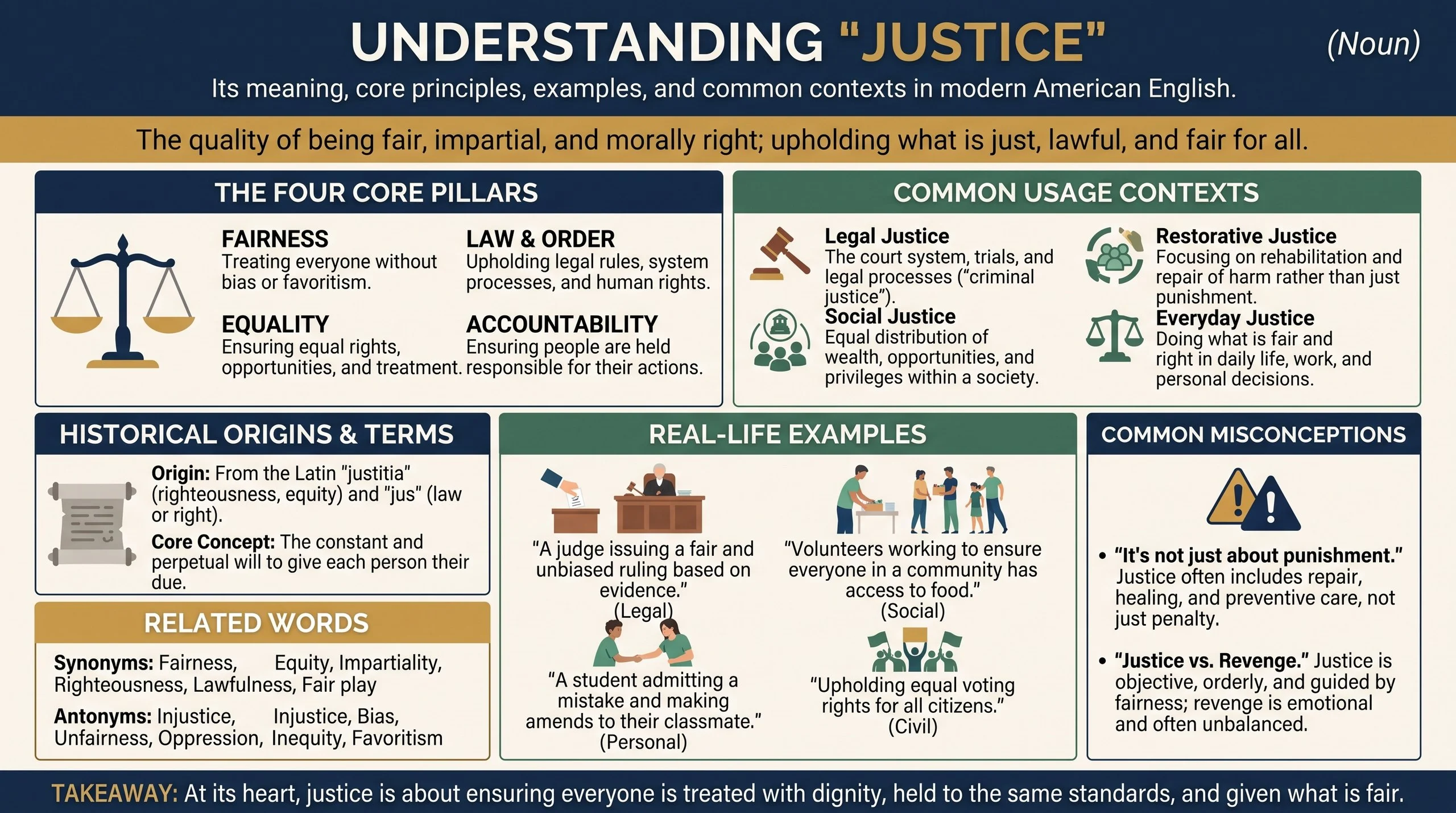
Justice meaning refers to fairness, equal treatment, and the proper application of rights, laws, or moral principles. It can describe fair decisions, lawful treatment, social equality, or the idea that people should receive what they deserve.
The justice meaning centers on fairness, rights, equality, and treating people according to accepted legal or moral standards. However, the word can mean slightly different things depending on where you see it.
For example, a judge may discuss justice in a courtroom. A student may use the word while talking about fairness at school. Meanwhile, someone on social media may say that justice was served after an unfair situation received a fair outcome.
The term also carries strong emotional weight. It can describe a personal belief, a legal principle, a social movement, or a demand for accountability. Therefore, understanding the context matters.
In everyday American English, people often connect justice with fairness. Still, the two words are not always interchangeable. Justice can involve rules, rights, consequences, institutions, and broader principles of equality.
This guide explains the term from several angles. You will learn its definition, origins, common uses, conversational meanings, related vocabulary, mistakes to avoid, and examples across modern communication.
Quick Answer Box
| Meaning | Context | Primary Platforms | Example | Tone |
| Fair treatment based on rights, laws, or moral principles | Legal, social, moral, personal | News, social media, texting, education | “They want justice for the victim.” | Serious, ethical, formal |
| A fair outcome or consequence | Everyday conversation | Texting, Instagram, TikTok | “Finally, justice was served.” | Emotional, conversational |
| A system based on laws and rights | Government and law | News, education, legal writing | “The justice system must protect rights.” | Formal |
What Does Justice Mean?
The justice meaning is fundamentally connected to fairness and rightful treatment. In broad terms, justice means giving people what they are properly entitled to receive according to law, rights, duties, or moral standards.
The word can describe both an ideal and a system.
As an ideal, justice represents fairness. For example, someone may believe that every person deserves equal treatment regardless of wealth or social status.
As a system, justice can refer to institutions and processes that enforce laws. Courts, judges, legal procedures, and correctional systems can all form parts of a justice system.
A Simple Definition
A simple definition is:
Justice is the principle or practice of treating people fairly and upholding their rights through appropriate rules, decisions, or consequences.
However, fairness alone does not explain every use. Justice can also involve accountability. If someone violates another person’s rights, a just response may involve a legal consequence.
Justice in Law
In legal contexts, justice relates closely to rights, laws, procedures, and fair treatment.
For example:
“The court’s decision sought justice for the victim.”
Here, the speaker refers to a fair legal outcome.
Legal justice does not simply mean giving someone whatever they want. Instead, it involves established procedures and legal standards.
Furthermore, a legal decision can be considered just even when one person dislikes the result. The central question is whether the process and outcome respect applicable laws and rights.
Justice in Morality
The concept also appears in moral discussions.
Someone might say:
“Justice requires treating everyone equally.”
In this sentence, the speaker is discussing an ethical principle rather than a specific court case.
Moral discussions often involve questions such as equality, responsibility, fairness, punishment, rights, and distribution of resources.
The Origin of the Word
The English word justice traces through Old French justice to Latin iustitia, a term associated with justice, fairness, and righteousness.
Over centuries, the word developed into a broad English term covering legal, moral, political, and social ideas.
Today, it appears in formal legal language as well as ordinary conversations.
Justice Versus Fairness
Justice and fairness overlap, but they are not identical.
| Word | Core Idea | Typical Use |
| Justice | Rightful and fair treatment based on principles, rights, or law | Courts, ethics, society |
| Fairness | Impartial and reasonable treatment | Everyday situations |
| Equality | Similar treatment or equal status | Rights and social policy |
| Equity | Fair treatment that considers different circumstances | Social policy and resource allocation |
| Law | A formal rule recognized and enforced by authority | Government and courts |
For example, a teacher might say, “That is not fair.”
A lawyer might instead discuss whether the decision satisfies principles of justice.
Therefore, context determines which word sounds most accurate.
Contextual Dynamics and Nuances of the Term
The justice meaning changes subtly depending on the speaker’s purpose. The word can sound formal, emotional, philosophical, political, or conversational.
Understanding these differences helps you choose the right wording.
Justice as Fair Treatment
The most common general interpretation involves fair treatment.
Example:
“Everyone deserves justice.”
This statement does not identify a specific law or court. Instead, it expresses a broad belief in fairness and rightful treatment.
Justice as Accountability
Justice can also imply that wrongdoing should have consequences.
Example:
“The family is still waiting for justice.”
This sentence may suggest that someone responsible for harm has not yet faced an appropriate consequence.
In this context, justice carries an emotional sense of resolution.
Justice as Equality
People often connect justice with equal rights and opportunities.
For example:
“Social justice focuses on fairness within society.”
Here, justice extends beyond individual disputes. It refers to broader questions involving social structures, rights, access, and treatment.
Justice as a Legal Process
The term can describe formal institutions.
Common expressions include:
| Expression | Meaning |
| Justice system | Institutions and processes involved in enforcing and interpreting law |
| Criminal justice | Legal processes concerning crimes and offenses |
| Civil justice | Legal resolution of disputes between individuals or organizations |
| Justice of the peace | A judicial or quasi judicial official in certain jurisdictions |
| Department of Justice | A government department responsible for federal law enforcement and legal matters |
| Justice served | A situation viewed as receiving an appropriate or fair outcome |
Justice as a Personal Principle
Someone may describe justice as one of their values.
Example:
“She believes strongly in justice and equality.”
This use describes a person’s moral outlook.
The term therefore does not always point to a courtroom. It can describe someone’s worldview.
Real Life Conversation Examples Using justice meaning
People rarely explain the definition directly during casual conversation. Instead, they use the word naturally to express fairness, accountability, or a desired outcome.
Example 1: Talking About a Court Case
Maya: “Did you hear the court finally made a decision?”
Jordan: “Yes. I hope the decision brings justice to the family.”
Maya: “They have waited a long time.”
Meaning: Here, justice refers to a fair legal outcome that recognizes the harm suffered by the family.
Example 2: Discussing an Unfair Situation
Alex: “They blamed her for something she didn’t do.”
Sam: “That’s not right. She deserves justice.”
Alex: “I agree. Hopefully, the truth comes out.”
Meaning: The speaker uses justice to mean fair treatment and correction of an unfair situation.
Example 3: Talking About Social Issues
Taylor: “Why are people protesting?”
Chris: “They’re calling for social justice and equal treatment.”
Taylor: “So they’re asking for changes to the system?”
Chris: “Exactly.”
Meaning: Justice here refers to broader social fairness rather than one individual legal dispute.
Example 4: Discussing a Workplace Decision
Manager: “We reviewed everyone’s performance before making the decision.”
Employee: “I appreciate that. I just wanted the process to be fair.”
Manager: “That was our goal.”
Meaning: The conversation demonstrates the connection between justice and fair procedures.
Example 5: A Casual Expression
Nina: “You ate my last cookie?”
Leo: “I did.”
Nina: “Justice will be served.”
Leo: “Okay, that sounds threatening.”
Meaning: The phrase is being used humorously. The speaker exaggerates a minor situation for comedic effect.
This example shows why tone matters. A serious word can become playful when used in an obviously trivial situation.
Platform Specific Breakdown
The term appears across modern digital platforms, but users often adjust its tone based on the platform.
How It Is Used on Snapchat
On Snapchat, justice usually appears in informal messages, reactions, stories, or captions.
Users might post:
“Justice was served.”
They may be talking about anything from a serious event to a humorous personal situation.
For example, someone might post a screenshot showing that a friend finally admitted being wrong. The caption could use justice humorously.
However, serious events require greater care. Using jokes around tragic situations can appear insensitive.
Therefore, consider the emotional context before using the term.
The Role of justice meaning on TikTok
TikTok frequently turns serious concepts into short explanations, commentary, storytelling, and cultural discussions.
The justice meaning may appear in videos about:
• Legal cases
• Social movements
• Historical events
• Personal experiences
• Workplace disputes
• Community issues
• Fairness debates
• Educational content
Creators may also use phrases such as “justice served” as a punchline.
For example, a creator could show a harmless prank followed by an amusing consequence and caption it:
“Justice served.”
The audience understands that the phrase is playful because the situation is minor.
TikTok therefore demonstrates how context can change the emotional force of a word.
Instagram and Texting Dynamics
Instagram captions often use justice in emotional or socially conscious posts.
A serious caption might say:
“We continue to stand for justice and equality.”
A humorous caption might say:
“Justice for the last slice of pizza.”
The first sentence uses the term seriously. The second uses deliberate exaggeration.
Texting tends to be even more flexible.
A friend might write:
“You finally got caught? Justice 😂”
The emoji signals a playful interpretation.
Without the emoji, the same sentence could sound more serious.
Therefore, digital communication often depends on surrounding clues.
Alternative Meanings and NLP Variations of the Phrase
Natural language processing systems need to recognize that one word can represent several related concepts.
Search engines and language models may connect justice with a large semantic field.
Common Semantic Variations
Relevant terms include:
| Related Term | Meaning or Connection |
| Fairness | Reasonable and impartial treatment |
| Equality | Equal status or treatment |
| Equity | Fairness that considers differing circumstances |
| Rights | Entitlements or protections recognized by law or principle |
| Law | Formal rules enforced by authority |
| Morality | Principles about right and wrong |
| Accountability | Responsibility for actions and consequences |
| Impartiality | Avoiding favoritism or bias |
| Righteousness | Morally correct conduct |
| Judgment | A decision or evaluation |
| Redress | Remedy for a wrong or harm |
| Reparation | Compensation or remedy for wrongdoing |
| Due process | Fair legal procedures |
| Punishment | A consequence imposed for wrongdoing |
| Mercy | Compassion that may reduce punishment |
These terms overlap, but they should not be treated as perfect synonyms.
Justice and Equality
Equality means treating people equally or recognizing equal rights.
Justice can include equality, but it can also involve other principles.
For example, two people may need different forms of assistance to reach a fair result. In that situation, simply giving both people exactly the same thing may not produce an equitable outcome.
Justice and Equity
Equity focuses on fairness while considering circumstances.
Justice can be broader. It may include equity, equality, legal rights, accountability, and institutional processes.
Therefore, replacing one term with the other can change the meaning.
Justice and Revenge
These concepts are particularly important to separate.
Revenge is usually driven by a desire to retaliate against someone who caused harm.
Justice, by contrast, is generally associated with fairness, rightful consequences, and recognized principles.
Someone may emotionally describe revenge as justice, but the concepts are not inherently identical.
Justice and Punishment
Punishment is a consequence for wrongdoing.
Justice may involve punishment, but it does not always require it.
A justice focused approach may also involve compensation, restoration, rehabilitation, reconciliation, or other remedies.
Misinterpretations: When NOT to Use justice meaning
Although the word is versatile, it can sound inappropriate when the situation is too minor, unclear, or unrelated to fairness.
Do Not Use It for Every Disagreement
Not every disagreement represents an issue of justice.
For example:
“My friend prefers pizza, but I prefer burgers.”
Calling this a matter of justice would sound exaggerated.
Instead, words such as preference, disagreement, or opinion fit better.
Avoid Using It When You Mean Revenge
Consider:
“I want justice because he embarrassed me.”
This statement may suggest a desire for retaliation rather than a fair remedy.
If you simply want an apology, say so.
“I want him to apologize.”
That statement communicates the desired outcome more clearly.
Be Careful With Serious Events
Justice often appears in conversations involving victims, crime, discrimination, inequality, or social harm.
Using the term casually in those settings can appear dismissive.
For example, joking about a serious court case may offend people affected by it.
Do Not Treat Justice as a Universal Synonym
Replacing justice with fairness always can weaken your writing.
Consider:
“The justice system.”
You cannot naturally replace this with:
“The fairness system.”
The second phrase does not carry the same institutional meaning.
How to Respond in Chat Comfortably
If someone uses justice in a message, your response should match the seriousness of the conversation.
When the Message Is Serious
You can respond with:
“I understand. I hope the situation gets resolved fairly.”
Or:
“I agree. Everyone deserves to be treated fairly.”
These responses acknowledge the person’s concern without exaggerating it.
When Someone Says “Justice Served”
A casual response might be:
“Honestly, finally 😂”
Or:
“Looks like things worked out.”
When You Disagree
You can remain respectful:
“I see your point, but I think there are more factors to consider.”
This approach works especially well during sensitive discussions.
When You Need Clarification
Try:
“What would justice look like in this situation to you?”
This question encourages the other person to explain their perspective.
When the Conversation Is Humorous
If someone uses the word jokingly, you can play along:
“The justice department has spoken 😂”
This works when both people clearly understand that the situation is harmless.
FAQs
What is the justice meaning in simple English?
In simple English, justice means fair and rightful treatment. It can involve equal rights, fair decisions, appropriate consequences, or correcting an unfair situation.
Is justice the same as fairness?
Not exactly. Fairness means treating people reasonably and impartially. Justice is broader and can involve laws, rights, accountability, moral principles, and social systems.
What does “justice served” mean?
“Justice served” usually means that someone believes a fair or appropriate outcome has occurred. In serious contexts, it may refer to legal accountability. In casual settings, it can be humorous.
Can justice have a positive meaning?
Yes. Justice usually carries a positive ethical meaning when people use it to describe fairness, equal rights, accountability, or protection from wrongdoing.
Is justice a legal word?
Justice is widely used in legal contexts, but it is not limited to law. People also use it when discussing morality, society, politics, education, relationships, and personal values.
What is the difference between justice and revenge?
Justice aims at a fair and appropriate response based on recognized principles. Revenge focuses on retaliation. The two may appear together in emotional conversations, but they represent different ideas.
Can I use justice in casual texting?
Yes, but context matters. People often use it humorously in casual messages, especially with phrases such as “justice served.” However, serious situations require a respectful tone.
What are common synonyms for justice?
Depending on the context, related words include fairness, equity, impartiality, righteousness, accountability, and lawful treatment. None is a perfect replacement in every sentence.
What does social justice mean?
Social justice refers to principles and efforts focused on fairness, equal rights, opportunity, dignity, and treatment within society. The phrase commonly appears in discussions about social institutions and public policy.
Why does justice have different meanings?
The word operates across several domains. Law, morality, politics, everyday conversation, and social media can each emphasize different aspects of the concept. Context therefore determines its precise interpretation.
Conclusion
The justice meaning reaches far beyond a simple dictionary definition. It connects fairness, rights, accountability, law, morality, and social equality.
In formal writing, the word can describe legal principles or institutions. In everyday conversation, it can describe a fair outcome. On social media, people may even use it humorously to describe a minor consequence.
Therefore, context remains the key to using the term well.
If you are writing for school, work, legal discussion, or social media, consider the tone before choosing the word. A serious situation may require precise and respectful language. A playful situation can support a lighter expression.
Ultimately, justice describes an important human idea: people should receive fair treatment and appropriate responses to their actions and circumstances. Understanding that broader concept makes it easier to recognize and use the word naturally across modern American English.