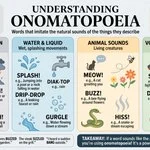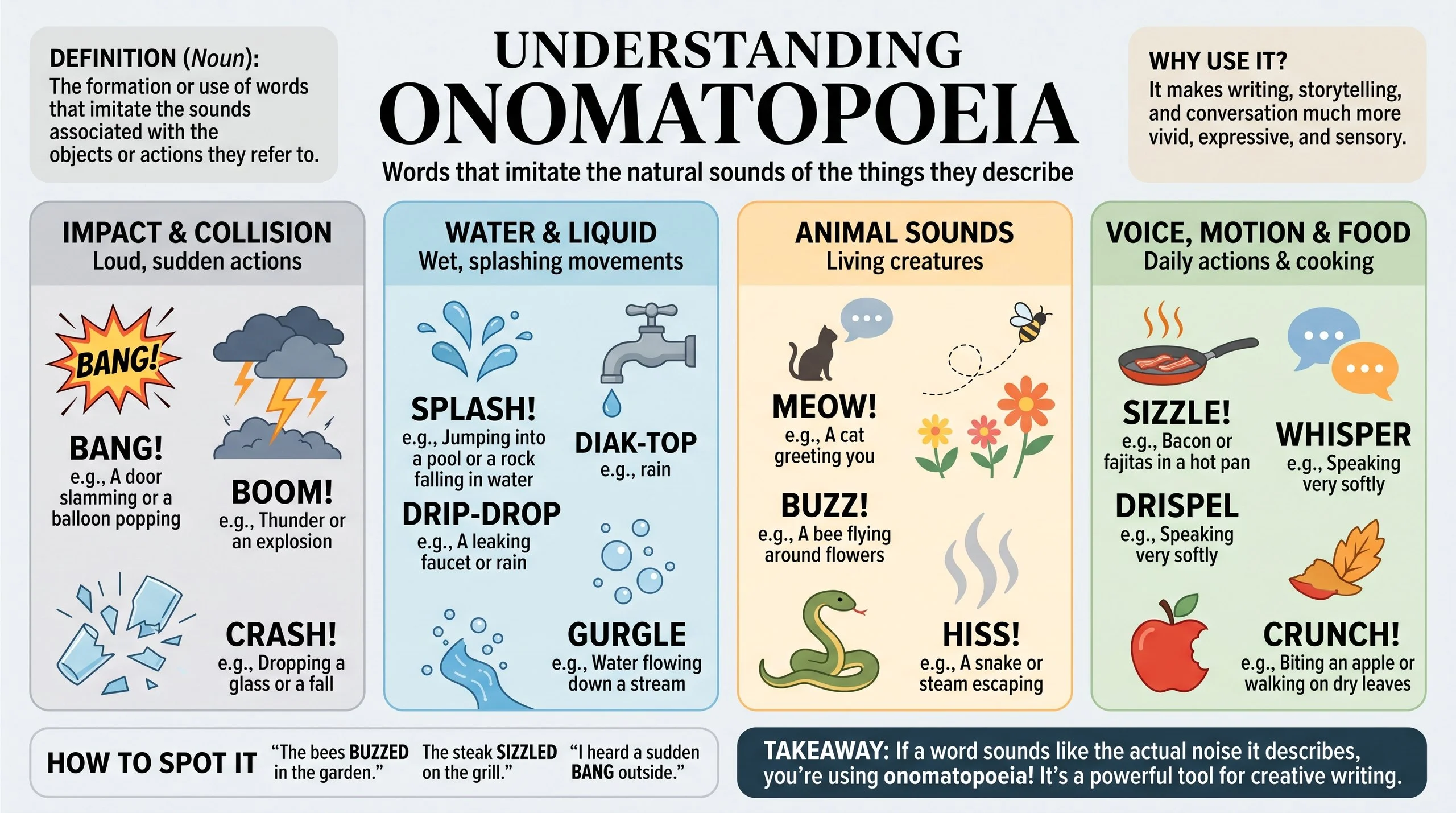
Onomatopoeia meaning refers to a word that imitates or suggests the sound associated with what it describes. Common examples include “buzz,” “hiss,” “bang,” “meow,” and “clang.” Writers use these sound words to make descriptions vivid, expressive, and easier to imagine.
onomatopoeia meaning describes a word that imitates, resembles, or evokes a real sound. For example, “buzz” suggests the sound made by a bee, while “crash” can suggest something breaking or falling loudly. These words appear everywhere, from comic books and novels to social media captions, text messages, advertisements, songs, and everyday speech.
However, onomatopoeia is more than a collection of funny sound words. It is a linguistic technique that connects language with sensory experience. When readers see “drip,” they can almost hear water falling. When someone writes “whoosh,” the word can create an immediate impression of fast movement.
Furthermore, different languages often represent the same sound differently. That difference shows that onomatopoeia can imitate real sounds while still being shaped by language and culture.
This guide explains the definition, origin, examples, context, pronunciation, common mistakes, digital usage, and practical applications of this expressive language device.
Quick Answer Box
| Meaning | Context | Primary Platforms | Example | Tone |
| A word that imitates or suggests a sound | Writing, speech, comics, literature, social media | TikTok, Instagram, Snapchat, texting, blogs | “The bees buzzed.” | Expressive, vivid, playful |
What Does onomatopoeia Mean?
The term refers to the use of a word whose sound is connected to the noise, action, or sensation it represents. In simple terms, the word itself can sound somewhat like the thing being described.
Consider these examples:
- Buzz suggests the sound of a bee or an electrical device.
- Hiss resembles the sharp sound produced by escaping air or a snake.
- Boom suggests a deep, powerful sound.
- Splash represents the sound or action associated with liquid hitting a surface.
- Tick tock imitates the repeated sound of a clock.
- Pop can represent a short explosive sound.
- Crack can suggest a sudden sharp noise.
- Sizzle represents food cooking on a hot surface.
- Chirps suggest a small bird’s sound.
- Meow represents the vocal sound associated with a cat.
The important point is that these words do not merely describe sounds. Their phonetic form contributes to the impression they create.
The Origin of the Word
The English word “onomatopoeia” comes from Greek roots associated with creating or making a name. The term entered English through Latin and French linguistic traditions.
Interestingly, the concept is ancient. People have long noticed that certain sounds can be represented through vocal imitation. However, languages do not copy sounds perfectly. Each language adapts those sounds to its own pronunciation system and vocabulary.
For example, an English speaker may write a dog’s sound as “woof,” while another language may represent the same bark differently. The animal makes the same physical sound, but humans interpret and spell it through different linguistic systems.
Is It a Word or a Literary Device?
It can be both.
Some onomatopoeic expressions function as ordinary vocabulary. Words such as “buzz,” “whisper,” and “clang” can appear naturally in everyday sentences.
At the same time, writers use onomatopoeia as a literary technique. In poetry, fiction, comics, and creative nonfiction, sound based vocabulary can strengthen imagery and atmosphere.
Therefore, it is useful to distinguish between the word itself and the literary technique involving sound imitation.
Contextual Dynamics & Nuances of the Term
The meaning and effect of a sound word can change depending on context. A word like “boom” might describe thunder, an explosion, music, a business success, or a dramatic moment.
Context determines the intended interpretation.
Literal Sound Use
The most straightforward use involves an actual sound.
The door slammed shut with a loud bang.
Here, “bang” directly represents the sound.
Figurative Use
Some sound words develop figurative meanings over time.
For example, “boom” can describe rapid economic growth:
The technology industry experienced a major boom.
In this sentence, no physical explosion occurs. The word carries an energetic association from its sound based meaning into a figurative context.
Emotional Effect
Sound words can also influence mood.
A gentle “purr” can create a calm feeling. By contrast, “crash,” “bang,” or “scream” can create tension.
Consequently, writers often select these words based on the emotional response they want readers to experience.
Strong Versus Soft Sound Words
Sound vocabulary exists across a broad intensity range.
| Softer or gentler | Stronger or sharper |
| murmur | crash |
| whisper | bang |
| rustle | slam |
| purr | boom |
| drip | crack |
| chirp | roar |
The distinction is not absolute. Context can change how powerful a word feels.
Onomatopoeia Versus Sound Description
Not every sound related word is equally imitative.
“Thunder” names the phenomenon associated with a sound. “Boom” attempts to represent the sound itself.
Likewise, “bird” identifies an animal, while “chirp” represents a sound associated with some birds.
This difference helps explain why sound imitation is central to the concept.
Real Life Conversation Examples Using onomatopoeia meaning
Sound words appear naturally in conversations, especially when people describe events quickly or dramatically. They also appear frequently in texts because they can communicate an experience without a long explanation.
Example 1: Describing a Kitchen Sound
Maya: Did you hear that?
Alex: Yeah. The pan just went sizzle.
Maya: I guess dinner is officially happening.
Usage: Someone uses “sizzle” casually while describing food cooking in a pan.
Meaning: The word recreates the sharp, continuous sound produced by hot food or liquid meeting a heated surface.
Example 2: Describing a Sudden Noise
Jordan: Why did everyone jump?
Sam: Something fell in the hallway. It crashed.
Jordan: Okay, that explains it.
Usage: A person uses “crash” to quickly communicate the intensity of an unexpected noise.
Meaning: The word suggests a loud collision, fall, or breaking sound.
Example 3: Describing a Phone Notification
Taylor: Did your phone just go ding?
Morgan: Yep. New message.
Taylor: I knew it.
Usage: Someone uses “ding” to imitate a familiar notification sound.
Meaning: The expression represents a short, clear electronic tone.
Example 4: Describing Rain
Chris: I love staying inside when it rains.
Riley: Same. Just hearing the pitter patter outside is relaxing.
Usage: The speaker uses a repeated sound expression to describe light, rhythmic rain.
Meaning: “Pitter patter” suggests a series of small, repeated sounds.
Example 5: Describing a Fast Vehicle
Nina: That motorcycle disappeared so fast.
Evan: I only heard vroom and then nothing.
Nina: Seriously.
Usage: The speaker uses “vroom” playfully to imitate an engine.
Meaning: The word communicates speed and engine noise in a humorous way.
These examples show that sound words do not need to appear in formal writing. They can work naturally in casual speech, texting, captions, and online conversations.
Platform Specific Breakdown
Different digital platforms encourage different forms of expressive language. Sound words work particularly well online because they create visual and auditory associations without requiring lengthy descriptions.
How It Is Used on Snapchat
Snapchat communication is usually fast, visual, and informal. Users often combine photos, short videos, captions, stickers, and text overlays.
A sound word can make a snap feel more immediate.
Examples include:
“Boom. Done.”
“Sizzle mode activated.”
“Whoosh, there goes my weekend.”
“Crash. My plans are officially ruined.”
These expressions do not always represent literal sounds. Instead, they can add personality to an image or video.
For example, someone posting a picture of a completed project might write “boom” to signal accomplishment. Someone posting a failed cooking attempt might use “sizzle” humorously.
The Role of onomatopoeia meaning on TikTok
TikTok provides an especially strong environment for sound based language because audio is central to the platform.
Creators can use written sound effects in captions, comments, text overlays, and scripts. A word such as “boom” can reinforce a visual transition. “Whoosh” can emphasize movement. “Pop” can highlight a sudden reveal.
However, TikTok usage often depends on the video’s context.
A creator might write:
“POV: Your productivity finally kicks in. Boom.”
The word creates a sense of sudden impact. It does not necessarily represent a literal explosion.
Another creator could caption a fast transition:
“And whoosh, the outfit changed.”
Here, the sound word supports the visual movement.
Instagram and Texting Dynamics
Instagram captions often rely on concise, expressive language. Sound words can make a caption more playful without adding much length.
For example:
“Coffee machine goes brrrr.”
“Pop. New chapter.”
“Sizzle season.”
“Boom, weekend plans.”
Texting works similarly. Friends may use “ugh,” “hmm,” “wow,” “boom,” “oops,” or other expressive forms to reproduce reactions or sounds.
Still, not every expressive interjection qualifies as strict onomatopoeia. Some expressions primarily represent emotional reactions rather than physical sounds.
That distinction matters when discussing language academically.
Alternative Meanings & NLP Variations of the Phrase
Search engines and language models may encounter several related forms of the concept. Understanding these variations helps writers choose more precise wording.
Common Semantic Variations
| Variation | Meaning or Relationship |
| Sound word | A broad term for words representing sounds |
| Sound effect | A performed or recorded sound, often used in media |
| Sound symbolism | A broader relationship between sound and meaning |
| Imitative word | A word formed or used through imitation |
| Expressive word | Language designed to create a strong sensory effect |
| Auditory imagery | Language that helps readers imagine sounds |
| Literary device | A broader category that can include sound based techniques |
These terms overlap, but they are not interchangeable in every context.
Onomatopoeia and Sound Symbolism
Sound symbolism is broader. It describes relationships between linguistic sounds and perceived meaning.
Onomatopoeia involves a particularly recognizable relationship between a word and an associated sound.
For example, “hiss” has a direct sound association. However, sound symbolism can involve subtler patterns that do not imitate an actual environmental noise.
Onomatopoeia and Interjections
Interjections express reactions or emotions.
Words such as “wow,” “ouch,” and “ugh” can represent spontaneous human responses. Some may have sound expressive qualities, but they should not automatically be labeled as onomatopoeia.
This distinction becomes useful in academic writing and language analysis.
Onomatopoeia in Comics
Comics provide one of the clearest examples of visual sound language.
Writers and artists may use large words such as:
BAM!
POW!
CRASH!
THUD!
The typography itself becomes part of the communication. Size, placement, shape, and lettering can amplify the perceived intensity.
Therefore, comic book sound effects demonstrate how language can move beyond ordinary sentences and interact directly with visual design.
Misinterpretations: When NOT to Use onomatopoeia meaning
Although sound words are flexible, they do not belong everywhere.
Avoid Forced Sound Words
A formal business report usually does not need phrases such as “boom” or “bang” unless they communicate a specific technical meaning.
Instead, choose precise professional language.
For example:
Informal: The project went boom overnight.
Professional: The project expanded rapidly over a short period.
The best choice depends on the audience and purpose.
Do Not Treat Every Sound Related Word as Onomatopoeia
A word can describe something associated with sound without imitating that sound.
For example, “music” refers to organized sound. It does not imitate music.
Similarly, “noise” identifies an auditory phenomenon but does not reproduce a particular noise.
Be Careful With Technical Writing
Scientific and technical contexts usually prioritize precision.
A medical, engineering, or laboratory document might use exact terminology rather than playful sound effects.
However, an educational article can introduce complex ideas with vivid examples before switching to technical vocabulary.
Do Not Assume All Languages Imitate Sounds Identically
One common misconception is that an animal sound has one universal written form.
Languages interpret and represent sounds differently. Pronunciation systems, spelling conventions, cultural patterns, and linguistic history all influence the final word.
Therefore, different representations can describe the same physical sound without one being inherently incorrect.
How to Respond in Chat Comfortably
When someone uses a sound word in a message, the best response depends on what they are trying to communicate.
If the expression is playful, match the energy.
Casual Responses
“LOL, literally.”
“And there it goes.”
“I can hear it already.”
“That sound says everything.”
Funny Responses
“Sound effects included? Nice.”
“10 out of 10 for dramatic audio.”
“Okay, that was basically a whole movie scene.”
Professional Responses
In a workplace conversation, respond to the actual meaning rather than focusing on the sound effect.
For example, if someone writes “Boom, the report is finished,” a natural professional response could be:
“Great, thanks for getting it done.”
This approach acknowledges the achievement without forcing an overly playful tone.
When Someone Uses a Sound Word Figuratively
Context matters even more here.
If someone says:
“Boom, problem solved.”
They probably mean that a problem has been resolved quickly or successfully.
A natural response could be:
“Nice. What was the fix?”
The phrase does not require a literal discussion of sound.
When Humor Is Appropriate
Humor works well with friends, casual group chats, captions, and social media.
However, sensitive conversations require more care. If someone describes an accident, conflict, or frightening event with a sound word, avoid turning the expression into a joke.
Tone should follow the emotional situation.
FAQs
What is onomatopoeia meaning in simple English?
It means a word that imitates or suggests a sound. Examples include “buzz,” “hiss,” “bang,” “meow,” “splash,” and “clang.” The sound of the word has a noticeable connection with the sound being described.
Is “buzz” an example of onomatopoeia?
Yes. “Buzz” is commonly considered an onomatopoeic word because its sound resembles the continuous noise associated with bees, insects, and some machines. Its exact meaning depends on the sentence and context.
Is “meow” onomatopoeia?
Yes. “Meow” represents a sound associated with cats. It is one of the easiest examples because the spoken word closely resembles the animal sound it describes.
Why do writers use sound words?
Writers use them to create vivid sensory imagery. A sound word can help readers imagine an event more quickly than a long description. As a result, these words are especially useful in fiction, poetry, comics, advertising, and children’s literature.
What is the difference between onomatopoeia and a sound effect?
A sound effect is an actual produced, recorded, or performed sound. Onomatopoeia is a linguistic representation of a sound. For example, a movie may use a recorded explosion, while “boom” can represent that explosion in written language.
Can onomatopoeia be used in formal writing?
Yes, but carefully. Literary, educational, journalistic, and descriptive writing can use sound based words effectively. However, highly technical or formal documents usually favor precise terminology over playful expressions.
Why are sound words common in comics?
Comics combine language with visual storytelling. Large words such as “BAM,” “POW,” and “CRASH” can communicate action and intensity instantly. Typography, placement, and lettering can make the effect even stronger.
Does every language use the same onomatopoeic words?
No. Languages often represent the same sounds differently. Linguistic structure, pronunciation, spelling, and cultural conventions influence how sounds become written words.
Is “wow” an example of onomatopoeia?
Usually, “wow” is classified as an interjection rather than a straightforward example of onomatopoeia. It expresses surprise or admiration instead of directly imitating an external sound.
How can I identify an onomatopoeic word?
Ask whether the word imitates, echoes, or strongly suggests a recognizable sound. If its pronunciation has a noticeable connection with the sound it represents, it may be onomatopoeic. Context should guide the final classification.
Conclusion
Understanding onomatopoeia meaning reveals how closely language can connect with sound, movement, emotion, and imagination. Words such as “buzz,” “splash,” “crash,” “sizzle,” and “chirp” can turn a basic description into something readers can almost hear.
At the same time, modern digital communication has expanded how people use expressive language. Social media captions, texting, memes, comics, short videos, and online conversations frequently use sound words for humor, emphasis, and personality.
However, not every expressive word is technically onomatopoeic. Context and linguistic function still matter.
Ultimately, the power of these words comes from their immediacy. They make language feel active, sensory, and alive. Whether you are writing a novel, explaining a concept, creating a caption, or sending a funny text, the right sound word can communicate an entire moment with just a few letters.