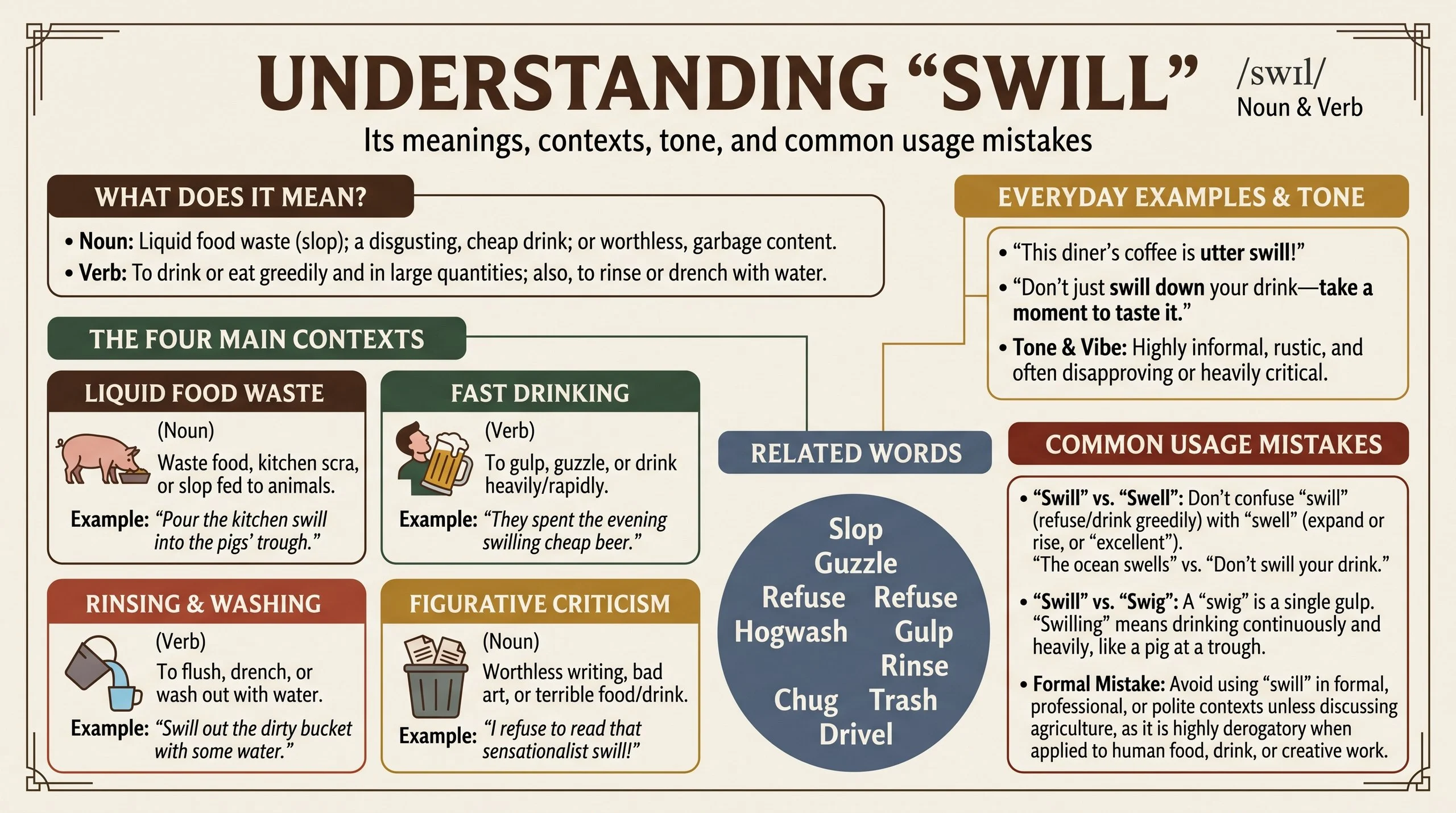
Swill meaning refers to liquid food waste, especially watery leftovers given to animals, or the act of washing something with water. As a verb, it can also mean drinking something quickly or in large amounts. Context determines the intended sense.
Swill meaning can seem simple at first, yet the word has several distinct uses that change significantly with context. In everyday English, swill may describe leftover food mixed with liquid, the act of rinsing something, or drinking something quickly and without much care.
Moreover, the word often carries a negative or rough tone. Someone might describe poor quality food as “swill,” for example. In another sentence, a person might say that someone “swilled down” a drink. The meaning changes because the grammatical role and surrounding words change.
This guide explains the word from several angles. You will learn its dictionary sense, historical background, modern usage, conversational tone, social media relevance, common misunderstandings, and practical examples.
Although the term is not primarily modern internet slang, people may encounter it in memes, comments, movies, casual conversations, reviews, and online arguments. Therefore, understanding its emotional tone matters just as much as knowing its basic definition.
Quick Answer Box
| Meaning | Context | Primary Platforms | Example | Tone |
| Liquid food waste or scraps mixed with liquid | Traditional or agricultural use | General English | The pigs were fed swill. | Neutral or practical |
| To wash or rinse with liquid | Verb usage | General English | Swill the bucket with water. | Neutral |
| To drink quickly or greedily | Informal usage | Conversation and literature | He swilled his coffee. | Informal |
| Something considered low quality | Figurative usage | Reviews, arguments, social media | That movie is absolute swill. | Negative |
| Poor food or drink | Critical description | Food and casual speech | The cafeteria served swill. | Strongly negative |
What Does swill Meaning Mean?
The word swill has several related meanings. Its most traditional noun sense refers to liquid food waste. This material may contain kitchen scraps, water, and other leftover food. Historically, people commonly used it as animal feed, particularly for pigs.
As a verb, swill can mean to wash or rinse something with water or another liquid. For example, someone might swill out a container after using it. In this sense, the action involves moving liquid around a vessel to clean it.
There is another important verbal sense. To swill a drink means to drink it quickly, heavily, or without much delicacy. The expression often suggests that the person is consuming the drink in a careless or excessive way.
The word can also become figurative. When someone calls food, writing, entertainment, or another product “swill,” they usually mean that it is cheap, poor quality, unpleasant, or worthless. Therefore, the word can express strong criticism.
Is swill a noun or a verb?
It can be both.
As a noun, swill can describe liquid food waste or something regarded as very poor quality.
As a verb, swill can describe rinsing something or drinking something quickly.
For example:
- Noun: The farmer prepared swill for the pigs.
- Noun: That website is full of political swill.
- Verb: Swill the container before putting it away.
- Verb: He swilled his drink and left.
- Verb: She swilled water around her mouth.
Therefore, you should look at the entire sentence rather than interpreting the word in isolation.
What is the basic definition?
The simplest definition depends on the grammatical context.
When used as a noun, the word can mean liquid food waste or something considered worthless. When used as a verb, it can mean rinsing with liquid or drinking quickly.
Consequently, a dictionary style definition alone may not tell you exactly what a speaker intends. The surrounding words provide the necessary clue.
Where does the word come from?
The word has a long history in English. It is associated with older English terms connected with washing, rinsing, and liquid waste. Its historical development helped produce the modern meanings associated with liquid movement, animal feed, and careless drinking.
The word therefore predates modern social media by many centuries. Its internet appearances are simply newer examples of an established English word.
Contextual Dynamics and Nuances of the Term
Context is especially important with this word because its emotional force can change quickly.
Consider the difference between “swill the bucket” and “this food is swill.” The first statement gives a practical instruction. The second delivers an insult or strong criticism.
Similarly, “he swilled his drink” does not necessarily mean that he drank alcohol. The phrase describes the manner of drinking. The exact beverage must come from the surrounding context.
Literal agricultural context
The traditional agricultural sense refers to liquid food material used as animal feed. It may contain food scraps and other suitable leftovers.
This use appears more often in historical writing, farming discussions, older literature, or descriptions of traditional animal husbandry.
For example:
The farmer collected the kitchen scraps and prepared swill for the pigs.
Here, the word has a literal meaning. There is no insult involved.
Cleaning and rinsing context
The verb can also describe rinsing something thoroughly with liquid.
For example:
Swill the pan with hot water before washing it.
This construction may sound somewhat old fashioned in contemporary American English. However, it remains understandable.
In many everyday situations, Americans would more naturally say “rinse,” “wash,” or “flush out.”
Drinking context
The drinking sense creates a more informal image.
If someone says:
He swilled down his coffee before the meeting.
The sentence emphasizes speed and manner. It suggests that he drank the coffee quickly.
Likewise:
They swilled beer all afternoon.
This sounds informal and somewhat judgmental. Depending on the context, it can suggest heavy or careless drinking.
Figurative criticism
The figurative sense is especially common when people want to criticize something strongly.
A reviewer might write:
The show was two hours of political swill.
Here, swill does not refer to actual liquid food. Instead, the speaker considers the show worthless or unpleasant.
The same pattern can describe writing, entertainment, advertising, opinions, or information.
For example:
I am tired of reading this online swill.
The speaker considers the material low quality.
Emotional intensity
The word generally has a negative association when used figuratively.
It can communicate disgust, contempt, frustration, or dismissal. Therefore, it may sound harsher than alternatives such as “bad,” “weak,” or “poor quality.”
However, tone depends on the sentence. A farmer discussing animal feed may use the term without emotional judgment.
Real Life Conversation Examples Using swill meaning
The following conversations demonstrate how context changes interpretation.
Example 1: Discussing poor food
Alex: How was the cafeteria today?
Jordan: Honestly, the lunch was swill.
Alex: That bad?
Jordan: The vegetables were cold, and the sauce tasted terrible.
Here, the speaker uses the word as a strong criticism of food quality. The term communicates more emotion than simply saying “bad food.”
Example 2: Talking about drinking
Mia: Did Ryan finish his coffee?
Chris: He swilled it down before we even left.
Mia: He must have been running late.
Here, the verb describes rapid drinking. The sentence does not necessarily insult the beverage itself.
Example 3: Historical or farming context
Ben: What did people traditionally feed pigs?
Laura: One common option was swill made from suitable food leftovers.
This example uses the traditional noun sense. The word does not function as an insult.
Example 4: Online criticism
Sam: Did you read that article?
Taylor: Unfortunately, yes.
Sam: Was it useful?
Taylor: Not really. It was mostly sensationalist swill.
Here, the speaker uses the word figuratively to dismiss the article as low quality.
Example 5: Cleaning a container
Nora: What should I do with this bucket?
Evan: Swill it out with clean water first.
This is a practical verbal use. The meaning is close to “rinse” or “wash out.”
Platform Specific Breakdown
The word does not belong exclusively to internet slang. Nevertheless, its figurative meaning can appear across online platforms.
Social media users often use strong vocabulary for humorous exaggeration. As a result, a traditional English word can acquire a fresh conversational role without becoming genuine internet slang.
How It Is Used on Snapchat
Snapchat conversations tend to be informal and highly contextual. If someone uses swill there, the intended meaning will usually come from the surrounding message.
For example:
“That cafeteria food was swill 😭”
The speaker probably means the food was awful. The emoji reinforces the humorous or dramatic tone.
Another example might be:
“Bro swilled that energy drink.”
Here, the verb describes rapid drinking.
However, users may also use the word jokingly. A friend could call an intentionally terrible snack “swill” as a playful exaggeration.
Therefore, do not assume that every social media use has a serious negative meaning.
The Role of swill meaning on TikTok
TikTok language changes quickly. Traditional words often appear in captions, comments, jokes, reaction videos, and storytelling.
The word can work particularly well in humorous criticism because it sounds stronger and more dramatic than ordinary words such as “bad.”
For example:
“POV: You paid $18 for this swill.”
The creator may be criticizing expensive food.
Similarly:
“Why am I still watching this swill?”
This could describe a deliberately terrible reality show, movie, or viral clip.
TikTok users may also use unusual vocabulary precisely because it sounds funny. The slightly old fashioned quality of the word can make an insult more theatrical.
Instagram and Texting Dynamics
Instagram captions and comments can use the term in a similar way.
A food reviewer might say:
“Beautiful presentation, terrible swill.”
That sentence creates a sharp contrast between appearance and taste.
In private texting, the word can become more playful:
“I just watched three episodes of absolute swill.”
The sender probably means the show was terrible but entertaining enough to keep watching.
This distinction matters. Online communication often uses exaggerated language for humor. Therefore, a literal dictionary definition may not capture the speaker’s intended emotional effect.
Alternative Meanings and NLP Variations of the Phrase
Natural language processing systems need to distinguish several senses because the same spelling can represent different meanings.
Noun variations
Common noun patterns include:
- animal swill
- food swill
- kitchen swill
- cheap swill
- political swill
- media swill
- literary swill
- absolute swill
The first group tends toward literal meaning. The second group usually carries figurative criticism.
Verb variations
Common verb patterns include:
- swill water
- swill out a container
- swill down a drink
- swill beer
- swill coffee
- swill something quickly
The surrounding object helps identify the sense.
Close synonyms for the noun
Depending on context, possible alternatives include:
| Word | Best Context | Emotional Force |
| Waste | General discarded material | Moderate |
| Slop | Liquid food waste or messy mixture | Moderate |
| Scraps | Leftover food | Low |
| Refuse | Discarded material | Moderate |
| Garbage | Unwanted material or poor quality content | Strong |
| Rubbish | Poor quality content | Moderate |
| Trash | Poor quality content | Strong |
| Junk | Poor quality material | Moderate |
| Drivel | Meaningless speech or writing | Strong |
| Garbage | Worthless content | Strong |
These alternatives are not interchangeable in every sentence. For example, “animal swill” has a more specific meaning than “animal garbage.”
Close synonyms for the verb
When swill means rinsing, alternatives include:
- rinse
- wash
- flush
- clean
- wash out
When it means drinking quickly, alternatives include:
- gulp
- guzzle
- drink quickly
- knock back
- consume rapidly
Again, each alternative carries a slightly different image.
“Gulp” emphasizes swallowing quickly. “Guzzle” often suggests excessive or greedy drinking. “Swill” can emphasize careless or heavy consumption.
NLP interpretation
From a semantic perspective, the word belongs to several related concepts.
The literal noun sense connects with animal feeding, food waste, liquid, leftovers, farming, and scraps.
The cleaning sense connects with water, containers, rinsing, washing, and flushing.
The drinking sense connects with beverages, speed, consumption, and informality.
The figurative sense connects with poor quality, contempt, criticism, garbage, and worthless material.
Therefore, an AI system or search engine should evaluate the surrounding sentence before selecting a definition.
Misinterpretations: When NOT to Use swill meaning
Although the word is useful, it is not appropriate in every situation.
Avoid it when you simply mean food
If you say:
“I ate swill for dinner.”
You probably communicated that the food was extremely poor.
If you simply mean “food,” use food. If you mean leftovers, use leftovers.
Avoid it in formal professional criticism
Calling a colleague’s report “swill” can sound insulting and unprofessional.
A better choice might be:
The report needs substantial revision.
That wording identifies a problem without attacking the person or work.
Avoid assuming it always means animal feed
Modern readers may interpret the word figuratively. Therefore, if you are discussing agriculture, provide enough context.
For example:
The farmer used liquid food waste as feed for the pigs.
That sentence removes ambiguity.
Avoid treating it as standard internet slang
The word may appear online, but that does not make it a dedicated social media slang term.
It is an established English word with older meanings. Internet users simply adapt it to modern conversations.
Avoid using it as a universal synonym for bad
The word can mean “bad” in a figurative context, but it usually carries a stronger image.
Calling something swill suggests that it is not merely imperfect. It suggests that the speaker considers it cheap, disgusting, worthless, or beneath consideration.
How to Respond in Chat Comfortably
- If someone uses the word in a conversation, first identify the context.
- If they are talking about food, they may be criticizing its quality.
- If they mention drinking, they may be describing how someone consumed a beverage. If they mention cleaning, they may mean rinsing.
When the word appears online, humor may also affect the interpretation.
If someone says your food is swill
You could respond:
“Wow, no mercy for the chef.”
Or:
“That’s bad? 😂”
These responses acknowledge the criticism without escalating the conversation.
If someone calls a movie swill
You might say:
“Bad enough to stop watching, or fun bad?”
This keeps the discussion casual.
If someone uses the word seriously
A more neutral response works better:
“Do you mean it was low quality?”
That approach checks the intended meaning instead of assuming the speaker’s tone.
If someone uses it as a joke
You can mirror the humor:
“Apparently my taste buds have survived worse.”
The best response depends on your relationship with the speaker. Friends can usually tolerate stronger joking language. Professional conversations require more neutral vocabulary.
FAQs
What does swill meaning refer to?
The expression refers to the definition and usage of the word swill. It can describe liquid food waste, rinsing with liquid, drinking quickly, or something regarded as extremely poor quality.
Is swill a bad word?
It is not a profanity. However, it can sound insulting when used figuratively. Calling someone’s work, food, writing, or entertainment “swill” communicates strong disapproval.
Is swill slang?
Not primarily. Swill is an established English word with traditional dictionary meanings. People may use it casually online, but its internet use does not make it exclusively modern slang.
Can swill describe bad food?
Yes. In figurative usage, swill can describe food that someone considers extremely unpleasant or low quality. The word is much stronger than simply saying “not very good.”
What is the difference between swill and slop?
The words overlap in some contexts, particularly when describing messy liquid food or waste. However, slop can emphasize a messy mixture, while swill has additional meanings involving rinsing and drinking.
Can you use swill as a verb?
Yes. As a verb, it can mean to rinse something with liquid or drink something quickly. The sentence usually makes the intended sense clear.
What does “swill down” mean?
“Swill down” means to drink something quickly, often with little attention to taste or manners. It can sound informal and may imply excessive consumption.
Is swill a formal word?
The word itself is established and legitimate English, but some of its uses sound old fashioned, informal, or strongly judgmental. Formal writing usually benefits from a more precise alternative.
Can swill be used positively?
Usually not when it describes quality. However, speakers may use it jokingly or affectionately in exaggerated situations. Tone and context determine the emotional effect.
What is a polite alternative to swill?
The best alternative depends on the intended meaning. For poor quality, use “low quality,” “poor,” or “substandard.” Use “rinse” or “wash out” for rinsing. For fast drinking, use “drink quickly.”
Conclusion
Understanding swill’s meaning requires more than memorizing one definition. The word has developed several established uses, including liquid food waste, rinsing, rapid drinking, and figurative criticism.
Its meaning changes with grammar and context. As a noun, it may describe animal feed or something considered worthless. As a verb, it can describe washing with liquid or drinking quickly. Online, meanwhile, people often use the word humorously to criticize food, entertainment, writing, opinions, or other content.
The most important point is tone. Calling something swill can sound much harsher than calling it “bad.” Therefore, consider your audience before using it.
Although social media has given old vocabulary new opportunities, swill remains an established English word rather than a purely modern slang expression. Once you recognize its different senses, its meaning becomes much easier to understand in conversations, comments, reviews, books, and everyday American English.