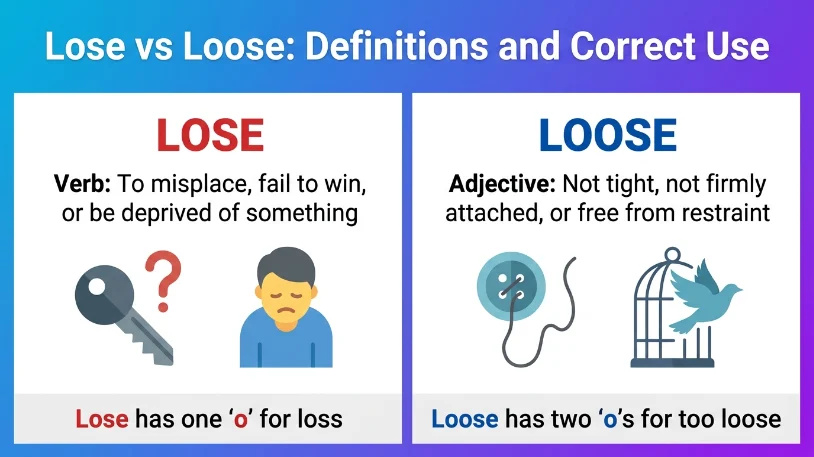
“Lose” is a verb that means to misplace something, fail to win, or no longer have something. “Loose” is usually an adjective that means not tight, not fixed firmly, or free to move. Although these words look similar, they have different meanings, pronunciations, and grammar. Remember this simple trick: you lose a game, but your shoelaces can be loose.
Have you ever typed lose when you meant loose, or noticed someone else making the same mistake? You’re not alone. It is one of the most common English spelling mistakes, especially in emails, school assignments, blog posts, and social media.
The confusion happens because the two words look almost identical. However, they have completely different meanings and are used in different ways. Using the wrong one can make your writing look unprofessional and even change the meaning of your sentence.
In this guide, you’ll learn the difference between lose or loose with simple definitions, pronunciation tips, memory tricks, examples, comparison tables, common mistakes, practice exercises, and frequently asked questions. By the end, you’ll know exactly which word to use in every situation.
What Is the Difference Between Lose and Loose?
| Word | Part of Speech | Meaning | Example |
|---|---|---|---|
| Lose | Verb | To misplace something, fail, or no longer have | I don’t want to lose my keys. |
| Loose | Adjective | Not tight or firmly attached | These shoes feel loose. |
Simple Rule to Remember
Use lose when talking about:
- Losing a game
- Losing money
- Losing your phone
- Losing weight
- Losing your job
Use loose when talking about:
- Loose clothing
- Loose hair
- Loose screws
- Loose teeth
- Loose animals
Understanding the Meaning of Lose
What Does “Lose” Mean?
Lose is always a verb. It describes an action where something is no longer in your possession, or you fail to achieve something.
Common Meanings of Lose
Misplace Something
Example:
- I always lose my sunglasses.
Fail to Win
Example:
- Our team might lose the match.
No Longer Have Something
Example:
- She doesn’t want to lose her confidence.
Reduce Something
Example:
- He wants to lose five pounds before summer.
Understanding the Meaning of Loose
What Does “Loose” Mean?
Loose is mainly an adjective. It describes something that is not tight, fixed, or secure.
Common Meanings of Loose
Not Tight
Example:
- My jacket is too loose.
Free to Move
Example:
- The dog’s collar is loose.
Not Firmly Attached
Example:
- The door handle is loose.
Lose or Loose Pronunciation
Many learners confuse these words because of spelling.
| Word | Pronunciation | Sounds Like |
|---|---|---|
| Lose | /luːz/ | “looz” |
| Loose | /luːs/ | “looss” |
Easy Pronunciation Tip
- Lose ends with a Z sound.
- Loose ends with an S sound.
Lose vs Loose Comparison
| Feature | Lose | Loose |
|---|---|---|
| Part of Speech | Verb | Adjective |
| Action or Description | Action | Description |
| Means | Misplace or fail | Not tight |
| Example | Don’t lose your wallet. | My shirt is loose. |
When to Use Lose
Use Lose for Actions
Examples:
- Don’t lose your passport.
- We might lose the game.
- She hopes to lose weight.
- I don’t want to lose this opportunity.
- They could lose customers if service is poor.
When to Use Loose
Use Loose for Descriptions
Examples:
- These jeans are loose.
- I have a loose button.
- The rope became loose.
- Keep your pet from running loose.
- His tie looks loose.
Memory Trick to Never Mix Them Up
Think About the Extra “O”
Loose has an extra O.
Imagine that extra O makes the object bigger and therefore less tight.
Lose has only one O because when you lose something, one letter is “gone.”
This simple visual trick helps many learners remember the difference.
Real World Examples
At School
❌ I don’t want to loose marks.
✅ I don’t want to lose marks.
At the Gym
❌ I want to loose weight.
✅ I want to lose weight.
Shopping
❌ These pants are too lose.
✅ These pants are too loose.
At Work
❌ We could loose customers.
✅ We could lose customers.
Common Mistakes
Using Loose Instead of Lose
Incorrect:
- I don’t want to loose my phone.
Correct:
- I don’t want to lose my phone.
Using Lose Instead of Loose
Incorrect:
- My shoes are too lose.
Correct:
- My shoes are too loose.
Forgetting the Part of Speech
Remember:
- Lose = action (verb)
- Loose = description (adjective)
Related Grammar Concepts
Lose vs Loss
- Lose is a verb.
- Loss is a noun.
Examples:
- Don’t lose hope.
- The company reported a financial loss.
Loose vs Tight
These are opposites.
Examples:
- Tight shoes
- Loose shoes
Lose vs Miss
Sometimes they have similar meanings but are not always interchangeable.
Example:
- I lost my wallet.
- I missed the bus.
Practice Exercises
Exercise 1
Choose the correct word.
I don’t want to _____ my wallet.
Answer:
Lose
Exercise 2
The screws are _____.
Answer:
Loose
Exercise 3
She hopes to _____ ten pounds.
Answer:
Lose
Exercise 4
The dog’s collar feels _____.
Answer:
Loose
Exercise 5
Choose the correct sentence.
A. I might loose the game.
B. I might lose the game.
Answer:
B
Frequently Asked Questions
Is it lose or loose weight?
The correct phrase is lose weight because “lose” is the verb meaning to reduce body weight.
What is the difference between lose or loose?
Lose means to misplace, fail, or no longer have something. Loose means not tight or securely attached.
Why do people confuse lose and loose?
They look similar in spelling, but they have different meanings, pronunciations, and grammar.
Is loose a verb?
Usually, no. Loose is most commonly an adjective. The verb form is loosen.
Is lose a noun?
No. Lose is a verb. The related noun is loss.
How do I remember lose vs loose?
Remember that loose has an extra O, making it “looser.” Lose has one O because you’ve “lost” the extra letter.
Do you lose a game or loose a game?
You lose a game. “Loose a game” is incorrect.
Do you say loose teeth or lose teeth?
Both can be correct, but they mean different things:
What is the opposite of loose?
The opposite of loose is tight.
Can Grammarly detect lose vs loose mistakes?
Yes. Most grammar checkers can identify many lose or loose errors, but understanding the rule yourself helps you avoid mistakes in any situation.
Conclusion
The difference between lose or loose is simple once you know the rule. Lose is always a verb that means to misplace something, fail to win, or no longer have something. Loose is usually an adjective that describes something that is not tight or securely attached.
A quick way to remember the difference is to think about the extra O in loose. That extra letter reminds you that something has extra room and is not tight. When you lose something, the extra O is gone.
Whether you’re writing an email, school assignment, blog post, or social media update, using the correct word makes your writing clearer and more professional. With the examples, memory tricks, and exercises in this guide, you’ll be able to choose the right word confidently every time.