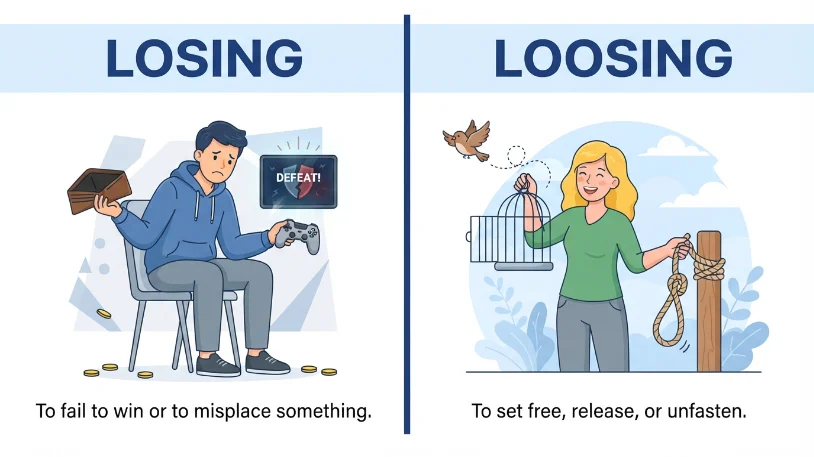
The correct spelling is almost always “losing,” which means to misplace something, fail to win, or experience a decline. “Loosing” means to release or set something free and is rarely used in modern writing.
Have you ever typed out a sentence, stared at the word “losing” or “loosing,” and felt a wave of uncertainty? If so, you are not alone. This single-letter difference represents one of the most common and persistent spelling errors in the English language. It is a mistake that appears everywhere, from casual social media posts to formal business emails, and it can easily undermine the professionalism of your writing. The root of the confusion lies in the fact that both versions look and sound somewhat similar, making it difficult to know which one is correct in a given context. However, the difference between these two words is actually quite clear. The choice depends entirely on what you are trying to say: are you talking about misplacing something or releasing something? This comprehensive guide will clarify the distinction between losing and loosing once and for all. By using simple explanations, real-world examples, and helpful memory tricks, you will learn to choose the right word with confidence every single time.
Key Takeaway
The most crucial point to remember from this entire discussion is simple. If you are writing about a decline in health, a missed opportunity, or a sports defeat, the word you need is “losing.” This is the present participle of the verb “lose”. On the other hand, “loosing” is the present participle of the verb “loose,” which means to release or set free. Since it is used so infrequently in modern English, “loosing” is almost always a mistake in contemporary writing. Therefore, if you are unsure which to use, the safest and most likely correct choice is “losing.”
Definition and Explanation
To use these words correctly, it helps to understand their definitions and grammatical roots thoroughly.
Losing
Losing” is the present participle form of the verb “lose.” This word carries three primary meanings. First, it signifies the act of misplacing something, such as when you cannot find your keys. Second, it means being defeated in a competition, game, or conflict. Third, it refers to the failure to keep or maintain something valuable, like a job or money. The pronunciation is key as well. Say the word aloud. It should sound like “loo-zing,” where the “s” makes a ‘z’ sound.
Loosing
In contrast, “loosing” is the present participle of the verb “loose.” It means to release, set free, or unfasten something. For example, a person might be “loosing” an arrow from a bow or a sailor “loosing” the sails from a ship. Given its specific meaning, this word is much less common in everyday language. It is often found in historical, poetic, or technical contexts. The pronunciation also differs slightly. “Loosing” is pronounced with a hard “s” sound, like “loo-sing”.
Lose vs. Loose
A helpful way to remember the difference between losing and loosing is to first understand the difference between their root verbs: “lose” and “loose.”
- Lose (one ‘o’): This verb means to be deprived of, cease to have, or fail to win something.
- Loose (two ‘o’s): This word is usually an adjective meaning not tight or not firmly attached. It can also be a verb meaning to set free, but this usage is less common.
Advantages and Disadvantages
While it might seem strange to consider “advantages” and “disadvantages” for a grammar rule, understanding these can help reinforce the lesson.
Correct Usage (Losing)
The primary advantage of using “losing” correctly is clarity. When you write “losing,” your reader immediately understands that you are talking about a failure, a loss, or a misplacement. The word is universally understood in this context. A disadvantage arises when “losing” is misspelled as “loosing,” as this can cause confusion. The reader might pause, misinterpret your intended meaning, or simply judge your writing as careless.
Correct Usage (Loosing)
The advantage of knowing “loosing” is that it allows for precise meaning in very specific situations. It also demonstrates a strong command of the English language. However, the disadvantage is the high risk of misuse. Because it is so rare, most people will assume it is a typo for “losing.” As a result, using it may cause more confusion than clarity in modern writing.
Real-World Examples
Seeing the difference between losing and loosing in common contexts makes the distinction easier to grasp.
Losing in Action
- In Competition: “Our team is losing the match, but we still have hope for the next round.”
- Misplacing Items: “I am constantly losing my keys. I need to find a better system.”
- Health and Wellness: “She has been successful at losing weight by exercising regularly.”
- Finance: “The company is losing money and may need to restructure.”
- Time: “Stop losing time on that trivial task and focus on the important one.”
Loosing in Action
These examples show how “loosing” is used in its rare, correct form.
- Releasing Animals: “The zookeepers are loosing the birds from their enclosures.”
- Untying Ropes: “The sailors were loosing the ropes to prepare the ship for departure.”
- Archaic Contexts: “The archer was loosing his arrows at the approaching enemy.”
Common Mistakes and Corrections
The most frequent mistake is using “loosing” when “losing” is the intended word. Here are the common errors and their fixes.
| Common Mistake | Correction | Explanation |
| “I am loosing my keys.” | “I am losing my keys.” | The context is about misplacing something, not releasing it. |
| “We are loosing the game.” | “We are losing the game.” | This is about being defeated, not setting something free. |
| “She is loosing weight.” | “She is losing weight.” | Weight loss is a decline, not a release. This is a very common error. |
| “He is loosing his mind.” | “He is losing his mind.” | This means failing to maintain sanity, not freeing it. |
| “They were loosing their jobs.” | “They were losing their jobs.” | This refers to a lack of employment, not an act of releasing something. |
Exercises with Answers
Practice makes perfect. Test your knowledge with these exercises.
Fill-in-the-Blanks
- I can’t believe I am _______ my phone charger again.
- The hunter is _______ the hounds to chase the fox.
- The team is _______ hope of winning the championship.
- The soldier was _______ the ropes from the tents.
- She is afraid of _______ the respect of her peers.
Answer Key
- losing (Misplacing an item)
- loosing (Releasing animals)
- losing (Failing to maintain hope)
- loosing (Untying or releasing ropes)
- losing (Failing to keep respect)
Identify the Correct Word
- (Losing/Loosing) a game is never fun, but it teaches you a lot.
- Are you (losing/loosing) your grip on the rope?
- I am (losing/loosing) sleep over the presentation tomorrow.
- The captain is (losing/loosing) the anchor from its chain.
- She is (losing/loosing) her mind trying to solve this puzzle.
Answer Key
- Losing
- Losing
- Losing
- Loosing
- Losing
FAQs
What is the main difference between losing and loosing?
The main difference is their meaning. “Losing” refers to misplacing something, failing to win, or experiencing a loss. “Loosing” is a rare word that means to release or set free from restraint.
Is “loosing” ever the correct word to use?
Yes, “loosing” is a valid word, but its usage is very rare. It is correct when you mean “to release” or “to set free,” like loosing an arrow or a hunting dog. You will usually find it in historical or literary contexts.
How do I remember when to use “losing”?
Use a simple memory trick: “Losing” has one ‘o’ for “loss.” If the situation involves a loss of some kind, whether it is a game or an item, the correct word is “losing.”
What is the difference between “lose” and “loose”?
“Lose” (one ‘o’) is a verb meaning to misplace or fail to win. “Loose” (two ‘o’s) is an adjective meaning not tight or not firmly held, and very rarely a verb meaning to release.
Can I say “loosing weight”?
No, “loosing weight” is a common but incorrect spelling. The correct phrase is “losing weight.” This refers to the process of reducing body weight, which is a form of loss.
Why do so many people confuse “losing” and “loosing”?
The confusion arises because the words are phonetically very similar and differ by only one letter. Many English words have the “oo” sound, making the incorrect spelling seem natural.
What is the correct pronunciation of “losing” and “loosing”?
“Losing” is pronounced with a ‘z’ sound, like /ˈluːzɪŋ/. “Loosing” is pronounced with a hard ‘s’ sound, like /ˈluːsɪŋ/.
Are there any common phrases that use the word “loosing”?
The most well-known phrase is “loosing the dogs of war.” This is a historical and literary quote from Shakespeare’s play Julius Caesar, which uses “loosing” to mean “unleashing.” This helps show its rare and poetic use.
Conclusion
The choice between losing and loosing is a common stumbling block in English. Yet, as this guide has shown, it is a simple distinction to master. Remember, the word “losing” is your default choice for any situation involving misplacement, defeat, or decline. It is the word that applies to games, keys, weight, and patience. In contrast, “loosing” is a specific term that means to release or set free and is rarely used in modern communication. By understanding the distinct definitions and applying the memory tricks, such as “one ‘o’ for loss,” you can confidently avoid this error.
Professional writing demands clarity and precision. Choosing the correct spelling is a small but significant step toward maintaining a credible and polished voice. Next time you are about to type “loosing,” pause for a second and ask yourself if you mean “losing.” Chances are, you do.