The correct spelling when referring to the cessation of life or the process of approaching death is dying, not dieing. While “dieing” is a common misspelling, it technically refers to a metalworking process using a die, making it an entirely different word with a specialized industrial meaning.
Have you ever typed the word “dieing” and watched your spellchecker light up with that angry red underline? You are not alone. This common confusion plagues many writers. They wonder which spelling is correct when describing the end of life or a fading object.
The English language presents many tricky spelling dilemmas. The confusion between “dieing” and “dying” ranks among the most frequent. Many people simply add “-ing” to the base word “die” and assume “dieing” is correct. This seems logical until you learn the truth.
The stakes matter because using the wrong spelling can change your meaning entirely. Your reader might pause, confused, if you write about a “dieing person.” They might even think you work in a machine shop.
This article clears up the confusion once and for all. You will learn the correct spelling, the contexts for each word, and practical memory tricks. By the end, you will never doubt yourself again when writing about death, decline, or industrial processes.
The rules are straightforward. However, many people continue to make this error in professional writing, social media posts, and even news articles. This guide provides clear examples and memorable tips to help you choose correctly every time.
Key Takeaway
The primary takeaway is simple: use “dying” when referring to death or gradual decline. The word “dieing” is almost always incorrect in everyday writing and has a very narrow technical application.
Furthermore, it helps to remember the third similar word: “dyeing,” which means coloring fabric or hair with dye. These three words sound identical but have completely different meanings.
- Dying relates to death, ceasing to exist, or fading away .
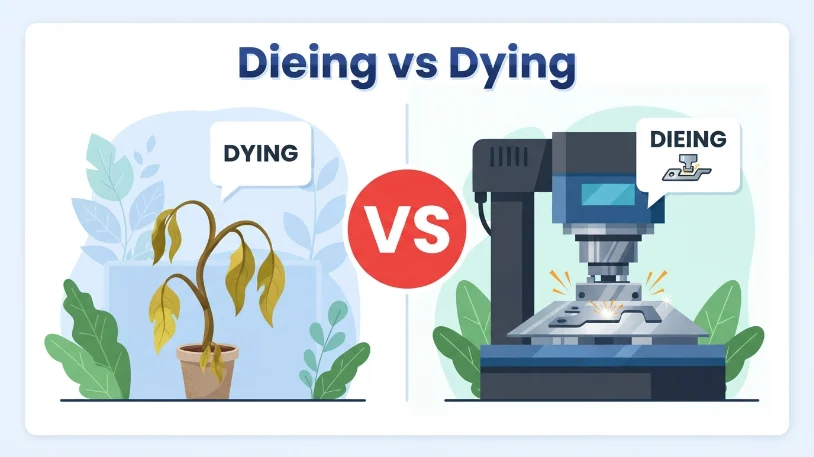
- Dieing refers to cutting or shaping material with a machine tool called a die .
- Dyeing describes the process of coloring something with dye .
In essence, unless you work in a machine shop describing the use of a die-casting machine, you will almost certainly need the spelling “dying.” Remembering this distinction will improve your writing clarity and prevent embarrassing mistakes.
Understanding the Core Definitions
Dying: The Correct Spelling for Death
The word “dying” serves as the present participle of the verb “to die.” It functions both as a verb and an adjective. It means ceasing to live, approaching death, or coming to an end . You also use it to describe something fading or losing importance.
For example, you might describe a plant with brown leaves as “dying.” A battery with one bar remaining is “dying.” An old tradition that fewer people practice could be a “dying art” . The word also describes the final moments of life, as in “dying words” or a “dying wish” .
Examples in sentences:
- The doctors told the family that the patient was dying.
- My phone battery is dying; I need to find a charger.
- Handwriting is becoming a dying skill in the digital age.
The word captures a sense of gradual transition from one state to another, usually ending in nonexistence or inactivity. The spelling follows a rule in English: when a verb ends in “-ie,” you change the “-ie” to “-y” before adding “-ing” . You see this with verbs like “tie” (tying) and “lie” (lying).
Dieing: The Rare Technical Term
“Dieing” is a specialized word with a very narrow definition. It relates to the process of cutting, forming, or stamping materials using a tool known as a die . This term exists primarily in the world of machining and manufacturing.
A die serves as a tool used to shape metal or other materials . For instance, think of a machine that cuts out metal parts for cars. That machine uses a die. The action of that machine could technically be described as dieing, though even in industrial contexts, the term is becoming obsolete .
In modern practice, people more often refer to this process as “die casting” or “die cutting.” Consequently, “dieing” has become a very rare word. Most dictionaries list it primarily to warn readers that it is an incorrect spelling of “dying” .
Examples in sentences:
- The process of dieing metal components has largely been replaced by modern die-casting techniques .
- His job at the factory involved the dieing of various automotive parts.
Unless you are an engineer or machinist, you can safely ignore this word entirely.
Dyeing: Coloring with Dye
A third word often enters the confusion: dyeing. This word is the present participle of the verb “to dye.” It means coloring something, such as hair or fabric, using a liquid .
While similar in spelling and pronunciation to “dying,” its meaning relates entirely to adding color. It does not involve death or industrial machining. Dyeing is a common hobby and professional craft. For instance, hairdressers specialize in dyeing hair, and artisans practice the craft of dyeing fabrics . This word completes a trio of confusing homophones.
Examples in sentences:
- She is dyeing her hair pink for the concert.
- The factory processes raw cloth and uses dyeing techniques to add vibrant colors.
You can remember the distinction because “dyeing” contains an “e” just like “dye” and “color,” helping you keep its meaning separate.
Real-World Examples
Context plays a crucial role in choosing the correct spelling. The table below provides clear examples of how to use each word correctly in different situations.
| Scenario | Correct Spelling | Why? |
| A hospital patient | Dying | Refers to the process of ceasing to live . |
| An old tree | Dying | Refers to the plant approaching death . |
| A fading trend | Dying | Refers to something ceasing to exist or become extinct . |
| Metal fabrication | Dieing | Refers to the process of shaping metal with a die (rare) . |
| Colouring hair | Dyeing | Refers to changing the colour of hair with dye . |
| A failing engine | Dying | Refers to something ceasing to function . |
| A request just before death | Dying | Refers to something happening at the moment of death . |
| A machine stamping metal | Dieing | Refers to cutting or stamping with a tool and die (rare) . |
This table shows that the context clearly dictates the spelling. “Dying” fits 90% of everyday situations. “Dyeing” applies to coloring. “Dieing” only fits in a very rare industrial context.
Common Mistakes and How to Avoid Them
Many people make spelling errors between “dieing” and “dying.” The most common mistake involves simply adding “-ing” to the verb “die.” This produces “dieing,” which looks logical but is incorrect for death .
Here are common mistakes:
- Mistake: The flowers are dieing because I forgot to water them.
- Correction: The flowers are dying because I forgot to water them.
- Mistake: He held his mother’s hand during her dieing moments.
- Correction: He held his mother’s hand during her dying moments.
- Mistake: The tradition is dieing out.
- Correction: The tradition is dying out.
People also confuse “dying” and “dyeing.” For instance, saying “I am dying my hair” implies you are experiencing a fatal event in a hair salon. The correct spelling for coloring hair is “dyeing .
Here is another common error:
- Mistake: I am dying my curtains to match the new sofa.
- Correction: I am dyeing my curtains to match the new sofa.
These mistakes often happen because the words sound identical when spoken. They are homophones, meaning they sound the same but have different spellings and meanings. Therefore, you must pay careful attention when writing.
Memory Tricks to Remember
Simple memory tricks can help you choose the correct spelling every time.
Remember Dying through its Meaning
Focus on the “y” in “dying.” You can associate this “y” with “why.” When something or someone is dying, you might ask “why?” This helps you recall that “dying” relates to the serious topic of death and cessation . Also, remember the rule: change the “-ie” of “die” to a “-y” before adding “-ing,” just like “tie” becomes “tying” and “lie” becomes “lying” .
Remember Dyeing through its Meaning
Focus on the “e” in “dyeing.” You can associate this “e” with “color.” The word “dyeing” includes an “e” just like “color” does. Alternatively, you can think of “dye” as a liquid, and both words contain an “e” .
Remember Dieing as the Exception
Remember that “dieing” is almost always wrong. It is a specialized industrial word that most people will never need to use. If you are unsure, always default to “dying” because it is correct for death and decline. The “die” in “dieing” refers to a stamping or cutting tool, which is a very different object from death .
Practice Exercises with Answers
Test your knowledge with these simple exercises. Choose the correct word: dying, dieing, or dyeing.
- The old man was ______ peacefully in his sleep.
- My grandmother is ______ her hair blonde for the summer.
- The company used a special machine for the ______ process of metal sheets.
- Many people believe that cursive writing is a ______ art form.
- I think my phone is ______. The screen keeps flickering.
- She spent the afternoon ______ fabric for her new dress.
Answers:
- dying – refers to the process of ceasing to live.
- dyeing – refers to the process of coloring hair.
- dieing – refers to the process of using a die in a machine shop (very rare).
- dying – refers to something gradually coming to an end.
- dying – refers to something ceasing to function.
- dyeing – refers to the process of coloring material.
Frequently Asked Questions
What is the difference between dying and dieing?
Dying is the correct spelling for the process of death or ceasing to exist. Dieing is a rare, technical term for cutting or shaping material with a die, but it is more commonly considered a misspelling .
Is it dieing of laughter or dying of laughter?
The correct spelling is dying of laughter. This phrase uses “dying” metaphorically to express being overcome with emotion. “Dieing” would be incorrect in this context .
How do you spell dying as in coloring hair?
For coloring hair, the correct spelling is dyeing. This word comes from the verb “to dye,” meaning to color. It is different from “dying,” which relates to death .
Why is dying spelled with a y?
The spelling “dying” follows a rule in English. When you add “-ing” to a verb that ends in “-ie,” you change the “-ie” to a “-y.” Therefore, “die” becomes “dying” . Other examples include “tie” becoming “tying” and “lie” becoming “lying.”
Is dieing a word in the dictionary?
“Dieing” is listed in some dictionaries as a very rare technical term referring to the use of a die in manufacturing . However, it is much more commonly identified as an incorrect spelling of “dying” .
What does dying mean in a metaphorical sense?
Metaphorically, “dying” describes things fading away or coming to an end. For instance, a “dying art” is a skill that fewer people are learning. A “dying fire” is one that is going out .
Can I use dieing when talking about death?
No, you should never use “dieing” when talking about death. The correct word is “dying.” Using “dieing” in this context is a common spelling error .
What are synonyms for dying?
Synonyms for dying as a verb include: passing away, perishing, expiring, and fading. As an adjective, synonyms include: moribund, declining, fading, and terminal .
Conclusion
Writing clearly requires attention to spelling details. The words “dieing” and “dying” sound identical, but they carry very different meanings. Correct usage makes your writing look professional and ensures your reader understands you correctly.
The core rule is straightforward: always use dying when you mean death, decline, or ceasing to exist. Reserve dyeing for coloring hair or fabric. Forget dieing completely. It is an archaic technical term that belongs in a machine shop, not in general writing.
Mastering this distinction is easy with a little practice. Remember to change the “ie” to “y” when forming the present participle of “die.” If you get stuck, think about the context. If you are discussing a person, animal, plant, or fading object, the spelling is definitely “dying.” If you are discussing a change in color, the spelling is “dyeing.”
We hope this guide has cleared up any confusion. You can now confidently write about a “dying tradition,” a “dyeing project,” or even the rare industrial process of “dieing.” Use the memory tricks and examples provided, and you will make the correct choice every time. Start writing with greater confidence today, knowing you have mastered this common grammar challenge.