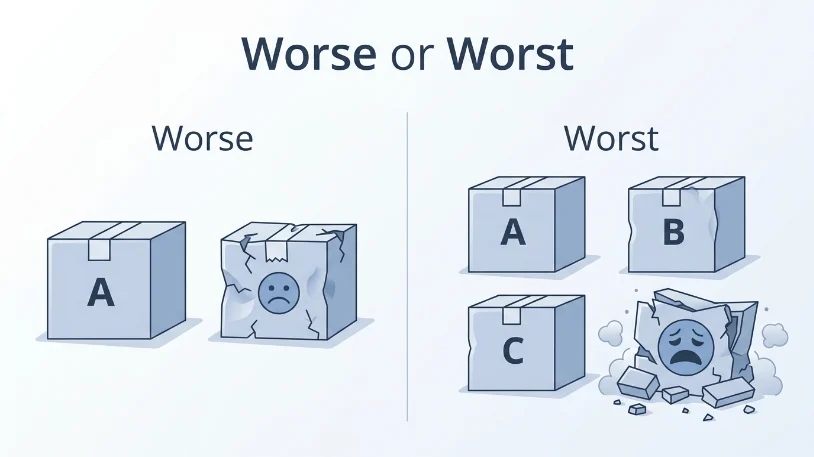
“Worse” compares two things and means “more bad,” while “worst” compares three or more things and means “most bad.” Use “worse” for a direct comparison between two items and “worst” to describe the absolute lowest degree among a group.
Have you ever paused mid-sentence, unsure whether to write “worse” or “worst”? This common dilemma trips up even seasoned writers and professionals. The confusion stems from the fact that both words describe something negative, yet they serve very different purposes. Choosing the wrong one can undermine your credibility and confuse your audience. Whether you are writing a business report, a formal email, or a social media post, using these words correctly matters. The distinction between “worse” and “worst” follows a simple rule of comparison. “Worse” enters the picture when you compare just two items. However, “worst” steps in when you compare three or more things. This guide will clarify this rule and equip you with memory tricks and examples. After reading this article, you will never second-guess yourself when choosing between worse or worst. Let us eliminate this confusion once and for all and help you write with greater confidence and precision.
Key Takeaway
The core rule is straightforward. Use “worse” when comparing two items or situations. It indicates that one is more bad than the other. Use “worst” when comparing three or more items or when describing the extreme negative limit. It signifies the most bad or the lowest possible quality. A helpful way to remember this is to associate “worse” with “comparison” and “worst” with “extreme.” The word “worst” also contains the word “most” in its meaning, since it deals with the highest degree of negativity. Remembering this simple distinction will prevent nearly all errors.
Definition and Explanation
To use these words correctly, we must understand their grammatical roles and specific definitions.
Worse
Worse” functions as the comparative form of the adjective “bad.” This means it describes a higher degree of badness when comparing only two things. For instance, if you have two options and one is more unpleasant, you would use “worse.” It indicates a relative decline from one state to another. Think of it as a direct, one-to-one comparison. For example, “This coffee is worse than the coffee we had yesterday.” It compares two specific cups of coffee. Similarly, “The weather today is worse than yesterday’s.” The comparison is limited to two specific days.
Worst
Worst,” on the other hand, functions as the superlative form of the adjective “bad.” This means it describes the extreme degree of badness among a group of three or more. It identifies the single most negative or lowest-quality item in a set. For example, “This is the worst coffee I have ever tasted.” This compares today’s coffee to every other coffee you have ever had. Since there are many cups of coffee in your lifetime, it represents the superlative. Similarly, “That was the worst storm of the decade.” The comparison is among all the storms in a decade, making it the most severe.
The Comparative and Superlative System
Understanding the broader system helps solidify the rule. Most descriptive words follow this pattern: positive, comparative, superlative.
| Positive | Comparative (Two Items) | Superlative (Three or More) |
| Bad | Worse | Worst |
| Good | Better | Best |
| Tall | Taller | Tallest |
| Smart | Smarter | Smartest |
This table shows that “bad” is simply an irregular adjective. Its comparative and superlative forms do not follow the standard “-er” and “-est” pattern. This irregularity is the main source of the confusion. Once you recognize this as a pattern, it becomes easier to remember.
Advantages and Disadvantages
Understanding the correct usage of worse or worst offers clear benefits and helps avoid significant drawbacks.
Advantages of Correct Usage
The primary advantage is clear communication. When you use “worse” correctly, your reader instantly understands you are comparing two specific things. When you use “worst,” your reader knows you are describing the absolute bottom of a group. This precision prevents misunderstandings. Additionally, correct usage enhances your professional credibility. People often judge writing quality based on grammar. A simple mistake like confusing “worse” and “worst” can make you appear careless or uneducated. Using them correctly shows attention to detail.
Disadvantages of Incorrect Usage
The main disadvantage of misuse is confusion. If you say, “This is the worse option,” when you are comparing many options, the listener might not understand your exact meaning. The primary drawback is the negative impression it makes on your audience. In professional settings, such errors can damage your reputation and reduce the impact of your message. Therefore, mastering the difference is essential for effective and professional writing.
Real-World Examples
Seeing these words in context helps clarify their proper usage. The following examples demonstrate both “worse” and “worst” in everyday situations.
Worse in Action
- Comparing Health: “I felt bad yesterday, but today I feel even worse.”
- Comparing Products: “This laptop is worse than the one I bought last year.”
- Comparing Situations: “Losing my job was bad, but losing my house was worse.”
- Comparing Performance: “He played poorly in the first half, but his performance in the second half was worse.”
- Comparing Options: “Between losing money and losing a friend, the latter is clearly worse.”
Worst in Action
- Describing an Event: “That was the worst movie I have ever seen.”
- Identifying the Extreme: “This is the worst possible outcome for our team.”
- Referring to a Record: “That storm was the worst in the country’s history.”
- Expressing Fear: “We feared the worst when we heard the news.”
- Describing a Person: “He is the worst employee the company has ever hired.”
Regional and Global Usage
The rules for worse or worst apply universally across all English-speaking regions. There is no difference between American, British, Canadian, or Australian English when it comes to this grammar point. The comparative and superlative forms remain consistent. However, the frequency of usage can vary based on context and culture. For example, in British English, self-deprecating humor often uses “worse” in a joking manner. Phrases like “Things could be worse” are common. In American English, the phrase “worst-case scenario” appears frequently in business and planning contexts. Despite these cultural nuances, the fundamental rule governing the choice between worse and worst remains unchanged worldwide.
Common Mistakes and Corrections
One of the most prevalent errors involves using “worst” when “worse” is the correct choice. This typically happens when the writer is not comparing a specific set or is relying on a vague feeling. Another common error is using “worse” for a comparison involving more than two items. The following table clarifies these frequent mistakes.
| Common Mistake | Correction | Explanation |
| “This is the worse day of my life.” | “This is the worst day of my life.” | A day is compared to all other days (more than two). |
| “Between the two candidates, he is the worst choice.” | “Between the two candidates, he is the worse choice.” | The comparison involves only two candidates, so the comparative is needed. |
| “The weather is worst than yesterday.” | “The weather is worse than yesterday.” | The comparison is between only two specific days. |
| “His skills are the worse in the team.” | “His skills are the worst in the team.” | The comparison is among all team members (more than two). |
| “This is the worse scenario possible.” | “This is the worst scenario possible.” | There are many possible scenarios, making this the most negative. |
Exercises with Answers
Practice identifying the correct usage of worse or worst with these exercises.
Fill-in-the-Blanks
- This is the _______ day we have had all summer.
- Between the two restaurants, the first one is _______.
- I thought the first movie was bad, but the sequel is _______.
- That is the _______ excuse I have ever heard.
- My headache is _______ than it was an hour ago.
- This is the _______ situation we could possibly face.
- She is the _______ singer in the choir.
- Losing the game was bad, but losing the championship was _______.
Answer Key
- worst (Compares to all days in summer, more than two)
- worse (Compares only two restaurants)
- worse (Compares only two movies)
- worst (Compares to all excuses ever heard, more than two)
- worse (Compares current headache to one from an hour ago)
- worst (Compares to all possible situations, more than two)
- worst (Compares to all singers in the choir, more than two)
- worse (Compares only two events: losing the game vs. losing the championship)
Identify the Correct Word
- The (worse/worst) part of the trip was getting lost.
- Between the two routes, which one is (worse/worst)?
- He is the (worse/worst) player on the entire team.
- My grades are (worse/worst) than my sister’s grades.
- We must prepare for the (worse/worst) possible outcome.
Answer Key
- worst (The “part” is compared to all other parts of the trip)
- worse (Only two routes are being compared)
- worst (Compared to all other players on the team)
- worse (My grades and my sister’s grades represent two items)
- worst (Compared to all possible outcomes)
Related Concepts or Comparisons
Several other word pairs follow a similar comparative and superlative structure. Exploring them can further reinforce your understanding of worse or worst.
Good, Better, Best
Just like “bad,” the word “good” is an irregular adjective. Its comparative form is “better,” and its superlative form is “best.” For instance, “Apples are better than oranges” compares two fruits. “That is the best cake I have ever eaten” compares it to all other cakes.
Far, Farther, Farthest
This pair also follows the same pattern, but with a nuance. “Farther” and “farthest” refer to physical distance. For example, “He ran farther than me” involves two runners. “She ran the farthest of all the athletes” involves many athletes.
Less, Lesser, Least
“Less” and “least” are comparative and superlative forms that describe a smaller amount. “Less” compares two things, while “least” describes the smallest amount among a group.
More, Most
“More” and “most” are the comparative and superlative forms for adjectives that do not take the “-er” and “-est” endings. For instance, “This is more beautiful than that” compares two things. “This is the most beautiful painting” compares to all others.
The Common Thread
The common thread among all these pairs is the distinction between comparing two things and comparing more than two. By understanding this fundamental concept, you can apply it to any pair of comparative and superlative words. Once you master the rule for “worse” and “worst,” you can apply it to “better/best” and “more/most” with ease.
FAQs
When should I use “worse” instead of “worst”?
Use “worse” when you are comparing exactly two items, people, or situations. It signals that one thing is more bad than the other. For example, “This situation is worse than the previous one.”
When should I use “worst” instead of “worse”?
Use “worst” when you are comparing three or more items, or when you are describing the absolute lowest degree of quality. It signals that something is the most bad among a group. For example, “This is the worst option available.”
What is the difference between “worse” and “worst” in grammar?
In grammar, “worse” is the comparative form of “bad.” The word “worst” is the superlative form. Comparative forms compare two things, while superlative forms compare three or more and indicate the extreme.
Can “worse” and “worst” be used as nouns?
Yes, they can sometimes function as nouns. For example, “Things went from bad to worse.” In this phrase, “worse” acts as a noun representing a negative state. Similarly, “We must prepare for the worst.” Here, “worst” acts as a noun meaning the most negative outcome.
Why do people confuse “worse” and “worst”?
People confuse them because they are both forms of the adjective “bad” and are very similar in spelling and pronunciation. The irregular pattern of “bad, worse, worst” also makes it less intuitive than regular adjectives like “tall, taller, tallest.”
How can I remember when to use “worse” or “worst”?
A useful memory trick is to remember that “worse” has an “e” which could stand for “more” or “comparison.” Meanwhile, “worst” has an “st” which could stand for “superlative” or “most.” You can also remember that “worst” has the word “most” in its meaning.
Is it “worse comes to worst” or “worse comes to worse”?
The correct phrase is “if worse comes to worst.” This idiom means if a bad situation becomes even worse, you must prepare for the most severe outcome. It uses both forms to show a progression from bad to the extreme.
What is the phrase “the worst for wear” mean?
The worst for wear” means to be in very poor condition, usually from use or age. For example, “After the hike, his shoes were the worse for wear.” This is a set phrase where “worse” is used, not “worst.”
Can “worse” and “worst” be used with “of”?
Yes, “worst of” is a common construction. For example, “He is the worst of the bunch” or “This is the worst of all possible outcomes.” Generally, “of” follows “worst” when the comparison involves a group. “Worse” is less commonly used with “of” and appears in constructions like “the worse of the two.”
Does “worst” always need “the” before it?
Not always, but usually. When “worst” functions as an adjective or noun describing a specific item in a group, it often requires “the.” For example, “the worst movie.” However, in some set phrases, it does not, such as “worst-case scenario.”
Conclusion
Choosing between worse or worst is a common challenge in English grammar, but it does not have to be a difficult one. The core principle is simple: use “worse” for a direct comparison between two things and “worst” to describe the absolute negative extreme among three or more. By remembering this fundamental rule, you can avoid a frequent and noticeable error in your writing. Consistency in using these words correctly will sharpen your professional communication and enhance your credibility. Apply the memory tricks from this guide, such as thinking of “more” for “worse” and “most” for “worst.” Practice with the exercises and review the examples to reinforce your understanding.
Ultimately, mastering the distinction between worse or worst will give you greater confidence. You will write more clearly and make a stronger impression on your readers. As you continue to develop your language skills, remember this simple rule and apply it to every comparison you make. It is a small change that yields significant results.