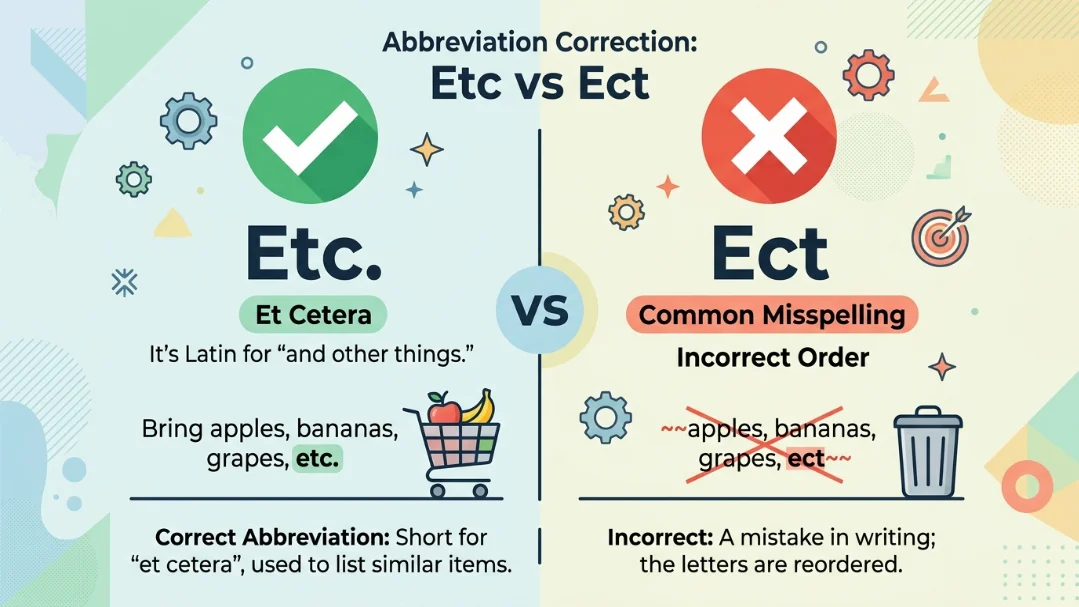
“Etc.” (abbreviation for the Latin et cetera) is the correct and universally accepted abbreviation meaning “and other similar things” or “and so forth.” Meanwhile, “ect” is a common typographical error that scrambles the letters of the abbreviation. Mastering this spelling distinction prevents careless typos in professional reports, academic papers, and everyday writing.
Latin abbreviations frequently cause confusion for modern writers. Scrambling letters in short phrases happens easily when typing quickly. A classic example involves choosing between ect or etc. People often wonder which option is correct when listing items in a sentence. Writers struggle to pick the right term for their business emails, academic essays, or blog posts. Grammar rules guide us toward correct usage every single time.
Mastering these abbreviations boosts your writing confidence. Clear sentences help readers understand your lists without mental distraction. Everyone benefits from strong communication skills. Let us explore the simple rules behind these terms right now.
Understanding basic abbreviation rules prevents awkward writing mistakes. Etc.” serves as the standard abbreviation derived from the Latin phrase et cetera, meaning “and others” or “and so forth.” “Ect” functions as an invalid typo caused by transposing the final letters. Pronunciation sounds like et-set-er-uh, which makes the visual spelling crucial for proper transcription.
Writers must check their spelling before publishing content. Abbreviation lists require the proper t-c order. Consistent accuracy creates professional and polished documents across all publishing platforms.
Definition and Explanation
What Does Etc. Mean in Detail
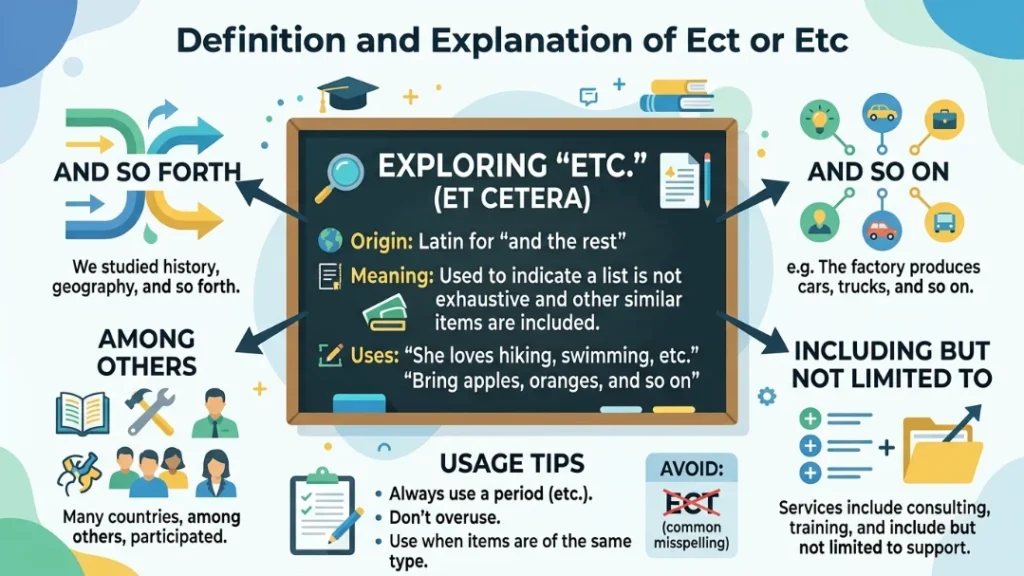
The abbreviation stands for the Latin phrase et cetera, where et means “and” and cetera means “the rest” or “other things.” This term establishes that a list is ongoing and includes unmentioned items of a similar category. For example, packing clothes for a vacation including shirts, pants, socks, etc., uses this specific abbreviation.
Proper Punctuation Rules
Grammar rules require specific punctuation for Latin abbreviations. Always include a period at the end of “etc.” because it is an abbreviation. If it appears at the end of a sentence, you do not need to add a second period.
Spelling Comparison
Grammar rules separate these two entries by correctness. Typing the letters backward creates an immediate typographical error.
| Abbreviation Variant | Dictionary Status | Etymology / Origin | Recommended Usage |
| Etc. | Standard Correct | Latin et cetera (and the rest) | Best for all professional and casual lists |
| Ect | Incorrect Typo | Transposed letters error | Avoid in all writing contexts |
Advantages and Disadvantages of Proper Usage
Benefits of Correct Abbreviation
Precise spelling elevates your professional reputation immediately. Business reports, academic papers, and technical manuals require absolute accuracy. Readers trust authors who master fundamental language rules.
Drawbacks of Careless Mistakes
Typos distract audiences immediately. Spell check software frequently flags “ect” with a red underline. Readers might judge your writing competence based on such basic transposition errors.
Real World Examples Across Industries
Business and Corporate Communications
Professional environments demand clear communication. A project manager listing required software tools, hardware components, etc., in an operational memo needs the correct abbreviation to maintain executive polish.
Academic and Technical Writing
Research papers and technical specifications often summarize categories of data. Proper formatting ensures compliance with strict style guides like APA or MLA.
Regional and Global Usage and Etymological Evolution
Global English Standards
English grammar remains uniform across global regions regarding this Latin abbreviation. Whether you are writing in London, New York, Sydney, or Toronto, the abbreviation “etc.” applies identically. Standard dictionaries maintain identical definitions worldwide.
Common Misuse Patterns
Writers sometimes repeat the word “and” before “etc.” (writing “and etc.”), which is redundant because et already means “and.” Avoid writing “and etc.” in professional prose.
Common Mistakes and How to Avoid Them
Transposing Letters (Ect instead of Etc.)
Authors frequently type “ect” because the fingers stumble over the keyboard layout. Proofreading catches these typos easily if you look closely at your ending letters.
Overusing the Abbreviation
Overusing “etc.” makes writing feel lazy or vague. Whenever possible, specify your list items completely rather than relying on an open-ended abbreviation.
Step-by-Step Guide for Using Etc. Correctly
- Verify the category: Ensure the items preceding the abbreviation share a clear contextual theme.
- Check the letter order: Spell it e-t-c, never e-c-t.
- Add the period: Always place a period at the end of the abbreviation (etc.).
- Avoid redundancy: Never write “and etc.” because it translates to “and and so forth.”
Exercises with Answers
Practice Questions
- Fill in the blank with the correct option: Please bring snacks like apples, bananas, oranges, ________.
- True or False: “Ect” is an accepted alternative spelling in major dictionaries.
- Correct the error in this sentence: We need to buy paper, pens, staplers, ect. for the office.
- Identify the redundancy in this phrase: “and etc.”
Answer Key
- etc.
- False
- We need to buy paper, pens, staplers, etc. for the office.
- And” is redundant because et in et cetera already means “and.
Related Concepts and Comparisons
Latin Abbreviations in English Prose
English incorporates many Latin abbreviations that require careful punctuation and spelling. Understanding their roots helps writers use them with confidence. Selecting appropriate abbreviations ensures logical coherence across paragraphs.
Synonyms and Alternative Terms
Writers expand their vocabulary using alternatives to keep prose dynamic. Rich descriptions improve writing quality.
| Alternative Phrase | Definition | Tone |
| And so forth | Continuing in the same way | Standard |
| And so on | And other similar things | Casual |
| Among others | Used to highlight specific examples from a group | Formal |
| Including but not limited to | Introducing a non-exclusive list | Legal / Professional |
Frequently Asked Questions
What is the difference between ect and etc?
“Etc.” is the correct abbreviation for et cetera, while “ect” is a common spelling typo.
What does etc. stand for?
It stands for the Latin phrase et cetera, meaning “and the rest” or “and so forth.”
Should I put a period at the end of etc.?
Yes, because it is an abbreviation, it always requires a period: “etc.”
Is “and etc.” correct?
No, it is redundant because et means “and.” Writing “and etc.” translates to “and and so forth.
How do you pronounce etc.?
It is pronounced et-set-er-uh.
Do spell checkers catch “ect”?
Yes, modern spell checkers and word processors flag “ect” as a misspelling.
Can etc. be used at the beginning of a sentence?
No, etc. should only appear at the end of a series or list within a sentence.
Are there alternative abbreviations?
While “etc.” is standard, writing out “and so on” is often preferred in formal literary prose.
Why do people spell it ect?
The letters “c” and “t” are easily transposed on standard keyboards when typing quickly.
Is etc. acceptable in formal writing?
It is acceptable, but professional style guides recommend limiting its use in formal academic prose in favor of explicit phrasing.
Conclusion
Mastering fundamental spelling strengthens your overall writing performance and builds professional credibility. Distinguishing between ect or etc prevents embarrassing typos in your correspondence. Consistent practice builds reliable editing habits over time.
Review your drafts carefully before publishing any content, paying special attention to common abbreviations. Small details matter significantly in professional environments. Apply these lessons daily to achieve complete grammatical clarity.